23 Warm Olive Green Living Room Ideas That Feel Layered, Not Flat
Olive green living room decor that reads warm instead of drab. 23 ideas with real paint colors, measurements, and prices for a layered, lived-in room.
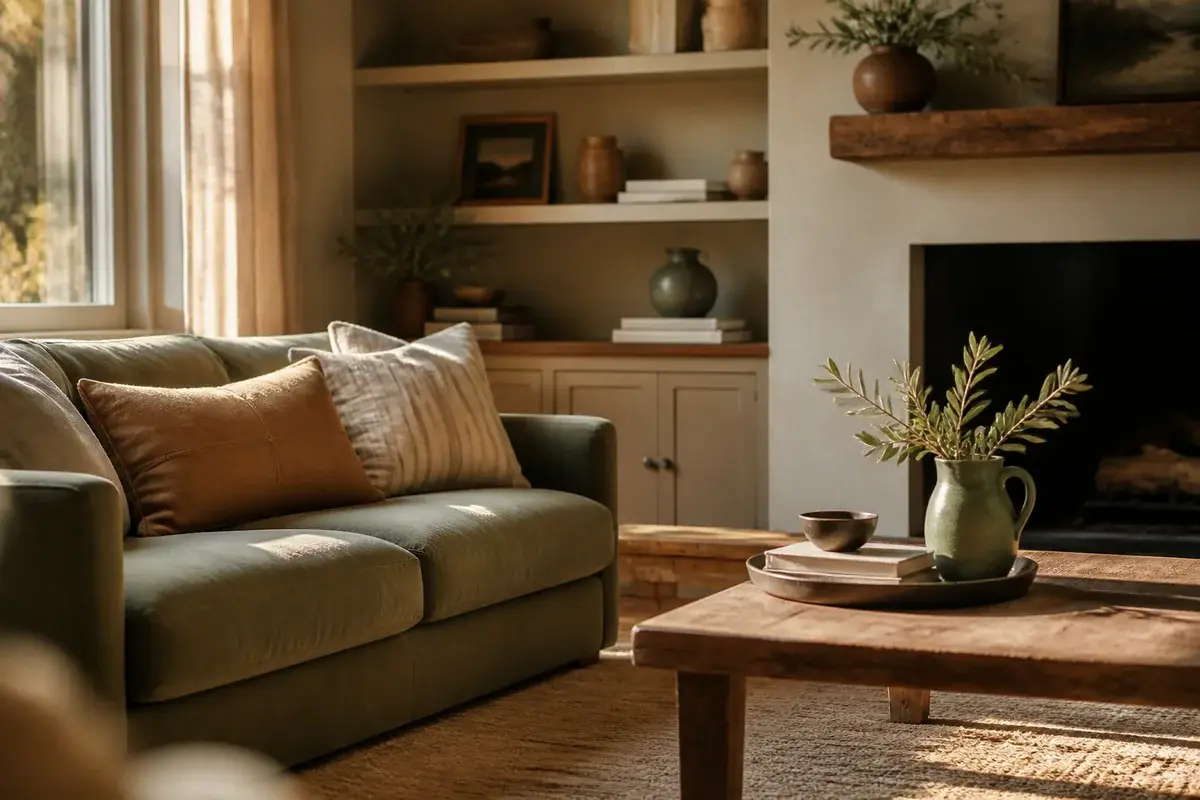
Most people pick olive green because they want warm and earthy, then end up with a room that feels flat and one-note. The color sits there, pretty but lifeless, because it isn't getting the texture, contrast, and light it needs. Olive is a strange green. It leans brown, it's heavily muted, and next to the wrong white or the wrong bulb it slides straight into drab. The fix isn't abandoning the color. It's these 23 specific moves, with the paint names, measurements, and rough prices behind each one, so the room ends up grounded and lived in rather than styled for a photo nobody sits in.
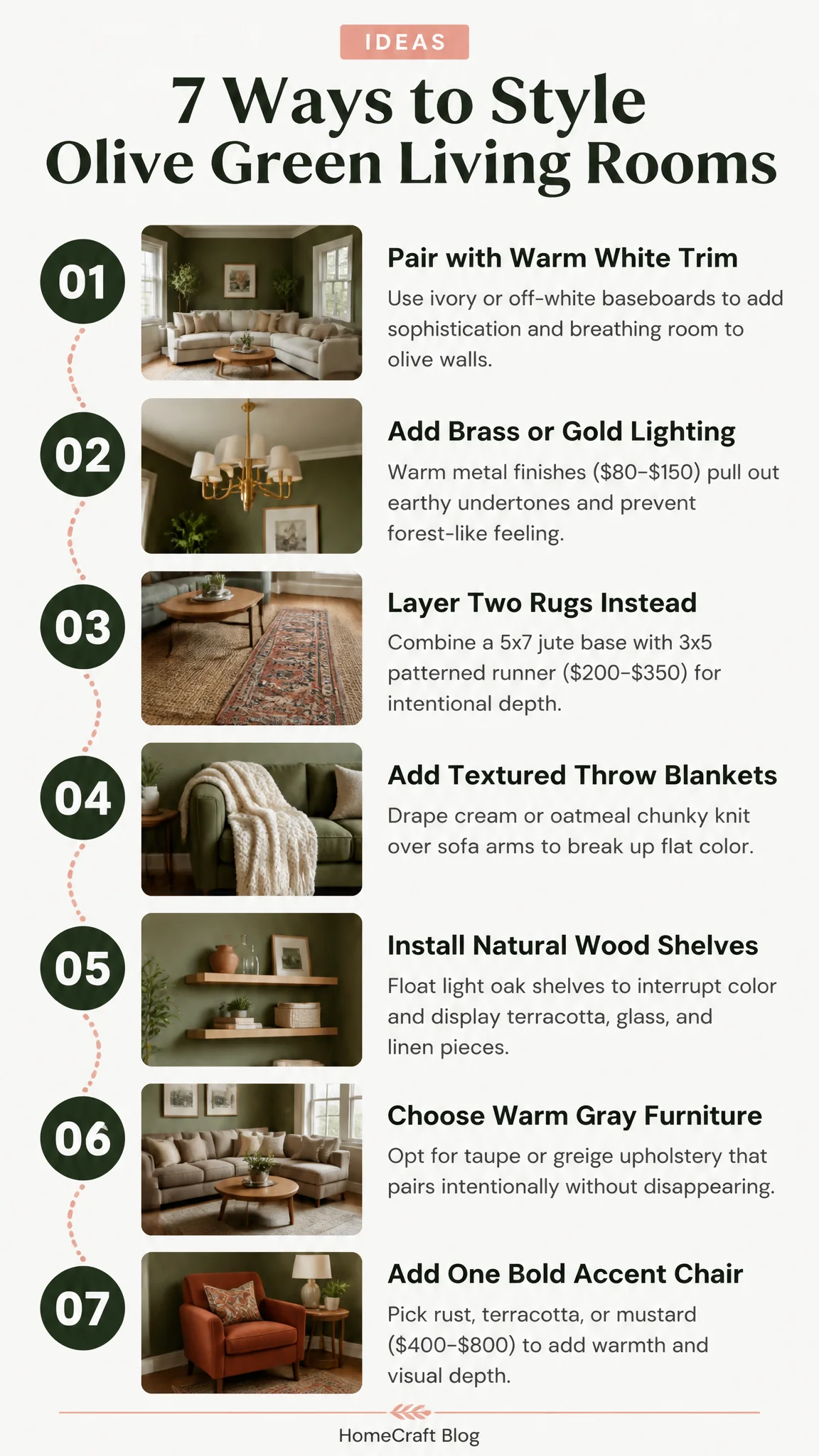
1. Pair olive walls with warm white trim and baseboards
Crisp woodwork against olive makes the green look deliberate rather than accidental. The whole trick is choosing a white with yellow in it instead of blue. Benjamin Moore White Dove OC-17, Sherwin-Williams Alabaster SW 7008, and Farrow & Ball Pointing No. 2003 all sit warm enough to flatter a muted green. Avoid the cool bright whites like Sherwin-Williams Extra White SW 7006: beside olive they pull the green toward grey and the wall starts to look dirty instead of earthy.
Finish matters as much as color. Keep the walls in matte or eggshell and put the trim in satin or semi-gloss, so the woodwork catches light and draws a clean edge around the green. A quart of waterborne trim enamel runs about $30 to $45 and covers roughly 100 linear feet of baseboard in two coats. If your baseboards are the builder-standard 3.25 inches, stepping up to a 5.25-inch profile costs around $1.50 to $3 per linear foot and gives the olive a heavier frame to sit inside.
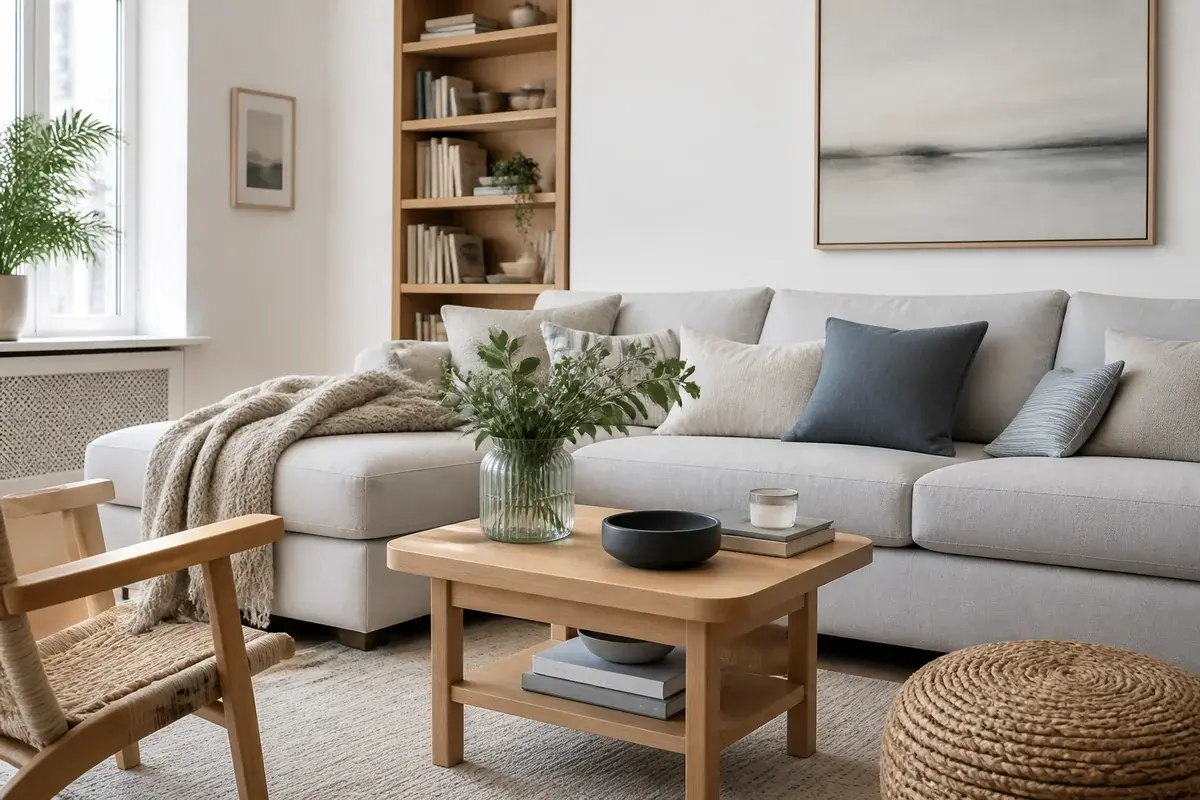
2. Hang a brass or brushed gold floor lamp beside the sofa
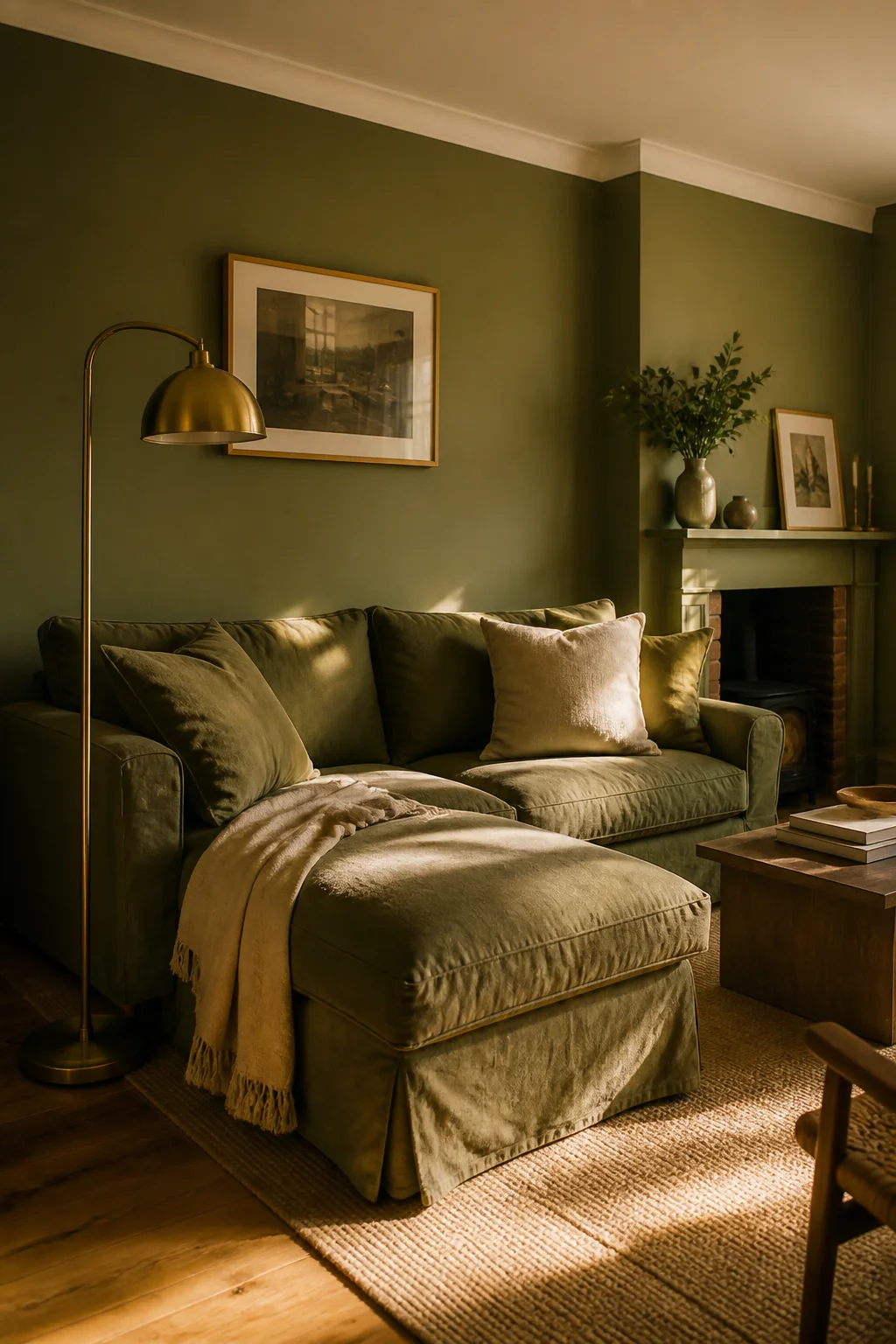 Metal finish carries more weight here than most people expect. Brass and warm gold pull the yellow forward in olive; chrome and polished nickel do the opposite and leave the corner looking cold. Look for a lamp 58 to 64 inches tall overall, which puts the bottom of the shade around 40 inches off the floor, just above eye level when you're sitting. Lower than that and the bulb glares straight at you. Higher and the light spills onto the ceiling instead of the seat.
A linen or parchment shade softens the beam and keeps the color of the light warm. Expect $80 to $150 for a simple column lamp and $150 to $250 for an arc that reaches over the sofa. Set the base 4 to 6 inches out from the sofa arm so the shade clears the cushions. One thing worth knowing before you buy: unlacquered brass darkens over a year or two into a soft brown-gold, which looks wonderful against olive but is not reversible. If you want it bright forever, buy lacquered.
3. Layer two smaller rugs instead of one big one
The single 8x10 neutral rug is the usual answer, and it is usually the problem: the furniture ends up perched along its edges and the seating group still drifts across the floor. Layering fixes that. Start with a 5x7 or 6x9 jute base, roughly $120 to $200, then set a 3x5 or 4x6 patterned wool runner on top, another $80 to $150. Jute gives you a sandy warm tone and a coarse weave that catches light; the wool gives you pattern and something soft underfoot.
Position the base so the front legs of the sofa and both chairs land on it. That single move is what makes a seating group read as one piece instead of three. Leave 12 to 18 inches of bare floor between the rug edge and the wall. Add a felt and rubber pad, about $40, or the top rug slides every time someone sits down. Fair warning: jute sheds for the first few weeks and it's scratchy if you sit on the floor, so a wool-jute blend is friendlier in a room where kids play.
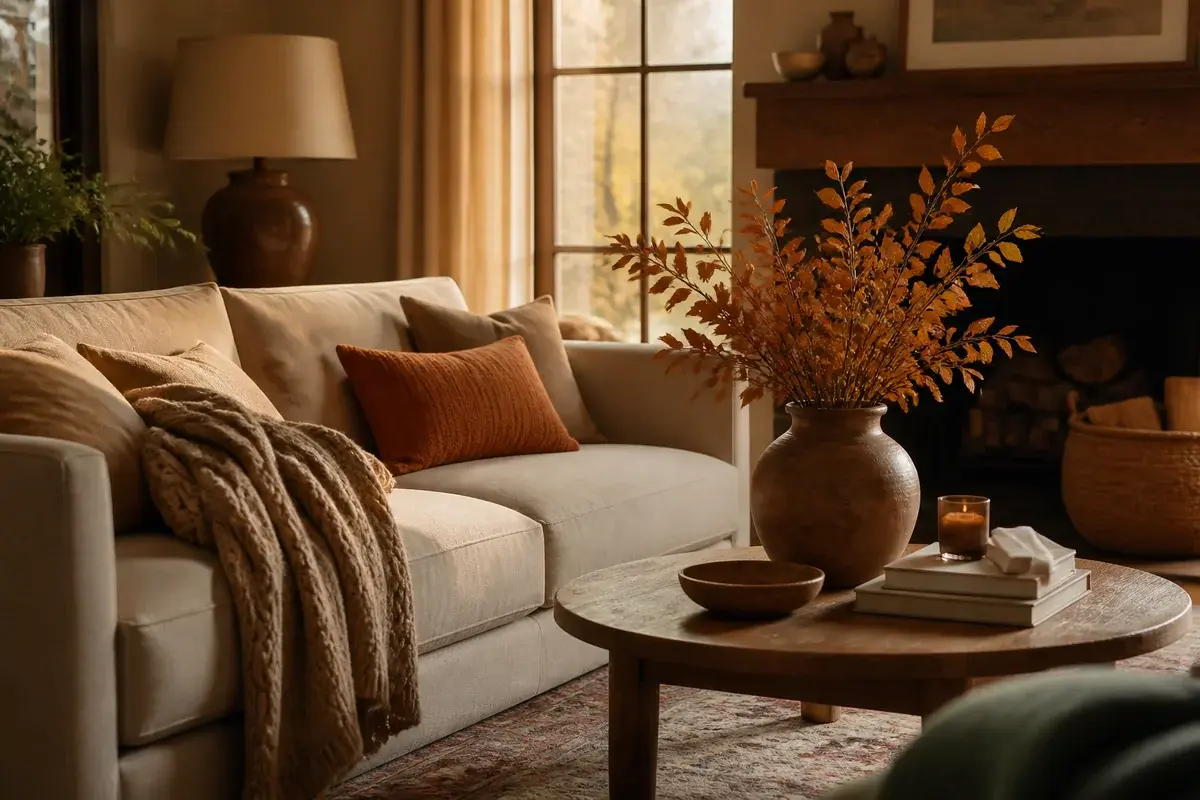
4. Add a textured throw blanket in cream or oatmeal
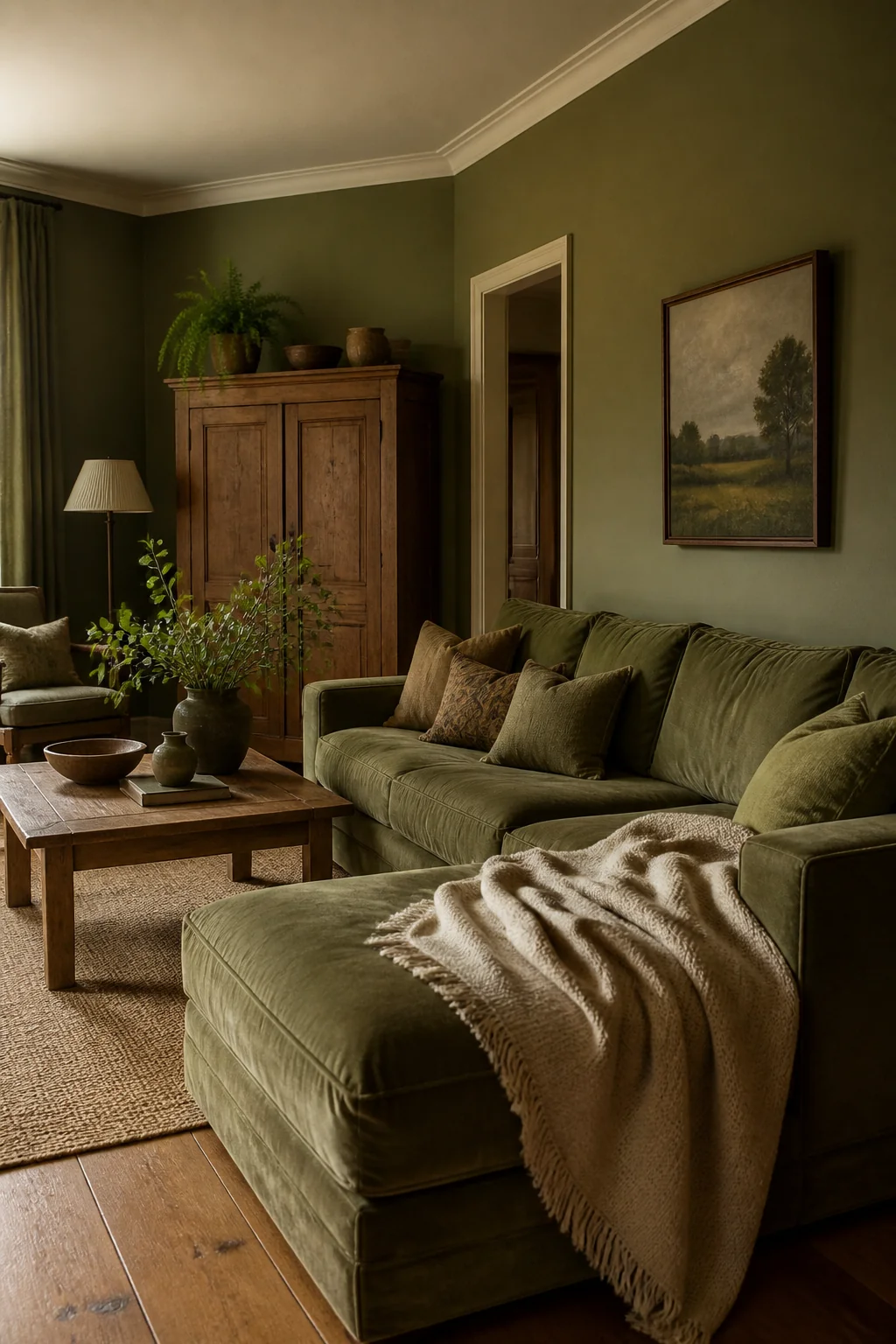 Texture is what stops a muted color from going flat, because a rough surface throws small shadows and a smooth one doesn't. A chunky wool knit or a washed linen throw does that work quietly, in a cream or oatmeal that reads as a pause rather than another color. Size matters more than you'd guess: anything under 50 by 60 inches looks like a lap blanket draped on a sofa, and 50 by 70 is the size that falls right over an arm.
Drape it over one arm at a diagonal with about a third hanging free, not folded into a neat rectangle. Chunky merino or wool blends run $40 to $90, washed linen $50 to $80, cotton waffle weave $25 to $40. Skip acrylic chenille. It looks convincing in photos, then pills within a season and takes on a plasticky sheen under warm 2700K bulbs, which is exactly the light you'll be using in an olive room.
5. Install floating shelves and style them with natural wood and glass
Olive walls need interruption, and shelves do it without adding another color. Natural oak or ash floating shelves in 8 to 10 inch depths and 24 to 36 inch lengths are the useful range: shallower than 8 inches and nothing but frames will fit, deeper than 10 and the shelf starts to feel like cabinetry. Stack them 12 to 14 inches apart vertically so a tall vase or a stack of books clears.
Hanging is the part people rush. Studs sit 16 inches on center in most homes, so a 30-inch shelf catches two if you plan for it. Into a stud, a solid oak shelf with a steel cleat holds 40 to 50 pounds comfortably. Into drywall alone with 1/4-inch toggle bolts, treat 25 pounds as the ceiling and keep the ceramics small. Expect $40 to $90 per shelf in solid wood, less in veneered MDF, which is fine on a wall but sags over 36 inches under weight. Style them loosely: terracotta pots, clear glass, a linen box, gaps left empty.
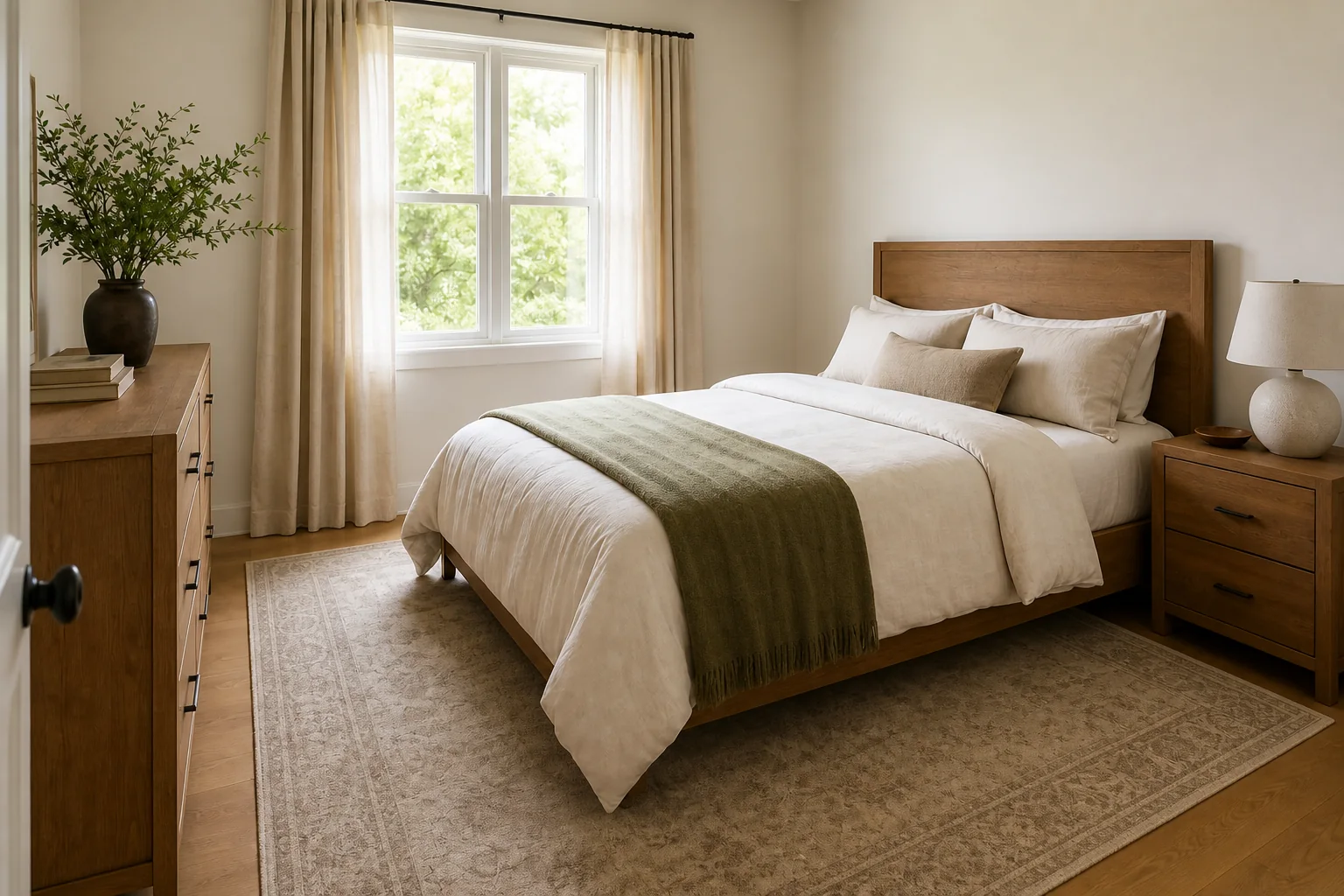
6. Choose warm gray or greige for upholstered furniture
A sofa in warm taupe or greige sits against olive without competing with it or vanishing into it. If you want a target to shop against, hold a paint chip of Benjamin Moore Revere Pewter HC-172 or Sherwin-Williams Accessible Beige SW 7036 next to the swatch. Those are the undertones you want. A cool grey sofa, the kind with a blue base, turns olive murky and makes the whole room look like it needs a window cleaned.
Fabric does as much as color here. Look for a textured weave rather than a flat one, because texture keeps a large neutral surface from looking like a slab. Check the durability rating: 15,000 double rubs is fine for a formal room, 30,000 and up is what you want if the sofa gets daily use. Performance polyester blends handle spills better than linen, which stains and relaxes into wrinkles. Budget $900 to $2,000 for a well-made three-seater, or buy a washable slipcovered model around $700 to $1,200 if you have a dog.
7. Incorporate a patterned accent chair in rust, terracotta, or mustard
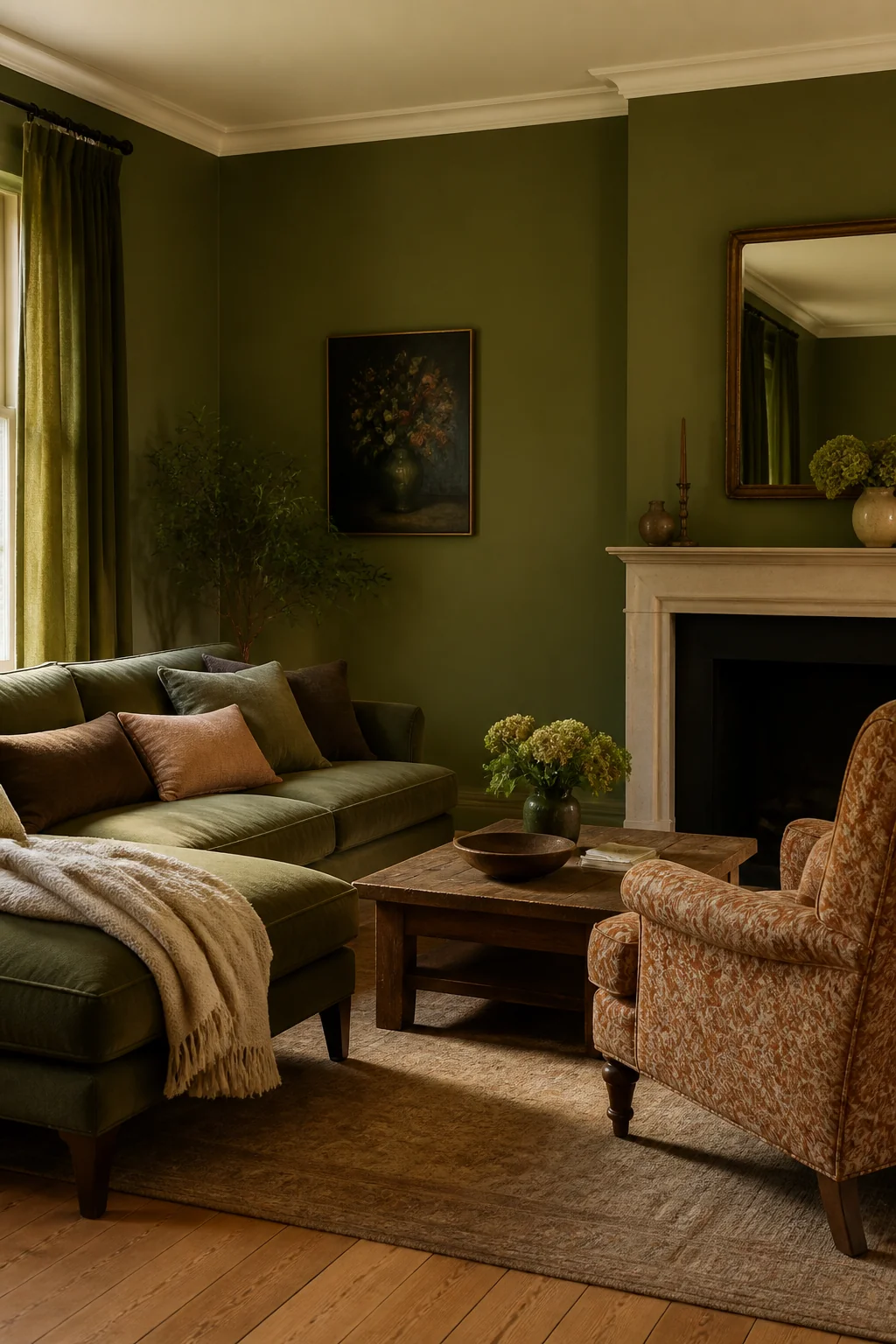 One patterned piece gives the eye somewhere to land. A chair in a rust and cream geometric, or a flat terracotta boucle, brings warmth into a room where the walls are doing something quiet. Watch the scale of the print: a repeat somewhere between 6 and 12 inches reads clearly from across a room, while a tiny 2-inch repeat dissolves into visual noise at eight feet away and a huge one gets chopped up by the arms and cushions.
Measure before you fall in love. A chair 28 to 32 inches wide fits most seating groups, and the seat height should land within about 2 inches of your sofa's so people aren't talking up or down at each other. Leave 30 inches of walkway around it. Expect $400 to $800 for something with a hardwood frame and decent foam. The failure mode is doubling up: if the rug already has a strong pattern, put the chair in a solid and let the floor carry the print.
8. Place a large mirror with a wood or rattan frame on one wall
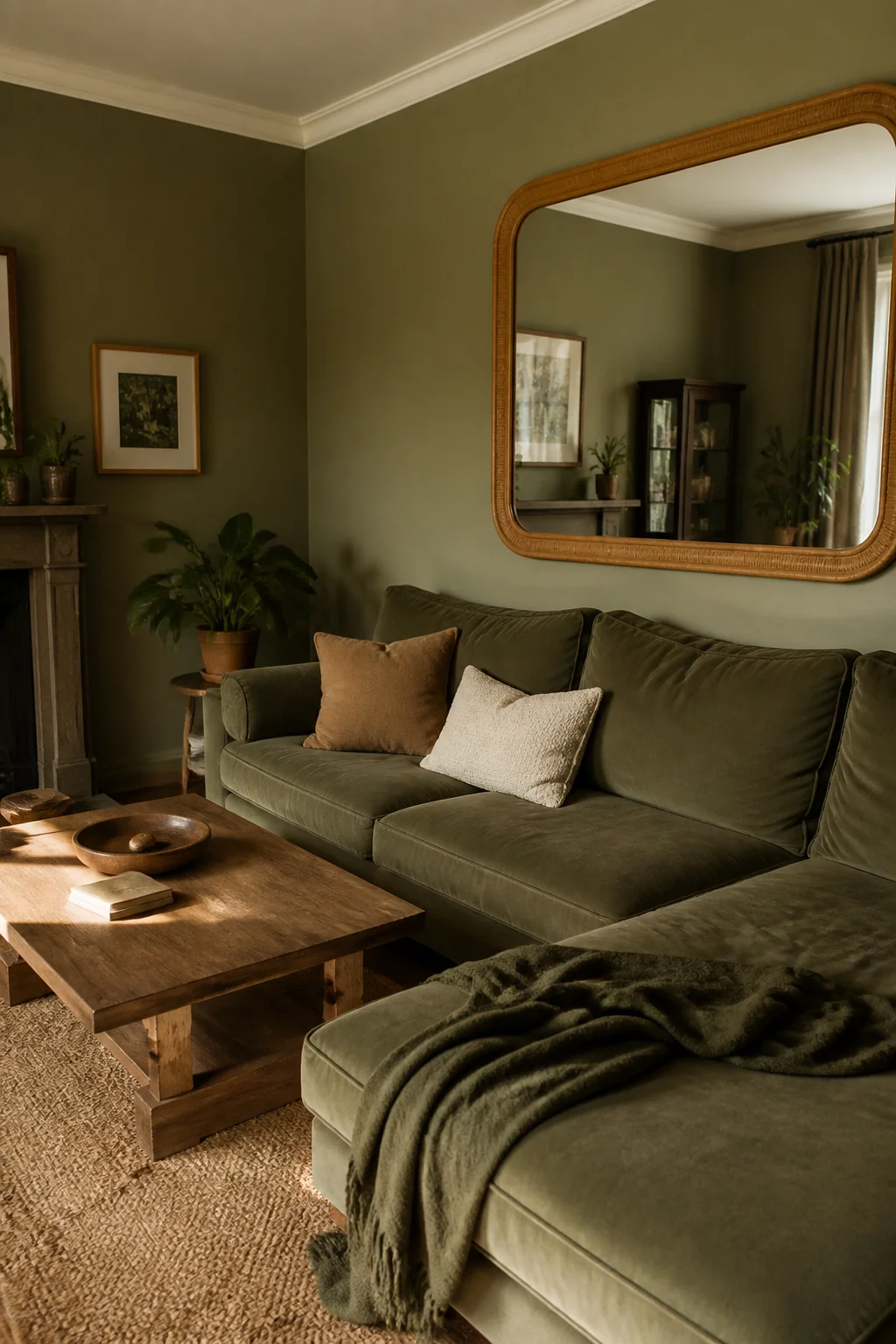 Mirrors bounce daylight deeper into a room, which matters when the walls are absorbing a lot of it, and olive absorbs plenty. The frame decides whether it feels warm or clinical. Natural wood and woven rattan add texture and echo the earthy side of the green; a thin black metal frame reads sharp and modern against it, which can work but won't soften anything.
Shop at 30 inches wide or more, and check the hanging hardware before you pay for it. Standard gallery placement puts the middle of the glass 57 to 60 inches up, and a mirror whose wire is fixed high on the back will hang four inches above that with no way to correct it short of fitting new D-rings. Placement is the part worth thinking through: hang it perpendicular to a window rather than directly opposite one, so it catches light at an angle instead of reflecting a glaring rectangle. And look at what will appear in it, because a mirror facing a cluttered console just doubles the clutter. Rattan frames are light, often 10 to 15 pounds, and hang on a single stud screw. Anything over 25 pounds needs a stud or a heavy-duty anchor rated for it. Budget $150 to $400.
9. Use warm Edison bulbs in all overhead and task lighting
Color temperature does more for olive than any object you can buy. At 2700K, warm LED filament bulbs push the yellow in the green forward and the room reads soft. At 4000K and above, the same paint on the same wall goes grey and institutional, because the light has less red in it to reflect back. Look for a CRI of 90 or higher too, since low-CRI bulbs render muted colors poorly and olive is nothing but muted color.
Do the whole room in one go. Mixed temperatures are what make a wall look patchy, one corner amber and another corner cool. For a standard table or floor lamp, 800 lumens matches an old 60W bulb; dimmable LED filaments run $6 to $12 each. Two cautions. Skip 2200K, which sounds cozier but turns olive muddy and brown. And if your dimmers are older triac models, cheap LEDs will buzz or flicker on them, so budget $25 to $40 for an LED-compatible dimmer.
10. Paint a single accent wall a deeper forest or sage green
One wall in a deeper green gives the room a focal point and makes the lighter olive read as a decision rather than a default. Stay in the same undertone family or the two greens will argue. Farrow & Ball Bancha No. 298 is a dark olive that sits naturally beside a lighter one; Sherwin-Williams Pewter Green SW 6208 leans grey-green and calms things down; Benjamin Moore Cushing Green HC-125 goes deeper and moodier.
Pick the wall you face when you walk in, or the one behind the sofa, and pick a wall without a door and two windows chopping it into pieces. A broken wall makes the color look like a mistake. Sample first: peel-and-stick swatches run about $6, sample pots $10 to $15, and you want to look at them at 9am and 9pm before committing, because olive shifts hard between daylight and lamplight. Buy one gallon and stop there: the 350 to 400 square feet on the label puts two coats on a 12-foot wall with paint still in the can, so the only real decision at the counter is which can, $70 to $85 for Benjamin Moore Regal Select against $120 to $130 for Farrow & Ball.
11. Hang linen curtains in natural or warm white
Linen scatters daylight instead of blocking it, so the light that reaches an olive wall arrives soft and even. Rod length is the part to settle before you pay, not after. Measure the window, add 8 to 12 inches at each end so the stacked panels sit clear of the glass when they're open, and a 60-inch window lands you on an 84-inch rod rather than the 72 that looks right on the shelf. Bracket height is the other number: 4 to 6 inches above the frame, or as high as 2 to 4 inches below the ceiling when you want the wall to read taller, and worth deciding before you order panels because it adds to the length you need.
Buy width, not just length. Your panels together should measure about twice the window width, or they'll hang like flat sheets with no folds. For hems, half an inch above the floor looks tailored and 1 to 2 inches of puddle looks relaxed; anything in between just looks short. Natural or warm white linen blends run $30 to $60 a panel. Two things to know: pure linen wrinkles permanently and can shrink 3 to 5 percent, so wash cold and hang damp, and skip blackout lining here since it kills the exact effect you're paying for.
12. Place a wooden sideboard or console table below a window
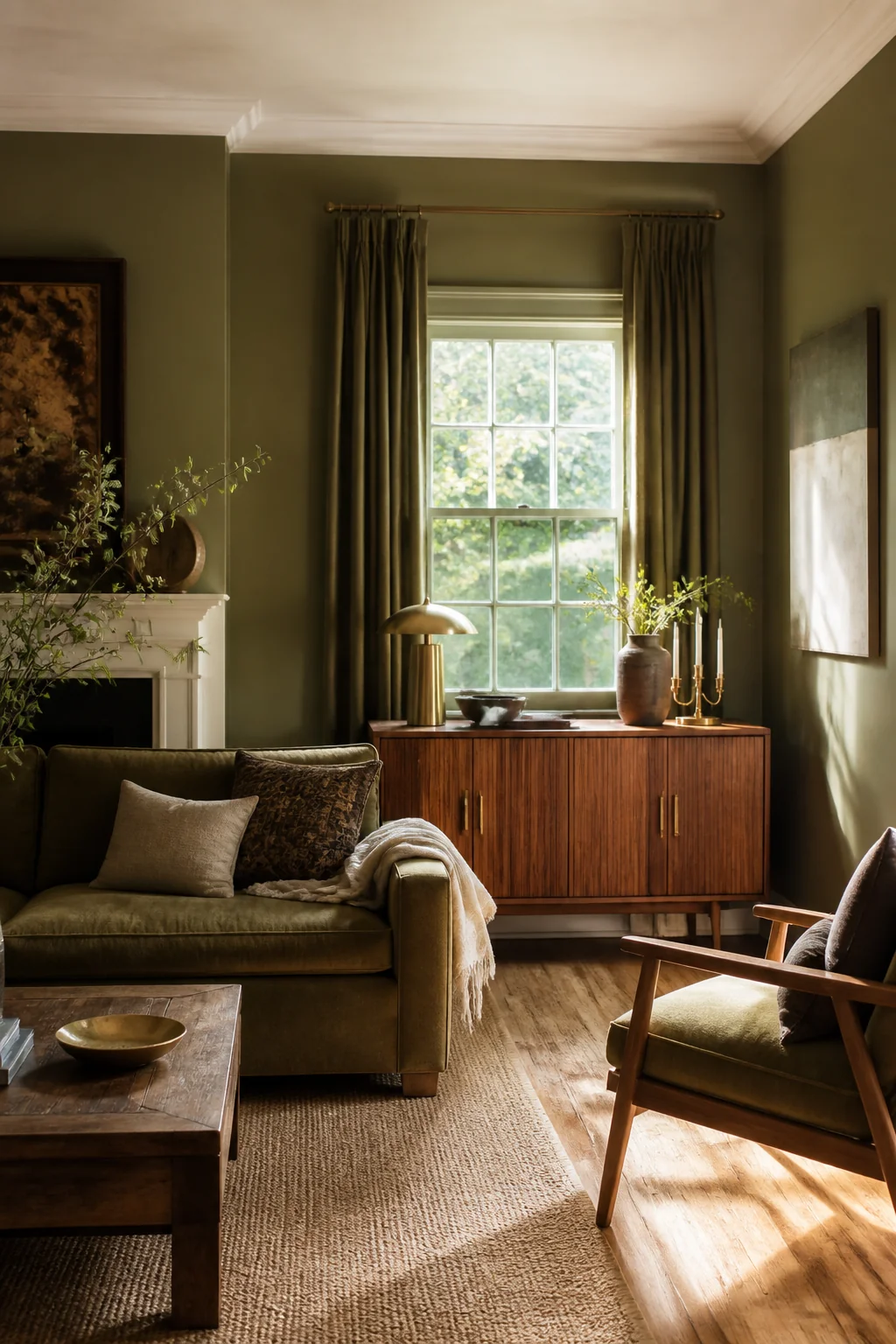 Wood grounds an olive room because the two share a warm base, and a solid horizontal piece under a window gives the eye somewhere to rest. White oak reads light and slightly golden, walnut goes deeper and chocolatey, and teak sits between them. All three flatter olive. Orange-toned varnished pine is the one to avoid, since its undertone clashes rather than harmonizes.
Measure the sill first. You want the top of the sideboard 4 to 6 inches below it, which usually means a piece 30 to 34 inches tall, with a depth of 15 to 18 inches so the walkway in front stays clear. Brass or aged bronze pulls tie it to the lamps. Budget $300 to $600 new, or $250 to $500 for mid-century teak on Facebook Marketplace, where a scratched top can be sanded and re-oiled for the price of a can of hardwax oil. One real caution: direct afternoon sun fades walnut unevenly, so move the objects on top every few months or you'll get permanent pale rectangles.
13. Add a gallery wall with a mix of art frames in natural wood and brass
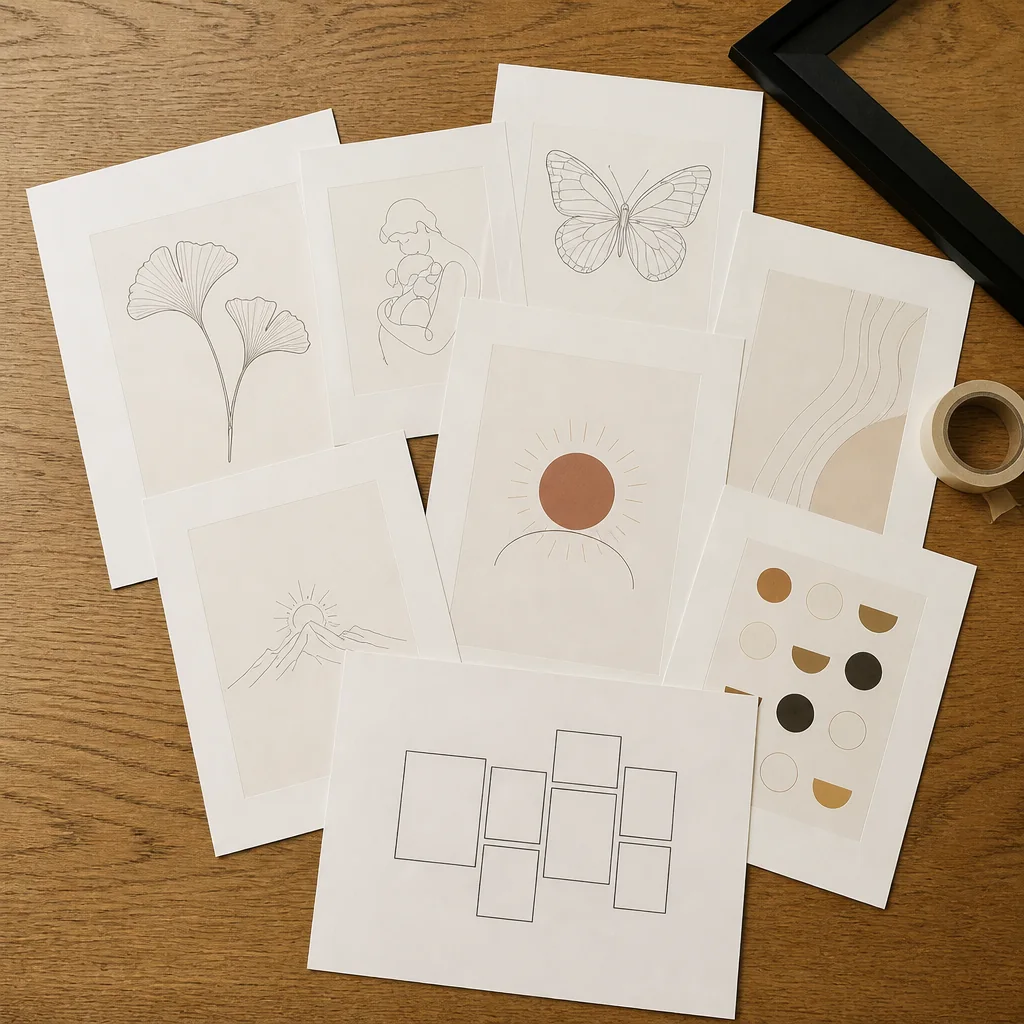
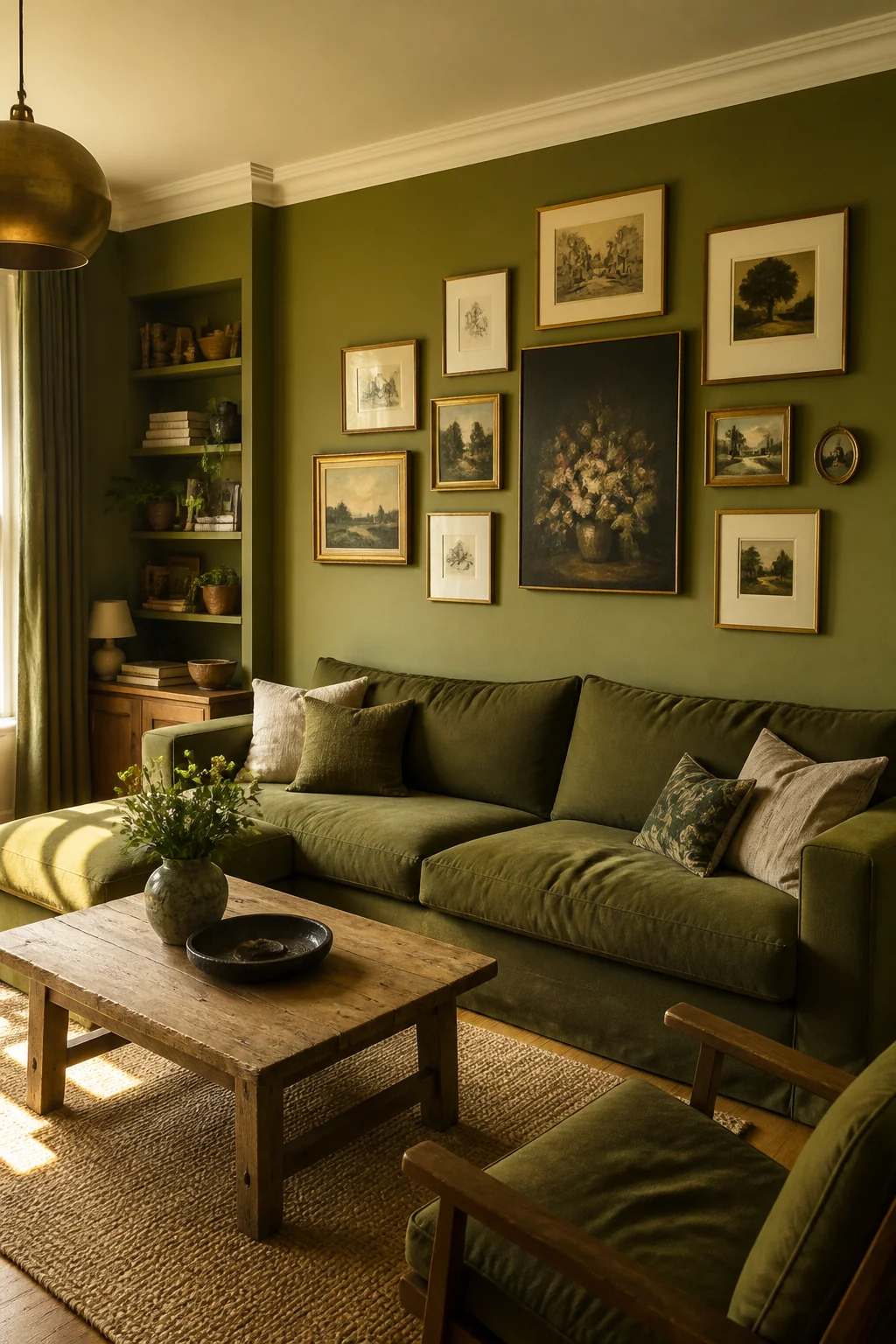 Mixing frames keeps a gallery wall from looking like a store display. Natural oak, aged brass, and one or two painted frames in cream give you variety in the metals and woods already in the room. What holds the mix together is consistency somewhere else: use the same white mat, 2 to 3 inches wide, in every frame, and the arrangement reads collected instead of chaotic.
Work on the floor first. Lay the frames out, shuffle them, then trace each onto kraft paper and tape the templates to the wall so you can move them around before a single nail goes in. Keep 2 to 3 inches between frames, and let the center line at 57 to 60 inches off the floor decide how many frames you buy in the first place. A block much taller than about 40 inches pushes its top row above where anyone is looking, so a tall wall calls for fewer, larger pieces rather than more small ones. Anchor it with one larger piece, 24x36 or bigger, or a crowd of small frames turns fussy fast. Frames run $15 to $40 each, so a nine-piece wall lands around $200. The approach also suits corner wall gallery ideas, where the art wraps two walls and warms a dead corner.
14. Layer olive green with warm terracotta or burnt orange accents
Terracotta and olive get along because they sit on the same side of the color wheel: both are muted, both carry yellow and red under the surface, so neither one has to win. Cool reds do not behave the same way. A raspberry or cherry cushion beside olive looks like an accident, because its blue base fights the green's yellow one. If you want a paint reference for the tone, Farrow & Ball Red Earth No. 64 is the clay-orange end of it.
Spread it across three heights rather than clustering it. A terracotta pot on the floor, $15 to $40 depending on size, two rust cushions at seating level, and a piece of art or a hanging vessel higher up. That vertical spacing is what makes an accent color look woven through a room instead of dropped in one corner. Keep the ratio small: if roughly a tenth of what you see is rust, it warms the olive. Much more than that and the two colors start competing for the same job.
15. Install warm wood shelving above a console or media stand
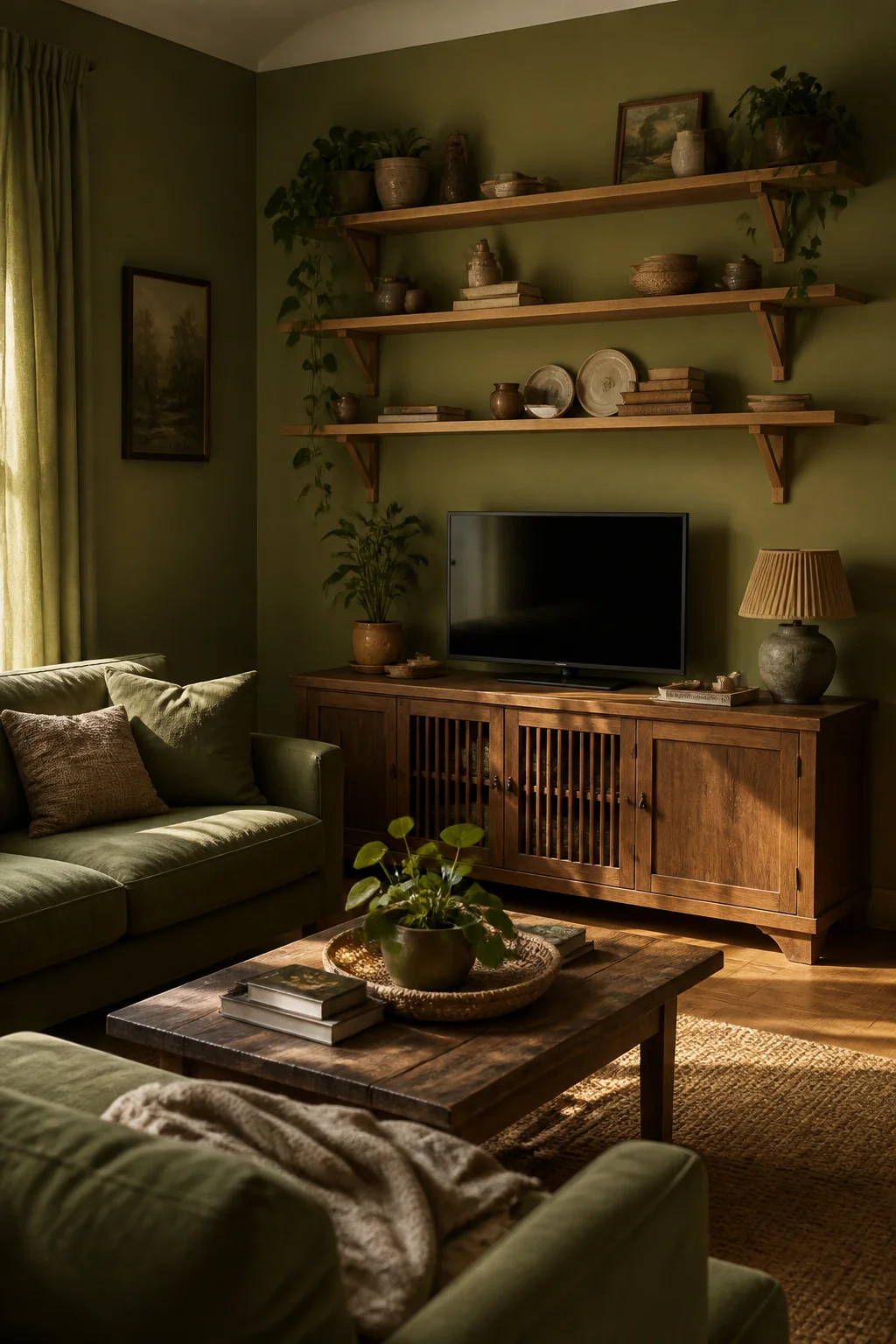 A wood unit with open shelving does something floating shelves can't: it turns a media wall into a composed block instead of a TV with clutter around it. Match its width to the console below within about 6 inches so the two read as one unit, keep the depth to 10 or 12 inches, and leave 16 to 20 inches of clear air between the console top and the lowest shelf so a lamp or a tall plant fits.
Finish is where olive rooms get decided. A natural white oak with hardwax oil keeps the wall light and warm; a dark espresso stain over a dark console stacks into a heavy slab that pulls the whole corner down. Expect $150 to $400 for a decent unit. Two practical notes: drill a 2-inch grommet or leave a gap at the back for cables, because a beautiful shelf with a power strip dangling off it is worse than no shelf, and anchor anything over 4 feet tall to a stud with an L-bracket.
16. Position potted plants and greenery throughout the space
Living green beside painted green works better than it sounds, because leaves are glossy and paint is matte, so the two never blur together. Spread them at three levels: something tall in a corner, something trailing from a shelf, something small on a console. A fiddle leaf fig at 5 to 6 feet wants a 10 to 12 inch pot and at least six hours of bright indirect light, and it will drop leaves if it sits below 60F or beside a door that opens onto winter. Expect $40 to $90.
If your room is darker, a pothos handles low light and only wants water when the top 2 inches of soil are dry, about $15. A ZZ plant is nearly unkillable at $25 and tolerates a two to three week gap between waterings. The one trap is monotony: an olive wall behind five green plants goes uniform. Break it with terracotta pots, a variegated pothos, or a plant with silvery leaves.
17. Hang a ceramic or woven wall hanging in neutral tones
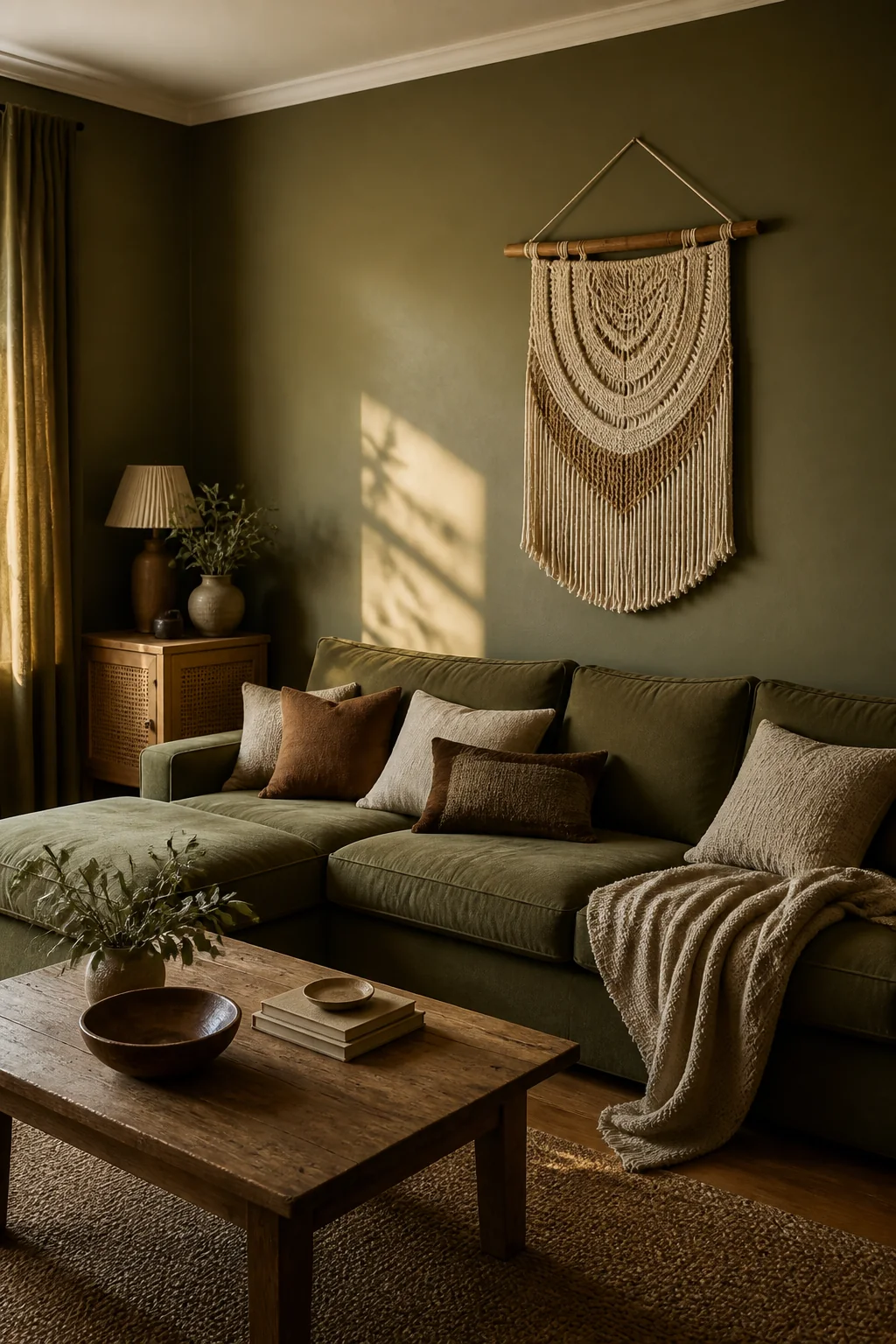 Fiber and ceramic bring a kind of texture paint can't fake: knots, ridges, and hand-thrown edges that catch lamplight and throw tiny shadows across the wall. In cream, beige, or unglazed natural white, they read as texture rather than as another color, which is what an olive wall needs.
Measure whatever sits below it and take two thirds of that width; that number is the narrowest piece worth ordering, because anything under it hangs like a sample swatch on a wall that size. Over a typical console it puts you shopping in the 24 to 36 inch range for a macrame panel, hung so the bottom edge clears the sofa back by 8 to 10 inches and heads don't hit it. Most weigh under 3 pounds and hang from a single nail, which makes this the cheapest wall fix on the list at $30 to $120. Maintenance is the part nobody mentions: cotton rope collects dust, so vacuum it with a brush attachment a couple of times a year, and keep it out of direct sun, which yellows undyed cotton over a season or two.
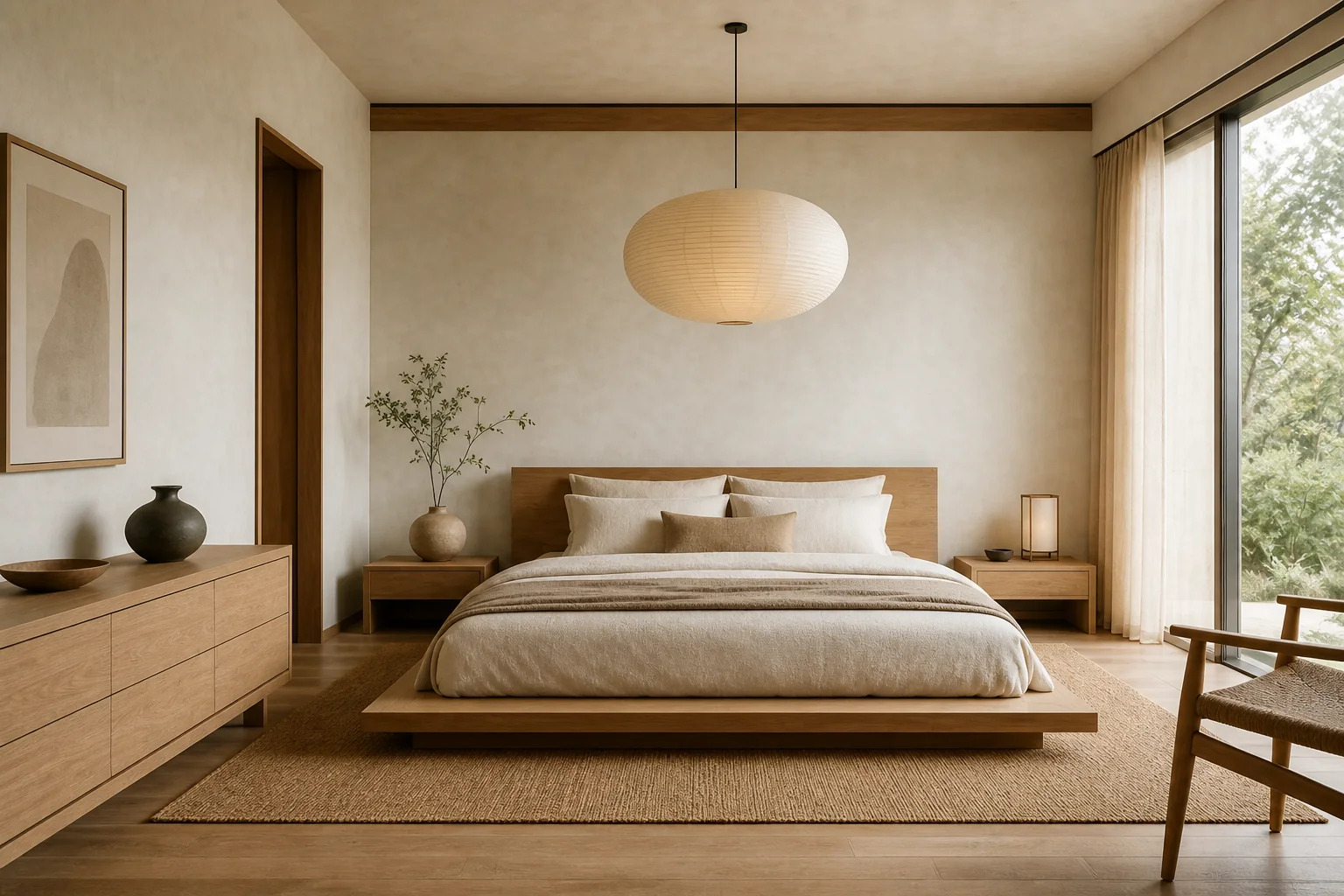
18. Choose throw pillows in olive, cream, rust, and soft yellow
Pillows are where the room's whole palette gets stated in miniature. Echo the walls with one or two in olive, use cream for contrast, rust or terracotta for warmth, and a soft mustard or ochre as the odd note. Vary the fabrics as much as the colors: linen looks dry and matte, wool reads soft, and velvet catches light so the same green looks lighter along the top of the pillow than down the side.
Size them properly and a sofa stops looking underdressed. On a standard three-seater, use 20x20 or 22x22 at the corners, 18x18 as a secondary, and one 12x20 lumbar in the middle. Inserts are the line item people match to the cover and then regret. Order one size up, a 22-inch insert for a 20-inch cover, and the pillow arrives plump instead of half-empty. Covers run $20 to $50, inserts $12 to $20, and the extra few dollars belong on feather-down or down-alternative; cheap polyester fill packs flat within a couple of months and never fluffs back.
19. Add a low wooden coffee table with tapered or turned legs
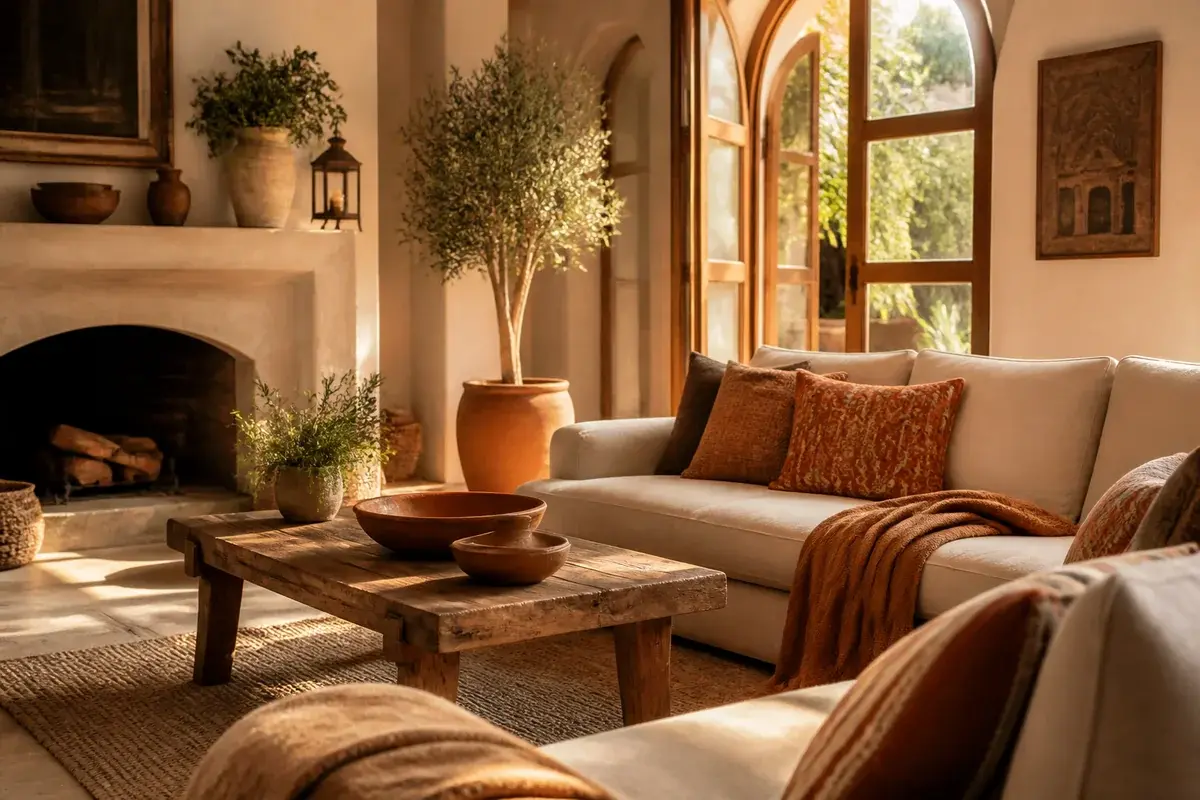
How heavy a room feels comes down to what you can see under the furniture. A coffee table on exposed tapered or turned supports lets floor and rug show through beneath it, so the furniture appears to take up less space than it does. A skirted or solid-block base does the opposite, and in a room with saturated walls that extra visual weight is what tips olive from cozy into closed in.
The measurements are simple. Height 16 to 18 inches, within about 2 inches of your sofa's seat height so you can set a cup down without reaching. Leave 14 to 18 inches between the table edge and the sofa front, enough to walk through but still within arm's reach. Length works out to roughly two thirds the sofa. Natural oak or walnut in that size runs $200 to $400. If your walkways are tight, closer to 30 inches, choose an oval or round top: square corners in a narrow path are the thing you bruise your shin on for years.
20. Install picture rail molding and rotate artwork seasonally
Picture rail is a slim moulding near the top of the wall that art hangs from on hooks and cords, so you can rearrange a whole wall without patching a single hole. On an olive wall that matters twice over: touch-up paint on a deep color almost never matches, because the sheen flashes even when the tint is right.
Install it 10 to 16 inches below the ceiling, or align the top edge with your door casing so the room has one consistent line. Primed pine picture rail costs $12 to $20 for an 8-foot length, brass rail hooks $4 to $8 each, and cord or wire another $10 to $15, which puts a full wall somewhere near $80. Each hook holds around 20 pounds, so heavy framed glass wants two. The one thing to watch: on 8-foot ceilings, setting the rail much lower than 12 inches down crowds the wall and leaves you a strip of olive at the top that looks like a mistake.
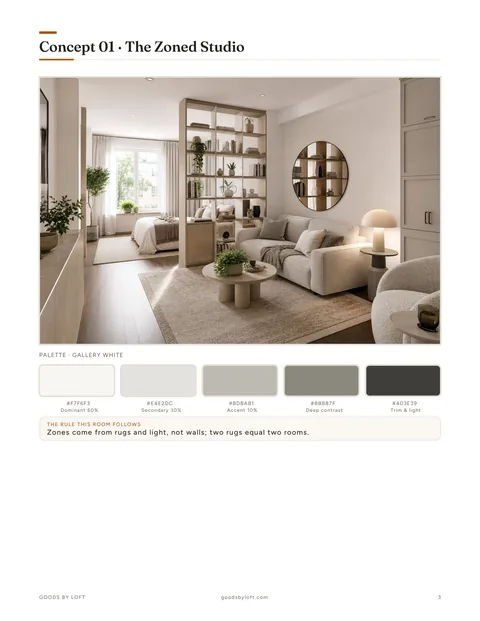
21. Place a warm-toned side table in natural wood or rattan
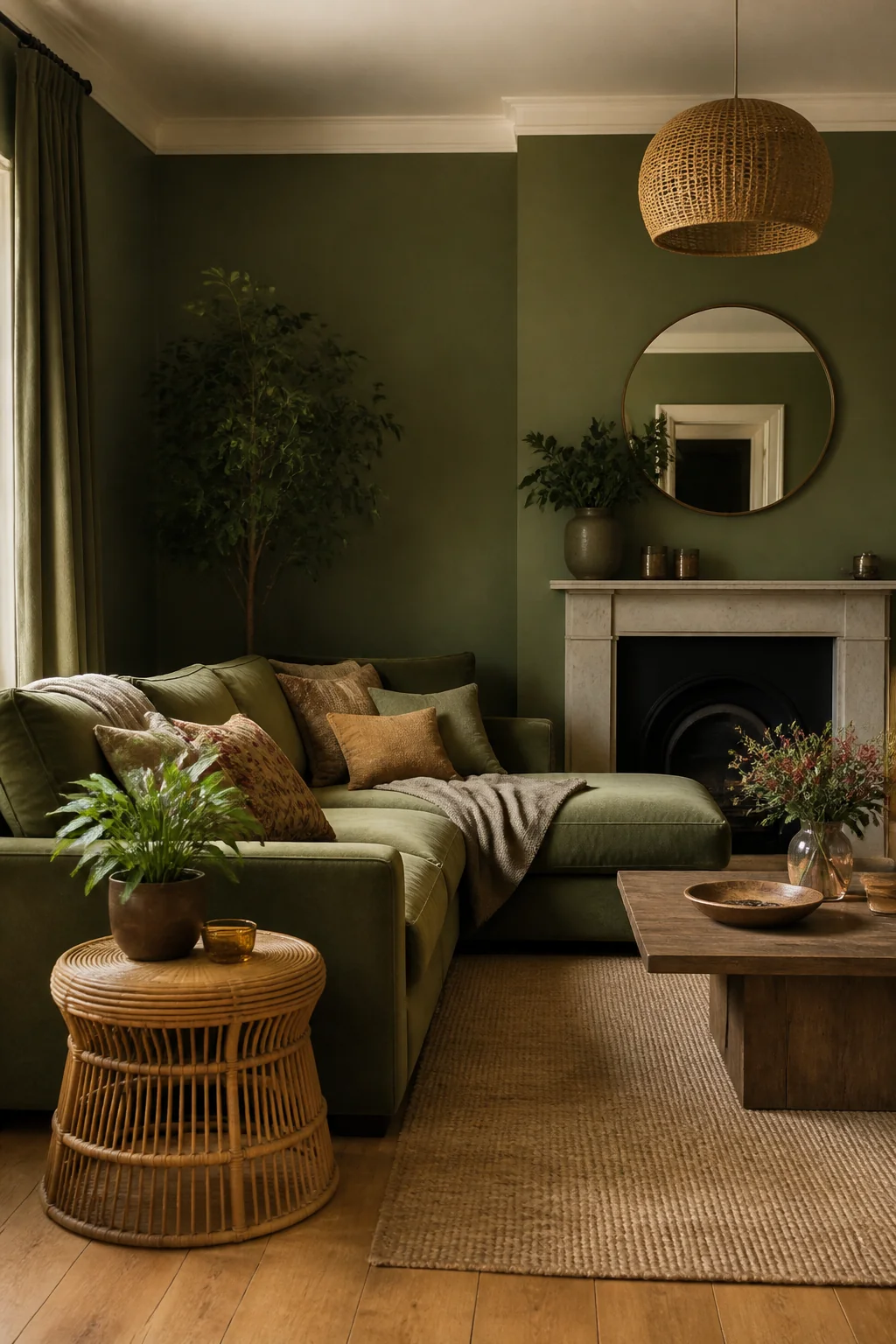 Every seat needs a surface within arm's reach, and a warm-toned one adds texture where the wall has none. Round is the friendlier shape beside an armchair: 18 to 20 inches in diameter, with the top height landing within 2 inches of the chair arm, usually 22 to 26 inches. Too low and you're reaching down for a mug; too high and it looms over the chair.
Rattan and cane bring the woven texture, but they come with a real limitation. An open weave won't hold a glass upright, so choose a piece with a solid wood or glass insert on top, or you'll be balancing drinks on a basket. Rattan also loosens in humid rooms and dries out in very dry ones, where the wrapping can crack; a solid oak or teak drum sidesteps both problems if your climate swings. Budget $80 to $200. A vintage teak stool at the low end does the same job and gets better with wear.
22. Bring in vintage or antique brass and copper accessories
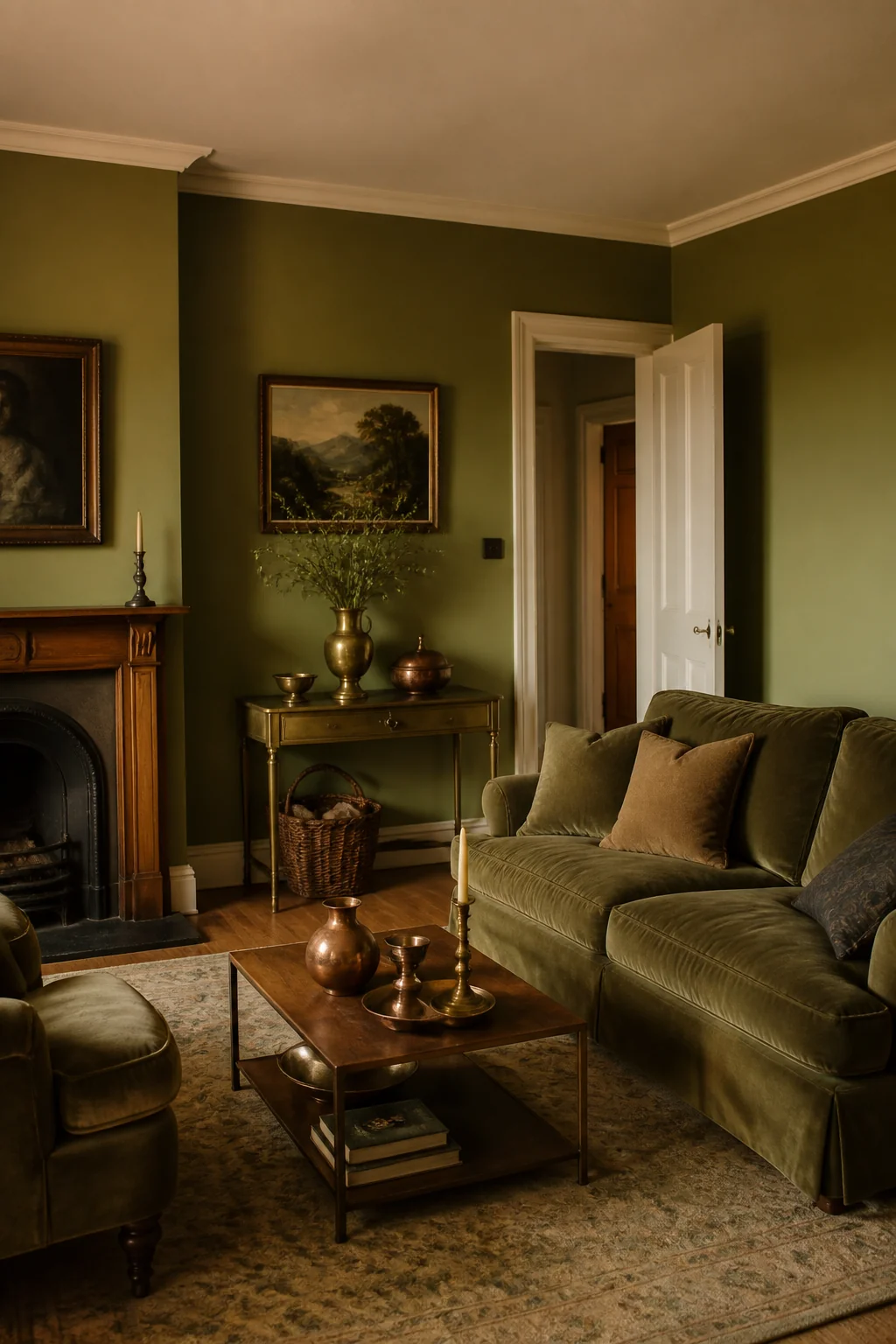 Aged metal is the fastest way to make an olive room look like it happened slowly. A brass bowl on the console, a copper vase, a pair of old candlesticks: the warm reflection pulls the yellow out of the green in a way a shiny new object never quite manages, because a soft patina scatters light instead of bouncing it back hard.
Bring a magnet when you shop. A magnet sticks to brass-plated steel and slides right off solid brass, which is how you avoid paying $30 for something with a plated finish that will chip. Thrift stores and estate sales run $5 to $25 a piece, and that is where the good stuff is. Group in odd numbers with real height differences, roughly 4 inches to 12 inches, so the cluster has a silhouette. If a piece is too dark for you, Bar Keepers Friend or half a lemon dipped in salt brings it back in minutes; copper will keep going brown either way, and it's better company for olive that way.
23. Use warm-toned wood paneling or shiplap on a feature wall
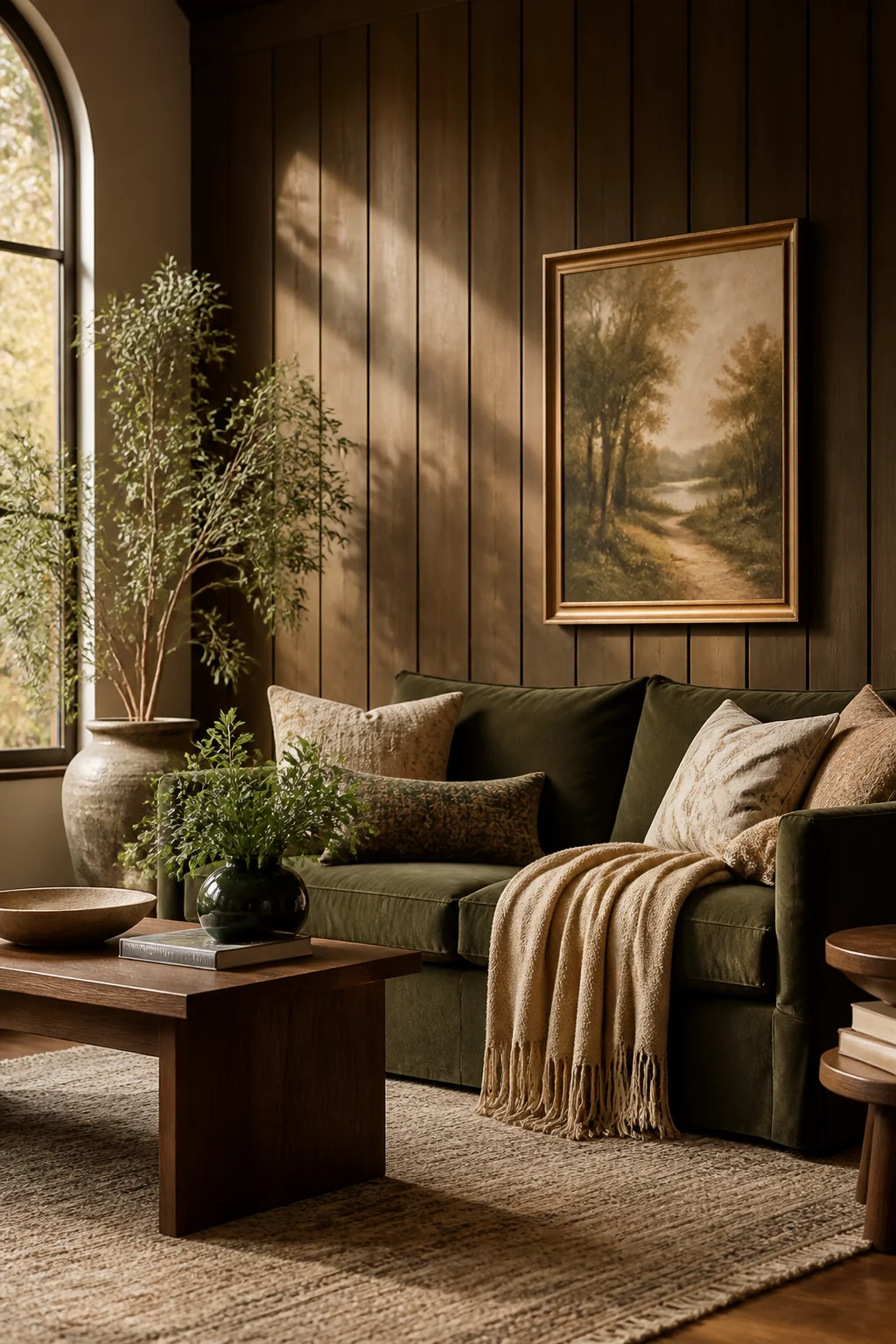
Cladding a single wall in warm wood, with olive on the rest, gives a room the feeling of a retreat. That comes down to grain: wood reads as continuous texture at a scale nothing else in the room matches. Nickel-gap shiplap in 5.25 or 7.25 inch boards is the usual choice, with a 1/8 inch reveal between courses that casts the shadow line doing all the work.
Costs split sharply by species. Primed pine runs $2 to $4 per square foot, white oak $8 to $14, so a 12 by 9 foot wall is roughly 108 square feet, or $250 in pine against $1,100 in oak. Mark your studs, start from a level line rather than the floor, which is never level, and fasten with 2-inch 18-gauge brad nails. The finish is where olive rooms fail: raw pine takes stain blotchily and dries orange, which fights the green. Use a pre-stain conditioner and a neutral or grey-wash tone, or seal it with matte hardwax oil. The look suits japandi living room ideas and warm farmhouse alike.
Save this for your next project
If there's one thing worth being careful about, it's the sampling. Olive is more sensitive to light than almost any color you can put on a wall, and the same paint can look sage at 9am, warm khaki under lamplight, and flatly grey on an overcast afternoon. Paint a two-foot square on two different walls, live with it for three days, and look at it in the evening under the bulbs already in your lamps. Half the rooms that end up feeling drab were sampled once, in bright midday sun, on the only wall that gets direct light.
Ideas fade by Friday. A plan finishes the room.
You just read a full guide to your living room. Saving ideas will not change it; a plan will. The Home Decor Collection is every planning tool we make, for every room in the house, in one download, so the after photos below stop being other people's rooms.
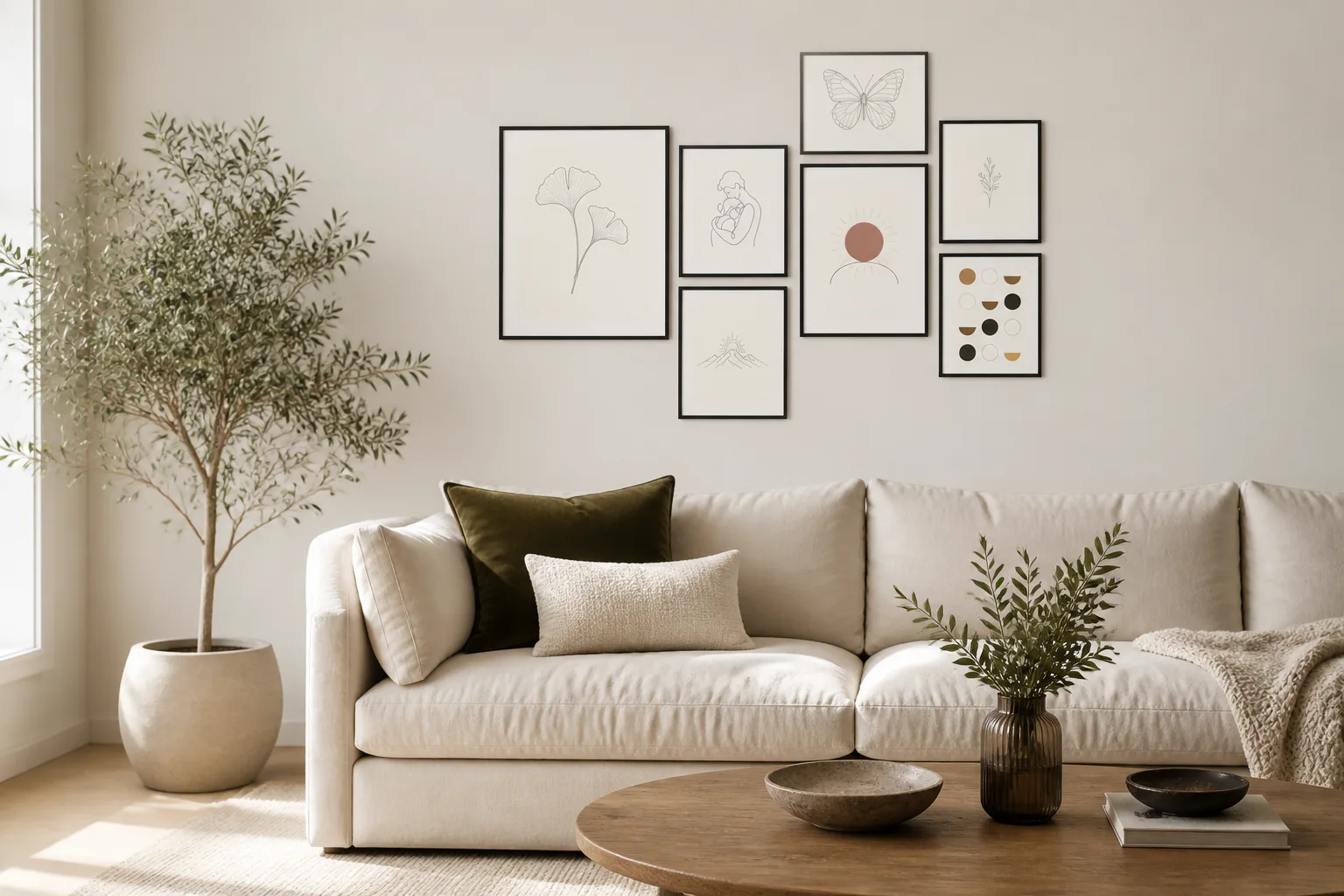
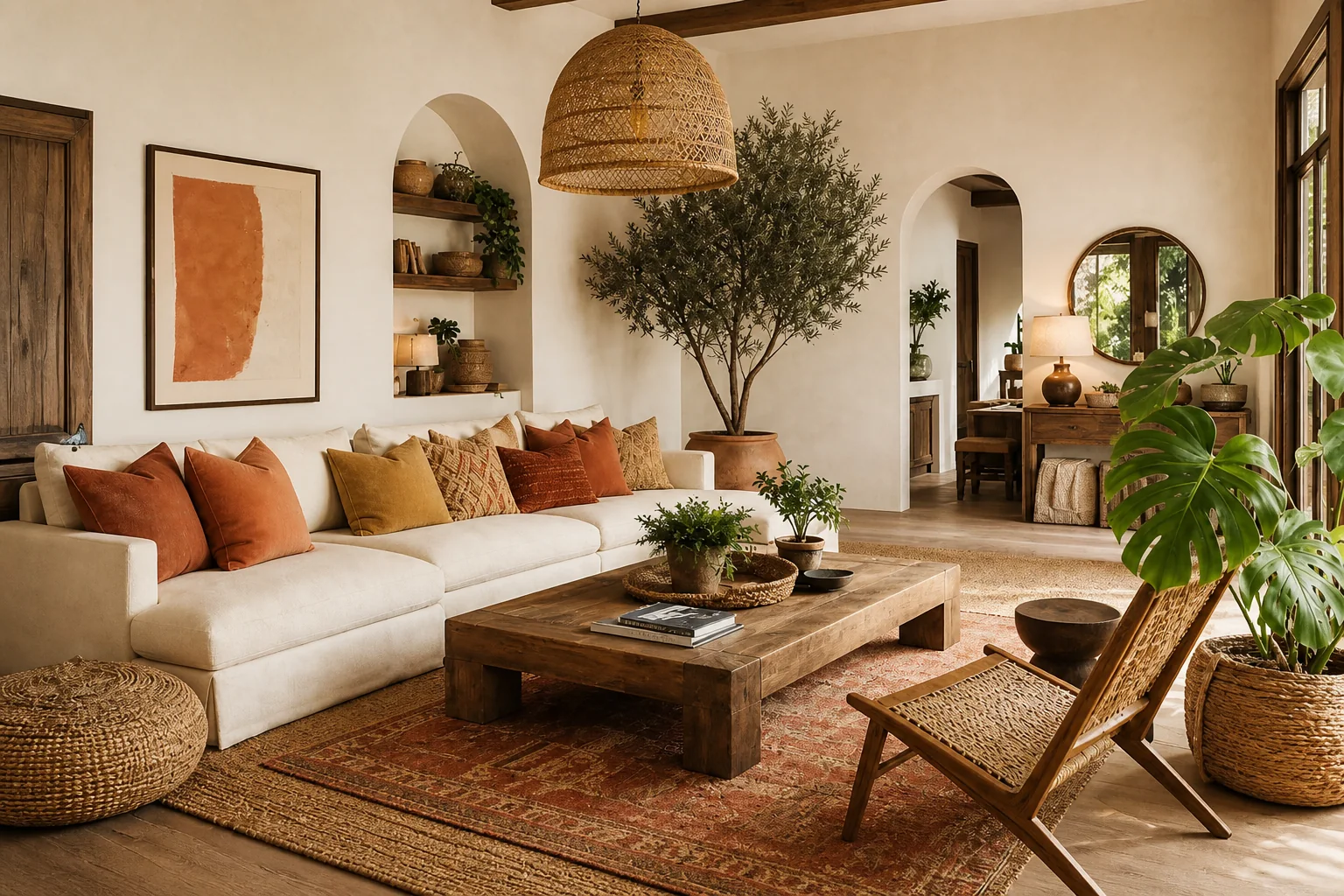
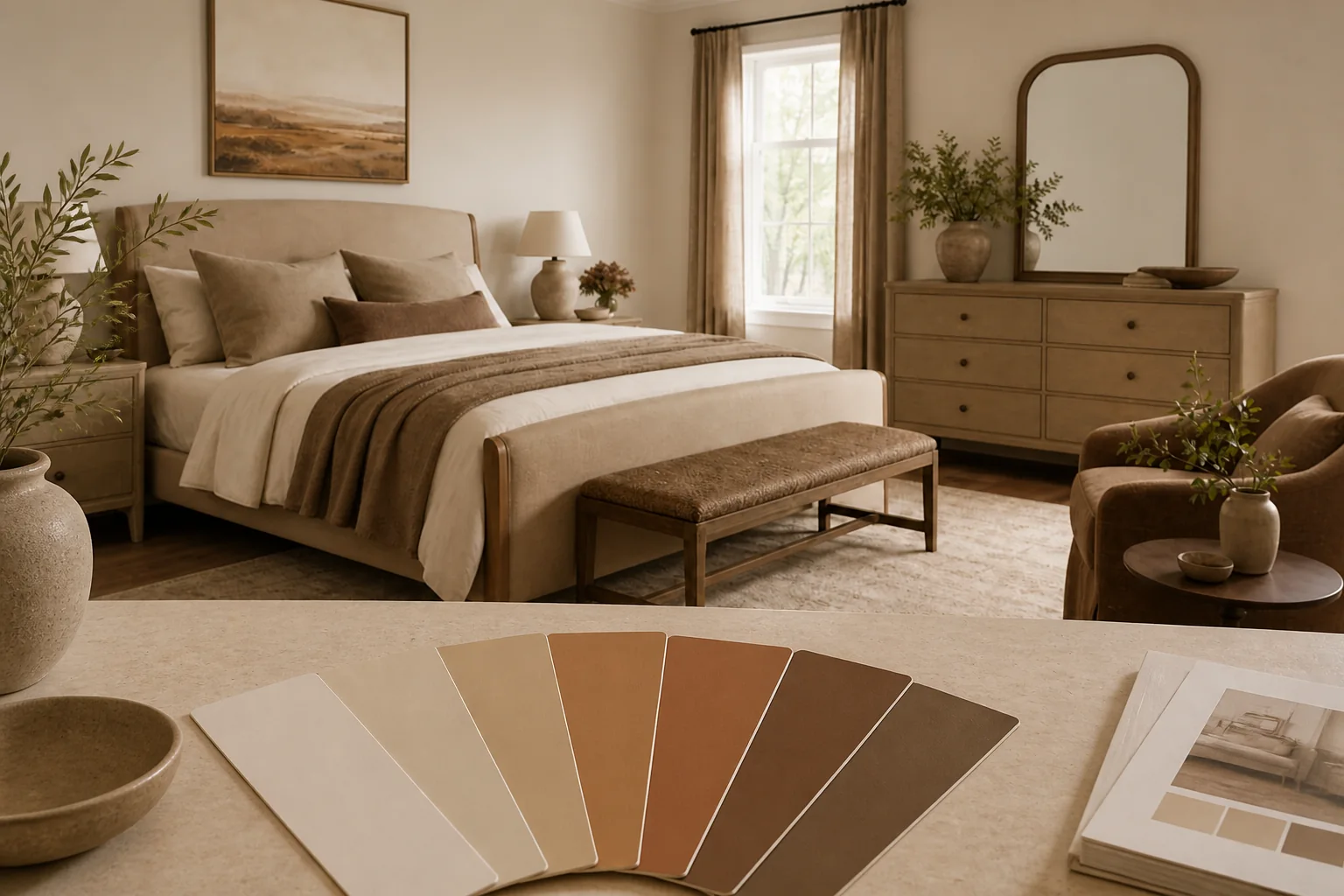
- Six room Style Kits, each with layout, palette and shopping list$114
- The Gallery Wall Studio: 200 prints + 15 measured layouts$29
- The Room Makeover System: 40 solved room layouts + workbook$29
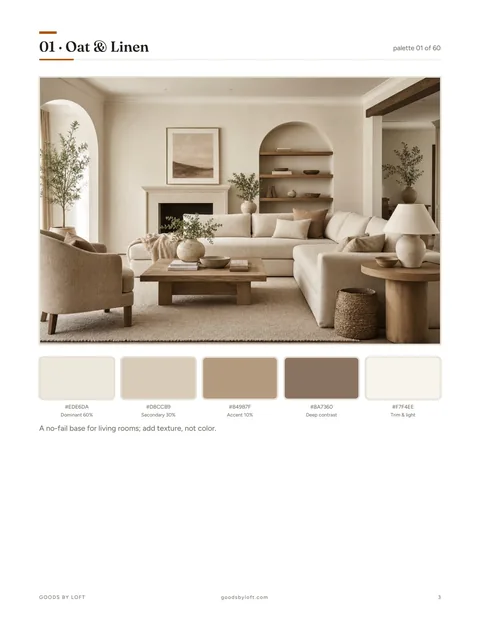
- The Color Palette Handbook: 60 palettes shown in real rooms$19
- The Whole-Home Reset: 40 printable organizing checklists$19
- The Decorator's Cheat Sheets: the 40 measurements that matter$9
- All eleven products, bought separately
$219$97
A single hour with an interior designer costs more than the entire Collection, and this one keeps answering for every room you will ever decorate. Free updates included as the products grow. And if it is not for you, the 14 day money back promise means you simply get a refund.