31 Japandi Living Room Ideas That Balance Calm and Warmth
Explore 31 japandi living room ideas with real dimensions, prices, and trade-offs, from low platform sofas and layered rugs to slat walls and warm lighting.
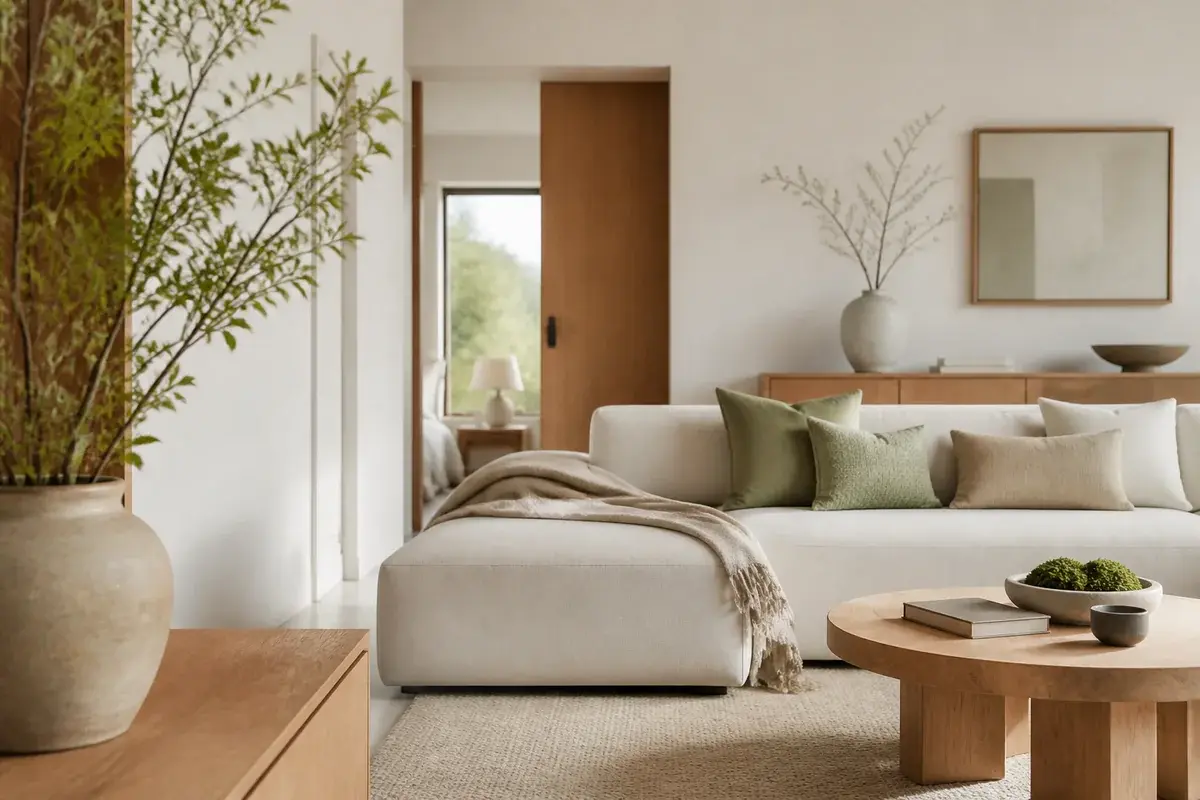
Most living rooms trying japandi end up feeling cold or overstuffed. You'll see rooms that nail the clean lines but lose the coziness, or rooms so layered with textures they blur into visual noise. The trick isn't picking one style or the other. Japandi works because it merges Japanese restraint with Scandinavian comfort, and when that balance tips, the whole room feels off. Here are 31 ideas that hold that middle ground, with the measurements, prices, and trade-offs behind each one.
1. Use a low wooden platform sofa
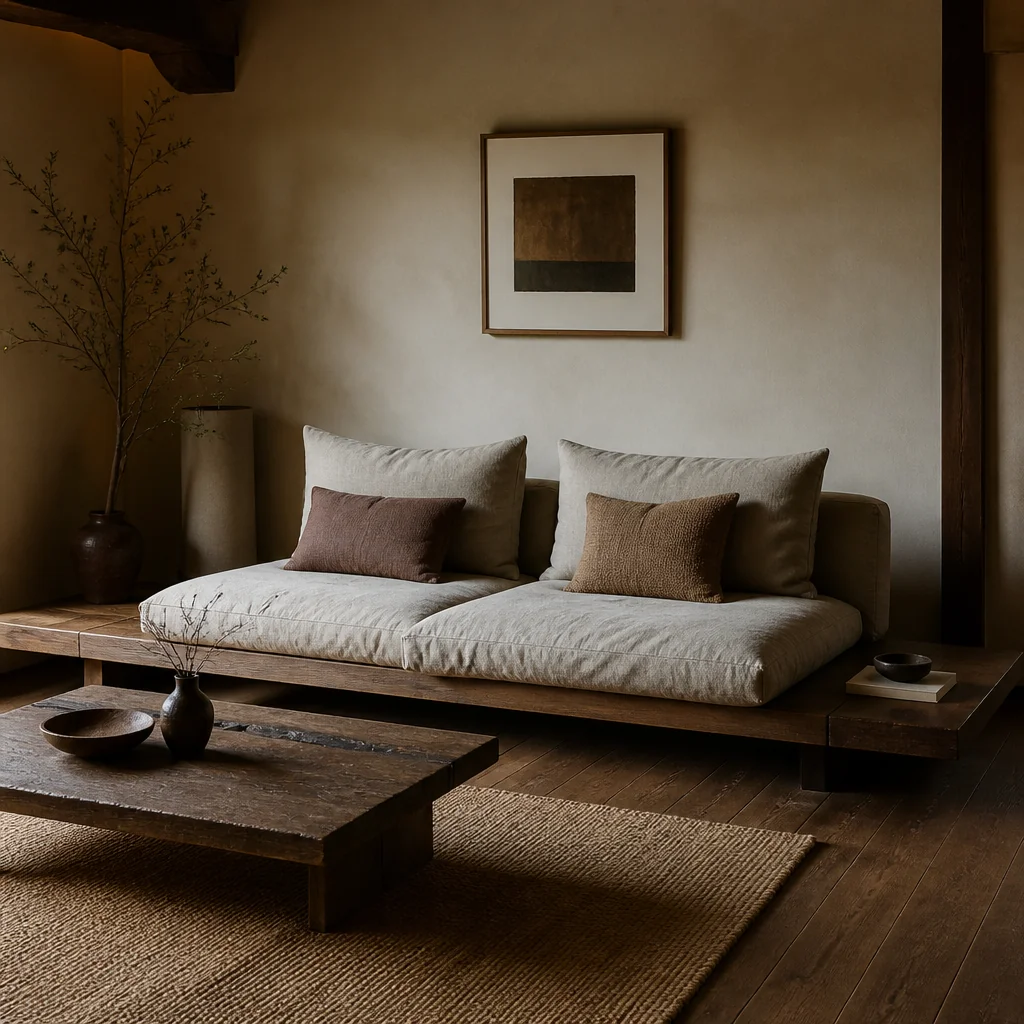
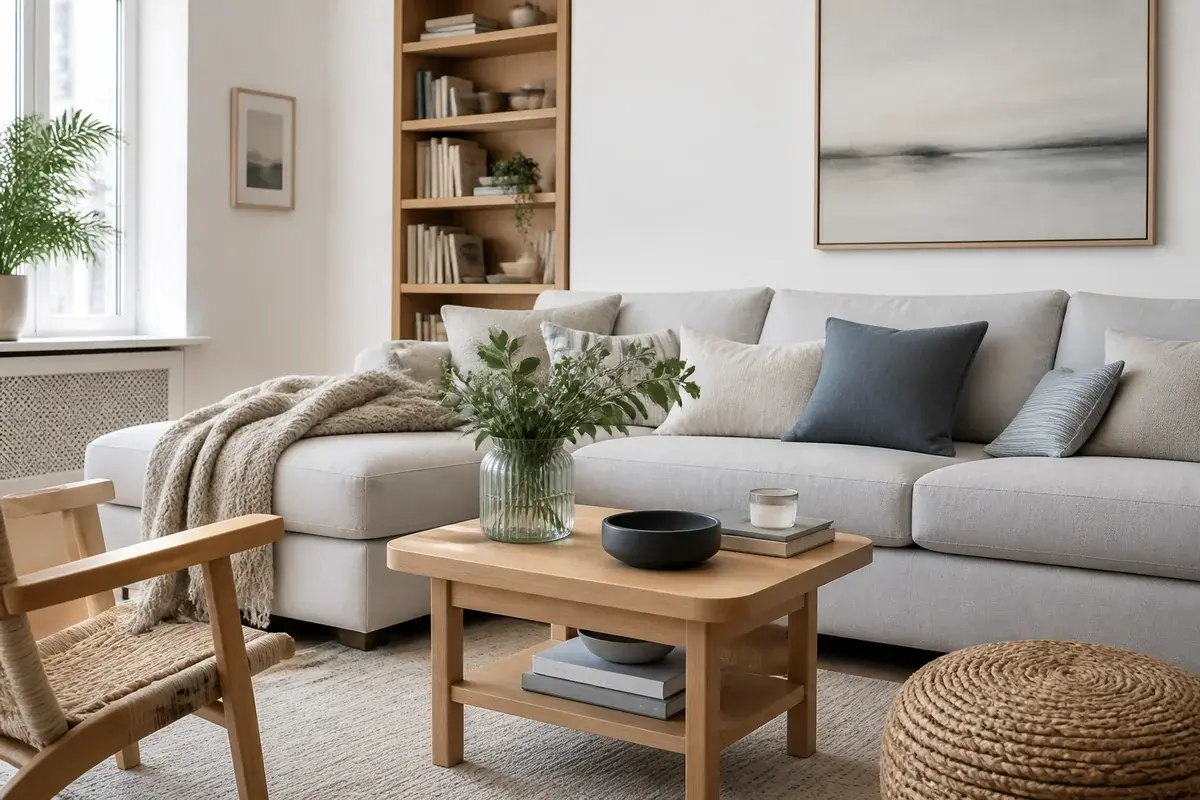
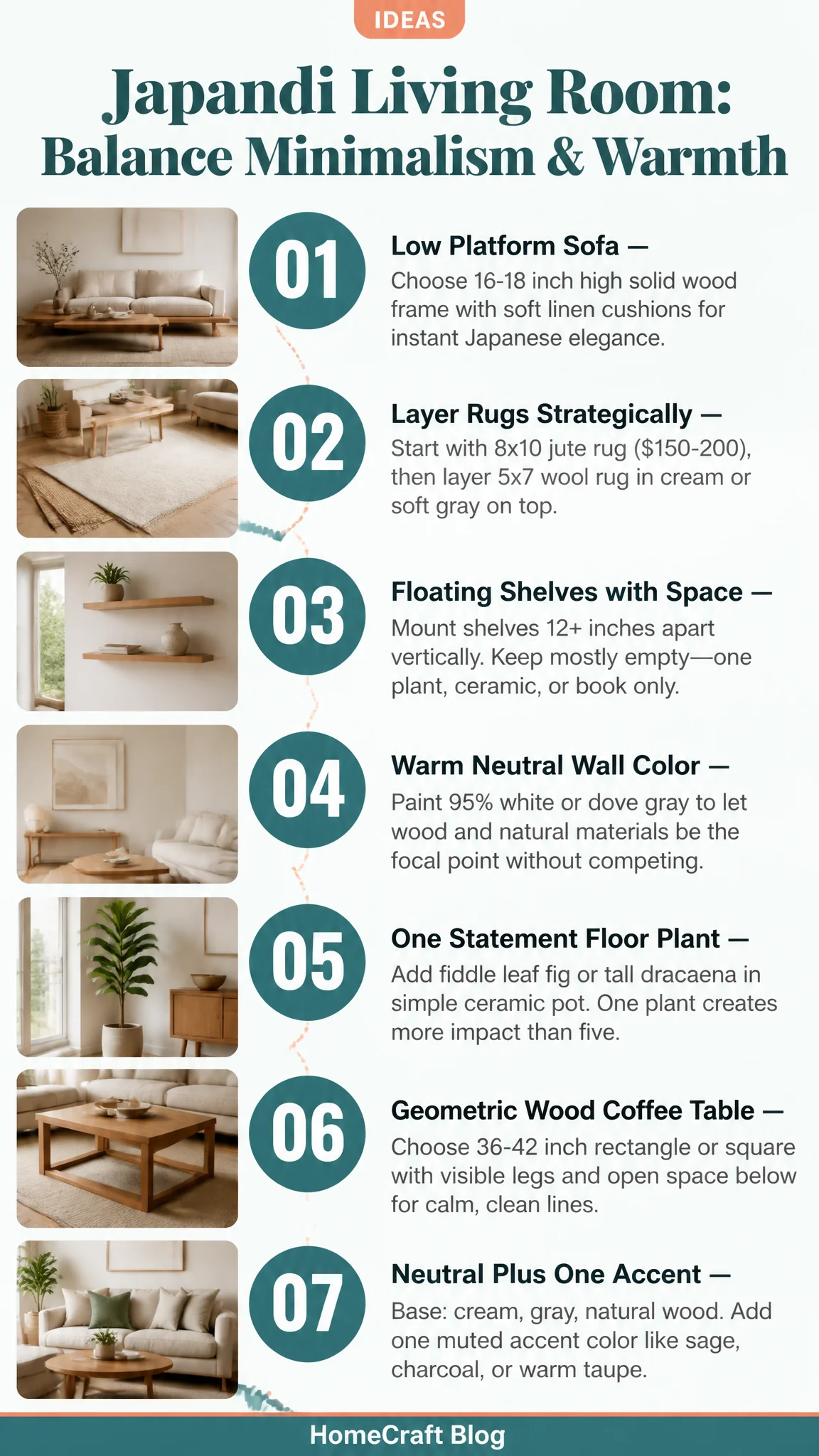
A sofa that sits closer to the floor reads instantly Japanese without giving up comfort. Aim for a seat height of 16 to 18 inches, against the 19 or 20 inches most Western sofas use. Those few inches are the whole effect: they drop your sightline, open up the wall above the backrest, and make an 8 foot ceiling feel taller than it measures. Look for solid ash or white oak frames with a visible base and a seat depth of 36 to 40 inches, so the low profile still invites you to sink in rather than perch. Cushions matter as much as the frame here. High-density foam wrapped in a down or feather topper keeps the seat from bottoming out after a year. Expect $900 to $2,200 for a solid hardwood frame. Two things to check before you commit: a low seat is hard work on stiff knees, and it pulls every other surface down with it, so your coffee table needs to land within an inch or two of that seat height.
2. Layer a jute rug under a smaller wool one
Two rugs do a job one can't. Put down a natural jute 8x10 first, roughly $150 to $250 for a decent flat weave, then set a 5x7 wool rug in cream or soft gray on top of it so 6 to 8 inches of jute shows on every side. The jute carries coarse, matte texture across a wide area. The wool puts something soft exactly where your feet land. Anchor the front legs of the sofa on the jute so the whole arrangement reads as one piece of floor instead of two islands. A few practical notes before you buy. Jute sheds heavily for the first month, so vacuum it without the beater bar. It also stains permanently, which rules it out anywhere people eat. And a thin felt pad between the layers, around $40, stops the wool creeping out of position every time someone crosses the room.
3. Install floating wooden shelves with breathing room
Spacing is what separates a japandi shelf from a storage wall. Keep at least 12 inches of clear air between shelves, and 14 to 16 inches if you plan to stand anything tall on them. A depth of 8 to 10 inches holds books and ceramics without projecting into the room, and a slab 1.5 to 2 inches thick reads solid rather than tacked on. Mount into studs, usually 16 inches apart on center, using a French cleat or steel rod brackets that disappear inside the shelf. A 36 inch oak shelf fixed into two studs carries 40 to 50 pounds comfortably. Solid oak floating shelves run $60 to $120 each. Then comes the difficult part: fill about a third of the run and stop. A few ceramic pieces, one plant, a single book laid flat. The empty stretches are doing as much work as the objects sitting on them.
4. Paint walls in warm white or soft gray
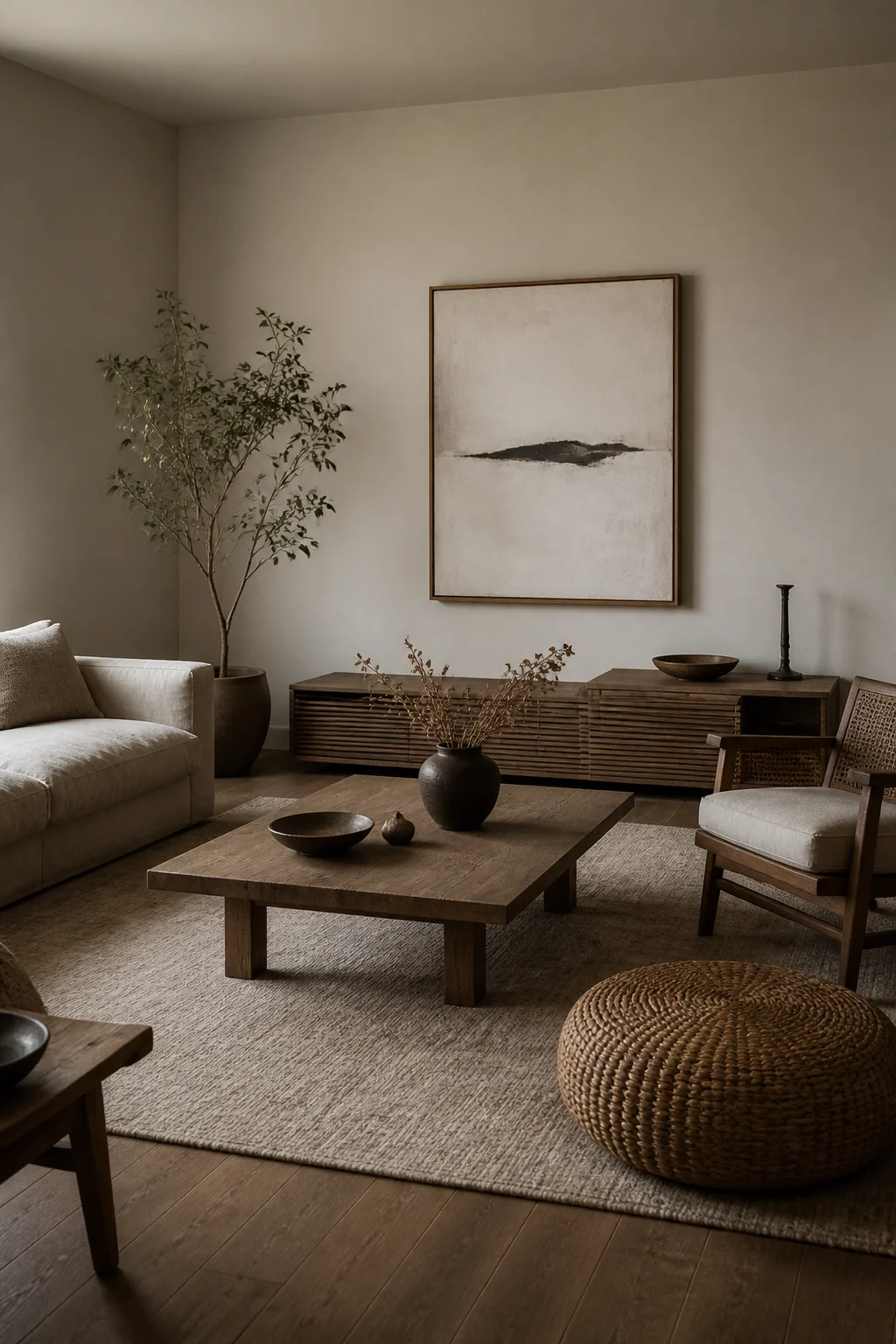
Skip pure white. It goes sterile in daylight and faintly blue in a north-facing room. What you want is an off-white with a warm base, something carrying a whisper of yellow or greige, or a soft dove gray with a light reflectance value in the low eighties. Test before you commit: paint two 12x12 inch patches on different walls and look at them in the morning, at dusk, and under your own lamps at night. Bulb color shifts the result more than the swatch does, and a warm white can slide toward cream under 2700K. Choose a matte or eggshell finish so the wall stays quiet and doesn't catch reflections from the window. Add your walls up before you buy: at 350 to 400 square feet to the gallon, a small living room takes one $50 to $90 can of decent low-sheen interior paint per coat, and a generous one takes two. These backdrops are deliberately unremarkable, which is exactly the point. They let wood grain, stone, and linen carry the room instead of competing with them.
5. Add one large floor plant in a corner
One large plant does more than five small ones scattered around, because a single vertical mass reads as architecture while the scattered version reads as clutter. A fiddle leaf fig at 5 to 6 feet runs $80 to $150 at a local nursery, usually less than the same plant at a big-box store. Set it in a corner in an unglazed stoneware or ceramic pot about 2 inches wider than the nursery pot, with a drainage hole and a saucer underneath, which adds another $50 to $120. Be honest about your light before you buy. A fiddle leaf wants bright indirect light within 3 to 5 feet of a window, hates drafts, and drops leaves if you keep moving it. If the corner you have in mind is genuinely dim, a kentia palm or a cast iron plant holds the same tall silhouette and forgives far more. Water when the top 2 inches of soil are dry rather than on a schedule.
6. Choose a wooden coffee table with clean geometry
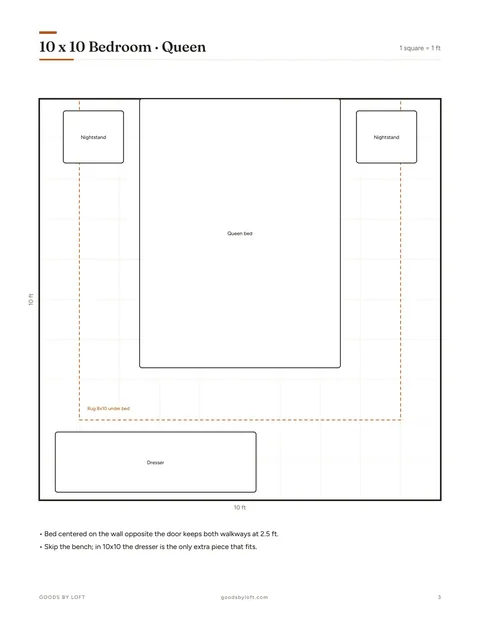
A rectangle or square in solid wood, legs visible, nothing shelved underneath. Around 36 to 42 inches long suits a standard three-seater, and the height should sit within an inch or two of your sofa seat, so 15 to 17 inches if you've gone low. Leave 14 to 18 inches between the table edge and the sofa: enough to slide past, close enough to set a cup down without leaning forward. Solid white oak or ash costs $300 to $800, and the finish matters more than most people expect. Hardwax oil feels wonderful under your hand and can be spot-repaired with a rag, but it will ring where a wet glass sits. Polyurethane shrugs off the glass and can't be spot-repaired at all. The empty space under the table isn't wasted, either. It's a good part of why the room feels open, so resist sliding baskets into it.
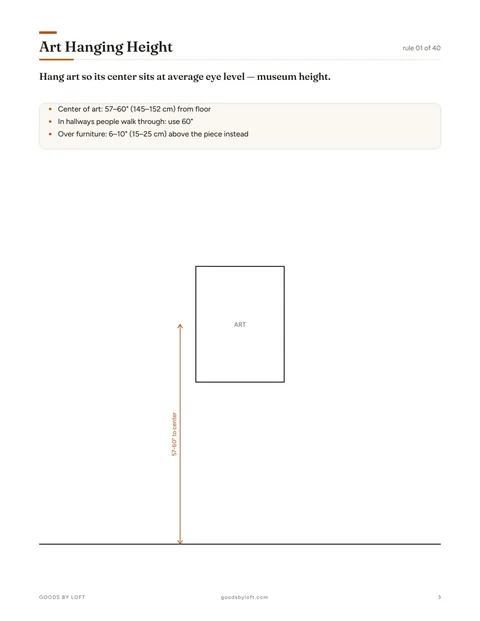
7. Hang artwork at eye level, usually 57-60 inches from floor
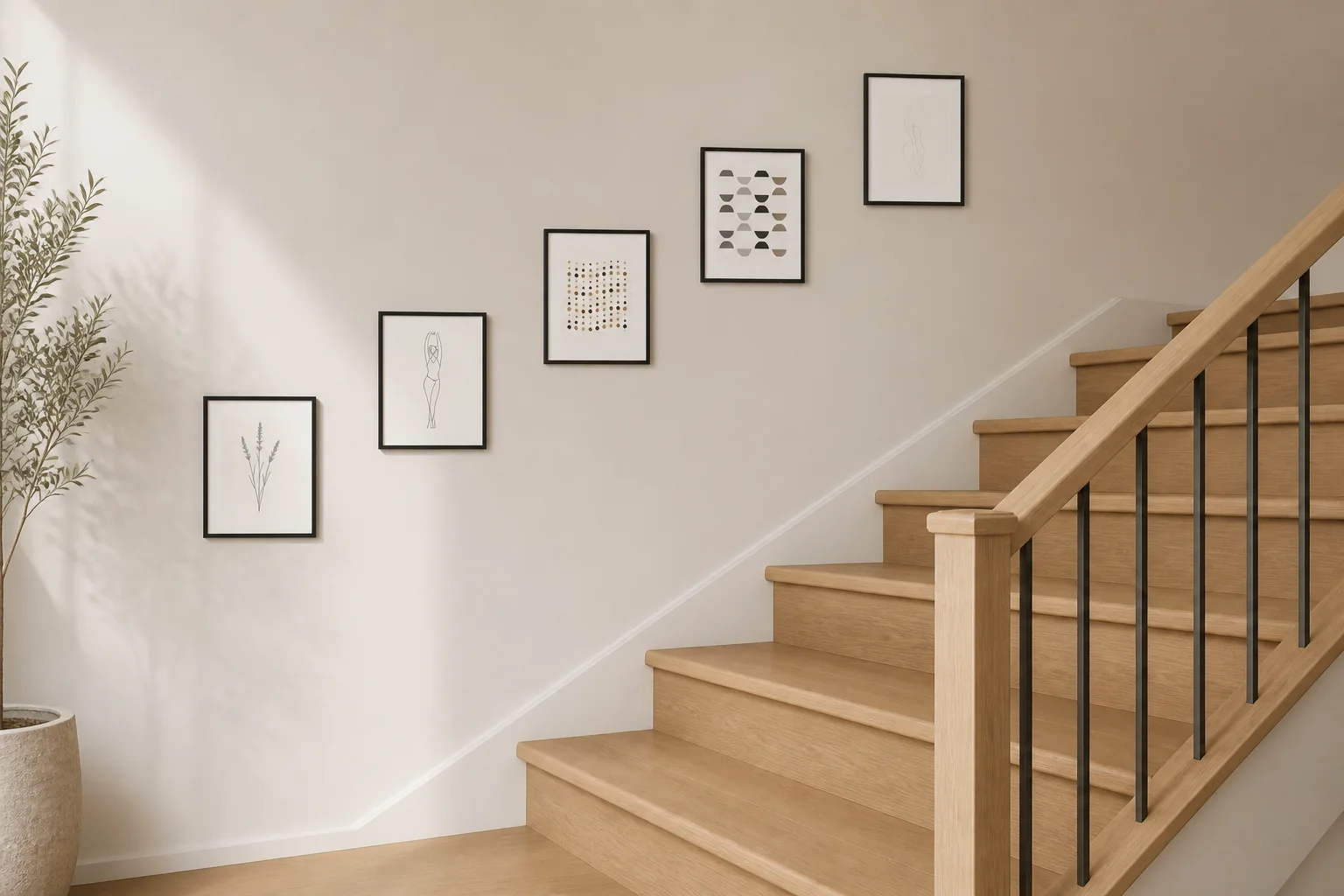
Put a tape on the wall before a hook goes anywhere near it. Anywhere from 57 to 60 inches up is where the center of the piece belongs, close to average eye level and the same band galleries work to. Above a sofa, take the measurement off the furniture instead: the bottom edge wants 8 to 10 inches of clearance above the sofa back, and while the tape is out, measure the sofa and check the piece you're eyeing comes to about two-thirds of that width. One larger piece or a pair beats a full gallery wall here, since japandi runs on breathing room rather than density. If you hang a pair, keep 2 to 3 inches between them so they read as a single unit. Frames in black ash or white oak with a slim 1 to 1.5 inch profile stay out of the way, and a 2 to 3 inch mat gives the image somewhere to sit. Ready-made gallery frames cost $40 to $120, while custom framing starts near $150 and climbs quickly with size.
8. Use linen curtains that puddle slightly on the floor
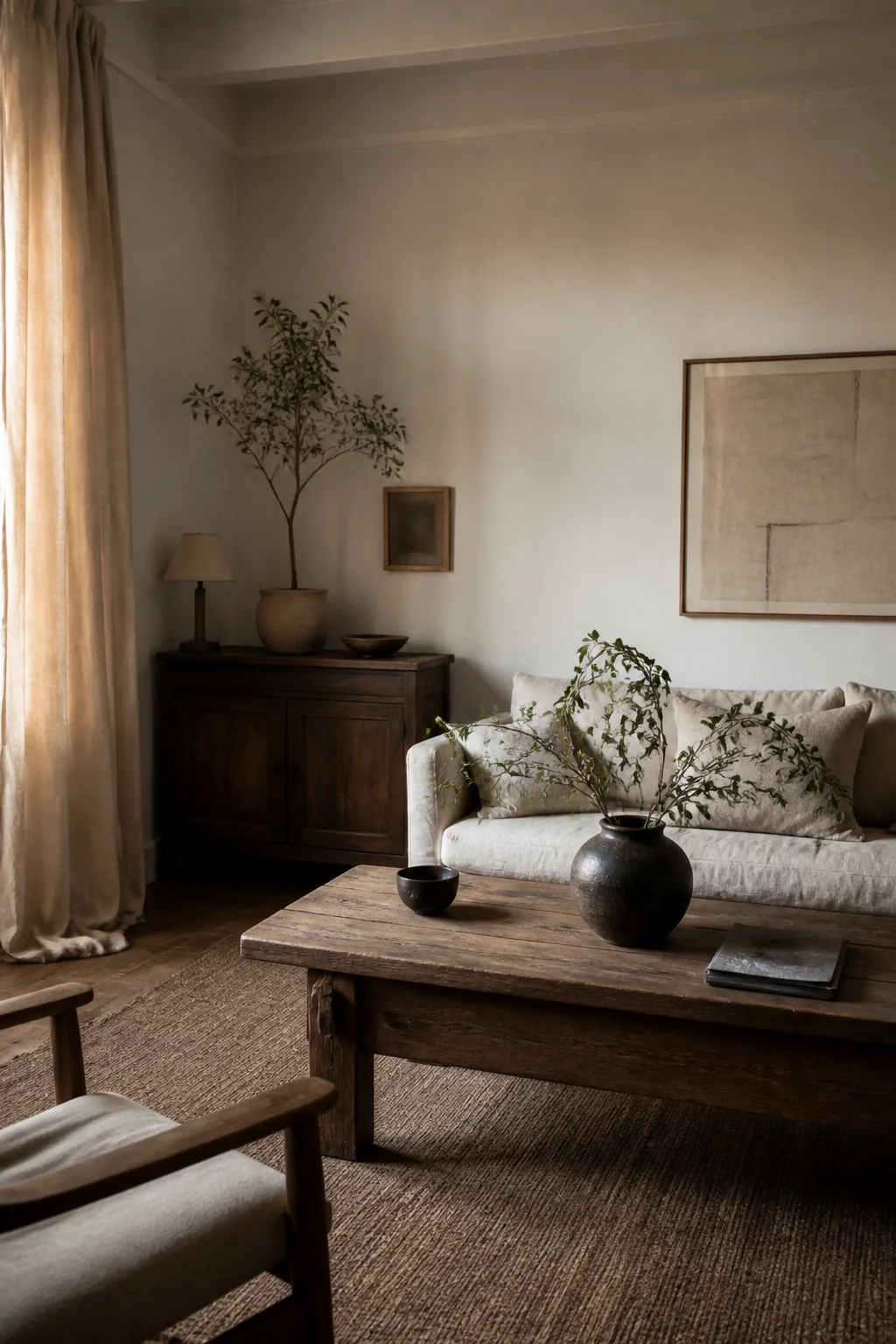
Linen in cream, taupe, or soft gray falls in a soft, slightly irregular fold that heavier fabrics can't manage. Two measurements settle this before you buy a rod. Put a tape at the top of the window frame and count 4 to 6 inches up for the bracket line, or go right under the ceiling if you want the wall to read taller. Then measure outward: 8 to 12 inches of wall past the frame on each side gives the gathered panels somewhere to sit that isn't glass, and that's what keeps full daylight coming through. Order twice your window width in total panel width for proper fullness; anything less hangs flat and looks cheap. For length, measure to the floor and add 1 to 2 inches for the break, then live with the panels for a week before hemming, because linen relaxes and drops as much as half an inch once it's carrying its own weight. Real linen costs $60 to $150 a panel. The trade-off is straightforward: washed linen creases, and it fades in a hard south-facing window over a few years.
9. Add a low wooden console table behind the sofa
When a sofa floats away from the wall, the back of it becomes dead space, and a slim console solves that. Twelve inches deep is the sweet spot: enough for a lamp, a tray, and your keys, not enough to eat the walkway. Set the height an inch or two below the sofa back so the table reads as a ledge rather than a second piece of furniture competing for attention, which usually means 28 to 30 inches tall. Length should be about two-thirds of the sofa, centered on it. Leave a 3 to 4 inch gap between the two so plugs and cords have somewhere to go, and keep at least 30 inches of clear floor behind the console for walking. Solid wood versions run $200 to $500. One caution: a table this narrow tips easily, so keep the heavy objects at the ends where the legs are.
10. Pick a neutral color palette with one muted accent
Cream, gray, natural wood: that's the base, and it belongs on the largest surfaces, meaning walls, rug, and sofa. Then choose exactly one muted accent and stay with it. Sage, soft charcoal, warm taupe, or a dusty clay all work. It shows up in small doses only, a cushion and a vase and maybe a book spine, never a whole wall. What makes this discipline succeed isn't the number of colors, it's undertone. Warm cream against a cool gray-blue accent reads muddy, and it usually looks worse under lamplight than in daylight, so check any combination at night under 2700K bulbs before you spend money on it. The same rule governs wood. Hold to two tones at most and make sure both lean warm or both lean cool. A red-toned cherry table beside a gray-washed oak floor is the most common way this palette falls apart.
11. Use ceramic or stone side tables instead of glass
Glass reads cold and faintly clinical, which works against the Scandinavian half of japandi. A ceramic garden stool at 18 inches tall and 13 inches across ($80 to $180), or a stone or concrete cube at 16 to 18 inches ($150 to $400), does the same job while adding weight and grain beside the sofa. Keep the top within 2 inches of your sofa arm height so setting a mug down doesn't take aim. The downsides are worth knowing in advance. A concrete cube weighs 40 to 60 pounds, so you'll drag rather than lift it when you vacuum: stick felt pads underneath before it ever touches the floor. Porous stone like travertine absorbs a ring from a wet glass unless it's sealed, and sealing wants redoing roughly once a year. Ceramic chips at the edges if something heavy knocks into it.
12. Hang paper lanterns or cloth pendant lights
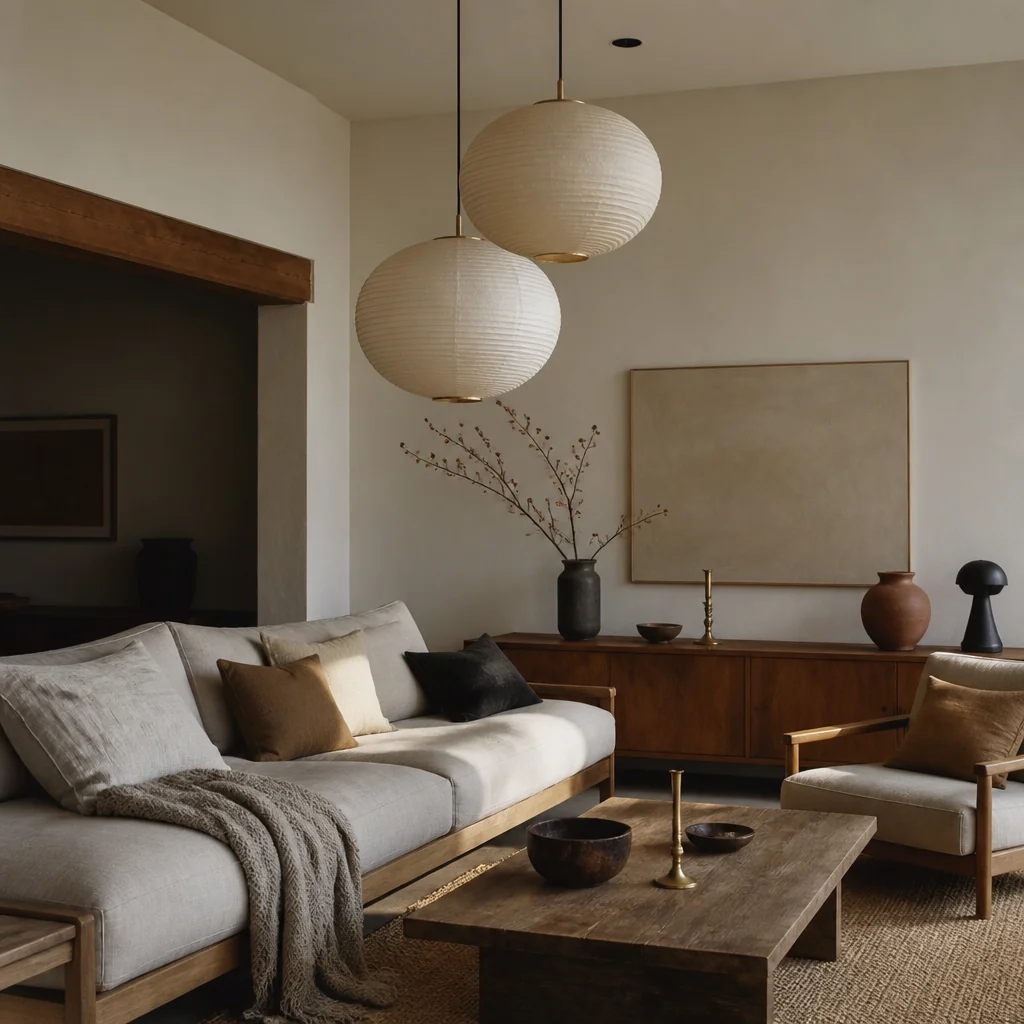
Skip brass and chrome. Rice paper, washi, or a linen drum shade diffuses light into something soft and even instead of throwing a hot spot onto the ceiling. Hang paper lanterns 24 to 30 inches above a side table, or 30 to 36 inches above a table you sit at, measuring to the bottom of the shade. Fit a dimmable 2700K bulb somewhere between 400 and 800 lumens, and keep the bulb at least 2 inches clear of the paper. LED runs cool enough for that; an old incandescent does not. Fixtures cost $80 to $250, and if there's no junction box in the ceiling, a plug-in swag cord kit runs about $25 and hangs from a single hook. The honest limitation of paper is age. It yellows over a few years and dents if you brush past it, so hang it out of the traffic path.
13. Layer throw blankets in cream and soft gray
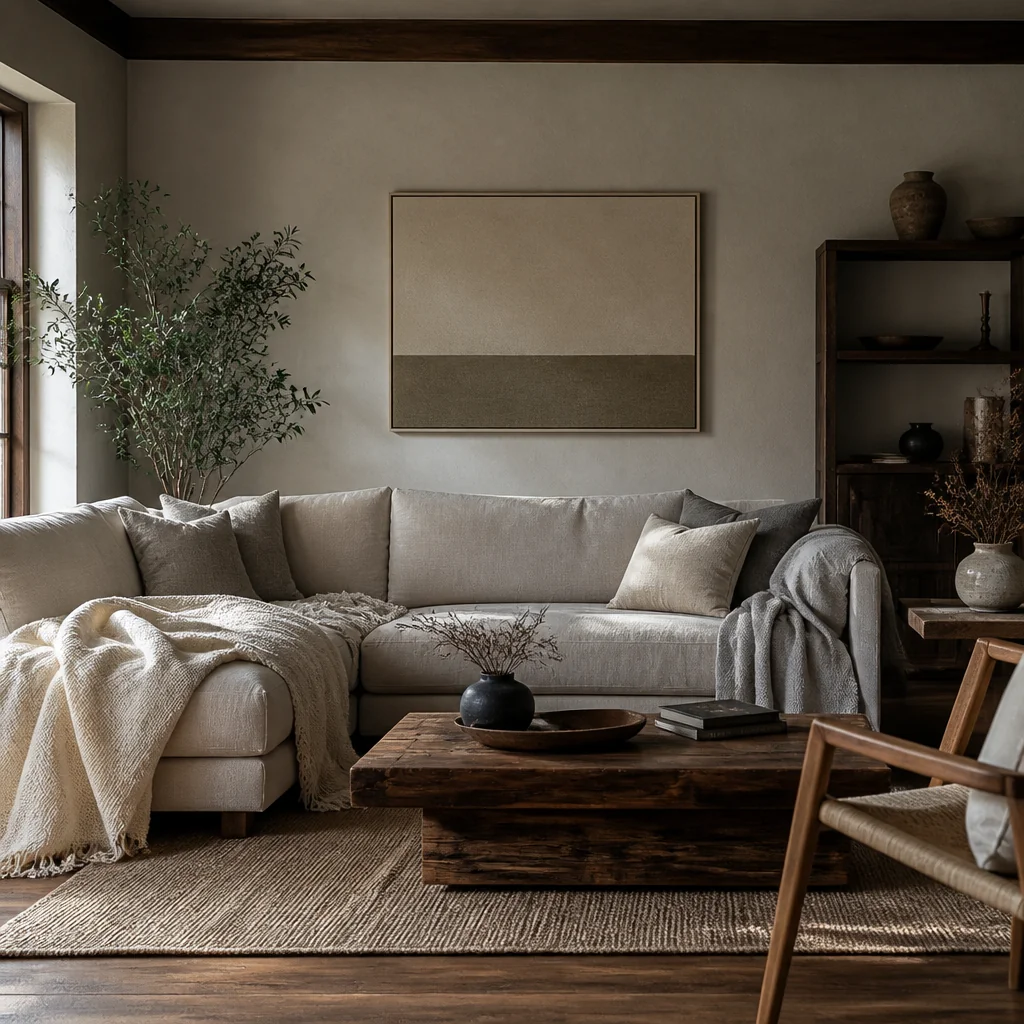
Two or three blankets, not five. A standard throw at 50 by 60 inches covers one person on a sofa, and anything much larger starts reading as bedding that wandered downstairs. Fold one in thirds over the sofa arm so a clean edge shows, then drape the second corner-first across the back, because the slight asymmetry is what keeps the arrangement from looking staged. Fiber does the seasonal work. A 3 to 4 pound wool throw carries winter, washed linen stays breathable in summer and softens with every wash, and cotton waffle sits comfortably in between. Expect $50 to $150 for one you'd reach for rather than just look at. Wool needs a cold hand wash and drying flat, so if you know that won't happen in your house, buy the linen. The failure mode here is volume: a pile of throws reads as unfolded laundry however good the colors are.
14. Display ceramics and vessels on shelves with intention
Handmade-looking pieces in cream, white, or gray, spaced 8 to 12 inches apart so your eye gets somewhere to rest between them. Group in odd numbers and vary the heights noticeably, say a 10 inch vase, a 6 inch bowl, and a small cup, so the outline of the group forms a rough triangle instead of a flat row. Matte and unglazed stoneware reads handmade because the surface scatters light rather than reflecting it, while high-gloss ceramic does the opposite and pulls attention off the wood. Small handmade vessels cost $20 to $60 at a craft market, and studio pieces start around $80. Whatever you gather, leave a third to half of each shelf genuinely empty. One maintenance note: unglazed pieces collect dust in their pores, so plan on a dry cloth every couple of weeks. Wet wiping darkens raw stoneware in patches that take days to even out.
15. Install shoji-style sliding doors or screens for visual interest
A shoji screen tucked into a corner or standing between two areas brings Japanese geometry into the room without building anything permanent. A basic three or four panel freestanding screen in kiln-dried wood runs $300 to $600, with each panel roughly 17 to 24 inches wide and 5.5 to 6 feet tall. Real sliding shoji on a track is a different project altogether: $800 to $2,000 installed, plus a header to carry the track. The appeal is that the panels filter daylight instead of blocking it, so you can separate an entry from a seating area and keep both sides bright. Traditional rice paper tears at the lightest contact, which rules it out anywhere a dog's tail or a toddler passes; laminated warlon paper looks nearly identical and survives family life. Freestanding screens also need a level floor, since an old sloping one stops them standing square.
16. Use a low wooden bench at the foot of a sofa facing the window
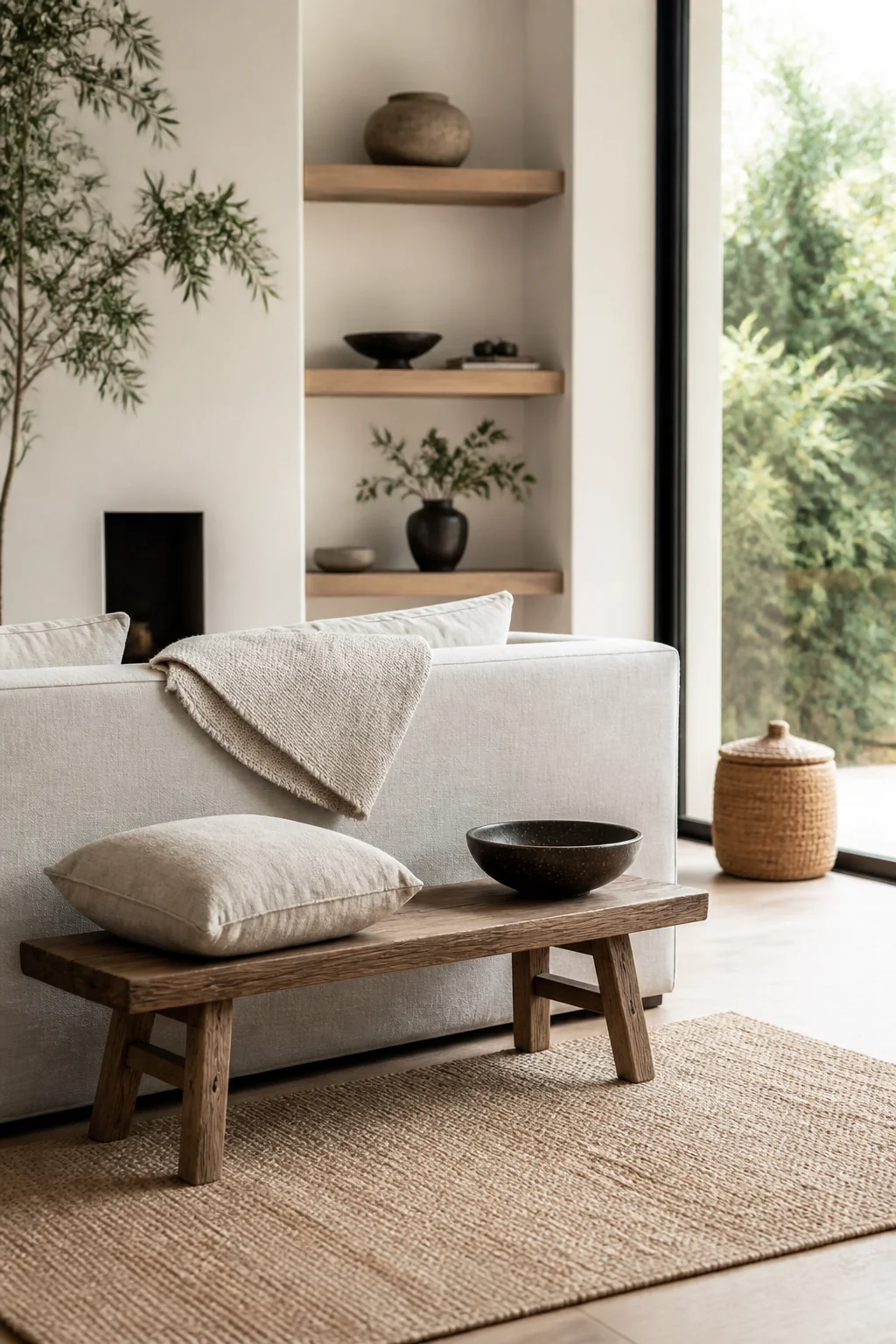
Set the bench 15 to 17 inches high, 36 to 48 inches long, and 14 to 16 inches deep, with 14 to 18 inches of clearance between it and the sofa so nobody barks a shin crossing the room. Add a floor cushion around 24 inches square and 4 to 6 inches thick and you have a reading spot facing the light, plus overflow seating when people come over. Solid ash or oak costs $150 to $400. Height is where this usually goes wrong. A bench bought at dining-chair height, 18 to 20 inches, sits above the line of the sofa seat and snaps the low horizontal band that holds a japandi room together, so measure your sofa seat first and stay at or below it. If the bench doubles as a surface, a shallow tray keeps mugs from tipping between the slats.
17. Add a small water feature or small indoor fountain
A tabletop ceramic fountain or stone basin, 10 to 14 inches tall and $60 to $150, adds a low trickle of sound that softens traffic noise and gives the room something to do besides look composed. The recirculating pump draws almost nothing, but it's thirsty in another sense: evaporation means topping the water up every two or three days, and a full change once a week keeps biofilm out of the basin. Hard tap water leaves white mineral scale on stone within weeks, so use distilled water if your area runs chalky. Two cautions before you buy. A splashy fountain in a small quiet room stops being calming after about an hour, though lowering the flow or setting a flat stone under the fall usually turns the splash into a murmur. And keep it well away from outlets, speakers, and anything with a paper shade.
18. Paint wood trim a warm cream or natural tone
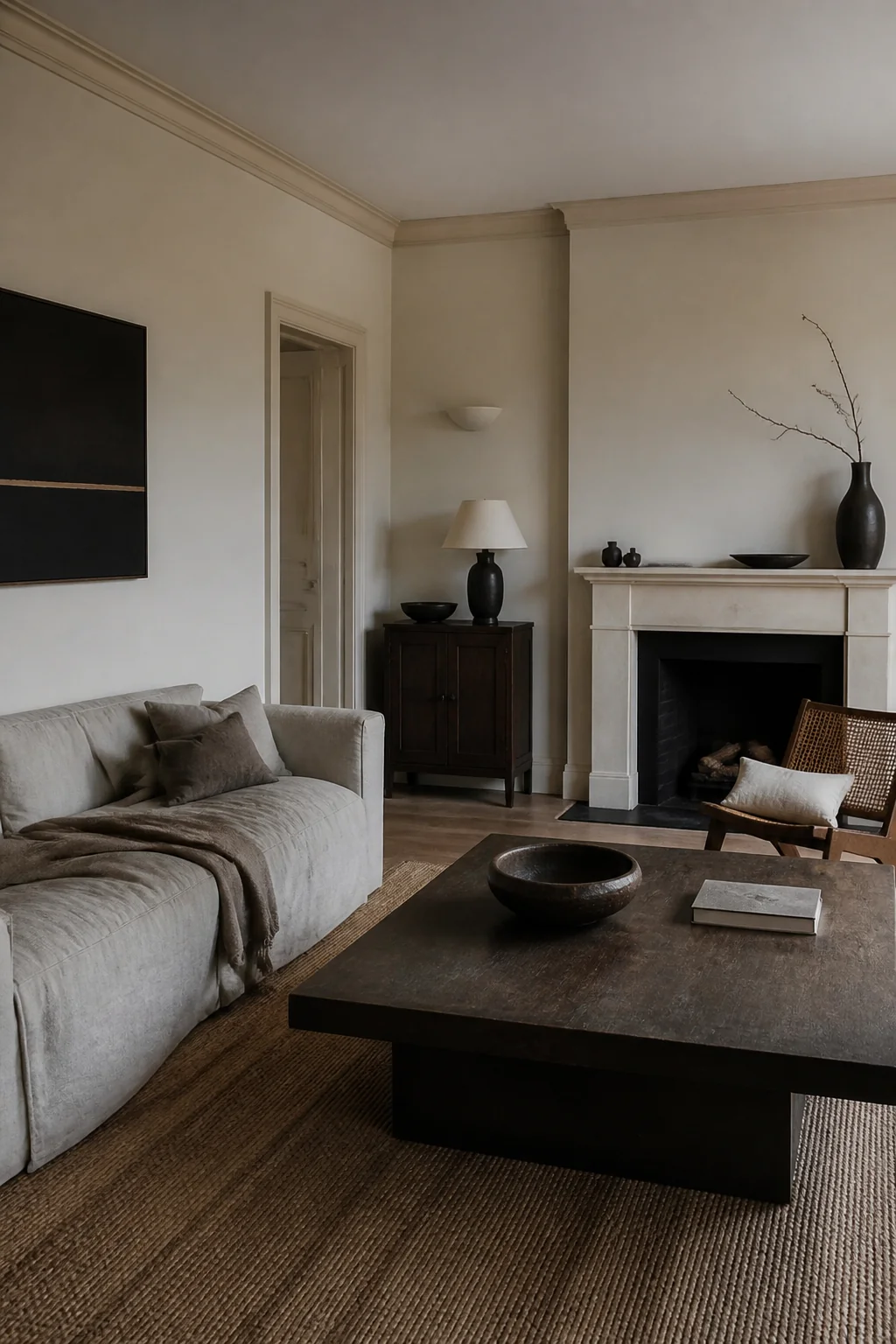
If your room has baseboards and crown molding, painting them the same warm white as the walls stops the trim carving the space into boxes. Change the sheen rather than the color: matte or eggshell on walls, satin or semi-gloss on trim, so the profile still catches light and reads as detail. Prep is most of the work here. Sand to 220 grit or wipe down with a liquid deglosser, caulk the gaps where trim meets wall, and prime any bare or previously stained wood with a stain-blocking primer, because oak and pine tannins bleed yellow through latex within days. Then two topcoats. Think this one through before you open the can, though. Painting genuinely good solid wood trim is close to a one-way decision, and stripping it back later costs far more than the paint ever saved. Oiled wood trim in a natural tone is just as japandi as painted.
19. Hang a low-light pendant over a side table for reading
Drop a fabric-wrapped pendant to 30 to 36 inches above the table beside a reading chair and one fixture gives you task light and mood together. Aim for 450 to 600 lumens at 2700K on a dimmer, bright enough for small print and warm enough that the corner doesn't feel like an office. Offset it slightly to one side rather than dead center over your head, so the shade never sits in your sightline once you're seated. A plug-in cord set with a ceiling hook costs $30 to $60 and needs no wiring at all, while hardwiring a new ceiling box runs $150 to $300 with an electrician. The thing to avoid is a bare bulb on a cord at seated eye level. It photographs beautifully and glares straight into your eyes the moment you sit down with a book.
20. Choose furniture with visible wood joinery or natural edges
Look for pieces where the construction is visible: wedged through-tenons, exposed dovetails at a drawer corner, finger joints along a box. Those details read handmade because they are, and they're stronger than a hidden dowel or a staple, which is a fair part of why the style survived as long as it has. Live-edge tops belong to the same family. A slab 1.5 to 2 inches thick has enough mass to look deliberate; thinner than that and it starts reading like veneer over ply. A 6 foot walnut live-edge table runs $800 to $2,500, with white oak generally cheaper. Solid slabs move with the seasons, so check for breadboard ends or figure-8 fasteners that let the wood expand instead of splitting, and know that a slab sealed on top but left raw underneath will cup within a year. Small gaps opening at the joints each winter are normal, not a defect.
21. Use a small wooden step stool as functional decor
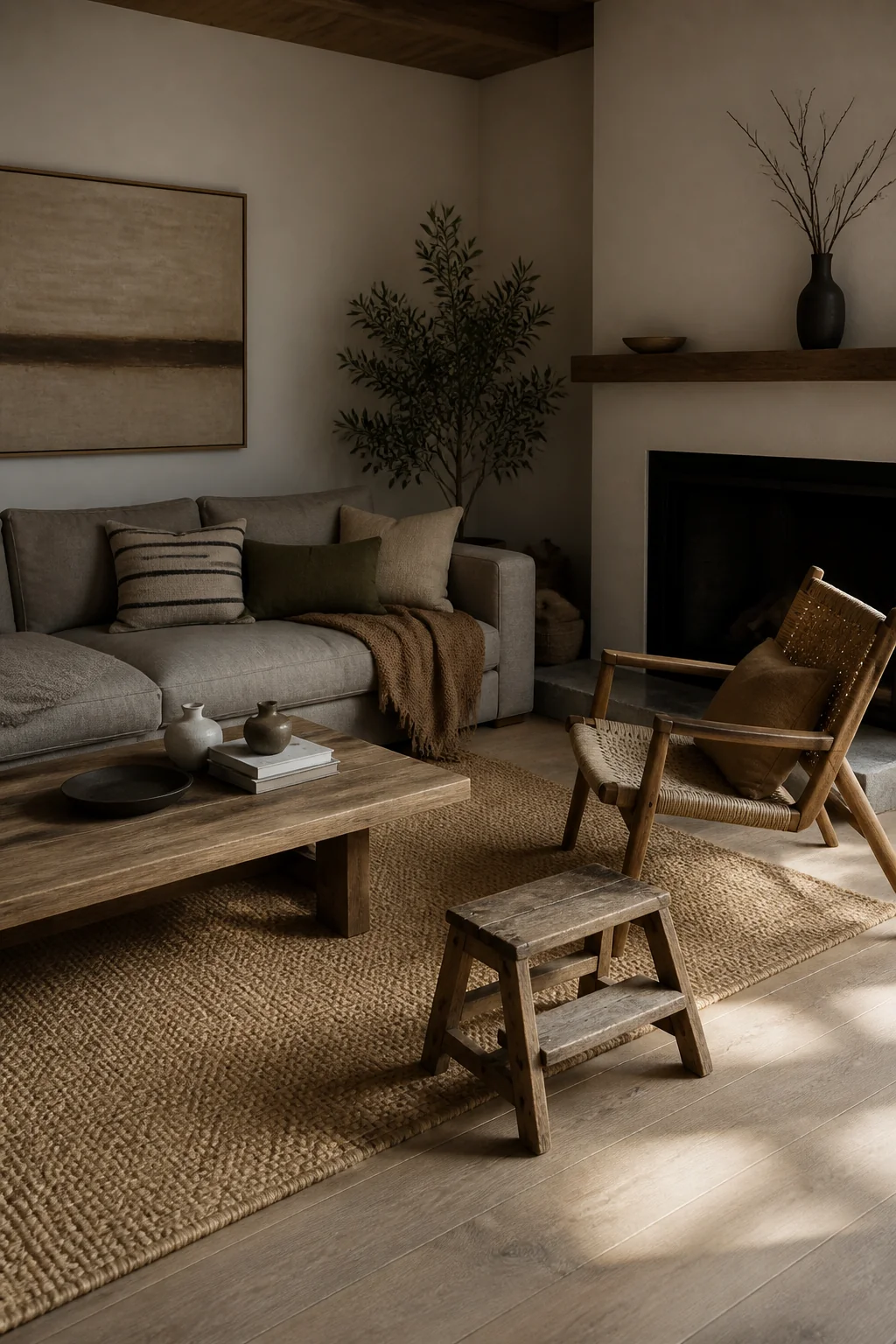
A traditional two or three step stool in solid beech or oak is one of the few objects that earns its floor space twice over. It stands about 18 inches tall, 16 inches wide, and 12 inches deep, so under a foot and a half of floor, and costs $40 to $120. Beside a reading chair it works as a side table for a mug and a book. In a corner it lifts a trailing plant off the ground and gives a low arrangement some height. And it still does the job it was built for when something's on the top shelf. Check two things before buying: a weight rating around 250 to 300 pounds, and how the thing is joined, because a stool screwed together through particleboard will wobble inside a year. Left unfinished or lightly oiled, beech ages to a warm honey tone that suits the rest of the palette.
22. Layer lighting: ambient, task, and accent
Three sources, each doing one job. Ambient comes from a dimmable overhead or a pair of floor uplights washing the ceiling. Task is a table lamp positioned so the bottom of the shade sits about 40 to 42 inches off the floor, which puts the bulb below your seated eye level and keeps the glare off your book. Accent is a wall sconce or a small shelf lamp, there to give the room depth after dark rather than to light anything in particular. Budget $150 to $400 for three decent fixtures, and put every one of them on a dimmer or a smart bulb, because being able to drop the whole room to a low glow at night is most of the effect. One rule holds the scheme together: use the same color temperature everywhere, 2700K. Mixing 2700K lamps with 4000K bulbs makes even a well-decorated room look grubby.
23. Arrange furniture to define zones with distance
Distance is a design tool here, not wasted floor. Put the sofa facing a low console and set a reading chair 6 to 8 feet away, angled 30 to 45 degrees toward the sofa so conversation still works without anyone craning their neck. Keep seats within about 9 feet of each other, since past that people start raising their voices and the grouping quietly stops functioning. Leave 30 to 36 inches for walkways between zones, and float the furniture 8 to 12 inches off the wall instead of pushing it flat against the plaster, because that small gap is what makes a room read as arranged rather than lined up. There's a size limit worth respecting, though. In a room under roughly 12 by 12 feet, gaps just look like leftover space, so define your zones with the edge of the rug and a change in lighting instead.
24. Add a low wooden side table with a single drawer
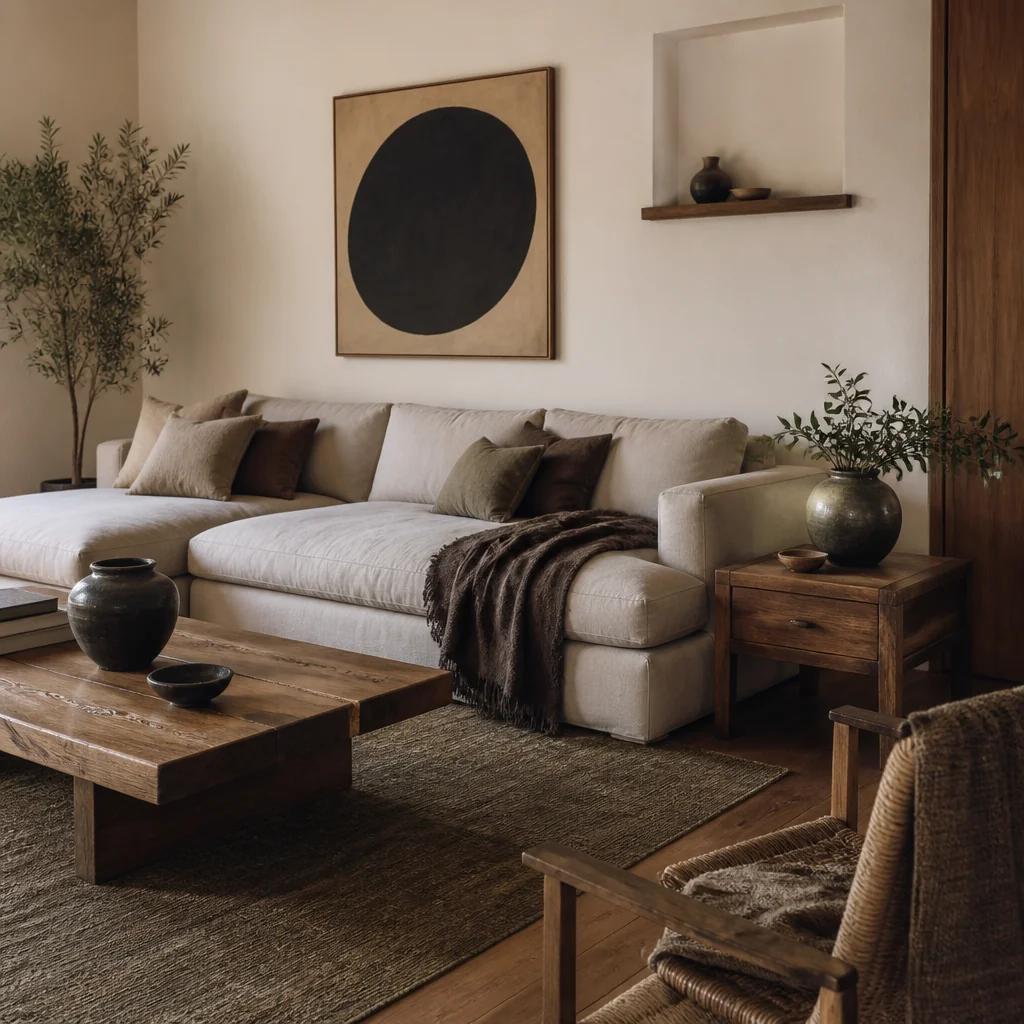
One drawer changes how a surface behaves. Remotes, coasters, and charging cables go inside, and the top stays clear for a lamp and a single object, which is the entire reason the piece looks calm. Aim for 20 to 24 inches tall, within a couple of inches of your sofa arm, and 16 to 20 inches square. A drawer 3 to 4 inches deep holds the small stuff without becoming a junk archive. If the wood grain is doing the decorating, choose it properly: quartersawn white oak shows ray fleck across the top, and straight-grained ash gives you clean parallel lines. Both cost more than rotary-cut veneer, and both look it. Expect $150 to $400. Check the runners before you buy, since traditional wood-on-wood runners swell and stick in humid weather, though a rub of paraffin along the track fixes that in about a minute.
25. Hang woven wall hangings in natural fibers
Scale is what makes this work: a single macrame or woven piece around 48 x 48 inches, in cream or tan cotton, jute, or wool, will hold a wall 8 to 10 feet wide by itself. Hang it so the bottom edge clears a sofa back by 8 to 12 inches. Most large hangings come mounted on a wooden dowel and weigh 3 to 8 pounds, light enough for two picture hooks in drywall, though catching at least one stud keeps the piece level over the years. Handmade versions cost $80 to $300, and the cotton rope for a DIY attempt runs around $40 if you're willing to learn the knots. Two things worth knowing: natural fibers fade noticeably in direct sun, so keep the piece off a south-facing wall, and dust settles deep in the weave, which a vacuum brush attachment clears once a month. Hang several and the wall reads scattered rather than considered.
26. Use natural wood frames for mirrors instead of ornate metal
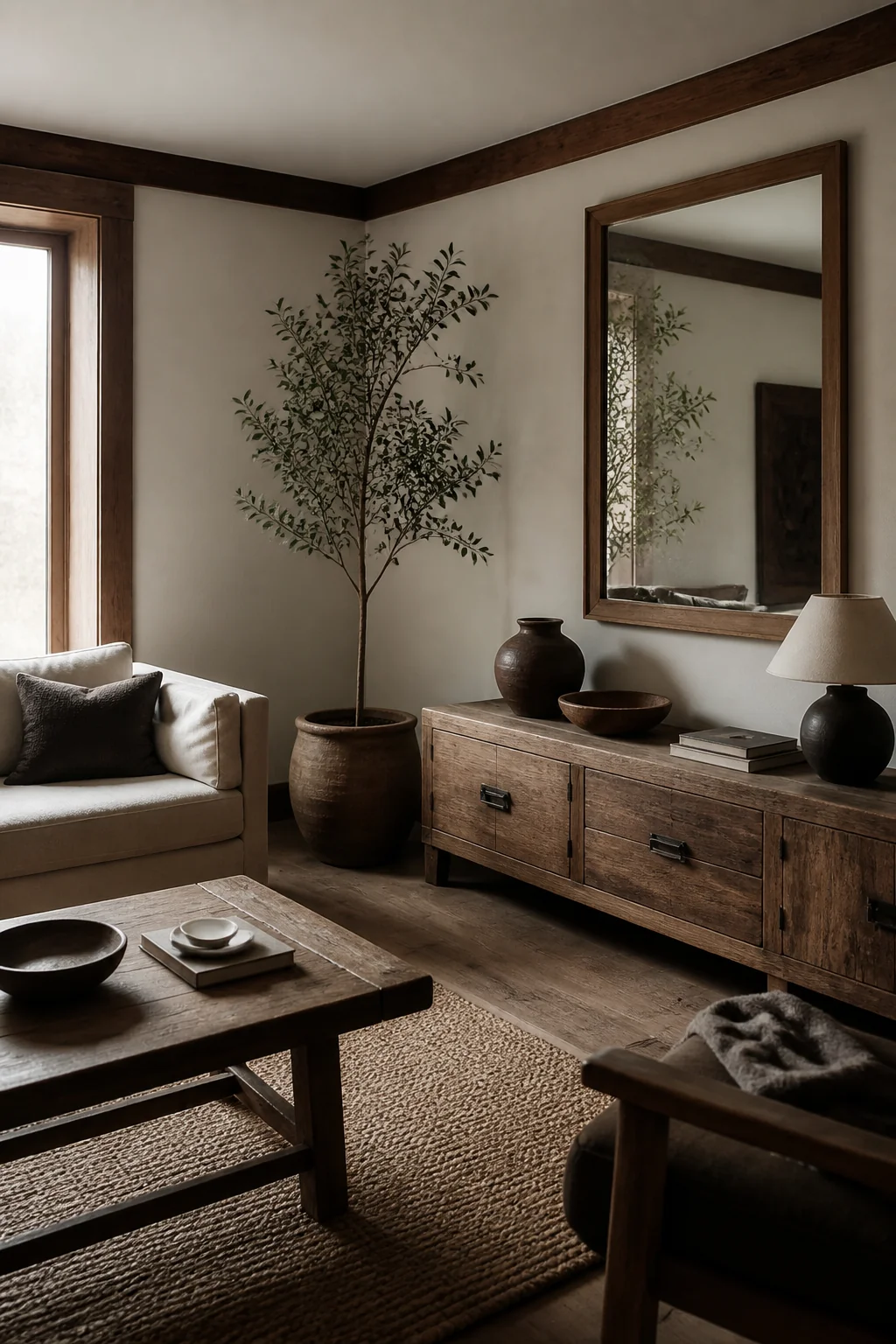
A plain square or rectangular mirror in an oak or ash frame, 30 to 36 inches wide, bounces daylight deeper into the room without adding pattern to the wall. Placement decides whether it works. Hung perpendicular to a window it spreads light across the room, while hung directly opposite it often just throws a bright glare spot back at you. Center it at 57 to 60 inches like artwork, or leave 6 to 8 inches above a console top if it sits over furniture. Weight is the part people underestimate: a 36 inch framed mirror runs 25 to 40 pounds, so hang it on two D-rings screwed into studs, or heavy-duty toggle bolts where the studs fall wrong. Wood-framed mirrors this size cost $150 to $400. Before you drill, stand where you'll be sitting and check what the mirror will show, because one reflecting a cluttered doorway doubles the clutter.
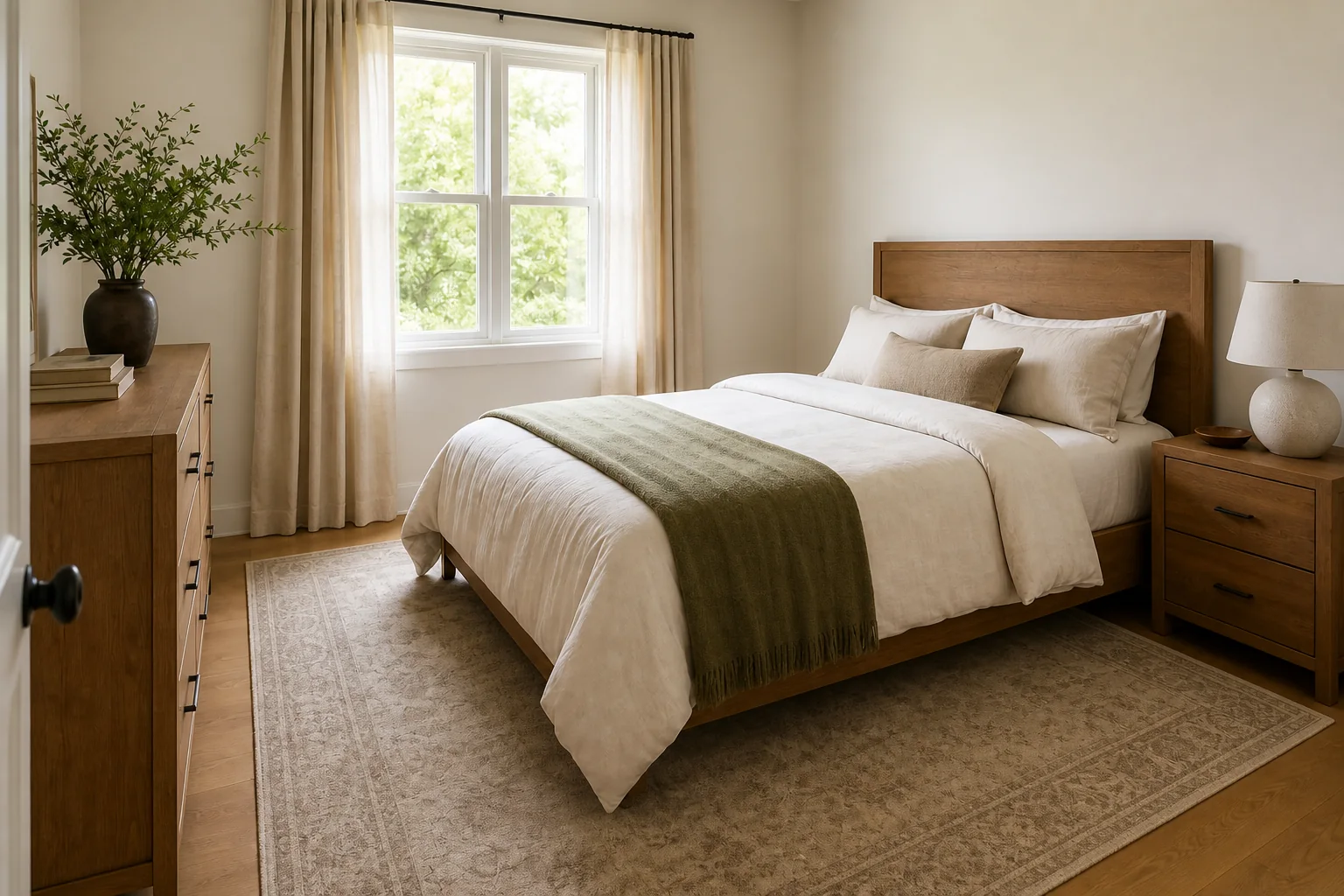
27. Place a low wooden trunk as coffee table and storage
Look for solid wood, about 24 x 40 inches and 16 to 18 inches tall, with the storage hidden inside. Blankets, board games, and the cables you can't bring yourself to throw away all disappear, which matters enormously in a style that depends on empty surfaces. Expect $250 to $700 for solid wood rather than veneered ply. Check for a lid stay or a soft-close hinge, because an unsupported lid that size slams hard enough to hurt a hand. A cedar-lined interior is worth seeking out if you're storing wool, since the oil in the wood deters moths. The catch shows up once you live with it: you have to clear the top every time you want what's inside. Keep the surface to a tray and one object and it stays genuinely useful. Pile it with books and magazines and the storage may as well not be there.
28. Choose neutral linen upholstery in grays and creams
Avoid patterns entirely and let the weave itself be the visual interest. Pure linen creases beautifully and wrinkles constantly; a linen-cotton or performance linen blend keeps the texture while surviving daily use and resisting the stains that sink straight into an untreated natural fiber. Check the durability rating on the spec sheet, where anything above roughly 15,000 double rubs is built for a sofa people sit on every evening. Color is a maintenance decision as much as an aesthetic one. Cream photographs beautifully and shows every mark, while oatmeal and mid-gray hide months of ordinary life. A 3-seater linen sofa runs $1200-1800 for solid quality, and a washable slipcovered version at the same price deserves serious thought if you have kids. Cats are the one real dealbreaker: an open linen weave snags into pulls that can't be repaired.
29. Add a single accent pillow in a natural weave
One pillow carries the texture. A 12 by 20 inch lumbar or a 20 inch square in jute, hemp, linen, or a chunky wool weave adds dimension against smooth upholstery, and on its own it does more work than four competing patterns would. Check the cover's measurement and add two inches to it before you order the filling, so a 20 inch cover takes a 22 inch insert. That overstuffing is what pushes the corners out instead of leaving them to sag. Feather or down inserts cost $20 to $30 and hold whatever shape you give them, while polyester goes flat within months and never recovers. Covers run $30 to $80. Flank the textured pillow with two plain neutral ones a shade or two off your base color so it has something quiet to sit against. Worth knowing before you order: a coarse jute or hemp weave is genuinely scratchy on bare skin, so it belongs behind your back rather than under your head.
30. Install wooden slat wall paneling on one accent wall
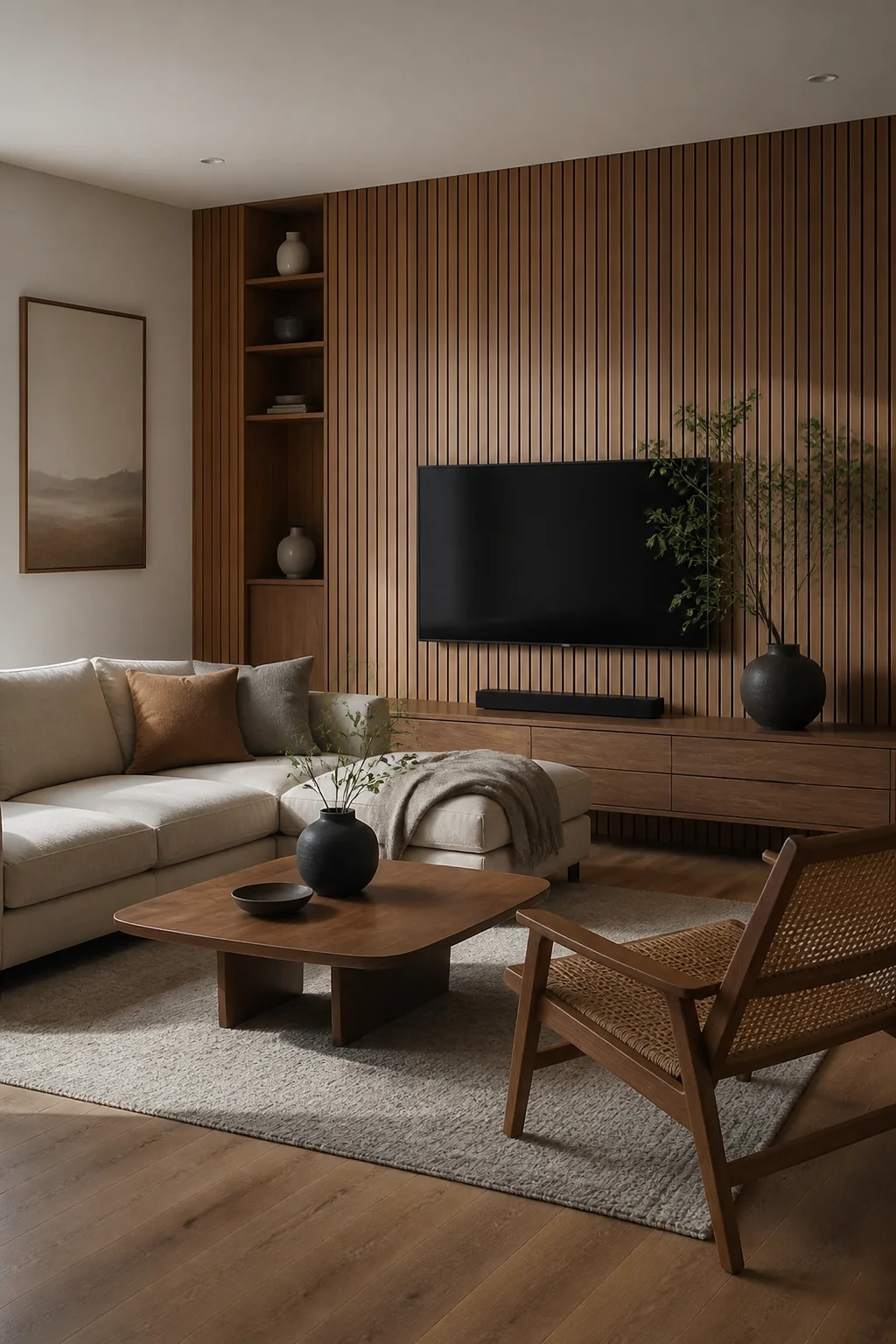
Thin horizontal slats in natural or light-stained wood create a focal point out of shadow instead of color. The usual proportion is slats around 5/8 by 2 inches, spaced 1 to 1.5 inches apart on a felt or dark-painted backer so the gaps read as clean lines. Ready-made panels roughly 94 by 12 inches cost $60 to $100 each, which puts a 10 foot wall somewhere near $600 to $1,000 once you add adhesive and edge trim. Solid oak slats cost considerably more than an MDF core with oak veneer, and only the solid version can be sanded back later. Installation is construction adhesive plus a few brad nails into studs, or a French cleat if you want it removable. Orientation matters: horizontal slats stretch a wall wider, vertical ones pull the ceiling up. The maintenance nobody mentions is dust, which settles into every groove and wants a brush attachment.
31. Keep the floor visible and relatively clear
Visible floor is what makes everything above it work. Leave 12 to 18 inches of bare floor showing around the edge of a rug rather than running it wall to wall, and resist adding a third layer on top of the two you already have. Baskets, stacked books, and boxes parked along the baseboard eat the same open ground, so storage in a japandi room goes up onto shelves or inside something with a lid. Furniture on visible legs helps as well, since the eye follows the floor underneath and reads the room as larger than it measures. One limit worth naming: bare floor is also hard floor, and a room with almost nothing soft in it echoes and feels cold underfoot in January. Emptiness isn't the goal in itself. It's leaving enough uninterrupted surface that everything you did keep has room to be seen.
Pin this for later
If there's a hierarchy in all of this, it's height and light. Furniture that sits low, lit at one warm color temperature throughout, will read japandi even when the accessories are wrong, while the most beautiful ceramics in the world can't rescue a tall sofa under a cold ceiling fixture. The other thing worth holding onto is that restraint has a floor as well as a ceiling. A room stripped back until nothing in it touches you isn't calm, it's unfinished, and the Scandinavian half of this style exists precisely to keep the Japanese half from going cold.
Ideas fade by Friday. A plan finishes the room.
You just read a full guide to your living room. Saving ideas will not change it; a plan will. The Home Decor Collection is every planning tool we make, for every room in the house, in one download, so the after photos below stop being other people's rooms.
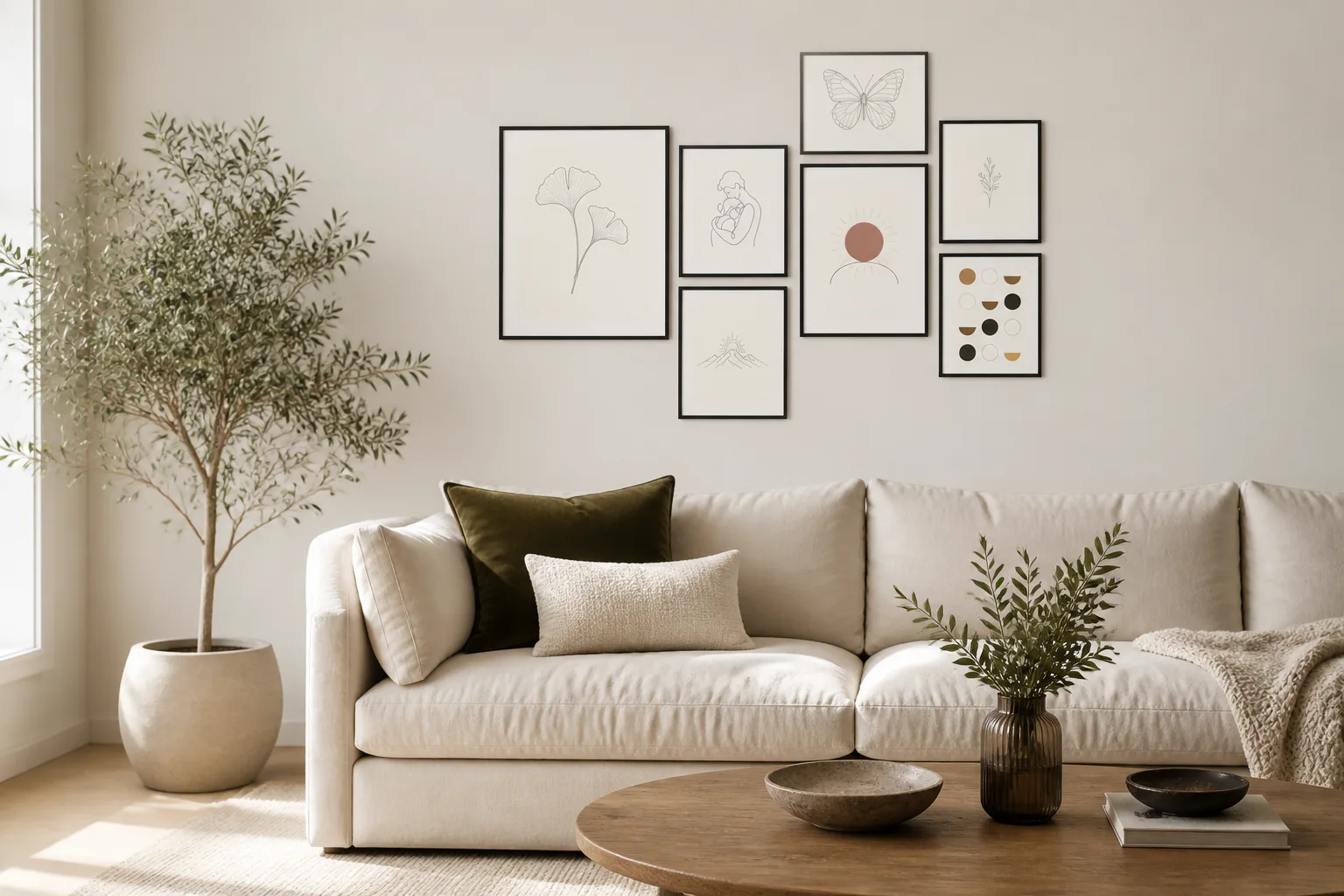
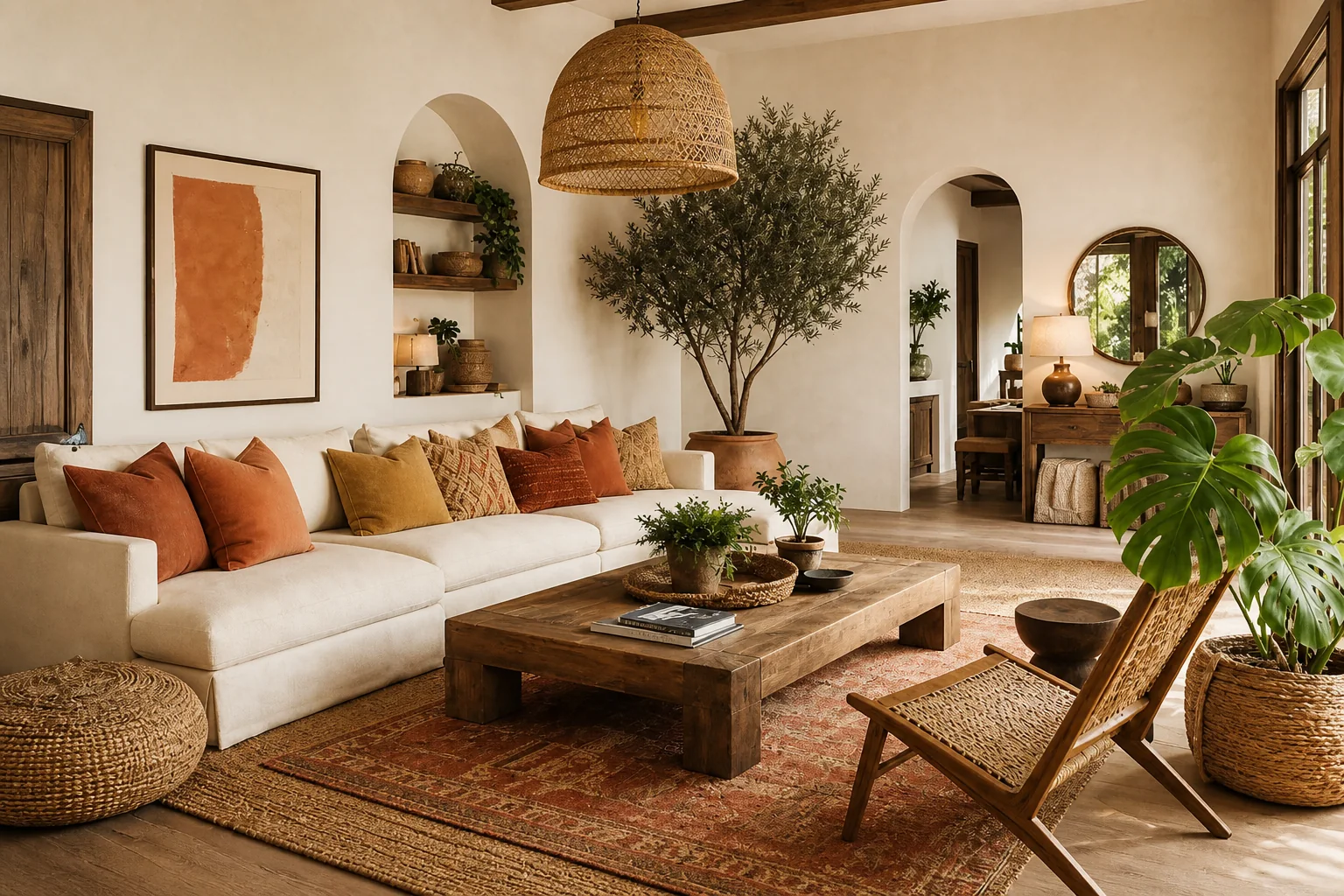
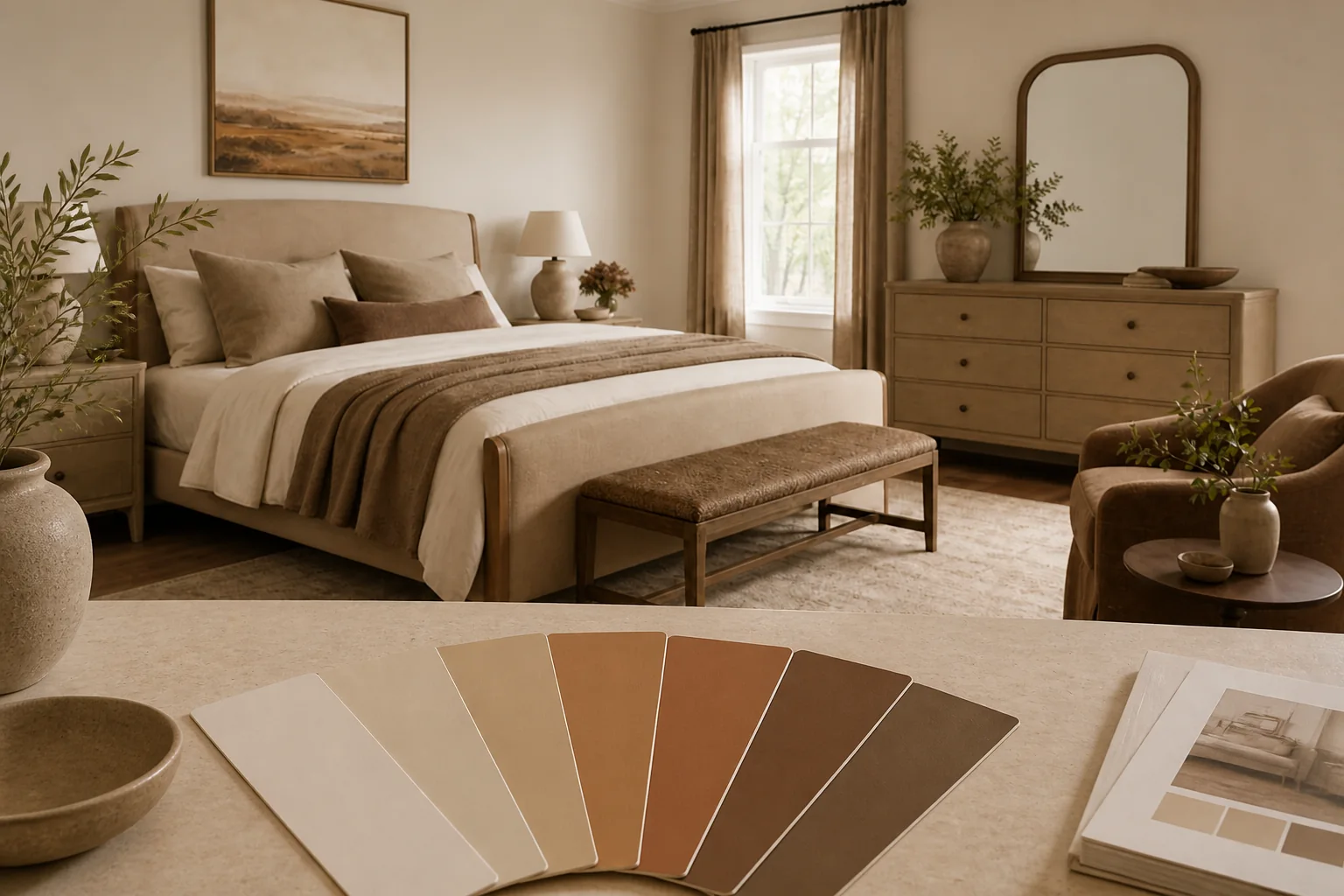
- Six room Style Kits, each with layout, palette and shopping list$114
- The Gallery Wall Studio: 200 prints + 15 measured layouts$29
- The Room Makeover System: 40 solved room layouts + workbook$29
- The Color Palette Handbook: 60 palettes shown in real rooms$19
- The Whole-Home Reset: 40 printable organizing checklists$19
- The Decorator's Cheat Sheets: the 40 measurements that matter$9
- All eleven products, bought separately
$219$97
A single hour with an interior designer costs more than the entire Collection, and this one keeps answering for every room you will ever decorate. Free updates included as the products grow. And if it is not for you, the 14 day money back promise means you simply get a refund.