23 Boho Bedroom Decor Ideas You Can Build for Around $300
Discover 23 boho bedroom decor ideas that won't drain your wallet. Create a cozy, laid-back space with affordable macrame, plants, and vintage finds.
This post contains affiliate links. As an Amazon Associate I earn from qualifying purchases. If you buy through our links, we may earn a commission at no extra cost to you.
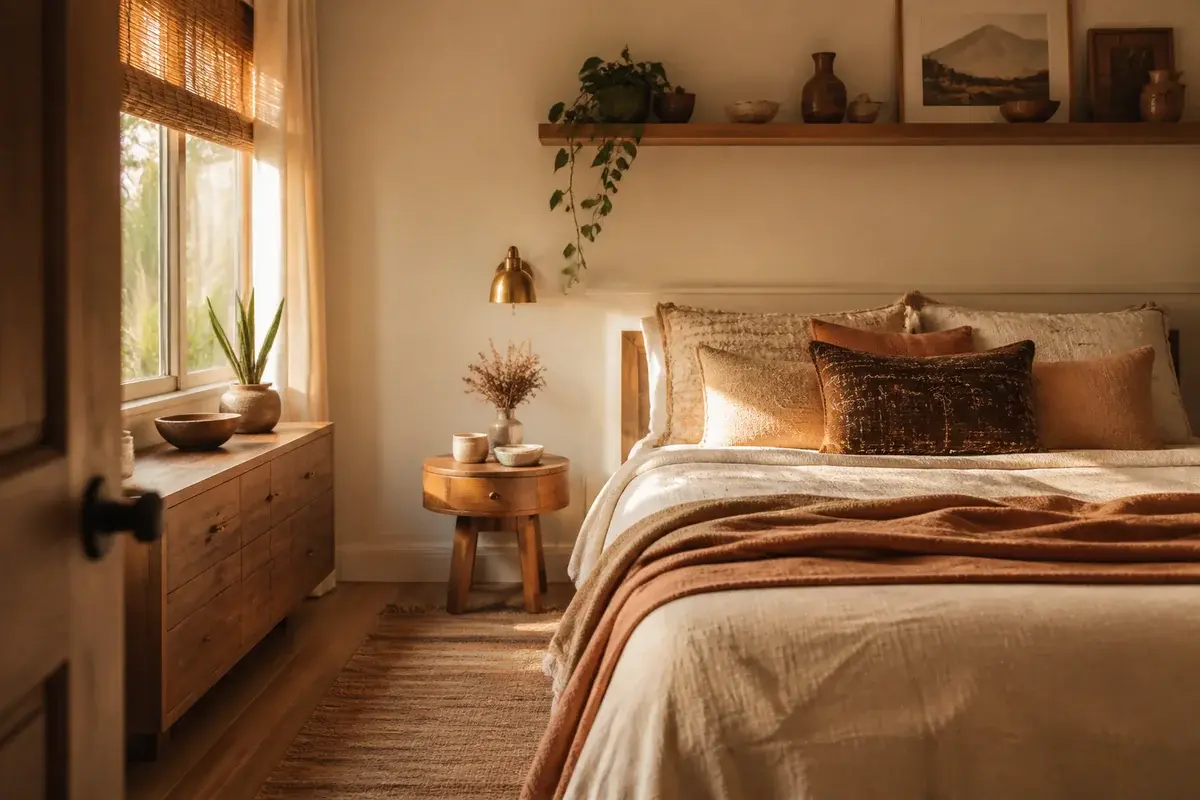
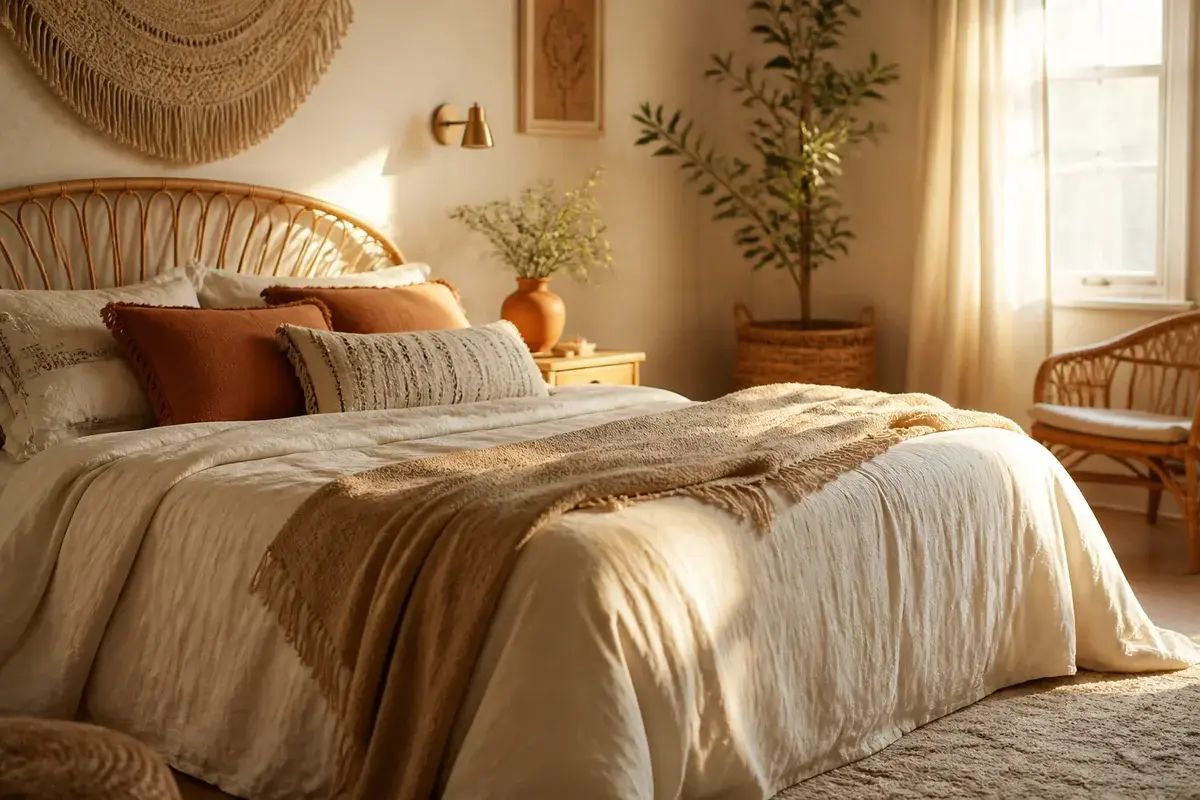
Bohemian style has a reputation for being expensive, and the photos don't help: hand-knotted rugs, artisan ceramics, textiles nobody can source. Look closely at what's doing the work in those rooms, though, and it's mostly texture, warm light and plants, which is what makes any cozy bedroom work, boho or not. All three are cheap. A whole bedroom done properly tends to land near $300 if you thrift the furniture and buy new only where it counts, like bedding and bulbs. Below are 23 ideas with real sizes and real prices attached, in an order that makes sense if you're starting from an empty room. Nothing here needs a landlord's blessing except the paint at the end. Two narrower versions exist: boho wall decor without paint or wallpaper and the boho look in a small bedroom.
1. Layer a 5x7 jute rug under your bed frame
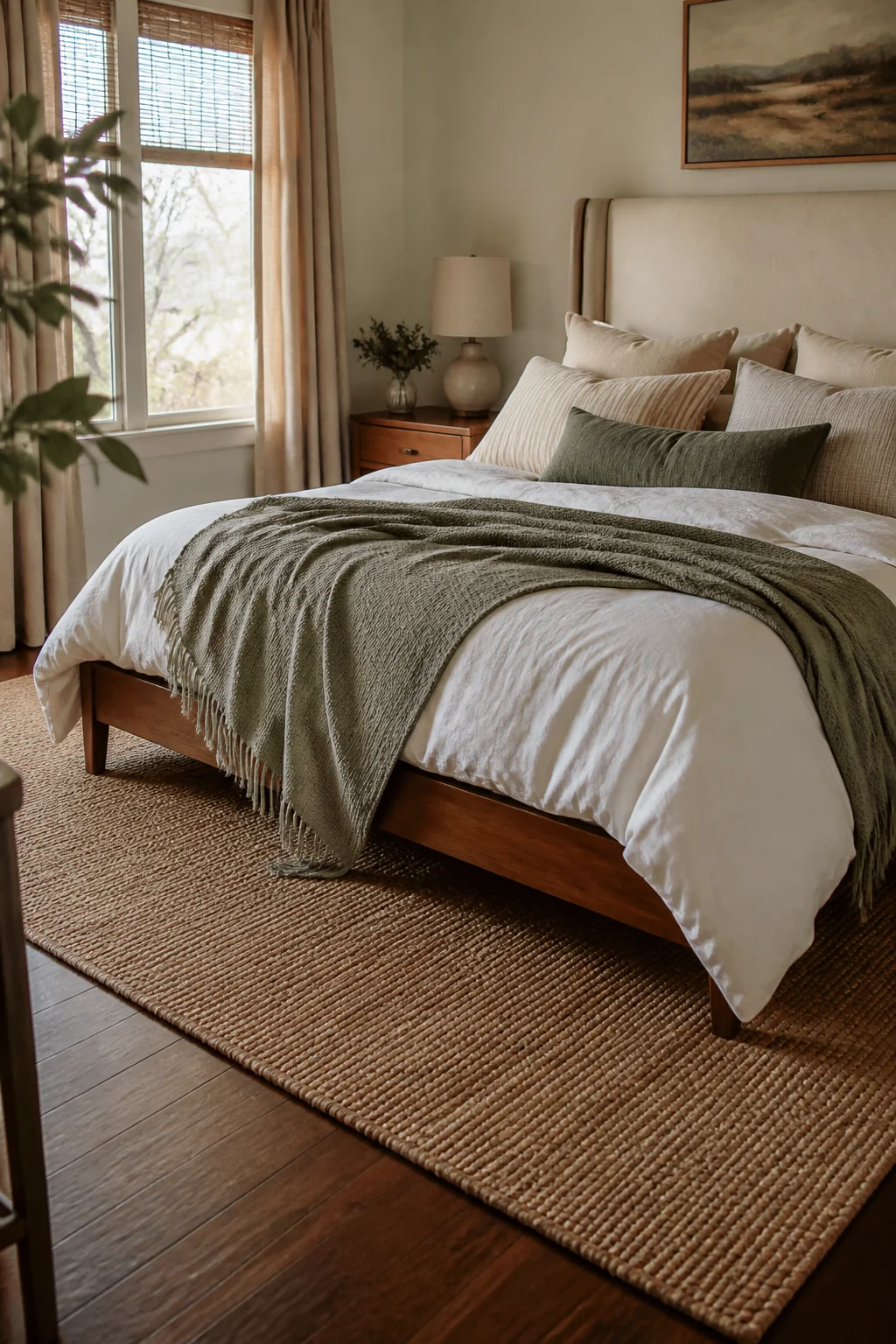
A jute rug gives the floor some grain and takes the chill off laminate or tile. Size it to the bed, not the room. A 5x7 measures 60 by 84 inches, which is almost exactly a queen mattress footprint, so slide it under the bottom two thirds of the frame and you get a soft landing on both sides plus a strip at the foot. If you want rug showing on all three sides, you need an 8x10 instead, and the price roughly doubles. Plain jute in a 5x7 runs $30-50, a jute and wool blend closer to $90. Two things to know before you commit. Jute sheds fiber for the first month or so, so vacuum on low suction with the beater bar switched off. And it holds damp, which means a basement room or a bedroom running a humidifier all winter will eventually smell musty. Add a $20 rug pad to stop it creeping across the floor.
2. Hang string lights in loose loops above the headboard
Warm white is the whole trick here. Look for 2700K on the box, because a 5000K strand turns linen a flat gray and gives you the dreamy vibe without looking childish in reverse. A 33-foot copper wire strand with 100 LEDs costs $10-15 and weighs almost nothing. Heavier G40 Edison-style strands look better up close and run $25-35 for 24 feet, but they need real anchors. Hang them in swags rather than a straight line: mark three points 12 to 16 inches above the headboard, space them evenly across the bed width, and let each dip sag 6 to 8 inches. Adhesive hooks rated for one pound hold the light strands; the Edison strands want small cup hooks driven into studs. Check the box for the maximum number of strands you can chain end to end, usually three, and if there's no outlet behind the bed, buy a USB or battery strand with a built-in timer.
3. Fill corners with tall potted plants
Height is what sells this, not the pot. A bird of paradise at 4 to 5 feet runs $40-60 at a garden center, a snake plant at 2 to 3 feet is $20-35, and both look better if you leave them in the plastic nursery pot and drop that inside a woven basket planter for $20-30. You water at the sink, let it drain, carry it back, and nothing seeps onto the floor. Light decides which corner works. A bird of paradise wants to sit within 3 or 4 feet of a window. Push a big leafy plant into a corner 6 to 8 feet from any daylight and you'll be sweeping up dropped leaves inside two months, at which point you've spent $60 on a slow decline. That dim corner wants a snake plant or a ZZ plant, both of which cope with low light. Vary the heights while you're at it: one plant on the floor, one raised on a stool at about 18 inches.
4. Swap your nightstands for vintage wood side tables
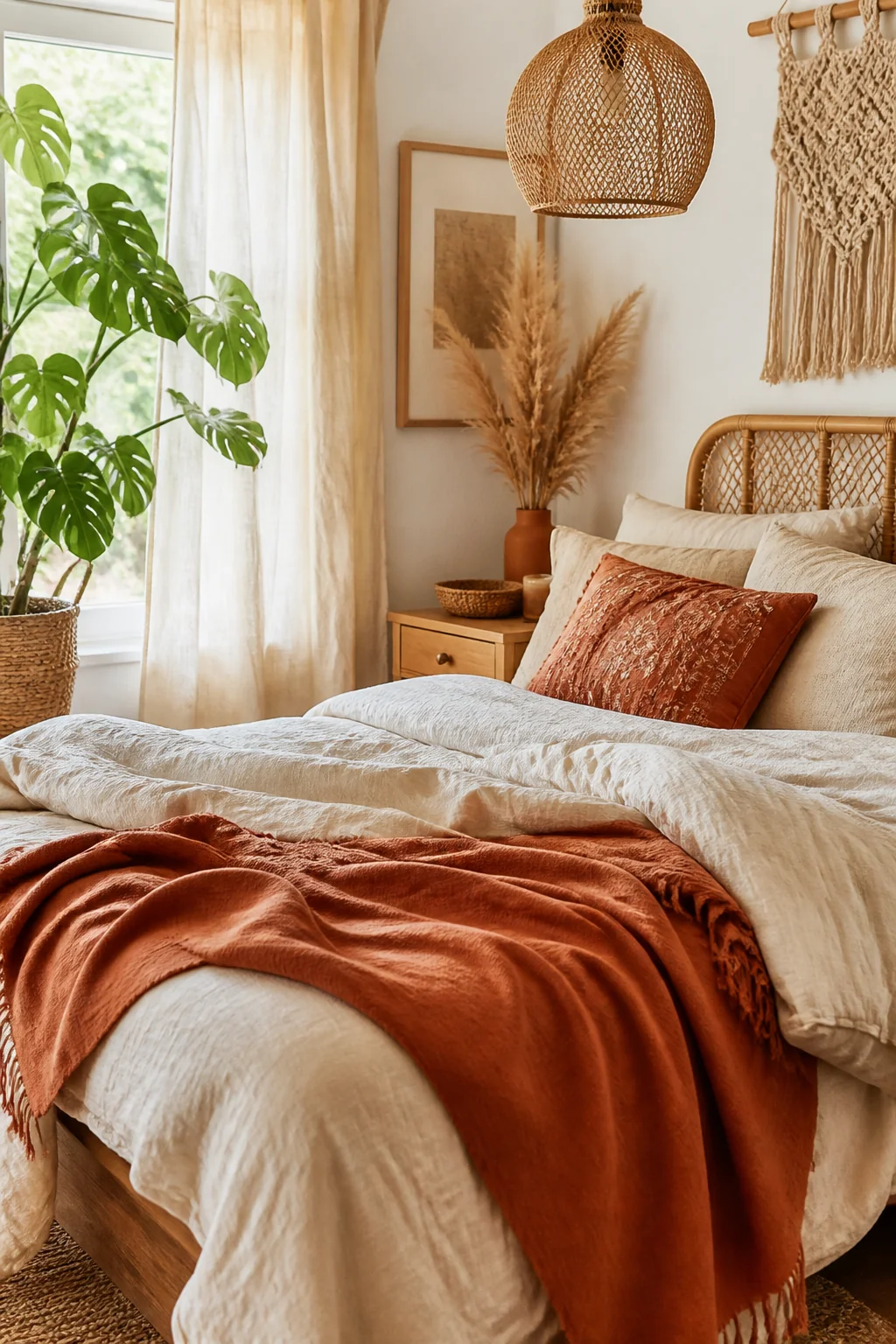
Thrift stores are full of these, but the useful ones sit in a narrow band of sizes. A mattress top usually lands 24 to 26 inches off the floor, and a nightstand reads right when its surface is within about 2 inches of that, so hunt for tables 24 to 28 inches tall. Sixteen to 22 inches wide fits most bedside gaps with a couple of inches left between the table and the frame. Expect $15-40. Wobble is almost always a loose corner block underneath, and a screwdriver plus wood glue clamped overnight sorts it. What you can't fix cheaply is bubbling veneer or a smoke smell soaked into the drawers, so open every drawer and sniff before you hand over money. Two different tables look more bohemian than a matched pair, but keep their heights within about 2 inches of each other or the mismatch reads as an accident rather than a choice.
5. Mix bedding patterns and textures
Build it in layers instead of buying a set. Lay down a solid base first, washed linen or cotton percale in oatmeal or white, then bring pattern in at two different scales: something large like a block print quilt, and something small like a narrow stripe. Hold the whole bed to three colors and let texture do the rest. Linen wrinkles, and that's the look, not a flaw. Waffle cotton, chunky wool knit and one velvet cushion each catch light differently, which is why a three-texture bed photographs better than a three-color one. On price, a linen duvet cover is $70-120, washed cotton sateen $40-60, a decent quilt $60-100. Skip polyester microfiber; it goes shiny after a dozen washes and pills where your elbows land. Order matters too: fitted sheet, flat sheet, quilt folded across the bottom third, then one throw laid at an angle over a corner rather than squared up.
6. Drape a woven or lightweight blanket as a headboard
No headboard, and no drilling into the bed frame either. Hang a woven blanket or a printed cotton panel on the wall behind the pillows instead. A standard 50 by 60 inch throw covers the width of a queen nicely; hang it so the top edge sits 50 to 60 inches off the floor and the bottom disappears behind the mattress. The cheapest hardware is a one inch wood dowel cut to width, about $8-12, resting on two small brackets, with the fabric clipped on using seven curtain rings so you can take it down and wash it. Under $25 total if the throw is one you already own. The failure to plan for is sag: thin fabric bellies out in the middle within a week, which is exactly why evenly spaced rings beat two adhesive hooks at the corners. Pick something machine washable, because the wall behind a bed collects dust and hair oil.
7. Add a wooden ladder as a blanket display
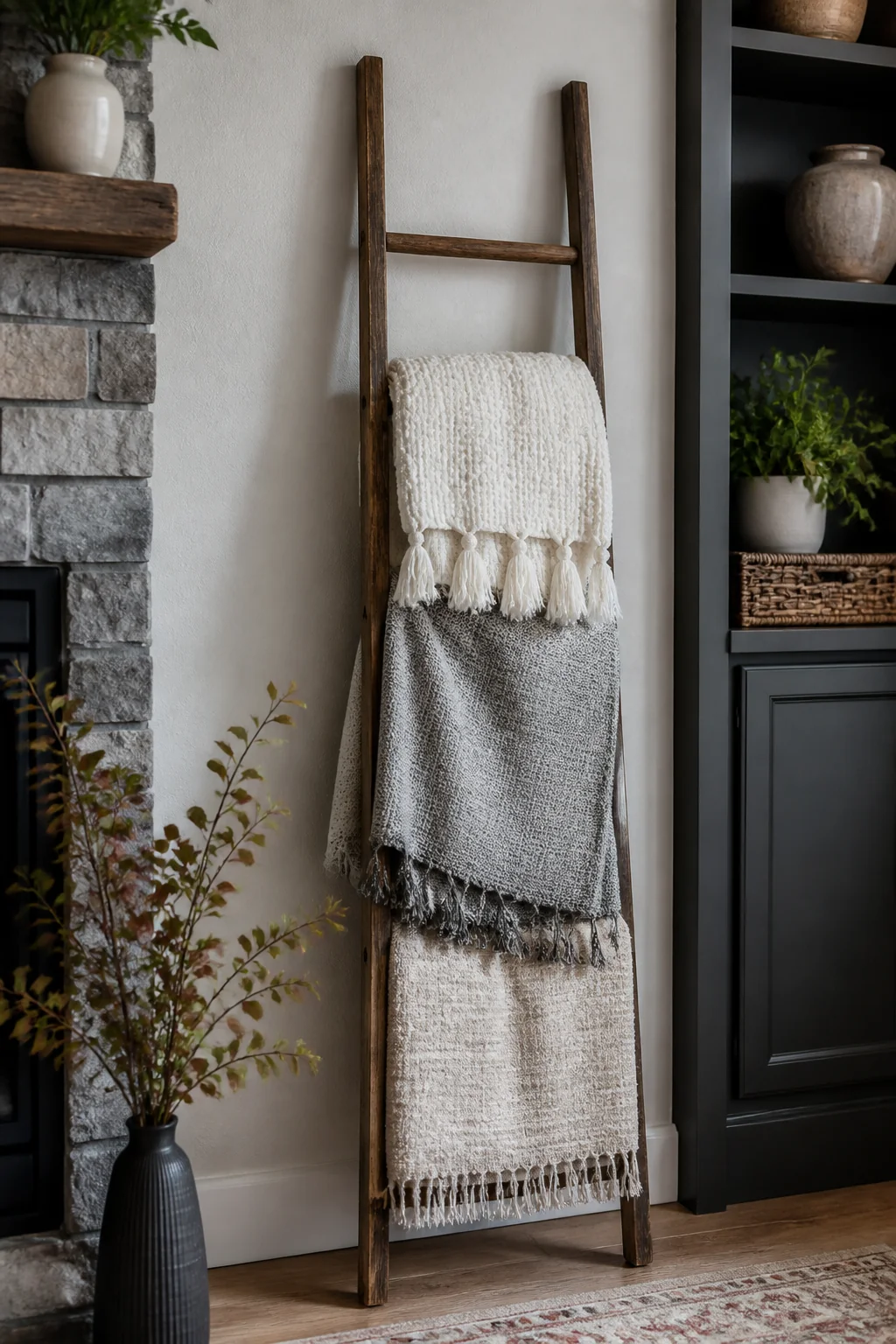
Lean a wooden ladder against the wall and every rung becomes a place to hang a throw, which is why it earns its footprint in small spaces. Decorative blanket ladders cost $35-60 new; a genuine orchard or painter's ladder from a flea market runs $20-40 and looks considerably better. Set the base 12 to 16 inches out from the wall. Any steeper and the feet skate on a hard floor once there's weight on the upper rungs. Secure the top with a small screw eye and a loop of wire if there are pets or kids around. Three throws is the sensible limit before it starts reading as laundry. It needs about 18 inches of clear floor, so in a bedroom where the walkway beside the bed is already under 30 inches, skip it and save your shins. Sand any splinters and finish with clear paste wax, and don't sand old painted rungs indoors, since paint from before 1978 may contain lead.
8. Use macramé wall hangings in different sizes
Scale is what separates a good macramé wall from a craft fair table. A queen puts 60 inches of bed under that wall, and a hanging much narrower than two thirds of it stops anchoring anything and starts floating, so you want 36 to 42 inches across with the bottom edge 6 to 10 inches above the headboard. Flanking pieces work at 12 to 18 inches. Etsy prices run $15-60 depending on size and rope weight, and if you'd rather knot your own, a 3mm cotton rope cone is $15-20 and yields two decent pieces. Hang it properly: a densely knotted dowel piece weighs 2 to 4 pounds, so use drywall anchors rated to at least 10 pounds rather than a nail pushed into drywall. One thing to check before you choose a spot. Raw undyed cotton yellows in hard afternoon sun, so a pale piece opposite a west-facing window won't stay pale. Dust it with the brush attachment on your vacuum.
9. Install floating wooden shelves for books and decor
Two or three shelves at staggered heights do more for a wall than one long one. Solid pine or oak boards at 24 and 36 inches cost $20-40 each. Pay attention to the load rating, because it's where these fail: hidden-bracket floating shelves carry 25 to 40 pounds when the brackets land in studs, but only 5 to 10 pounds on drywall anchors, and a 12 inch run of hardcovers weighs about 10 pounds by itself. Leave 10 to 12 inches between shelves for books, 14 to 16 if a trailing plant goes on one, and start the lowest shelf at least 18 inches above a dresser so the surface stays usable. Find the studs, mark a level line, drill pilot holes, then load the heavy items directly over the brackets. Shelves tip when the weight sits out at the front lip, and that's the leverage that pulls anchors out of drywall.
10. Switch to linen curtains in cream or natural beige
Linen sells the relaxed part of this style, mostly through how it hangs. Curtains take their proportions from the hardware rather than the fabric, and a rod cut to the casing gives you a squat window whatever you hang on it. Lift it 4 to 6 inches above the frame, or halfway to the ceiling where the wall allows, and run it 8 to 12 inches wider on each side, which parks the open panels on plaster and leaves the glass to do its job. Buy total panel width around twice the window width, or the gather looks thin and rental-grade. For length, measure to the floor and add an inch for a soft break. Linen-blend panels are $25-40 each, full linen $60-90. Here's the catch nobody mentions: linen alone passes a lot of light, so if you're a light sleeper or the room faces east, fit a plain blackout roller shade inside the frame and let the linen stay purely decorative. Steam the panels once they're on the rod rather than trying to iron them flat.
11. Create a gallery wall with mismatched frames
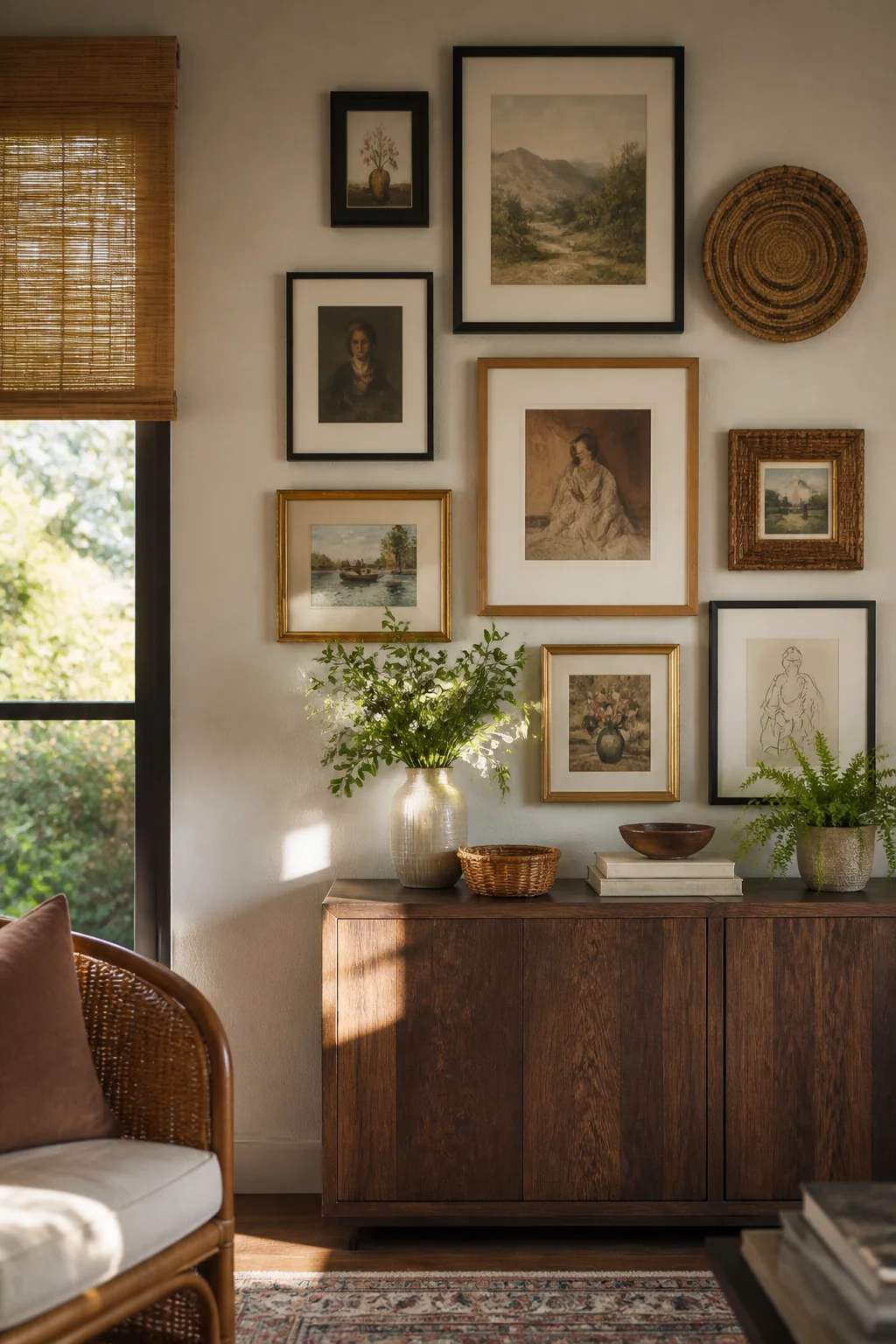
Lay the whole arrangement out on the floor first and photograph it, because moving paper around is a lot easier than patching holes. Keep gaps between frames at 2 to 3 inches; open them past 4 and the group stops reading as one piece. Height gets decided by whoever is holding the hammer, and holding a frame up feels natural about a head higher than it should sit, so measure instead of trusting your arms: the center of the arrangement wants to land 57 to 60 inches off the floor, and above the bed the bottom edge stays 8 to 10 inches clear of the headboard. Three frame materials is plenty: raw wood, thin black metal, rattan or cane. Thrifted frames go for $2-8 and new ones $10-25, so the frames often cost less than the printing. Tape paper templates to the wall, mark the hook positions through them, then use a level on the first frame in each row. Directly over a pillow, choose acrylic glazing rather than glass.
12. Place a large woven basket at the foot of your bed
One big basket at the foot of the bed swallows the duvet you kick off in July and the throws you never fold. Look for something 18 to 22 inches across and 14 to 16 inches tall, which handles a queen duvet plus a couple of blankets. Seagrass and water hyacinth versions cost $25-50. Check the construction before you buy: a rolled and stitched rim survives being dragged around, a glued one comes apart inside a year, and stitched coils beat stapled ones every time. Clearance decides whether this works at all. You want 24 to 30 inches of walking room at the foot of the bed, so in a room shorter than about 10 feet with a queen in it, the basket becomes a permanent shin hazard and you'd be better off using the space under the bed. Line the inside with an old pillowcase, since bare seagrass snags wool and loose knits.
13. Layer multiple throw pillows on your bed
Here's a formula that works on a queen without turning the bed into a showroom. Two standard sleeping pillows at the back, two 26 inch euro squares in front of them, two 18 to 20 inch accent squares, then a single 12 by 20 lumbar at the front. Covers cost $8-20 and inserts $6-12. Corners are the first thing to go limp on a cushion, and they only stand up when the insert has to squeeze itself into the cover, which is what buying it 2 inches oversized gets you.
Vary the fabric more than the color: one woven or embroidered, one plain linen, one knit or velvet. The real limit is how many you're willing to move at bedtime. If clearing the bed takes more than about ten seconds, those pillows will live on the floor by week two, and a heap on the floor isn't the look anyone is going for. Matching sets, meanwhile, read stiff and hotel-like, which is the opposite of the point.
14. Add a small round mirror with a wooden or rattan frame
A round mirror does two jobs at once: it breaks up the straight lines of a bed and dresser, and it throws daylight into the part of the room that never gets any. A 24 to 30 inch rattan or cane-framed mirror runs $40-80. Above a dresser, leave 6 to 10 inches between the dresser top and the bottom of the frame, and center it on the furniture rather than the wall. Weight matters more than people expect. These run 8 to 15 pounds, so hit a stud or use an anchor rated well beyond the mirror's weight, and hang from two points if the frame allows it. If you'd rather lean it, it has to stand on the floor with a felt pad under the frame, never propped on a dresser edge where a closing drawer can walk it off. Place it opposite or perpendicular to a window so it reflects light, not a blank wall.
15. Hang sheer fabric from the ceiling corners to your bed
Two hooks and a length of sheer fabric give you a canopy with no frame involved. Ten yards of cotton muslin or voile costs $4-7 a yard, or two sheer curtain panels will do the job for $15-25 total. Screw two ceiling hooks into joists 36 to 48 inches apart above the head of the bed, or use toggle anchors rated to at least 15 pounds. Adhesive hooks are the wrong choice overhead, since the load pulls straight down and fabric plus gravity peels them off within a week, usually at 3am. Run the fabric up through the hooks and let the ends fall wide toward the corners of the bed so it frames the pillows rather than closing you in. Two cautions. Anything suspended over a bed collects dust, so plan on washing it every couple of months. And keep 12 inches minimum between the fabric and any bulb, heater or vent.
16. Use vintage or thrifted brass accents
Take a fridge magnet thrifting with you. Solid brass isn't magnetic, so if the magnet sticks you're holding brass-plated steel, which chips at the edges and shows gray underneath within a couple of years. Real brass candlesticks turn up for $3-10, a floor lamp for $30-70, drawer knobs for a dollar or two each. Cleaning depends entirely on the finish. Unlacquered brass responds to a cut lemon dipped in salt, or to Bar Keepers Friend; lacquered brass should only ever be dusted, because polish clouds the coating permanently and you can't undo it. Leaving the patina is a legitimate choice, and it's part of why old brass looks warmer than new. The one thing worth being strict about is metal mixing. Brass sitting in the same sightline as chrome or brushed nickel looks unresolved, so keep the lamps, knobs and frames warm and leave the door hardware and outlet plates out of it.
17. Layer a colorful woven blanket as a throw
Size the throw to where it's going. A standard 50 by 60 inch throw is right for a chair, but across the foot of a queen you want 60 to 70 inches of width so it hangs evenly on both sides instead of stopping short on one. Wool runs $40-90, cotton $25-40, acrylic under $20, though acrylic pills at the fold lines and doesn't breathe, which you notice the first warm night you leave it on the bed. Terracotta, mustard and olive all sit well against jute and raw wood. To drape it, fold it in thirds lengthwise, lay it diagonally across one corner of the bed, and let 10 to 12 inches hang over the edge. A throw that matches your pillows exactly cancels out the layering, so let this be the odd one out. Check the care label first: most real wool wants a cold hand wash and a full day drying flat.
18. Place mood lighting with a brass or wood table lamp
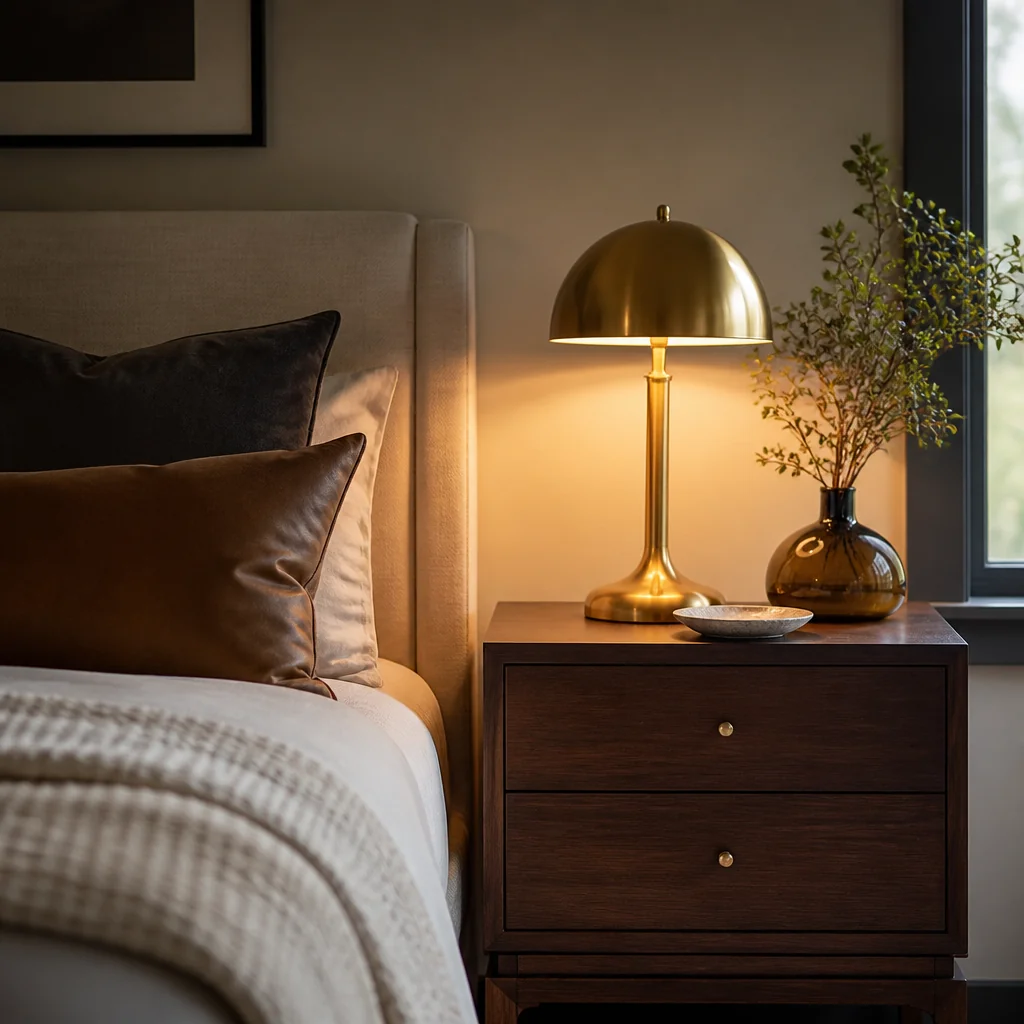
The nightstand lamp does more work than the ceiling fixture ever will, so size it properly. On a nightstand 24 to 26 inches tall, a lamp with a total height of 24 to 28 inches puts the bottom of the shade near your eye level when you're sitting up in bed, which is the whole point: you should see light, not the bulb. A shade roughly twice the width of the base keeps the proportions right. Put a 2700K bulb in it at 450 to 800 lumens, about a 40 to 60 watt equivalent, and add a $10-15 dimmer socket adapter or a smart bulb so you can wind the level down late in the evening. Thrifted brass and ceramic lamps go for $15-40, new wood or ceramic $40-70. If the cord is cracked or the plug has two flat unpolarized prongs, budget $10 for a rewiring kit or walk away.
19. Fill a corner with a cozy reading nook using floor cushions
Give the nook about 4 by 4 feet and treat it like a real seat rather than a photo prop. Floor cushions 24 to 26 inches square and 4 to 6 inches thick cost $30-60 each; a firmer pouf is $50-80. Your back is the part everyone forgets. A bare wall gets uncomfortable in roughly fifteen minutes, so add a large lumbar cushion or lean a folded blanket behind you. It also needs its own light source. Overhead light coming from behind puts your own shadow on the page, so plan on a plug-in swing arm sconce at $30-50 or a slim floor lamp beside the cushions. Be honest about the getting-up part, too. If your knees object to the floor, or if this is a corner you'd be standing up from repeatedly, a low armless chair at $80-150 gets used and the cushions quietly don't.
20. Hang dried pampas grass or eucalyptus in glass vases
Dried stems cost $2-8 a bunch for eucalyptus or bunny tails, $10-20 for a few real pampas plumes, and they hold for months rather than days. The vessel is the part to get right. Pampas is top heavy and will tip a light vase, so use one at least 10 to 12 inches tall with a narrow neck and drop a handful of pebbles or sand in the bottom for ballast. Keep the stems at roughly one and a half times the height of the vase. Pampas also sheds fluff onto every surface below it; take the plumes outside, mist them with cheap unscented hairspray, let them dry, and the shedding largely stops. Eucalyptus smells good for a few weeks, then fades and turns brittle, which is normal rather than a defect. Keep all of it out of direct sun so the color doesn't bleach, and well away from candles, since bone-dry grass catches fast.
21. Add a low wooden bench at the foot of your bed
A bench at the foot of the bed is where the throw pillows land at night, which is the practical reason to own one. Aim for 40 to 48 inches long against a 60 inch wide queen so it reads narrower than the bed, with a seat height of 17 to 19 inches and a depth of 14 to 16. Leave 24 to 30 inches between the bench and whatever's behind it, or you'll be sidestepping every morning; in a room under about 11 feet long, it simply blocks the path. Thrifted benches go for $20-40, new ones $80-150. Sit on it in the shop and rock side to side. That racking movement means the joints have loosened, and corner brackets plus glue usually fix it for a few dollars. Raw wood tops pick up shoe scuffs, so wipe on mineral oil or a hard wax and refresh it once a year.
22. Style your nightstand with a small plant, a candle, and a stack of books
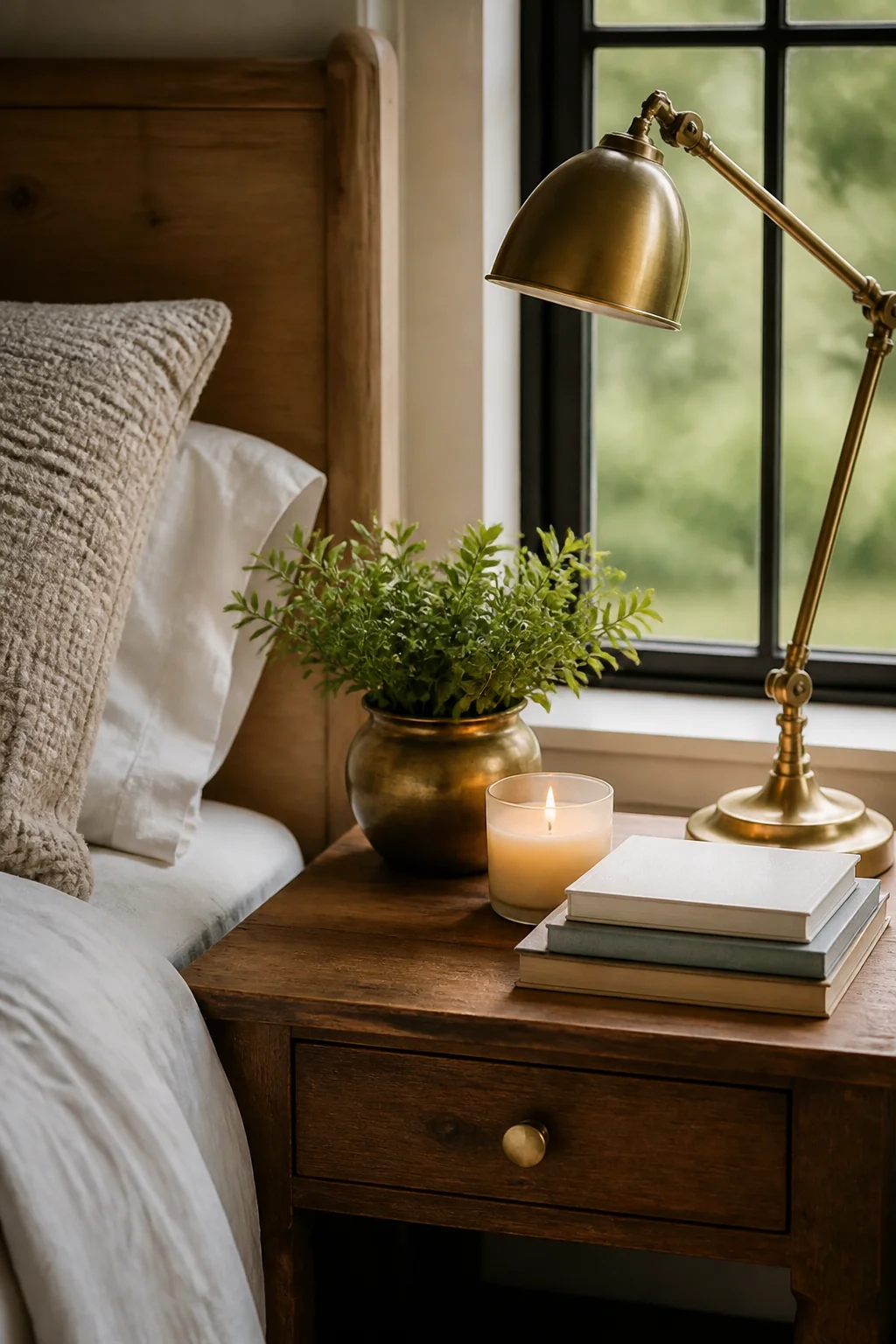
Style it in three heights, then leave room to use it. Tall is the lamp. Medium is a 4 to 6 inch potted plant or a taper candle in a brass holder. Low is three stacked books with a small dish on top for rings and hair ties. Then stop, and keep about a third of the surface clear for a glass of water, your phone and your glasses, because a nightstand with no free space gets cleared off in a week anyway and the styling goes with it. A clip-on cable holder for $10 keeps the charging cord from sliding down behind the table every night. On prices, a wood-wick candle is $12-25 and a 4 inch succulent $5-8. One caution on the plant: succulents fail on a nightstand more than about 4 feet from a window, so use a pothos cutting in a small glass jar instead and top the water up weekly.
23. Paint an accent wall in a soft earthy tone like sage green or warm terracotta
The wall behind the bed is the one to paint. You never look at it while you're lying there, it frames the headboard from the doorway, and it's usually the wall with the fewest windows and door casings to cut in around. Run the numbers before you shop. One wall is far less paint than it looks: 12 feet wide by 9 feet tall is about 108 square feet, and since a can stretches to 350 or 400 of those per coat, a single gallon takes the wall through two coats with enough left in the bottom for touch-ups. Budget $30-45 for a gallon of decent eggshell, plus roughly $15 for a roller kit, tape and a drop cloth. Sage green, warm terracotta and muted clay all sit well beside jute and raw wood. Buy a $6 sample pot first, paint a 12 inch square, and look at it at night under the lamp you use, because warm bulbs push greens toward yellow.
Take the guide with you
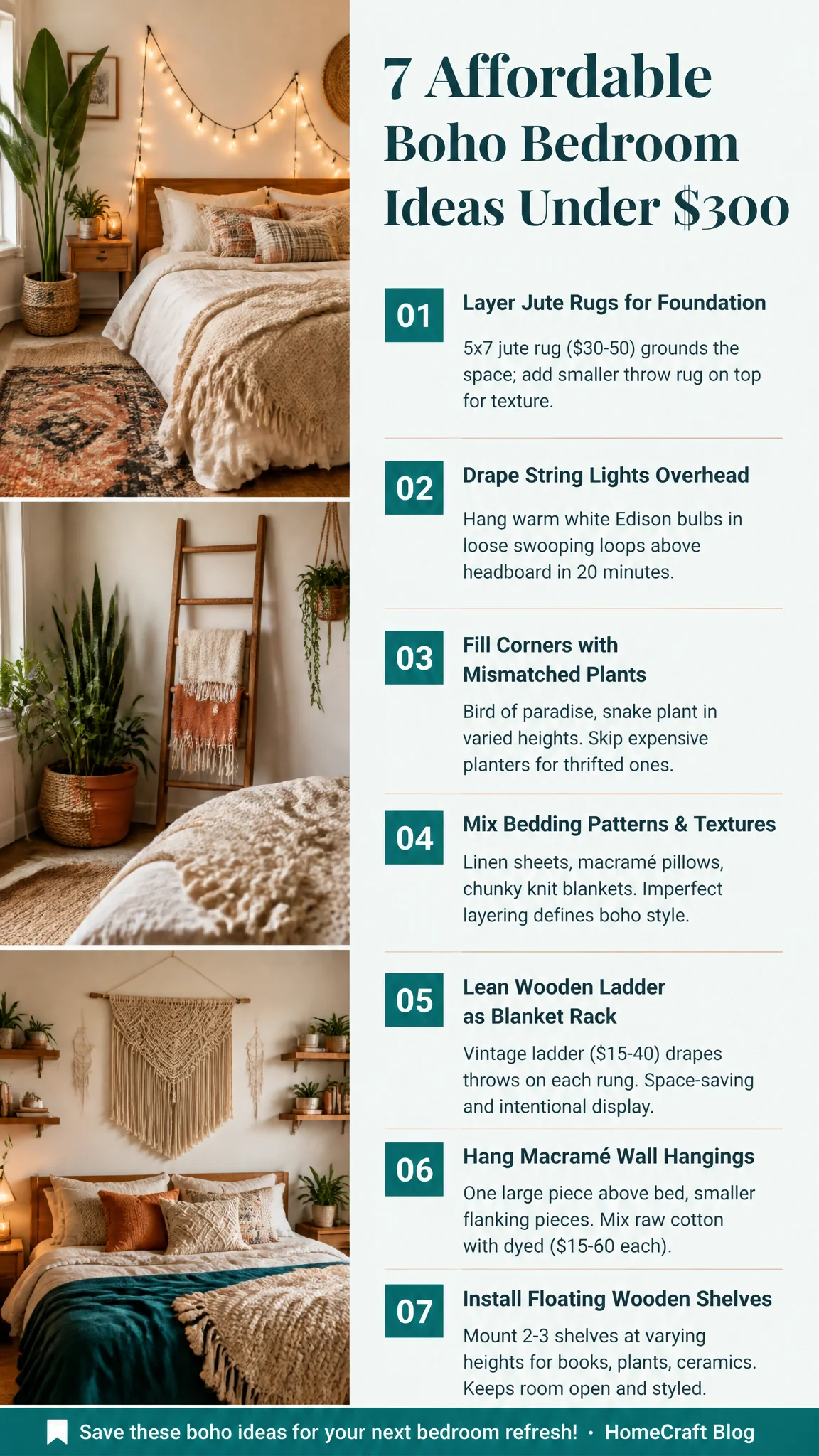
If the budget only stretches to two things on this list, make them the lighting and something soft underfoot. Warm bulbs and a rug do more for how a bedroom feels at 10pm than any wall hanging will, and both are reversible if you're renting. The rest can arrive whenever it arrives. A room assembled slowly ends up with genuine mismatch in it, which is the part nobody can buy in a single order.