11 Small Bedroom Storage Ideas That Earn Their Space
11 small bedroom storage ideas with the measurements, prices and clearances each one needs, from under-bed bins and floating shelves to a wall-mounted pegboard.
This post contains affiliate links. As an Amazon Associate I earn from qualifying purchases. If you buy through our links, we may earn a commission at no extra cost to you.
When a Small Bedroom Starts Working Against You
A small bedroom rarely fails all at once. It fails at the door, where the swing catches on a pile of sweaters, and then beside the bed, where the walking lane has narrowed to the width of one foot. Put a queen mattress in a 10 by 10 foot room and it claims 60 by 80 inches of floor on its own, which is most of what you started with.
Three clearances are worth defending before you buy a single bin. Keep 22 to 24 inches of walking space on at least one side of the bed. Keep 30 inches in front of a dresser so the drawers open all the way instead of stopping halfway. And give the door its full arc, since a standard 30 or 32 inch bedroom door needs that whole sweep to latch.
Every idea below gets judged against those three numbers and against what it costs. If you want the softer side of a tight room, our cozy bedroom ideas guide covers that separately.
Under-Bed Storage Bins: The Obvious Choice That Earns Its Keep
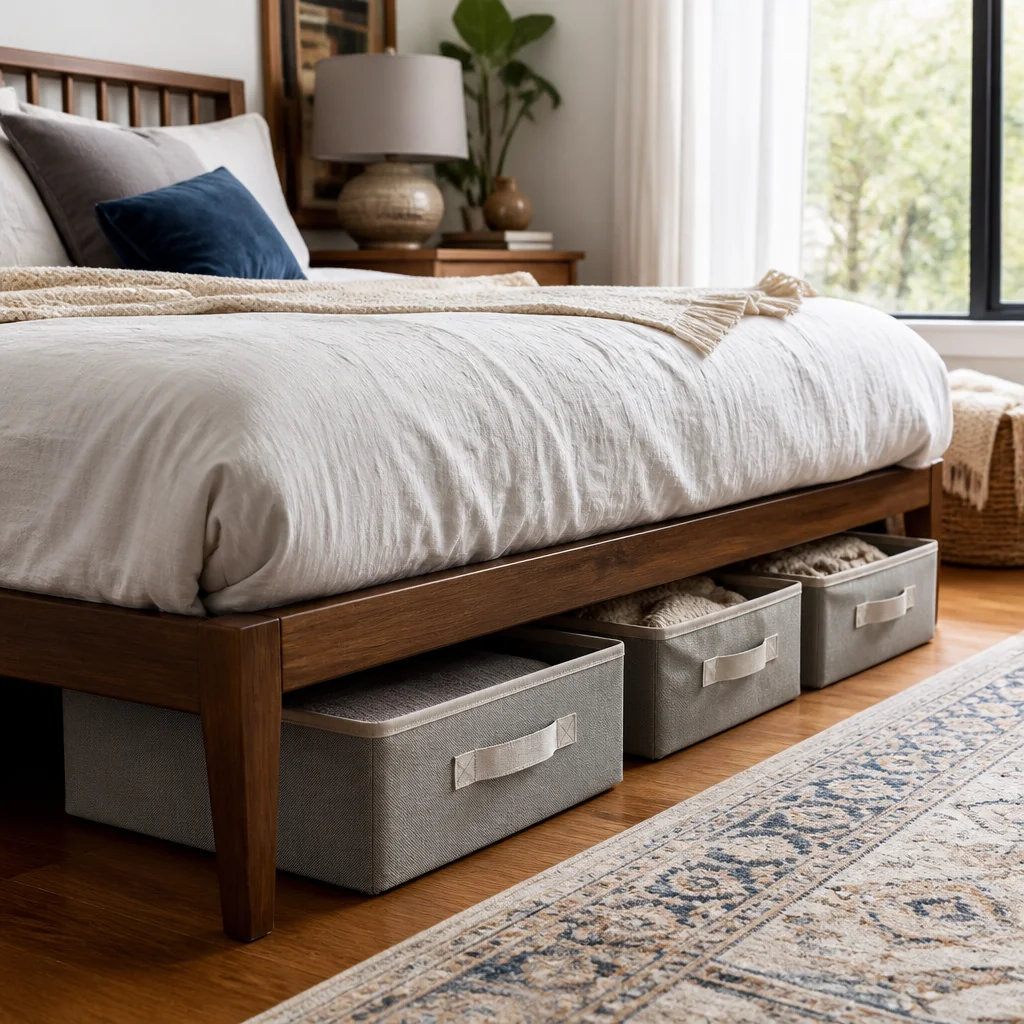
Start with a tape measure rather than a shopping cart. Measure floor to frame at the lowest point, which is usually a center support rail and not the side rail you can see. A typical platform or metal frame leaves about 8 inches, so a bin no taller than 6 inches slides in and out without scraping the slats.
Clear polypropylene rolling bins cost around $22 each, and two of them swallow a season of clothes plus a spare duvet. Label the short end of the bin, not the lid, so you can read it from floor level without dragging anything out first. That one habit is the whole difference between storage and a mystery box.
Two things go wrong. Casters do not roll on thick pile carpet, so on carpet pick a smooth-bottomed bin with a webbing pull handle. And open bins collect dust under a bed remarkably fast, so pay the extra couple of dollars for lids on anything fabric.
If your frame is too low, bed risers add 3 to 5 inches for about $15 to $25 a set.
Floating Shelves Above the Dresser
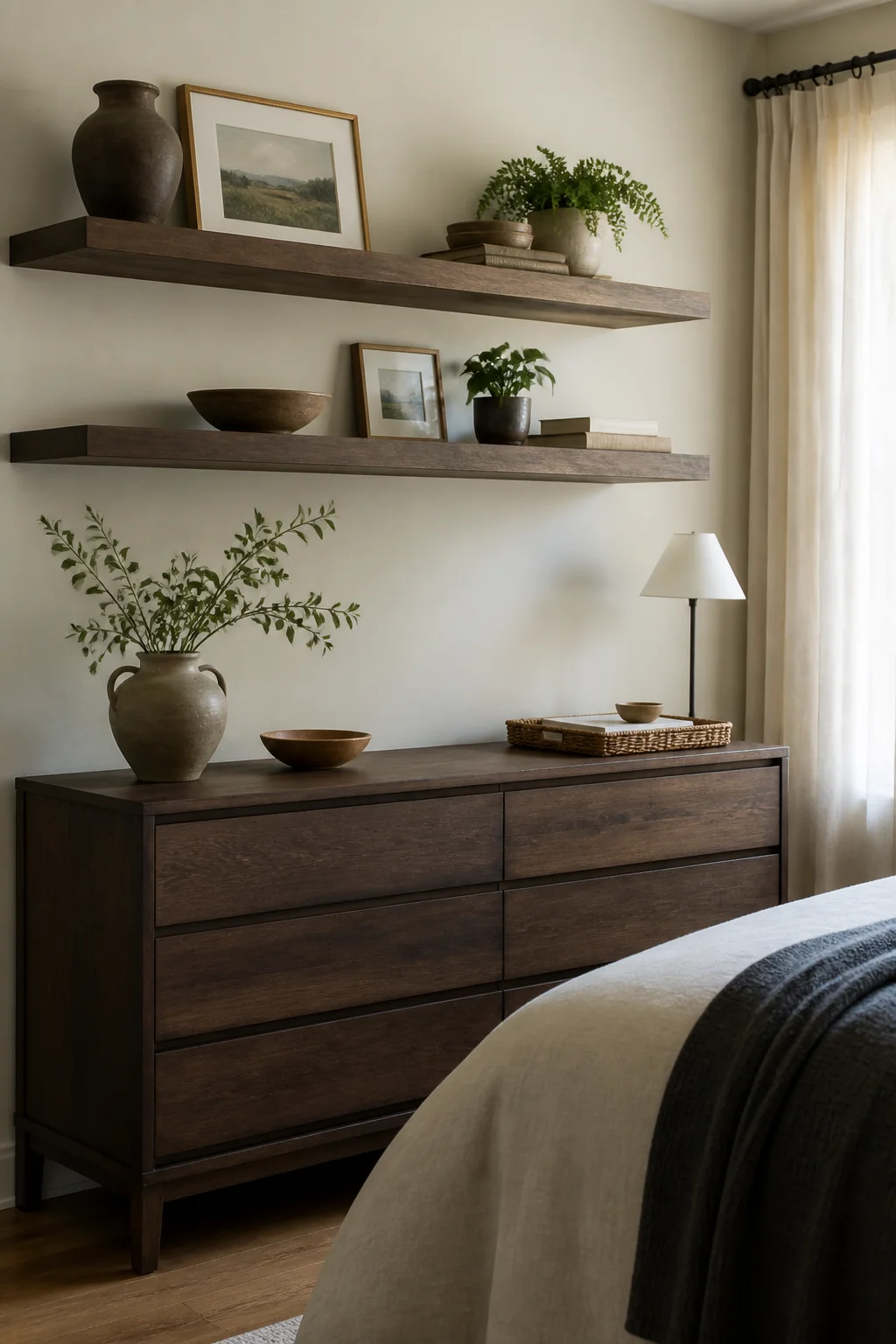
The wall above a dresser is usually the largest unused surface in a small bedroom. Three floating shelves there run about $60 and take an afternoon.
Find the studs first. In most homes they sit 16 inches apart on center, and a bracket screwed into framing will carry a loaded basket without complaint. Drywall anchors on their own are where this goes wrong: a toggle rated for 20 pounds is fine behind a picture frame and not fine behind a basket of hair tools you tug at every morning.
Height matters more than people expect. Leave 10 to 12 inches between the dresser top and the first shelf so a lamp and tall bottles still fit underneath, then repeat that spacing going up. Check depth too. Most floating shelves are 6 to 8 inches deep while a lot of storage baskets are 10 inches or deeper, so the basket hangs over the front edge and the whole wall looks unplanned.
Baskets do the hiding: hair accessories in one, skincare in another, something seasonal in the third.
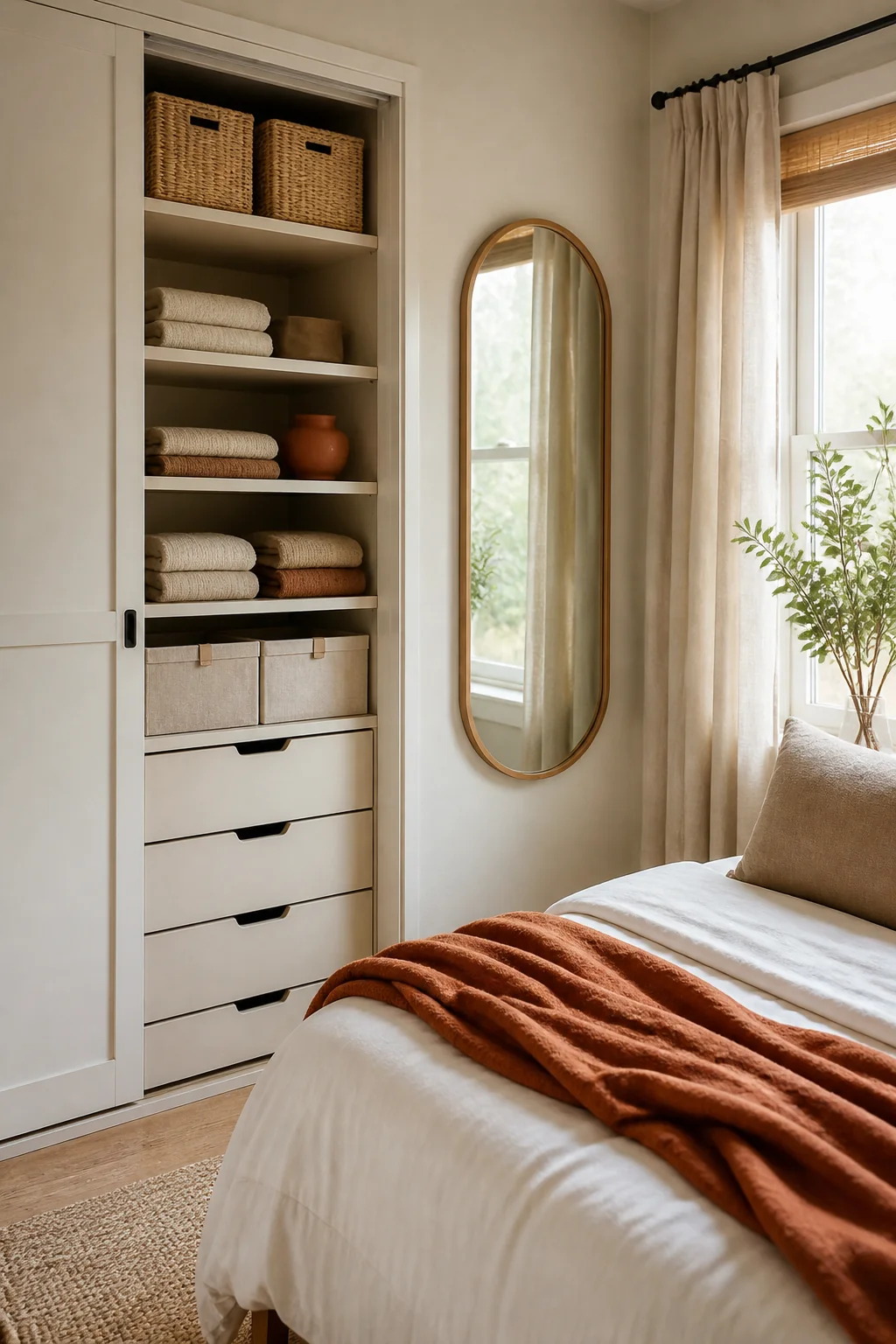
Hooks, and More of Them Than You Expect
Six adhesive hooks along the inside of a closet door cost about $15 and take the daily overflow that otherwise lands on a chair: a tote, a cardigan, a small crossbody bag, a straightener in a heat-proof pouch. The chair goes back to being a chair, which in a tight room is a real square foot of floor.
Respect the weight ratings, because they are not generous. Small adhesive hooks hold roughly 1 pound, medium about 3, large about 5. Wipe the surface with rubbing alcohol rather than a household spray, which leaves a film the adhesive cannot grip, and give a fresh strip an hour before you load it.
Where they fail: textured walls, flat matte paint, and anything painted in the last week. On those, use screw-in hooks or an over-the-door rack instead. If you go over the door, measure the door thickness first, since most racks fit up to about 1 3/8 inches and a thicker door will not latch with one in place.
Space hooks 4 to 6 inches apart so what hangs on them does not overlap.
A Tension Rod Hidden Inside the Nightstand
A tall, narrow nightstand almost always has an open shelf below the top surface, and that opening will take a small spring tension rod. Set it about 3 inches down from the underside of the top and you have a hanging bar for scarves, a charging cable, and a lightweight throw, all out of sight from the doorway.
The rod costs about $8. Measure the inside width, then buy one whose adjustment range puts that number near the middle rather than at the very end of its travel, because a spring rod stretched to its limit loses most of its grip.
Keep the load light. A rod this size holds a few pounds at best and needs two rigid opposing sides to push against, so skip it if one side of the nightstand is a thin veneer panel. If it slips on a slick painted interior, a disc of rubber shelf liner cut and slid over each end fixes it for nothing.
What you gain is the drawer below, which stops being a cable graveyard and starts holding the eye mask, lip balm and book you want at midnight.
Over-the-Door Shoe Organizer (Not Just for Shoes)
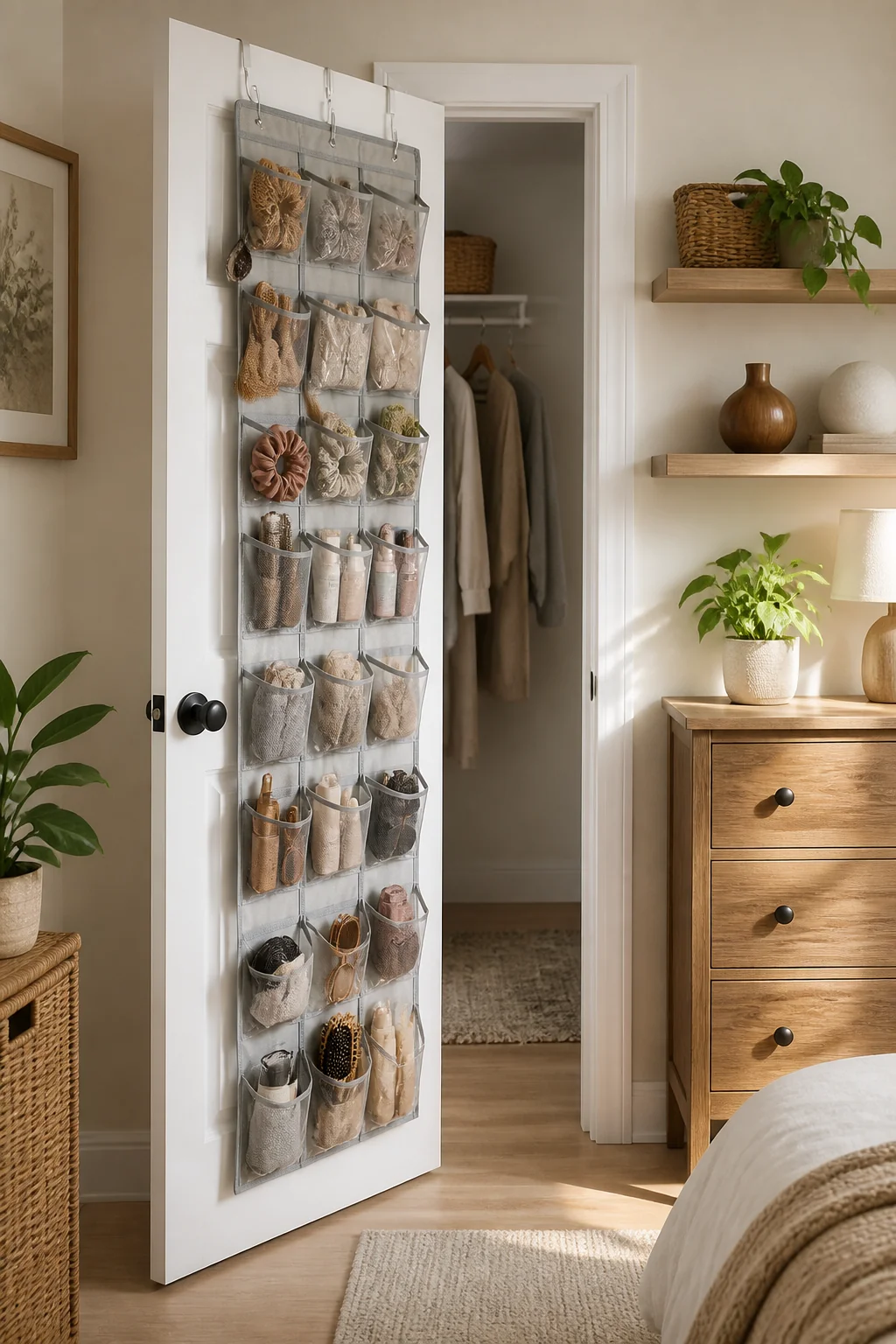
A 12-pocket organizer on the back of the bedroom door costs around $18 and absorbs everything that scatters across a dresser: socks, hair clips, chargers, sunglasses, jewelry rolled into small pouches, face masks. None of it touches the floor or a shelf.
Measure before you order. Pockets on a standard organizer run roughly 5 by 5 inches, which takes a folded pair of socks and refuses a folded sweater. The metal hooks add about an inch to the top edge of the door, so check that the door still clears its frame and latches. On a tight frame, a slim-profile hook or a version that screws to the door solves it.
Two rules keep this one working. Skip heavy items, because weight high on a door makes it swing hard and drags the hooks down through the paint. And skip anything you reach for several times a day, since every retrieval means swinging open a door that may be inches from your bed.
Vertical Closet Dividers and Shelf Risers
Stacked sweaters collapse for a simple reason. Once a stack passes roughly 12 inches, the bottom pieces carry too much weight, the column leans, and you stop digging and wear the top three items forever. A set of three wooden shelf dividers, about $24, caps each stack at a height that stays upright and keeps every piece readable from the front.
Check your shelf before buying. Clamp-on dividers are cut for solid shelves up to about an inch thick. Wire shelving needs the wire-specific version with a clip that grips underneath, or a shelf liner board laid across the wires first to give the divider something flat to hold.
A stackable riser, around $12, sits on the shelf above the rod and splits that dead vertical space into two usable levels. Keep light seasonal things on the upper level, since heavy boxes overhead on a bracket shelf are asking for trouble.
Neither of these makes the closet bigger. They make the parts you already own reachable, which is the part that was missing.
The Wall-Mounted Pegboard Above the Desk
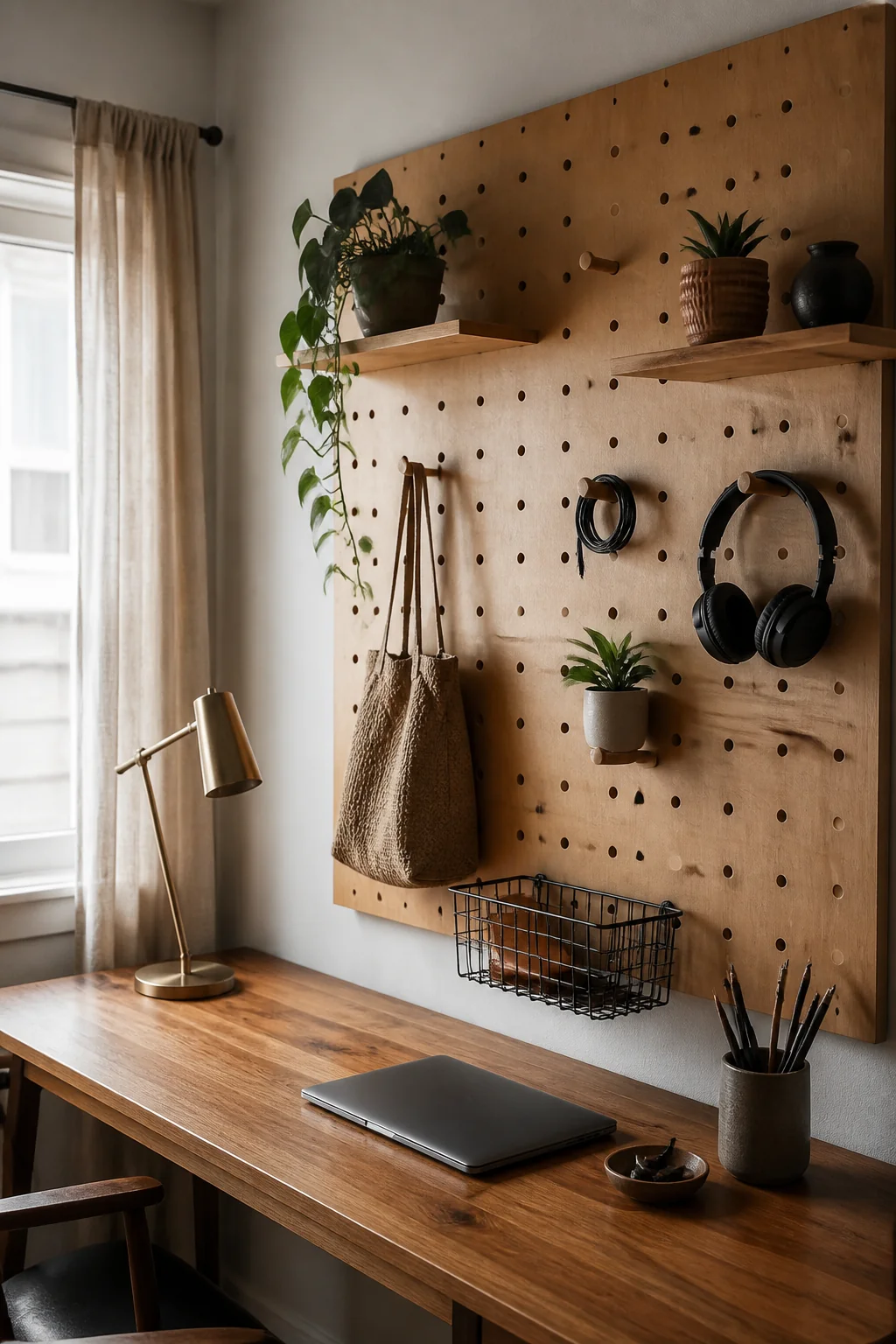
An 18 by 24 inch pegboard over a small desk holds work supplies, camera gear and beauty tools on hooks, in shallow baskets, on tiny shelves, and every one of those can move when what you own changes. Budget roughly $30 for the board and $40 for hooks and baskets, so about $70 all in.
The detail most people miss is the standoff. Pegboard has to sit about 1/2 inch off the wall or the hook tips have nowhere to seat and they pop straight back out under load. Use the spacers in the kit, or screw two thin furring strips to the wall first and mount the board to those. Once you plan to hang more than about 10 pounds, drive at least two of those screws into studs.
The trade-off is visual. A pegboard is honest storage, so whatever hangs on it is on display. Keep it to things you touch weekly, or you get a wall of clutter at eye level.
What Doesn't Work, and Why It Fails
Hanging fabric closet organizers, the tall ones with five or six pockets that clip over the rod, take back more than they give. A typical one occupies 12 to 14 inches of rod. Shirts on hangers need about an inch of rod each, so in a closet with 36 inches of rod you have traded a dozen shirts for six pockets that would have been perfectly happy on the door.
Beds with built-in drawers have the same problem in a different place. The drawer interiors are often only about 6 inches deep, and a side-mounted drawer needs 24 to 30 inches of clear floor to pull out fully, which is exactly the clearance a small bedroom does not have. The platform also lifts the mattress higher in a room that already feels tight.
Vacuum bags disappoint slowly. They compress well on day one, then creep back up over a few weeks wherever the seal is imperfect, and knits come out of them deeply creased.
Making It All Feel Cohesive
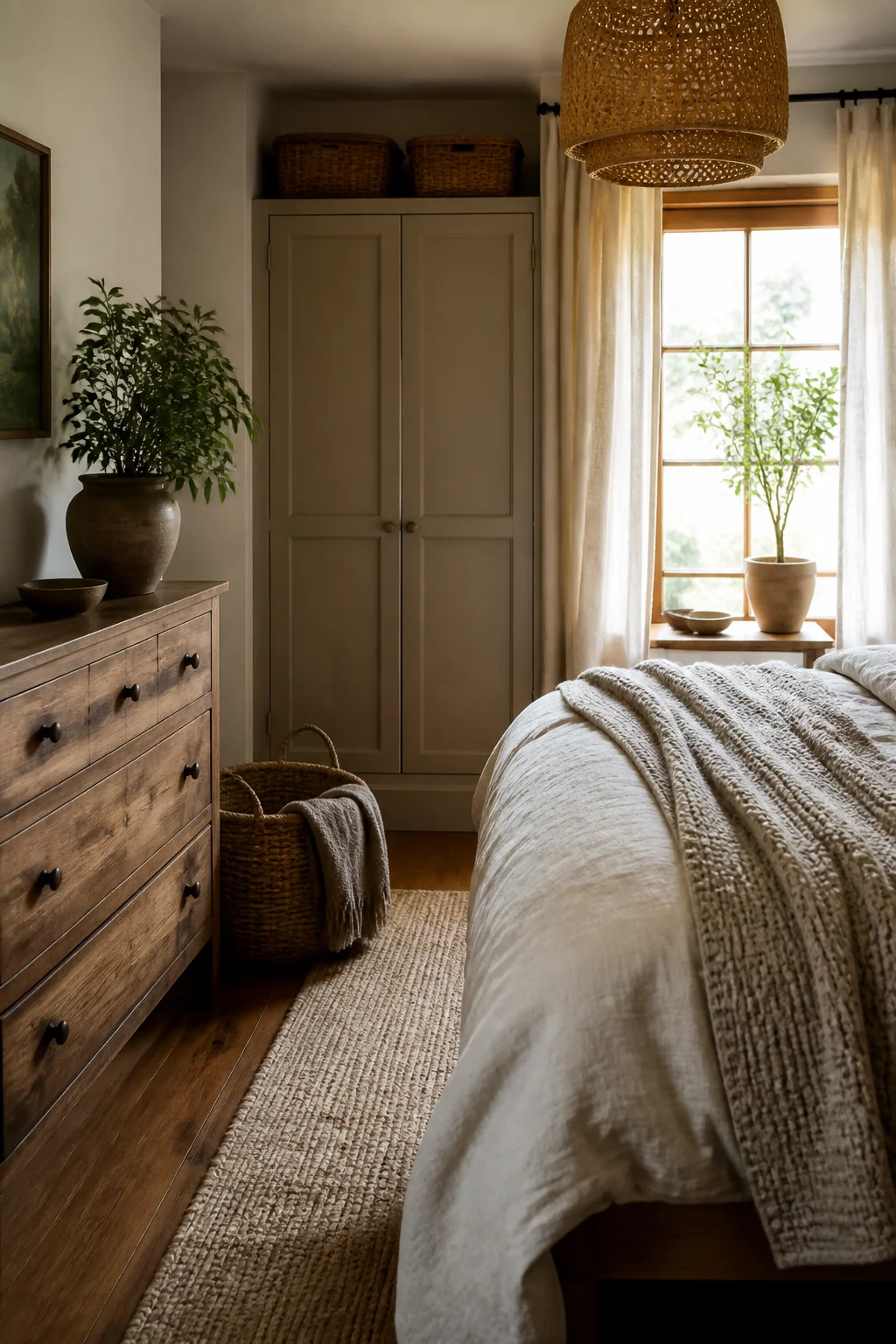
Storage stops looking like storage once the containers agree with each other. Choose one material and one tone, seagrass or cotton rope or felt, in natural wood, cream or light gray, then buy the same model in two sizes instead of five different ones. Repetition is what reads as calm; variety is what reads as leftovers.
Measure before that order too. Most floating shelves are 6 to 8 inches deep while a common seagrass basket is 10 to 13 inches deep, so the basket overhangs and the wall looks like an accident. Match basket depth to shelf depth first, then worry about width.
Put labels in the same place on every bin, front face, same height, and leave a hand's width of shelf empty at one end. A shelf packed corner to corner reads as a supply closet no matter how good the baskets are.
Then put back the things with no job at all: a small plant, a framed photo, a candle. A room organized to the last inch and nothing else is a room nobody wants to sit in.
What Gives the Most Room Back
Ranked by floor and clearance recovered per dollar, the cheap ideas win. Hooks and under-bed bins together come to about $60 and hand back the chair, the strip of floor beside the bed, and the door swing, which are the three things that make a small bedroom feel unlivable. Shelves and pegboards photograph better and do less for circulation.
The caution worth repeating: buying containers before measuring is how storage becomes its own clutter. Four numbers cover nearly everything on this list. Frame height under the bed, shelf depth on the wall, door thickness, and rod length in the closet. Put them in your phone before you order anything.
Save this for your next project
And no bin fixes volume. If a single closet is holding three winters of clothes, dividers only organize the overflow; the donate pile does more for a small bedroom than any product here. For the rest of a tight home, our apartment decorating ideas guide picks up where this one stops.