22 Simple Small Space Multifunctional Furniture Ideas That Earn Their Footprint
Small space multifunctional furniture that does two jobs well. 22 ideas with real dimensions, prices, clearances, and the failure modes to check before you buy.
This post contains affiliate links. As an Amazon Associate I earn from qualifying purchases. If you buy through our links, we may earn a commission at no extra cost to you.
Most small spaces fail because every piece does exactly one thing: the coffee table is only a coffee table, the nightstand only holds a lamp. Then you add a desk, a bookshelf and a dresser, and the room turns into a maze with one clear path through it. Pieces that do two jobs keep a small room working without eating its floor, and they don't have to be compromises. They're also the first change worth making in a 200 square foot room, which is why furniture leads our small living room ideas. Here are 22 of them, with the dimensions, prices and clearances that decide whether each one works where you're putting it.
1. Ottoman with hidden storage inside
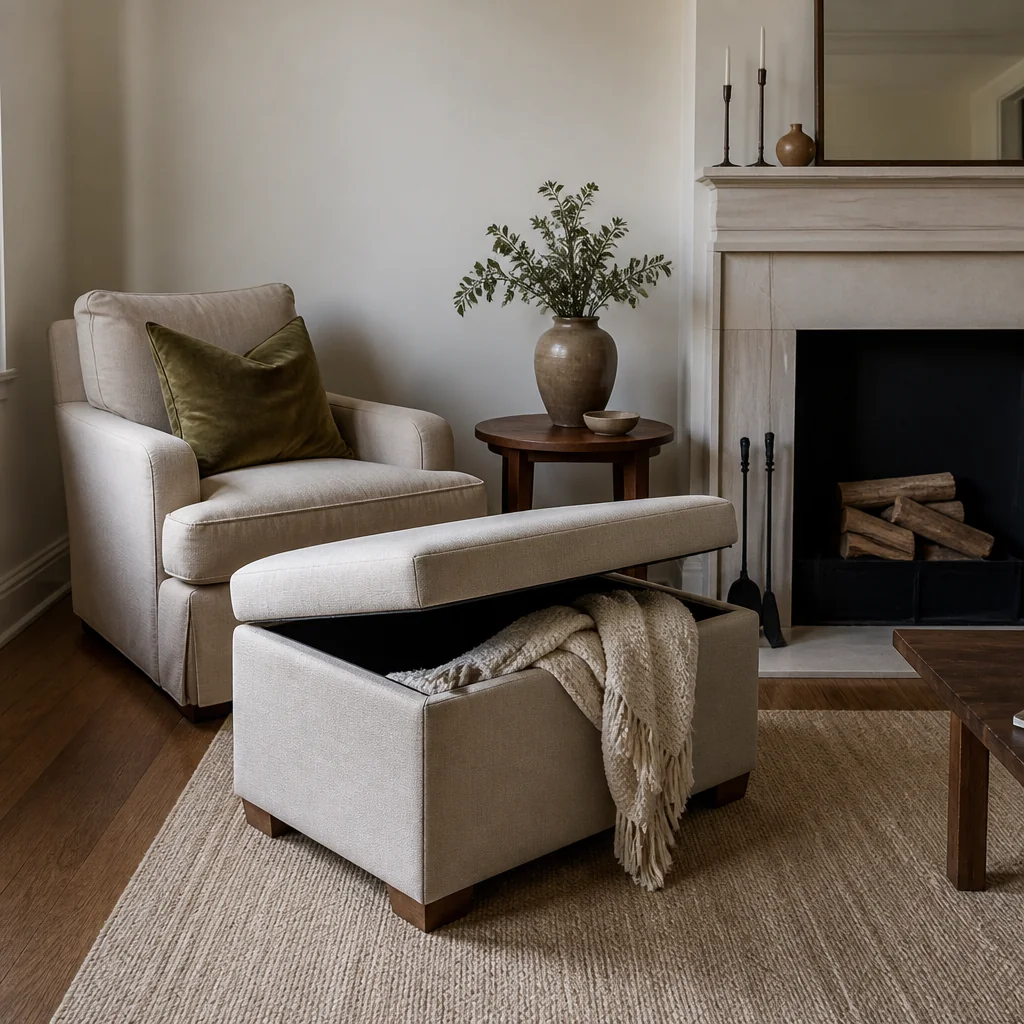
An ottoman earns its spot by working as a footrest, a spare seat and a closed box at the same time. Aim for a seat height within an inch or two of your sofa cushion, usually 16 to 18 inches, or it's an awkward thing to put your feet on. An 18-inch square gives you roughly two cubic feet inside, which swallows two throw blankets or a stack of board games. Expect $80 to $200 in woven fabric, more in leather. Two things decide whether it survives daily use. First, the weight rating: pieces sold as decorative storage cubes often top out near 200 pounds and the lid flexes when someone sits down, while seating-rated frames use plywood rather than thin MDF. Second, the lid. A lift-off top means setting it on the floor every time you want a blanket, and a hinged lid without a stay will drop on your fingers.
2. Bed frame with drawers underneath
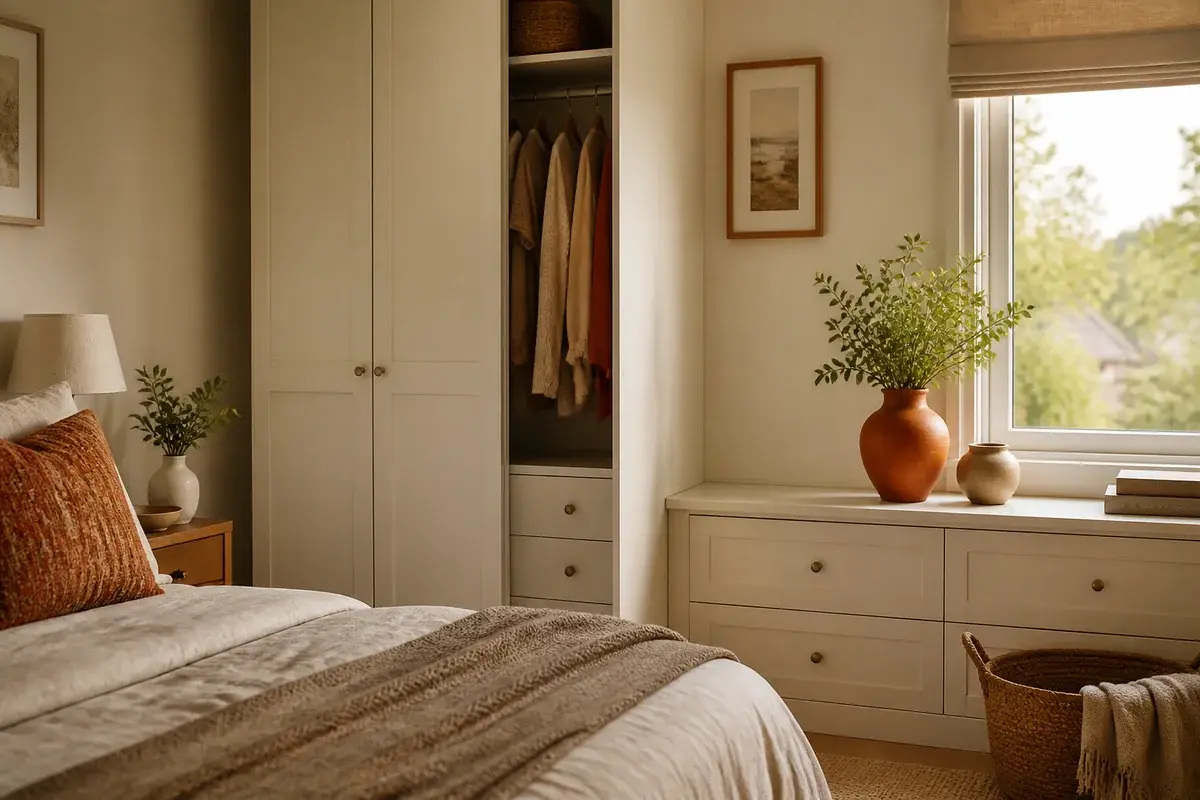
Here's where the math usually goes wrong: you buy a bed, then push a dresser against the only free wall, and the room loses its walking path. A queen platform with four drawers puts that same storage under the mattress for $400 to $700. Measure your side clearance first, because those drawers pull out 18 to 24 inches, and a bed shoved against a wall makes half of them unreachable. If only one long side is open, look for a frame with a foot-end drawer instead. Interior depth usually runs 6 to 8 inches, which suits folded sweaters, sheets and off-season t-shirts, not tall boots or a vacuum. Check the glides too: plastic wheels riding straight on carpet bind and eventually chew the fibers, so you want a solid bottom deck or steel runners. One trade-off worth knowing is weight. These frames hit 150 to 200 pounds assembled and don't slide, so cleaning underneath stops being an option.
3. Wall-mounted drop-down desk
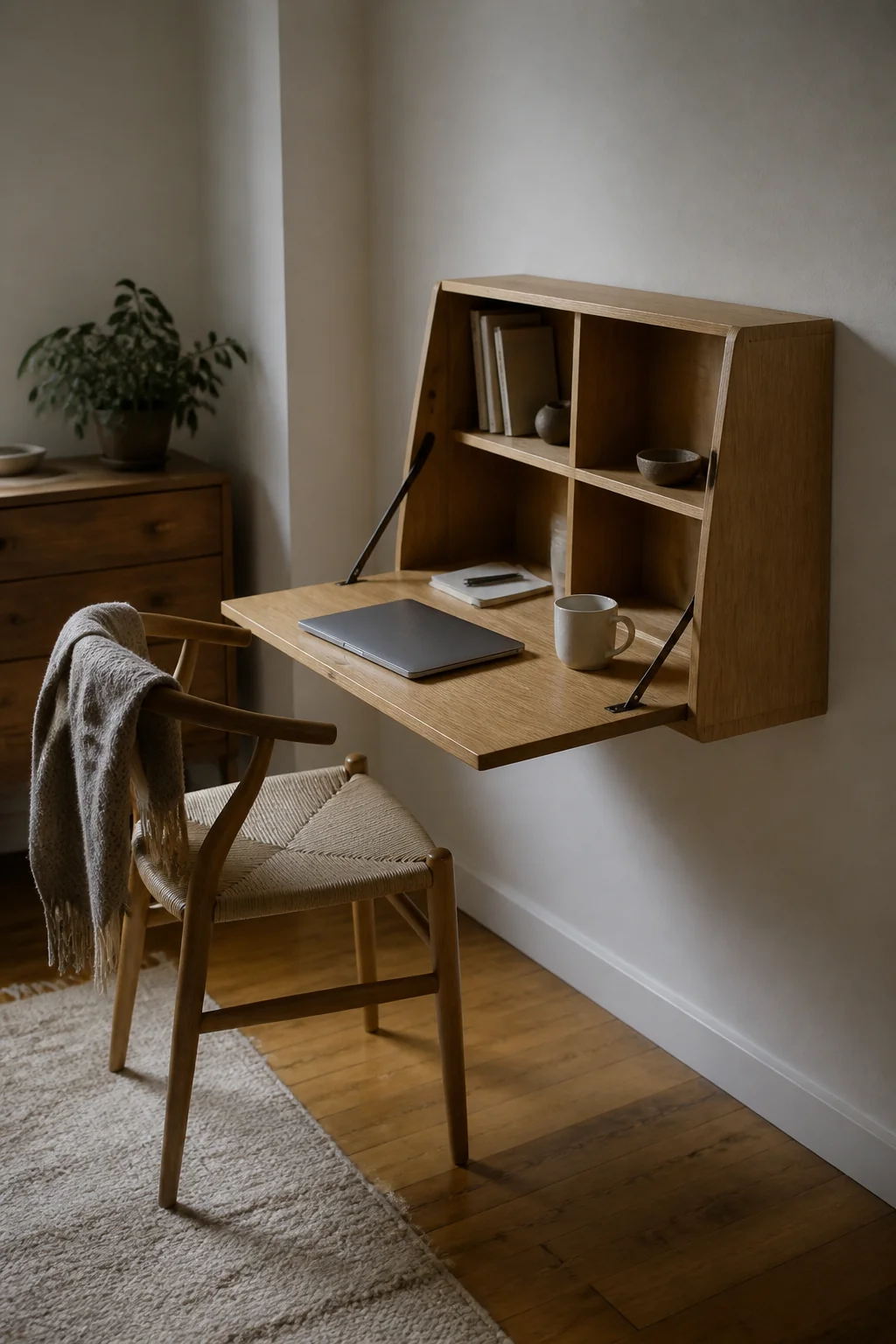
A fold-down desk disappears into the wall when you're finished, which is why it suits the dead strip between two windows or the run above a low radiator. Most need 36 inches of clear width, open to about 20 inches deep, and fold back to 4 to 6 inches. Set the writing surface at 29 to 30 inches from the floor so an ordinary dining chair slides under it. The mounting is the part people rush. Two lag screws into studs at 16-inch centers will hold; drywall anchors on their own creep and eventually pull out once a laptop, your forearms and a mug are all leaning on the front edge. A piano hinge running the full width beats two small butt hinges, which sag into a visible droop within a year. Budget $120 to $350. If the only free wall is tile or plaster over masonry, price the anchors before you price the desk.
4. Sofa with a pull-out bed inside
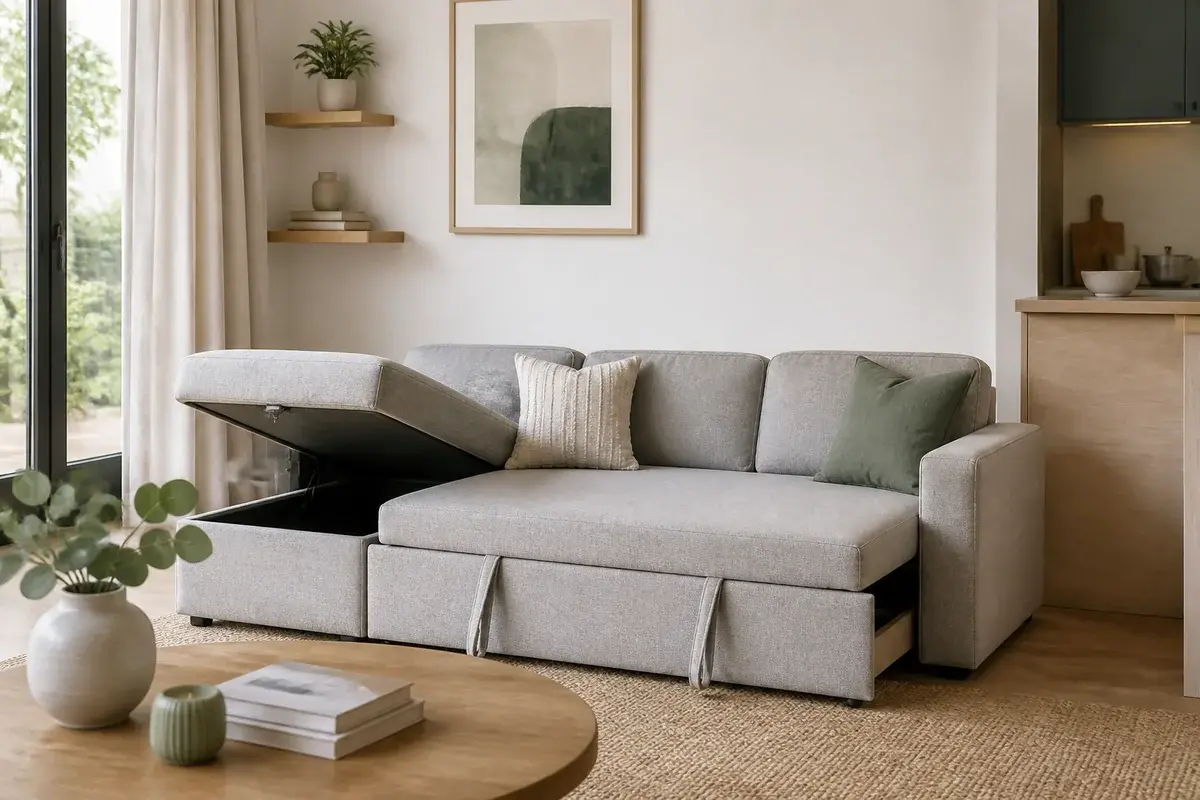
In a studio or a one-bedroom, the living room is the guest room, and a sleeper handles that honestly. Plan for 40 to 46 inches of clear floor in front of it, since the mechanism unfolds forward rather than up. Know the mattress size before the fabric wins you over: a full sleeper mattress is typically 54 by 72 inches, about three inches shorter than a standard full, so tall guests hang off the end. The mattress itself is 4 to 4.5 inches of foam over a support deck, and on cheaper frames you feel the crossbar right under your lower back at three in the morning. Bar-free mechanisms cost more and are the difference between a guest bed and an apology. Expect $600 to $1,200. Measure doorways and stair turns as well, because sleeper frames weigh 150 to 250 pounds and the folding mechanism means they can't be broken down for the trip in.
5. Coffee table that lifts up to dining height
A lift-top brings the surface up to you instead of making you fold over it. The top rides on a spring-loaded or gas-strut pantograph hinge and travels from about 18 inches to 28 or 30, landing over your lap when you're on a sofa with a 17 or 18 inch seat. That's the catch worth naming out loud: it's dining height for someone sitting on the sofa, not for someone in a dining chair. Raised tops are usually rated for 40 to 50 pounds, which covers a laptop and a plate but not your elbows bearing down. Look for a steel mechanism and test the wobble in the raised position, because the flimsy ones rattle with every keystroke. Underneath there's a shallow storage well, generally 4 to 6 inches deep, which is where remotes and chargers finally live. Expect $250 to $450 for one still working in year three.
6. Shelving unit that doubles as a room divider
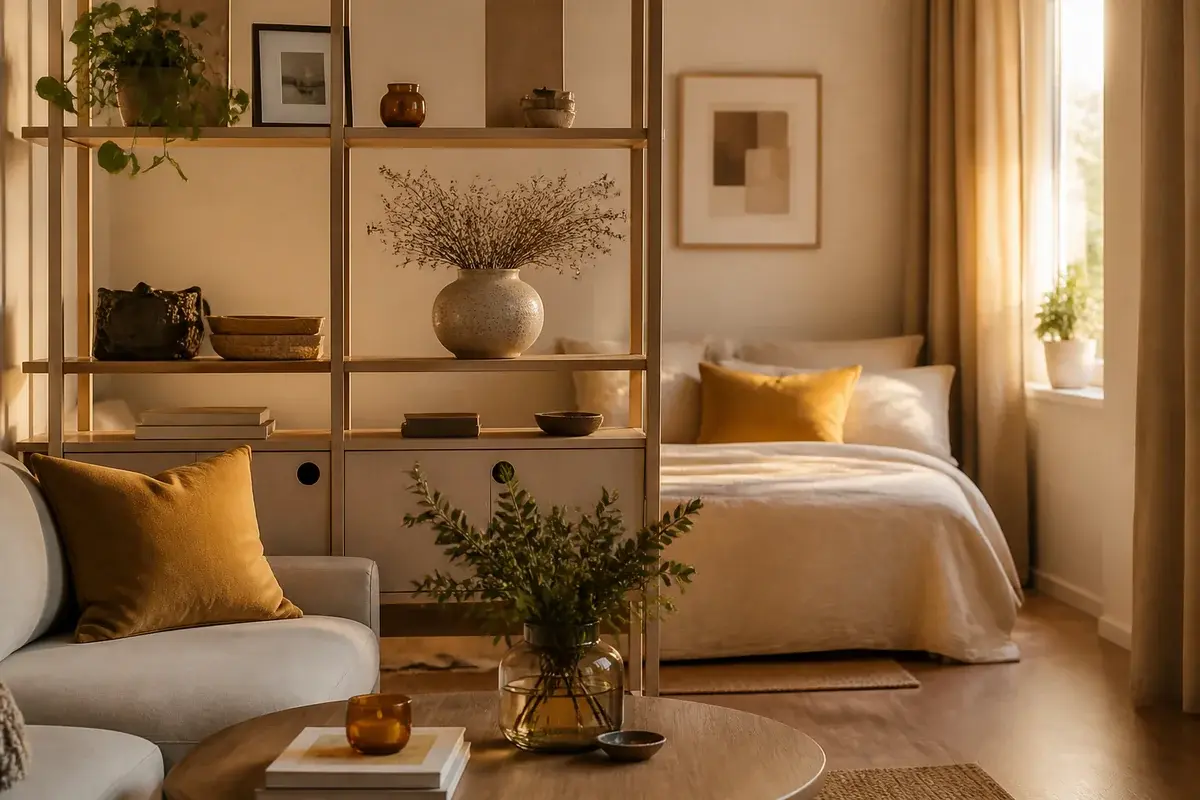
A tall open bookcase splits a studio into zones without building anything. Something near 72 inches tall and 30 to 36 wide reads as a divider while light still passes through it, so choose open-back or ladder-style. A solid back turns both halves dark and you've built a wall by accident. Load the side facing the living area with books and baskets, keep the sleeping side sparse, and the two zones stop competing. Two safety points matter here. A freestanding 72-inch case loaded on one face only wants to tip, so run an anti-tip strap into a stud behind it, or use a tension-pole unit that jacks against the ceiling. And keep the top shelf light, since weight up high is what makes these unstable in the first place. Particleboard shelves bow at around 30 to 40 pounds per span. Leave 30 to 36 inches of walkway alongside. Budget $200 to $400.
7. Bench with storage at the foot of the bed
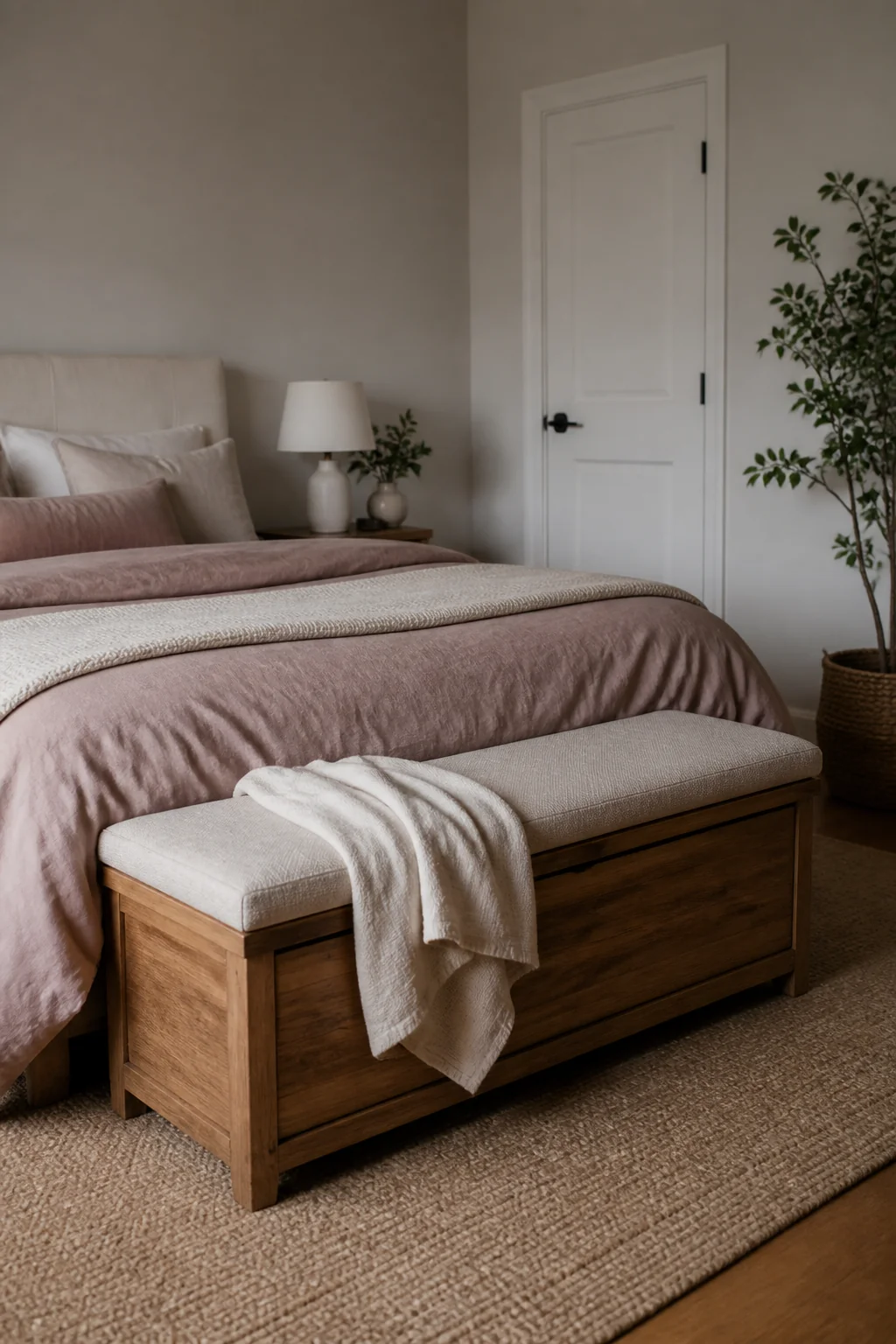
The strip of floor at the end of a bed usually does nothing, and a lidded bench turns it into a linen chest you can sit on to put your shoes on. Height matters more than you'd expect: 16 to 18 inches keeps the bench at or just below mattress level so it reads as part of the bed rather than a second piece of furniture. A 48-inch bench suits a queen, whose frame is around 62 inches wide, leaving a few inches of breathing room on each side. Then leave 24 to 30 inches between the bench and whatever's behind it, or the room stops working as a path. On hardware, a lid stay or soft-close hinge is not a luxury on a lid that heavy. Raw MDF interiors hold onto smells, so keep linens in a cotton bag or add a cedar liner. Good ones run $150 to $300.
8. Ladder shelf against a corner
Corners collect nothing but dust unless you give them a job. A leaning ladder shelf does it with a base footprint of roughly 18 to 24 inches, shelves that taper from about 12 inches deep at the bottom to 6 or 8 at the top, and a height near 72 inches. The taper is the point: the deep shelf takes books and a plant, while the narrow top holds one small object and doesn't loom over the room. It rests at a 10 to 15 degree angle, which means it needs a flat run of wall to lean on. For a true 90-degree corner, look instead for a corner etagere with triangular shelves that sits square in the angle. Thick baseboard pushes the base out and steepens the lean, so add felt pads and strap it to a stud or it walks forward on hardwood. Treat the top two shelves as decoration, 5 to 10 pounds at most. Expect $60 to $150 in pine or bamboo.
9. Nightstand with open shelves and a drawer
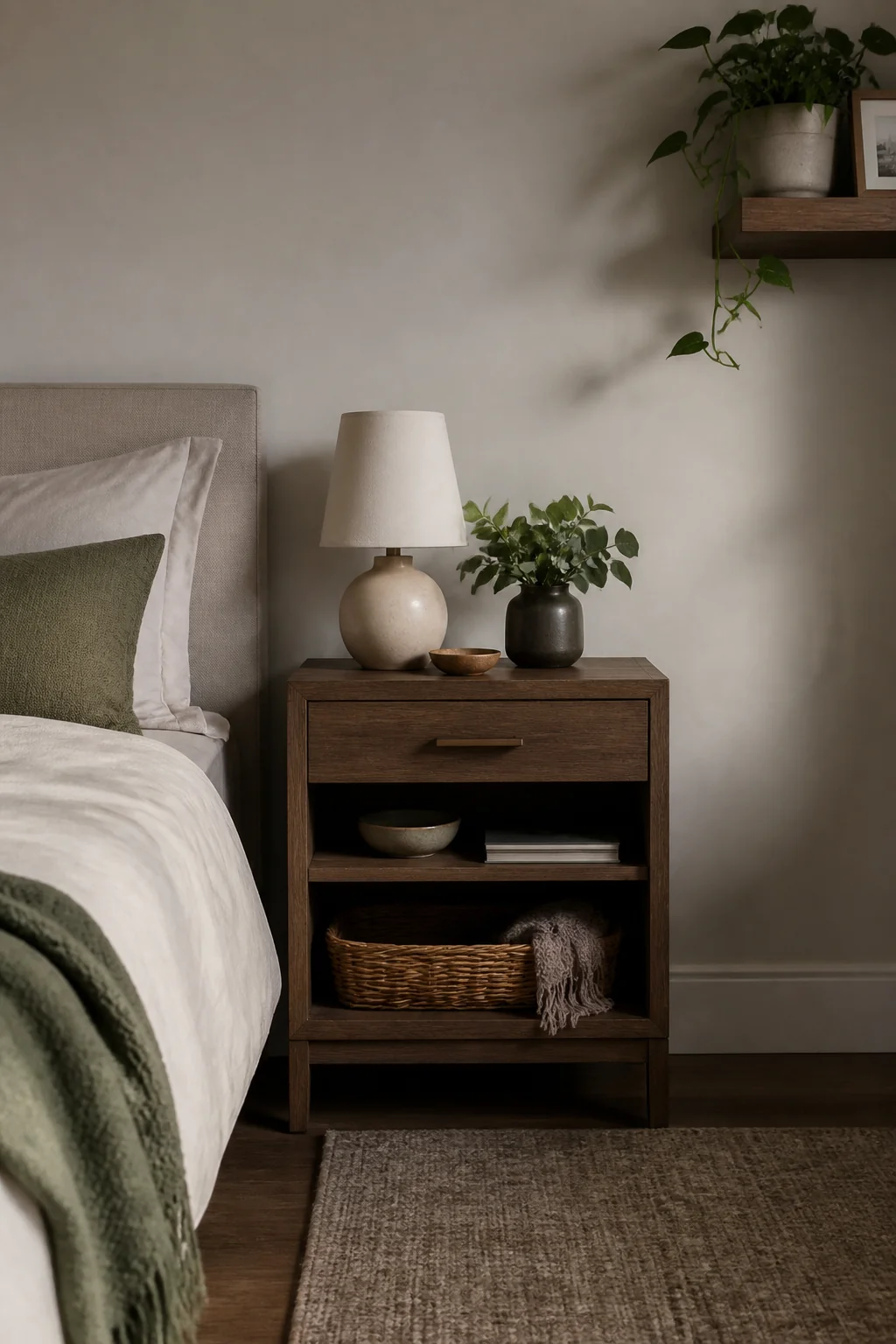
A closed box beside the bed wastes the volume underneath it. A nightstand with a top, a drawer and an open lower shelf gives you three storage zones in the same 16 to 20 inch footprint. Height is the spec most people skip: the top should land within a couple of inches of your mattress surface, which usually means 24 to 28 inches for a modern bed and higher if you sleep on a thick pillow-top. Too low and you knock your water over reaching down for it. The drawer takes the things that read as clutter, chargers, medication, hand cream. The open shelf takes one 12-inch basket or a short stack of books. That's the honest trade-off with open shelving: it only looks calm with one contained thing down there instead of five loose ones. If the back panel allows it, notch a cable pass-through so the charger cord isn't looping over the top. Prices sit around $60 to $180.
10. Desk with shelves built above it
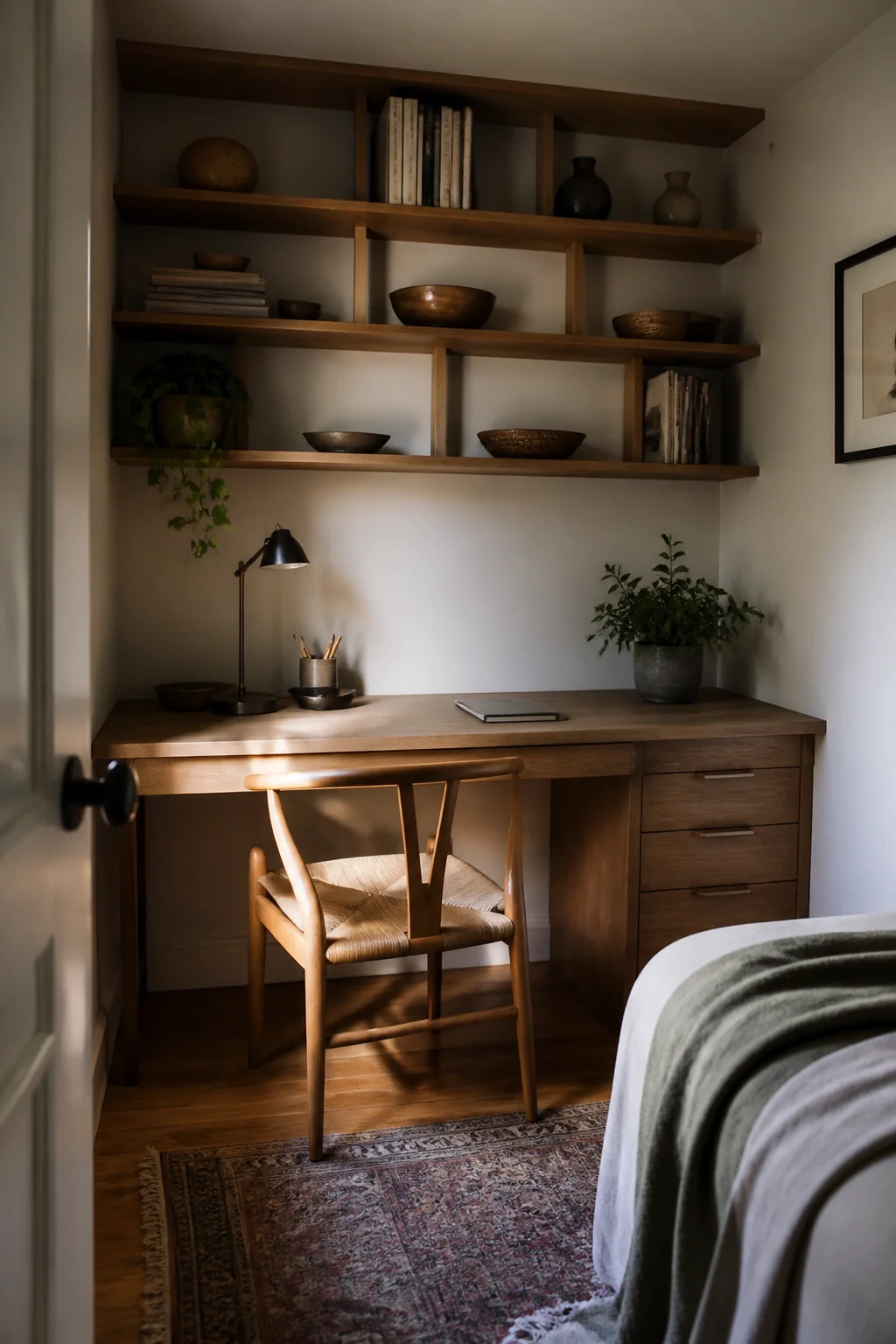
When the floor is spoken for, the only direction left is up, and a hutch stacks storage over the work surface rather than beside it. Typical widths run 36 to 48 inches, total height lands near 60, and the writing surface sits at 29 to 30. Depth is the number that decides whether you'll like it: you want 20 to 24 inches so a screen sits at arm's length, and a hutch with deep shelves quietly takes some of that back. Check the clearance under the first shelf too. Less than 18 to 20 inches and a 24-inch monitor won't fit beneath it, which is how people end up with a hutch full of paper and a laptop balanced on their knees. Make sure the hutch bolts to the desk instead of just resting on it, especially with a cat or a toddler in the house. Expect $250 to $600 depending on veneer over particleboard versus solid wood.
11. Console table that expands to dining height
A console that opens into a dining table is the trick that lets a studio host four people. Closed, it's about 12 inches deep and lives behind a sofa or flat against a wall holding a lamp. Open, butterfly or drop leaves take it out to somewhere between 36 and 70 inches long. Plan on 24 inches of table edge per person, so a 60-inch extension seats four comfortably and six only if everyone likes each other. Before buying, look at where the legs land when it's extended, because a table with legs at the outer corners leaves nowhere for knees at the ends. The failure mode on inexpensive versions is sag: leaves out, no center support leg, and the middle dips enough that glasses lean. Test the locking mechanism as well, since a top that shifts while you're eating gets retired inside a month. Expect $200 to $400.
12. Storage headboard with built-in shelves
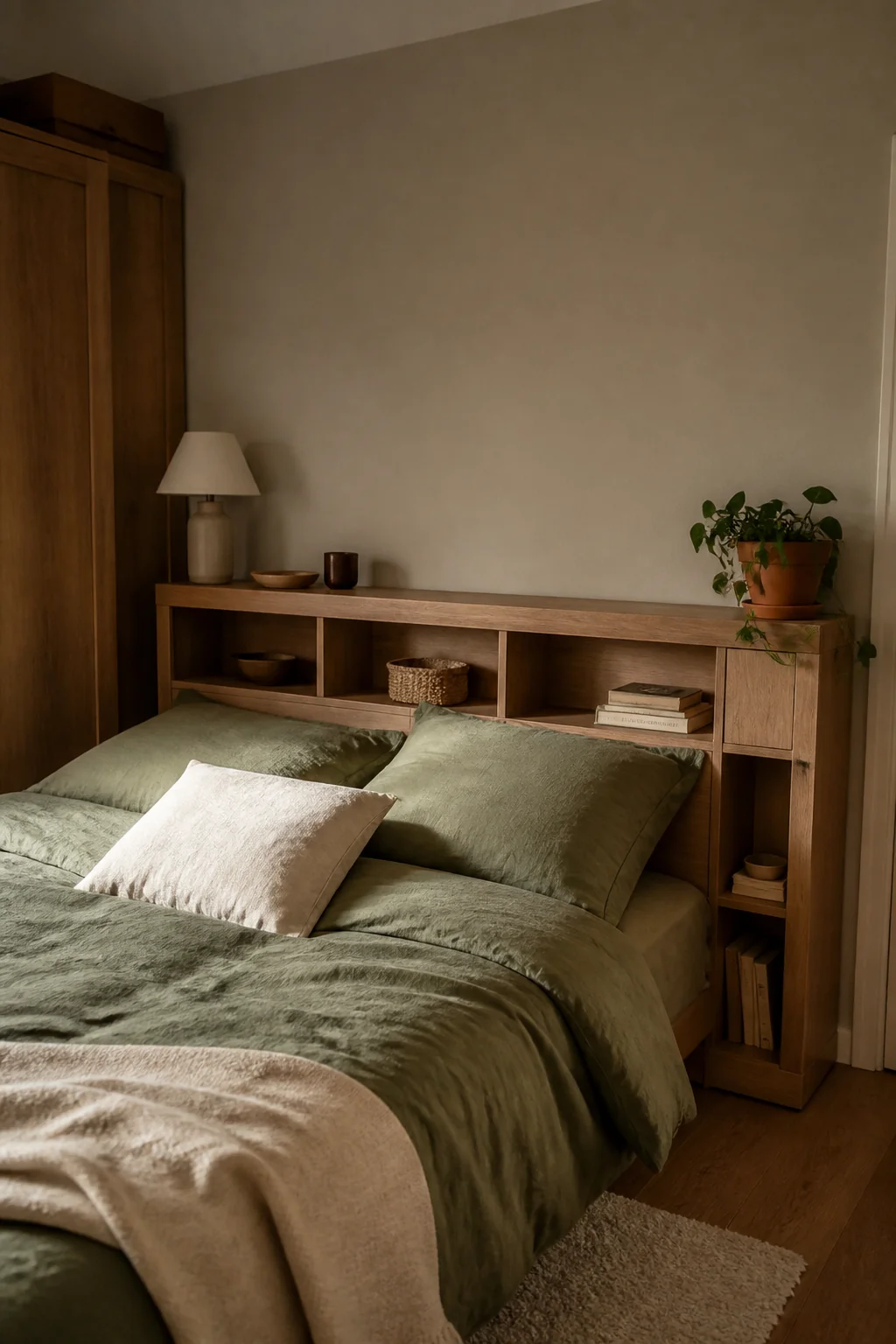
Shelves fixed to the wall behind the bed do the work of a headboard and a nightstand at once, and they cost you no floor at all. Set the underside of the lowest shelf 12 to 16 inches above the mattress: high enough that you don't crack your head sitting up to read, low enough to reach a lamp switch lying down. Keep the depth to 8 or 10 inches so nothing juts into head space, and mount into studs with brackets rated for at least 50 pounds. Drywall anchors above a pillow are a bad gamble. What you put up there matters just as much: a lamp, a book, a phone, a glass of water. Not framed glass, not a heavy speaker, not anything you'd hate to have land on your face. If you rent and can't drill, or the wall is solid masonry, a bookcase headboard about 12 inches deep does the same job standing on the floor. Shelving runs $100 to $250.
13. Vanity mirror that folds into a compact desk
A flip-top vanity keeps its mirror under the lid, so closed it reads as a slim console and open it's a makeup station. The compact ones take about 18 to 20 inches of wall; a comfortable one has a surface 32 to 36 inches wide and 16 to 18 deep, sitting at 29 or 30 inches with an 18-inch stool tucked underneath. Knee room is where these fall down. Many put a full-width drawer directly under the top, which leaves nothing for your legs if you also want to answer email there, so sit at one before you commit. Light is the other thing worth spending on, since a mirror facing a window fights glare all afternoon. Two small sconces at eye level, roughly 24 inches apart and 2700 to 3000 kelvin, light a face evenly instead of casting the shadows an overhead fixture gives you. Small units run $80 to $150, solid wood climbs past $200.
14. Sofa arm table that clips on
A clip-on arm table gives you somewhere to set a mug without adding a whole piece to the floor plan. The C-shaped ones hook over the arm, fit arms roughly 4 to 9 inches wide, carry a tray around 12 inches square, and hold 15 to 25 pounds before they start to tilt. That fit range is the entire story. Rolled arms, sloped arms and anything upholstered over a soft frame let the table lean or slide off, and a chunky sectional arm at 12 inches across simply won't accept one. Press down on your arm before you order: a solid wood or firmly padded frame holds, loose cushioning does not. If yours won't take a clip-on, the alternative is a C-table whose flat base slides under the sofa, which needs 3 to 4 inches of clearance beneath the frame and works on any arm shape. Clip-ons run $30 to $70, sliding C-tables $50 to $120.
15. File cabinet that looks like a side table
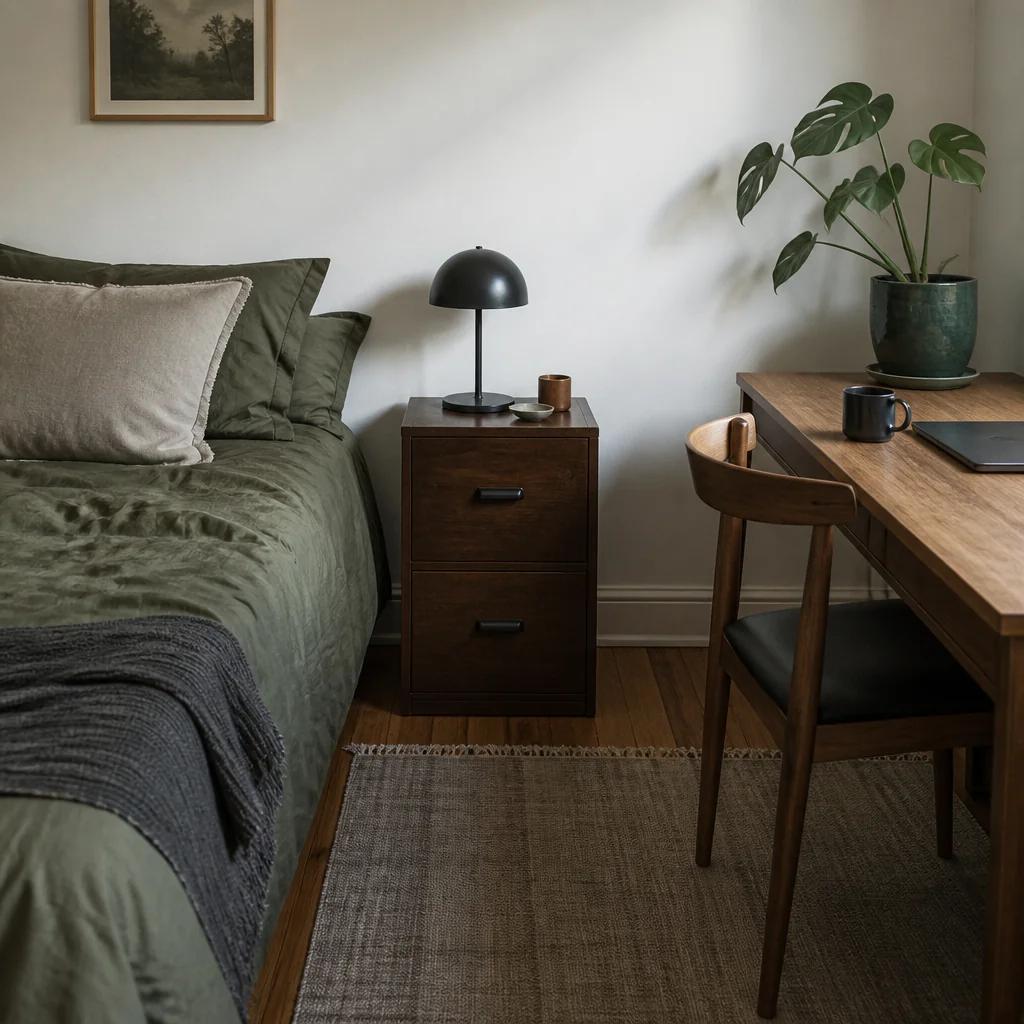
A filing cabinet in a wood or painted finish reads as a side table until someone opens it, which is how paperwork stays out of sight in a home with no office. Format decides where it can live. A vertical two-drawer is only about 15 inches wide but 25 to 28 inches deep, which is too deep to sit politely beside a bed. A lateral two-drawer is 30 to 36 inches wide and 18 to 20 deep, so it behaves like real furniture against a wall. Both land near 28 to 29 inches tall, close enough to nightstand height. Check that the rails accept the folder size you use, letter at 12.25 inches or legal, and that the slides are full-extension ball bearing rather than friction, or the back third of every drawer becomes a place things go to be forgotten. Loaded, one of these passes 100 pounds, so look for a drawer interlock that prevents both opening at once. Expect $80 to $180.
16. Dining chairs with built-in storage
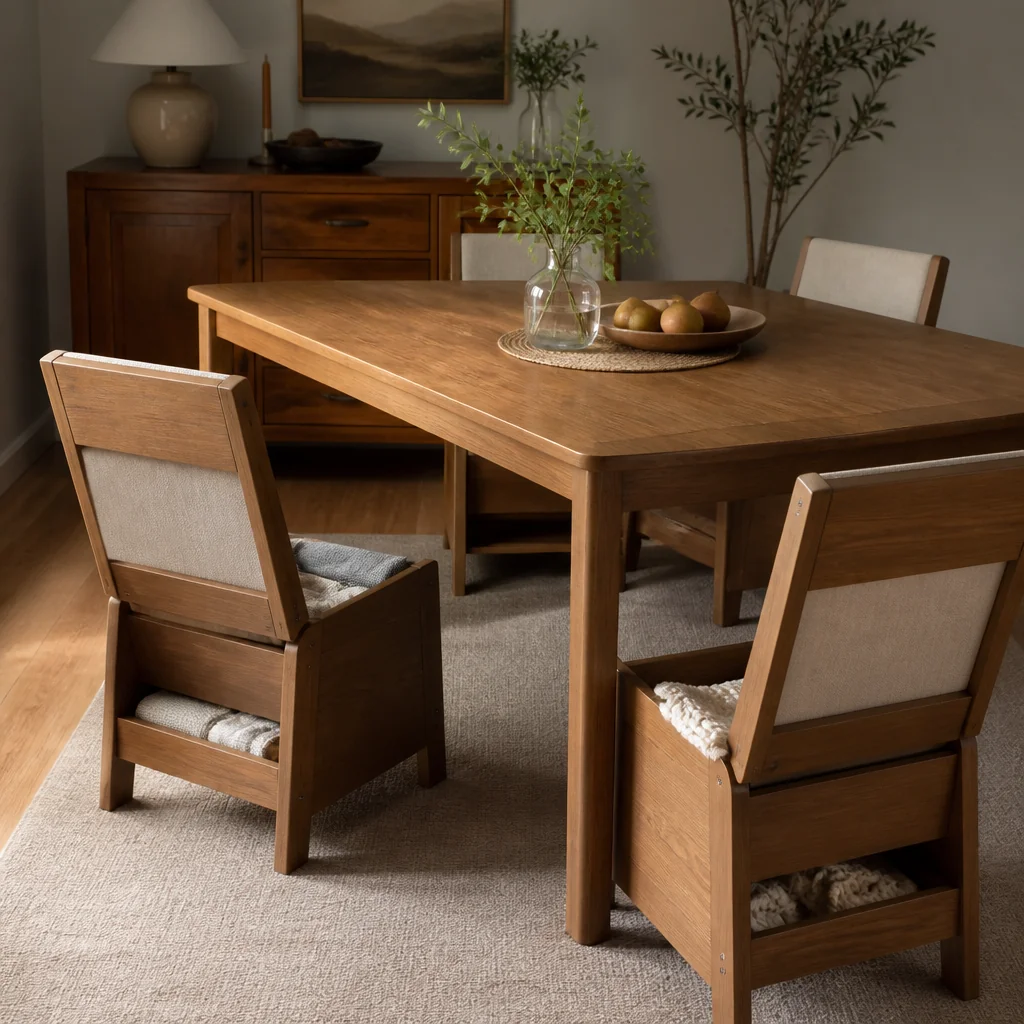
Chairs with hinged seats hide the things that belong near a table and nowhere else: placemats, napkins, spare candles, the good tablecloth you use twice a year. The cavity is shallow, usually around 14 by 12 inches and 4 to 6 deep, which is right for flat textiles and wrong for anything heavy, because you lift the whole seat every time you want in. Seat height stays standard at about 18 inches, so you still get 10 to 12 inches of thigh clearance under a 30-inch tabletop. Two details separate the good ones from the regrettable ones. The lid needs a stay or a slow hinge, since a seat panel dropping on fingers is a genuine hazard with children around. And the cushion should attach with hook-and-loop rather than sit loose, or it slides off every time you open the chair. A set of four runs roughly $300 to $600 depending on upholstery.
17. Entryway bench with coat hooks and cubbies
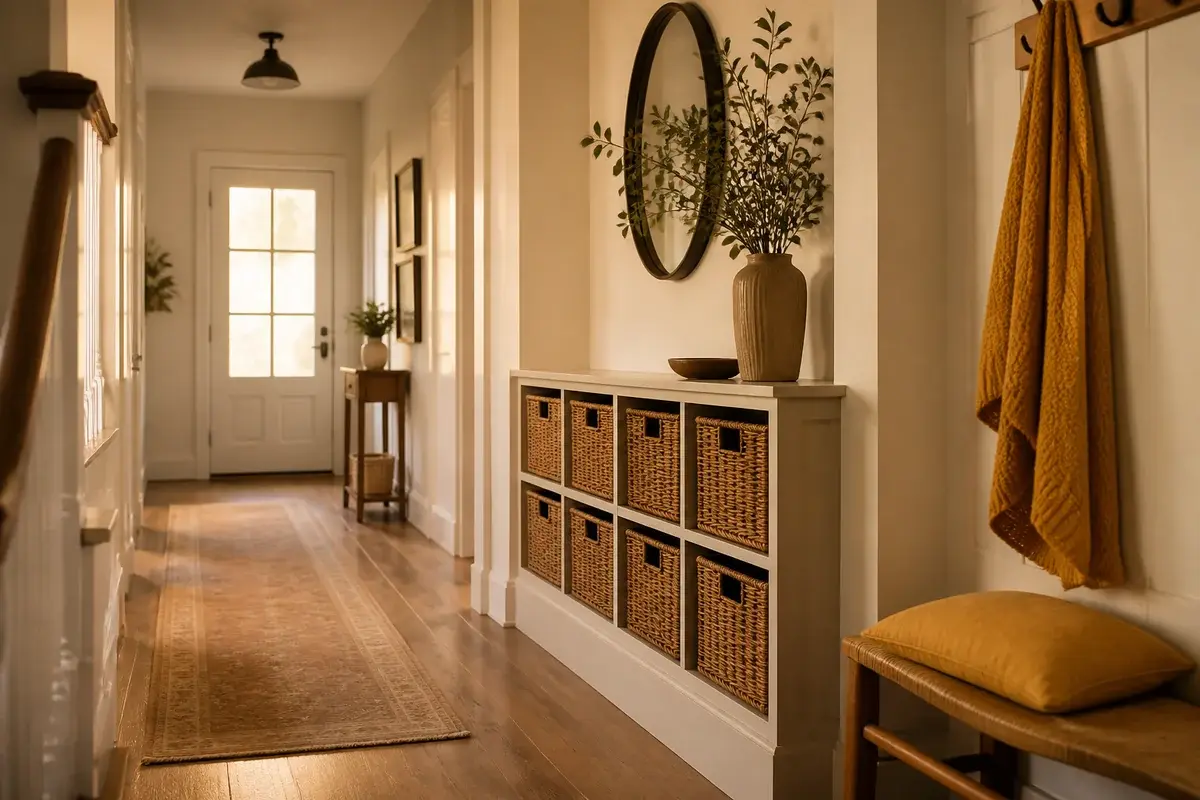
An entry that's really just a hallway can still handle coats, shoes and bags if you stack the three functions vertically. A bench around 36 inches wide with hooks above and cubbies below does it, and depth is what makes or breaks the layout. You need 14 to 16 inches of bench depth to genuinely sit and pull boots on, plus 36 inches of clear walkway past it. In a 36-inch hallway that arithmetic fails, and the better answer is a 10 to 12 inch deep hook rail with a shallow shoe tray on the floor beneath. Set hooks 60 to 66 inches from the floor for adults, and add a second row near 40 inches if there are kids who need to reach their own coat. Cubbies about 12 inches square hold two pairs of sneakers each, or one pair of boots. Expect $150 to $350 for a solid one.
18. Tall, narrow bookcase in a corner or along a wall
The narrow bookcase is the quiet workhorse of a small room: 24 inches wide, 11 to 12 deep, holding what a dresser holds without blocking a window. Check that depth against what you actually plan to store, since standard fabric bins want 13 to 15 inches and will hang over the front edge. Shelf spacing near 12 inches takes hardcovers, while art books and binders need 14, so adjustable pin holes are worth more than a nicer finish. On a 72-inch unit the real risk is sag: particleboard shelves bow over spans longer than 30 inches once they're full, so choose solid wood or a thicker shelf on wider models and keep the heavy things on the bottom two. Strap it to a stud, always with children in the house. If you want it floor to ceiling, check for crown molding first, which stops the case a couple of inches short of the wall. Expect $80 to $200.
19. Rolling cart with three tiers
A three-tier cart on casters is storage that goes wherever the need is: kitchen overflow one month, art supplies in the bedroom the next. Typical dimensions run 17 to 20 inches wide, 12 to 14 deep and 30 to 33 tall, with 10 to 12 inches between tiers and a sensible load of 20 to 25 pounds per shelf. If the plan is to slot it beside the fridge or between counter and wall, measure the gap and add an inch, because the handle usually projects past the basket. Casters are where cheap carts disappoint. Two-inch wheels stall on rug edges and door thresholds, and without locks the cart drifts every time you pull something off it. Powder-coated steel shrugs off spills while plastic joints work loose over a year of being dragged. Open mesh baskets also let small items fall through, so add a liner if it's holding pens or spice jars. Expect $40 to $100.
20. Bed with a built-in desk at the foot
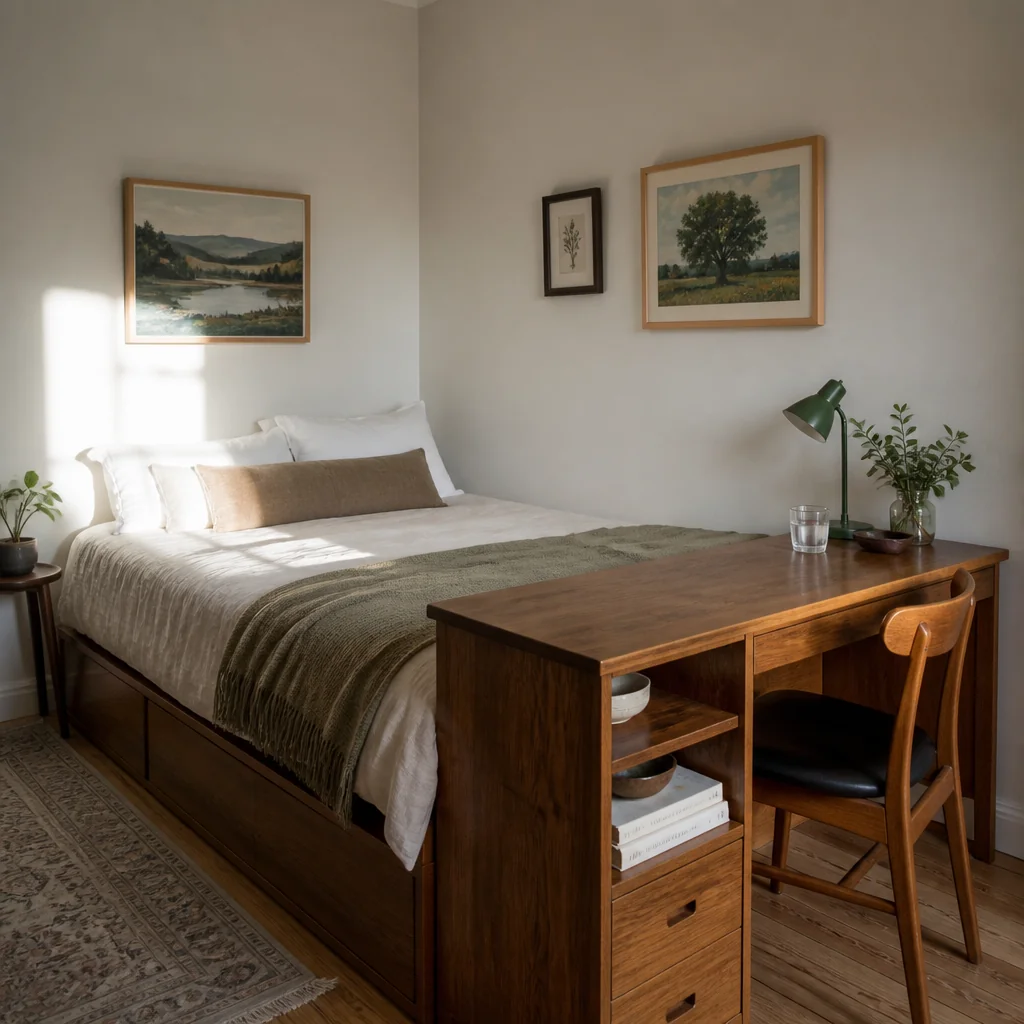
Some frames build a small work surface into the footboard, which genuinely helps in a room that has to be a bedroom and a study at once. Be realistic about the size: the surface is usually around 40 inches wide and 16 to 20 deep, fine for a laptop and a notebook, too shallow to put a monitor at a comfortable viewing distance. It also stretches the bed's overall length by 20 to 24 inches, so a queen version can need close to 100 inches of wall, which is more than some rooms have. Sit at one before buying. Knee clearance is the usual disappointment, since a support panel or drawer often occupies exactly where your legs want to be, and you can't adjust a surface fixed at 29 inches. For homework, video calls and a laptop it earns its keep. For eight hours a day at a real workstation, it doesn't. Expect $500 to $800.
21. Wall-mounted folding table for the kitchen
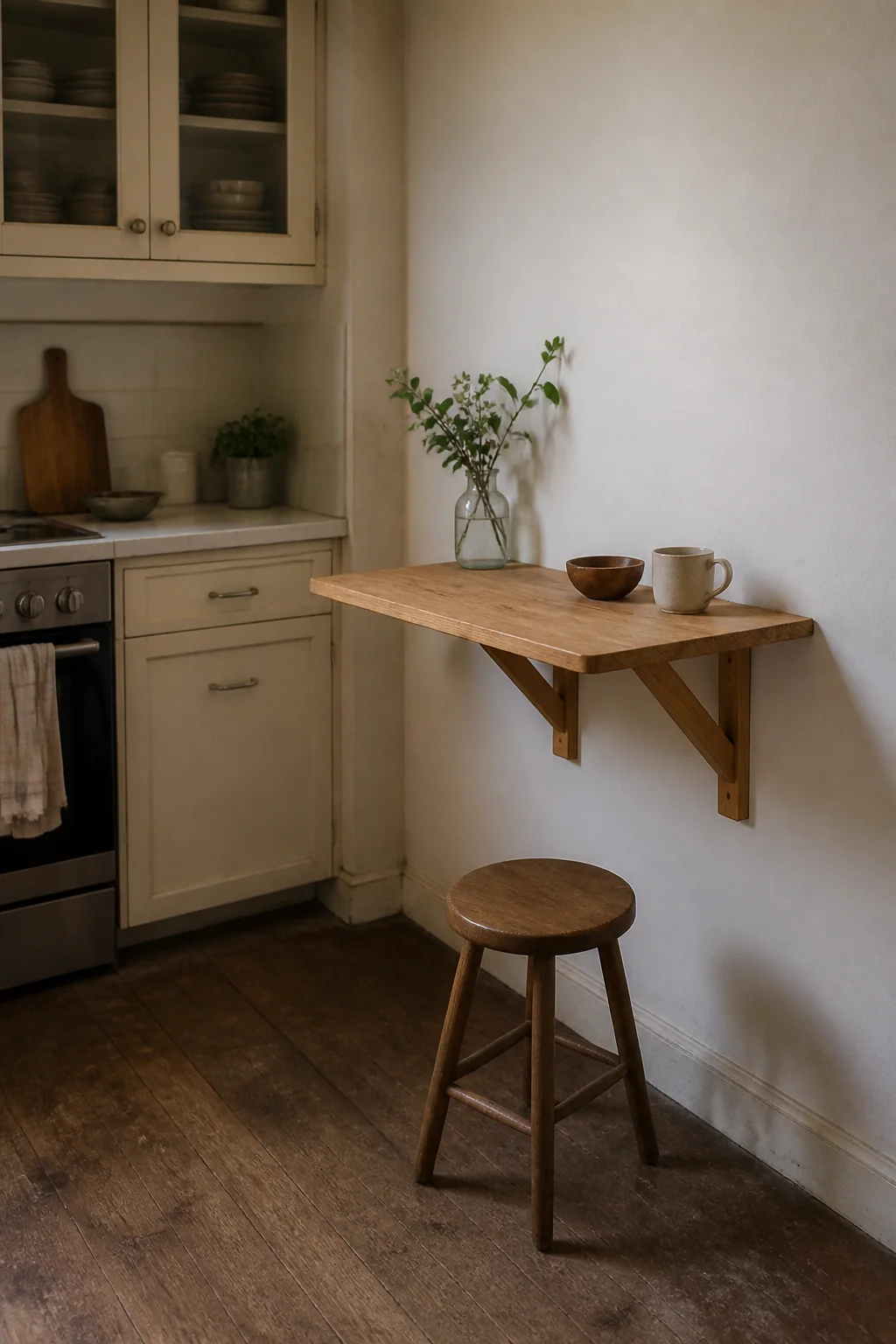
A wall-mounted folding table gives a galley kitchen a prep surface or a two-person dining spot that vanishes afterward. Most are 24 to 30 inches wide, open to 15 to 20 inches deep, and fold to about 4 inches against the wall. Mounting height decides what the table is, so decide before you drill: 30 inches from the floor for dining chairs, 36 for counter stools. Getting that wrong is the single most common regret with these, and the holes are already in your wall. The bracket does all the work, so hit two studs and use a drop-leaf bracket rated for 50 to 100 pounds, or the correct masonry anchors if you're going into tile over concrete. Allow about 24 inches of edge per person, meaning a 30-inch top seats two facing each other and no more. Check the swing path too, so the folded leaf doesn't block a drawer or cover an outlet. Prices start near $70.
22. Settee or loveseat with a pull-out storage bench
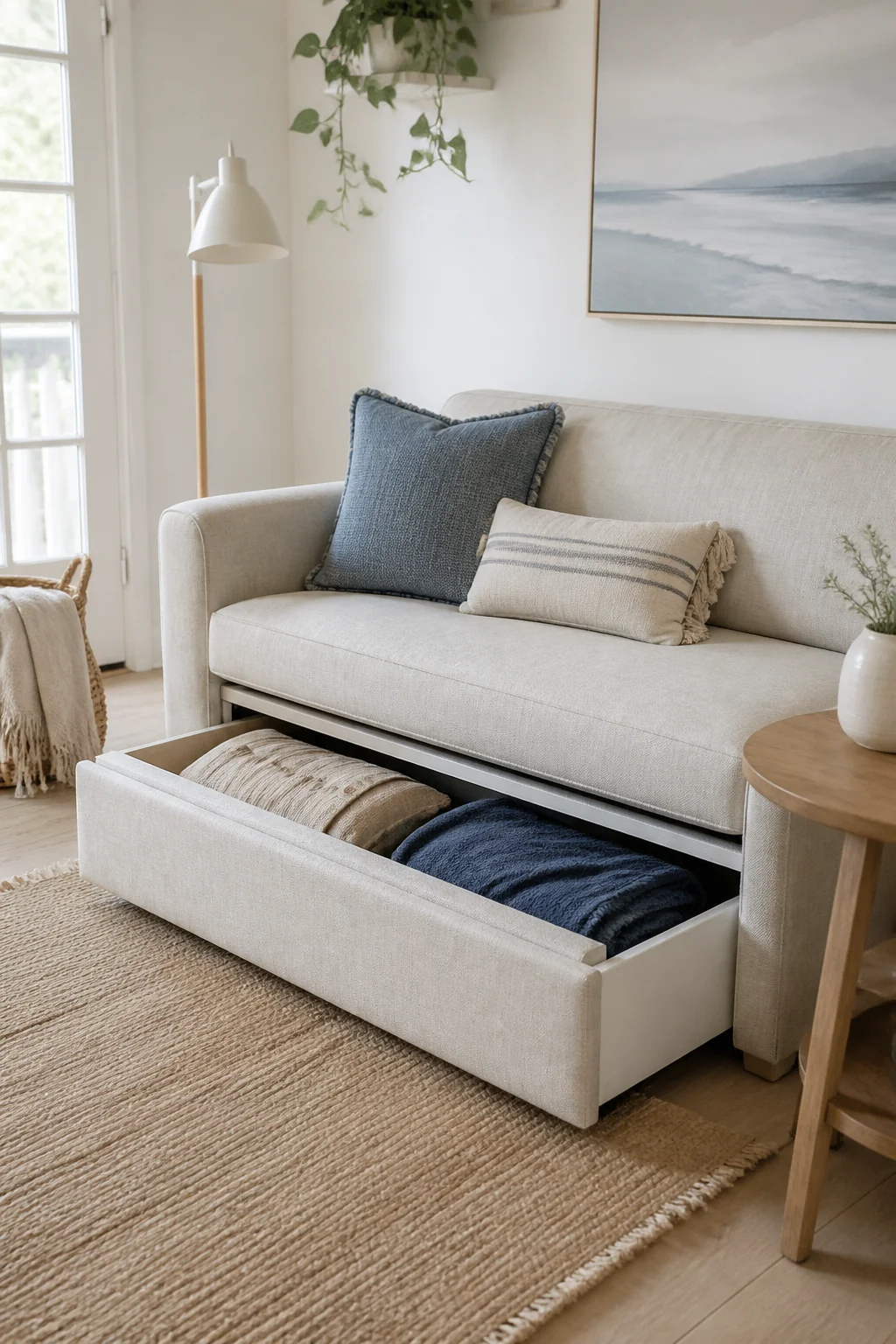
A settee is a sofa with the lounging designed out of it, and in a tight room that's often a fair trade. Expect 48 to 58 inches wide against the 84 of a standard three-seater, and a seat depth around 20 to 22 inches instead of 24, which keeps you upright rather than sunk back. Pair it with a lidded storage bench in front and you get seating, a coffee table and a blanket box inside the floor area a sofa alone would have taken. Size that bench at 36 to 40 inches long and 16 to 18 tall so its top sits just below the seat cushions, and add a tray if drinks are going on it. Ask what the frame is made of: kiln-dried hardwood survives moves, stapled pine doesn't. Most settees weigh around 90 pounds and clear a 30-inch door in one piece. Budget $400 to $800 for the pair.
The whole guide in one image
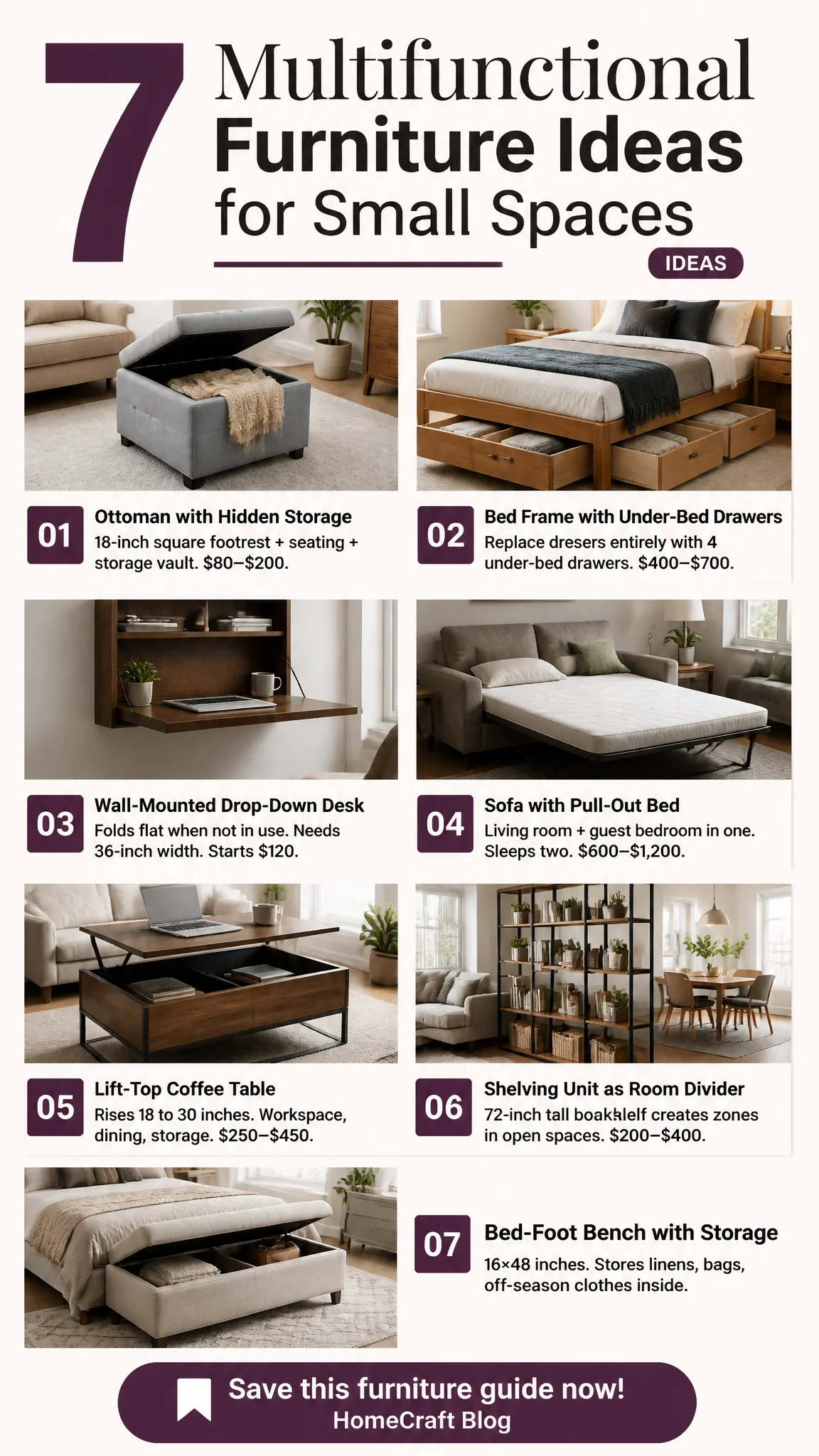
One caution before any of this turns into a purchase. A piece that does two jobs badly is worse than two pieces that each do one well, and the test is whether the second function costs you anything in the first. A sleeper you hate sitting on is a bad sofa. A lift-top that rattles is a bad table. The pieces here that last are the ones where the mechanism is boring, the hardware is rated for real weight, and the open dimensions still fit the room you have rather than the room in the photograph.