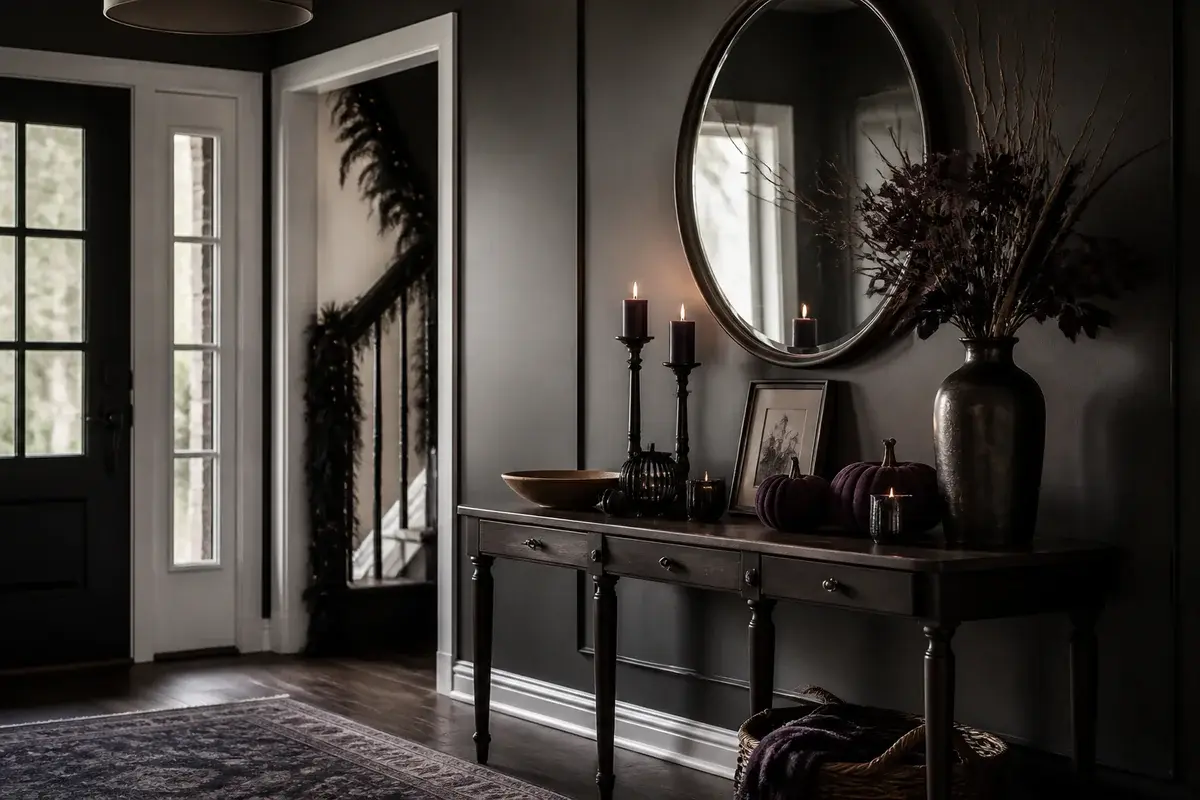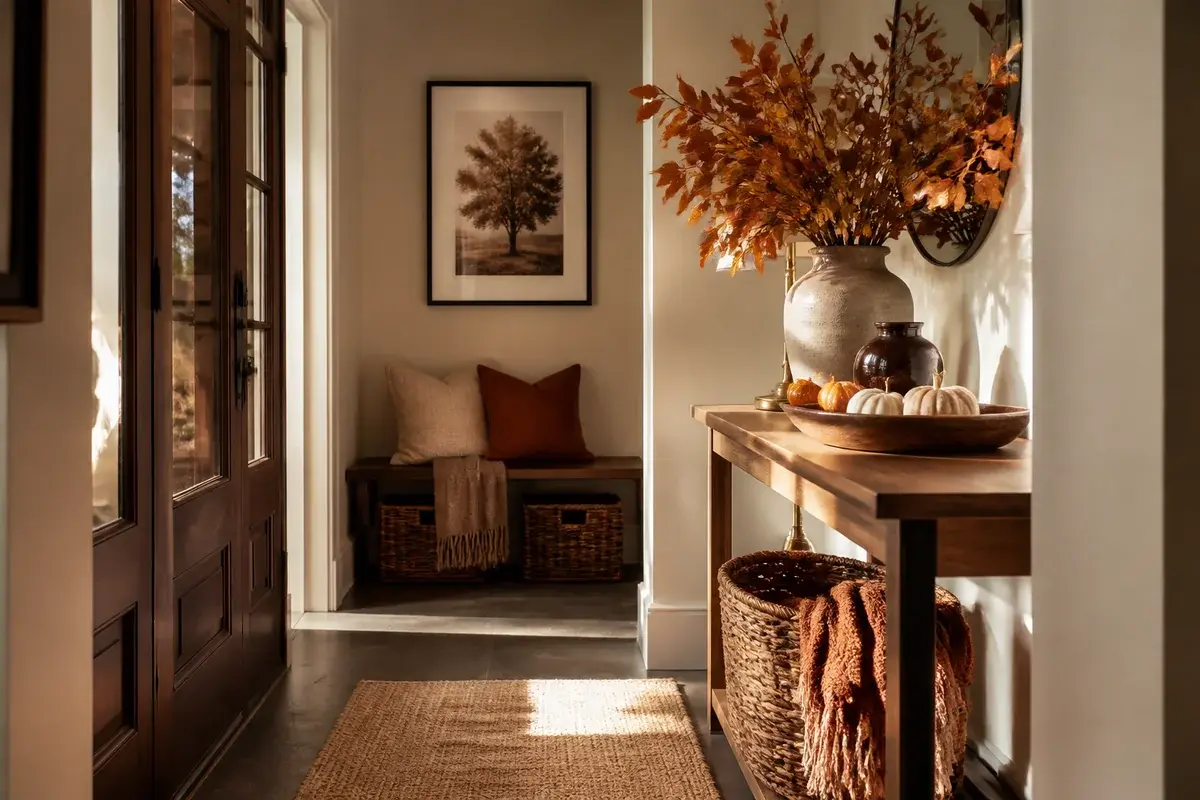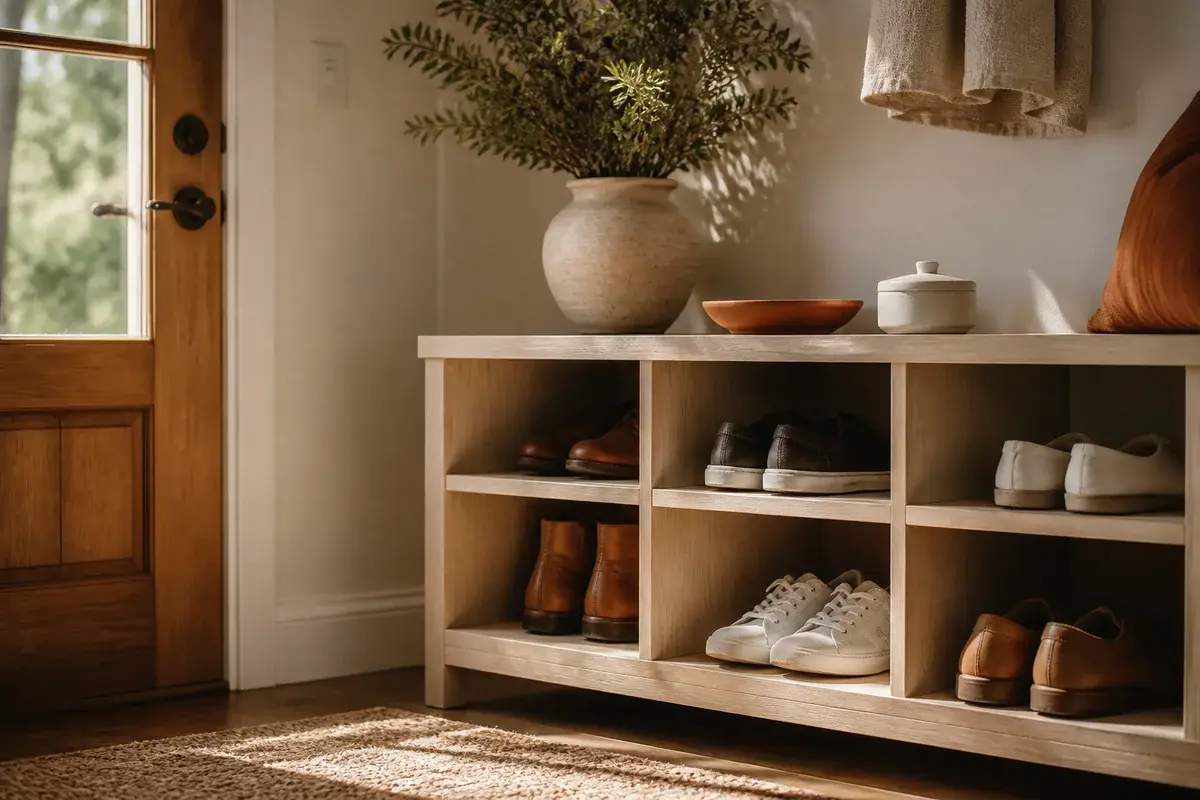
How to Style a Modern Farmhouse Entryway for Under $400
Modern farmhouse entryway ideas with real rug sizes, sconce heights, prices and renter-friendly hanging methods for small halls.
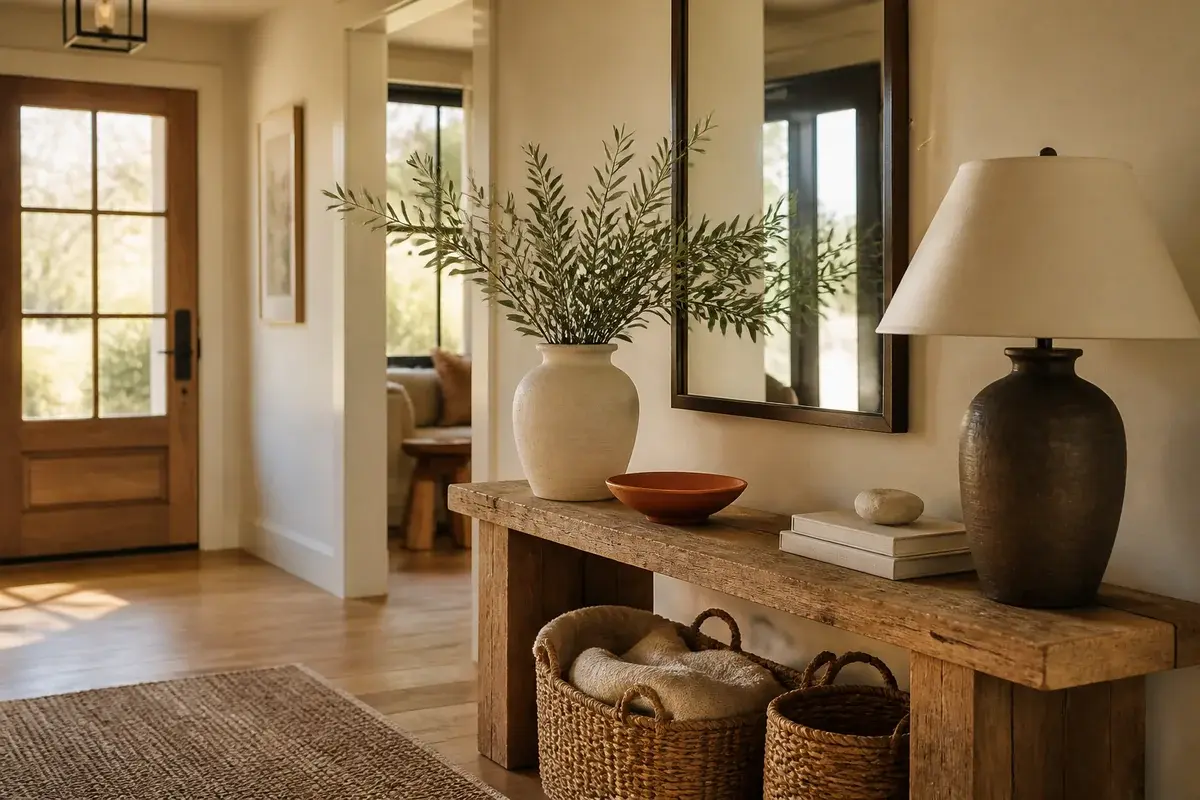
An entryway is the smallest room in the house and the one everybody forms an opinion about. Usually it's four to six feet of floor, one door, and whatever slice of wall you can reach before the hallway starts. That's also why it's the cheapest room to fix. Modern farmhouse suits it because the style is built from texture rather than furniture: natural fiber underfoot, plain or painted wood, warm metal, and a mirror doing most of the heavy lifting. You don't need a mudroom, a bench with cubbies, or a statement chandelier. Around $400 covers a rug, a light, a mirror, somewhere to drop keys, and somewhere for shoes to live, and most of that goes to the two pieces you use every single day. Here's how to spend it, in the order that makes the biggest difference.
Start With a Rug That Anchors the Space
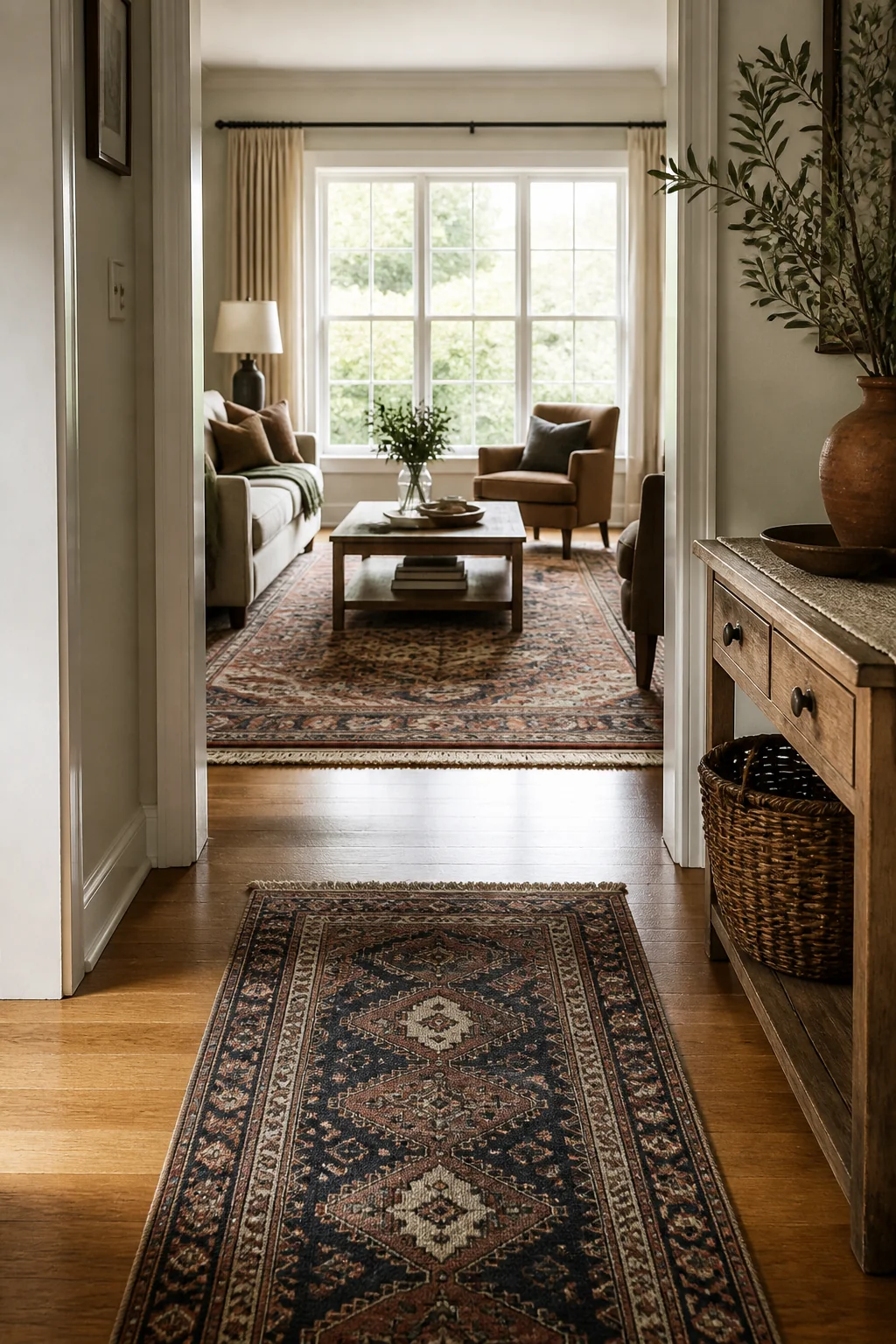
A good entryway rug does more work than you'd expect. It defines the space, catches grit before it travels down the hall, and gives you a warm surface to land on. For a modern farmhouse look, natural fiber reads right: jute, sisal, or a wool flatweave with a quiet neutral stripe.
Size first, because that's where most entryways go wrong. A 3x5 looks like a bath mat parked in front of the door. In a standard hall a 4x6 or 5x7 sits properly, and a long entry wants a 2'6" x 8' runner instead. Check the door swing before you buy anything: you need roughly half an inch of clearance between the bottom of the door and the pile, so a low flatweave beats a shag every time.
Expect $45 to $60 secondhand and $60 to $120 new for something that survives a winter. Jute is the one catch. It wicks water and dries with brown rings, so if wet boots come through that door, a polypropylene indoor-outdoor rug woven to look like jute is the smarter buy. Add a $15 felt and rubber pad underneath so it stops creeping toward the stairs.
Your Front Door Doesn't Need Paint (But Color Helps)
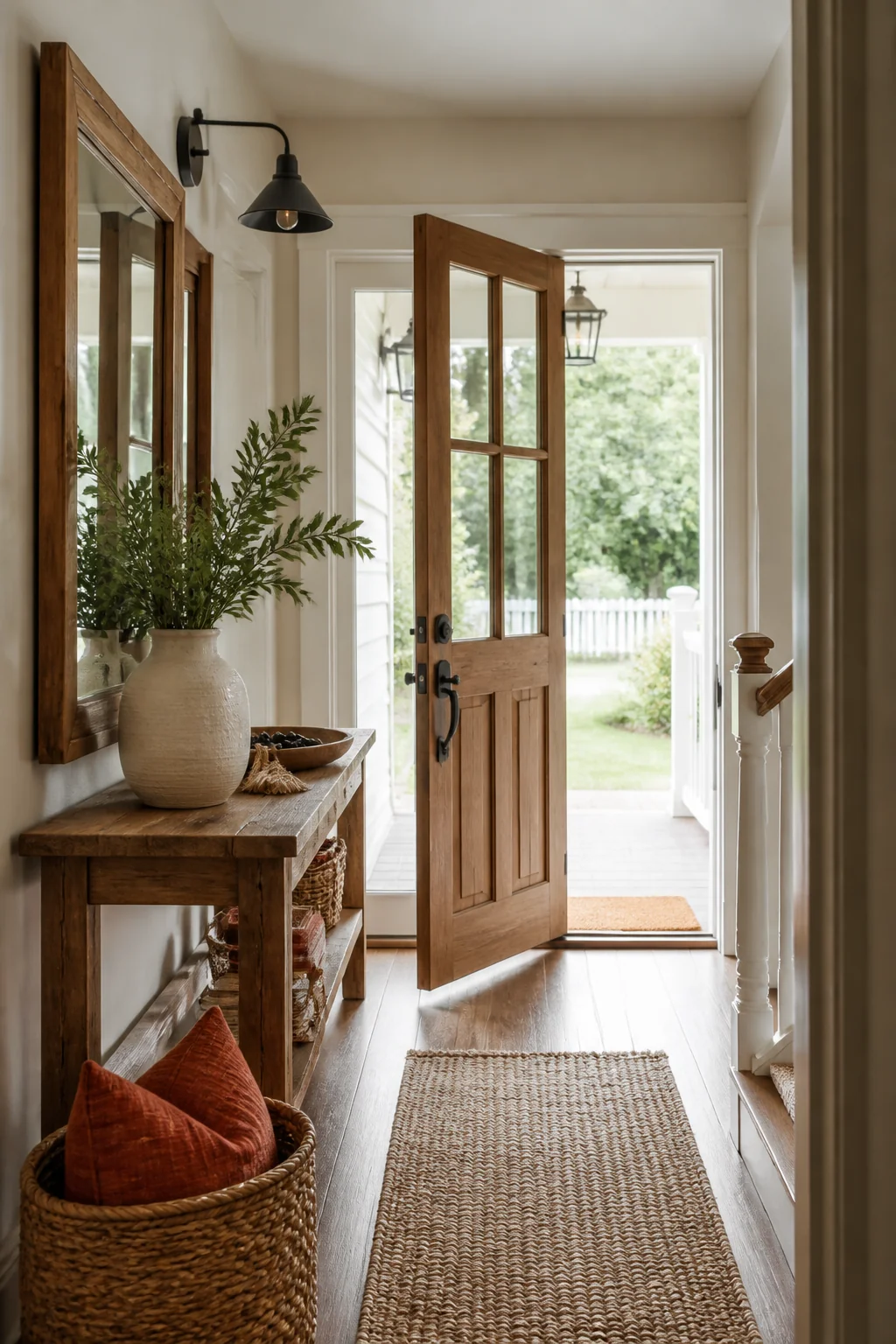
If your door is solid, clean and already a neutral you can live with, leave it alone. Cream, warm white and soft greige all sit comfortably inside a farmhouse palette, and repainting a door that's perfectly fine is the easiest way to lose a weekend and see nothing change. Build the rest of the entryway around the tone you've got.
When paint is worth it, the prep is the actual job. Wipe the door with a degreaser, scuff the whole face with 220 grit paper, spot prime any bare wood or knots, then brush on two thin coats of exterior acrylic enamel. Leave four to six hours between coats, and prop the door open for a full day before it closes against the weatherstripping, or the two surfaces bond and the paint tears off in strips the first cold morning.
Budget $30 to $50 for a quart, a brush and sandpaper. Two cautions worth knowing. Don't paint in direct sun above 90F, because the surface skins over before it levels and you're left with brush ridges. And check the warranty before you go soft black on a fiberglass or vinyl-clad door: dark colors absorb enough heat to warp some of them, and plenty of manufacturers exclude that damage.
Wall Decor That Feels Collected, Not Curated
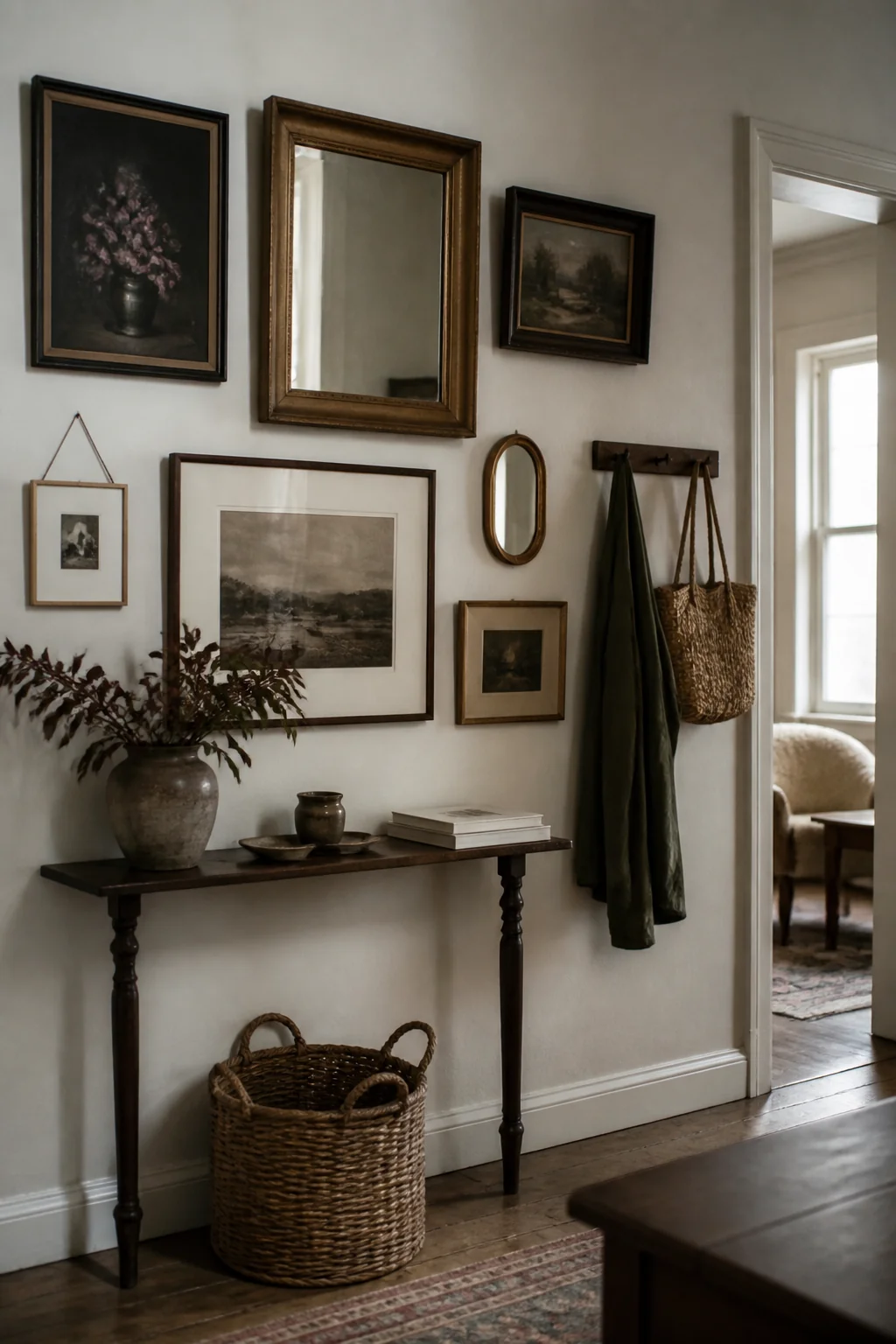
Here's where the least money buys the biggest visual change. A modern farmhouse wall should read as gathered over years rather than ordered in one cart: framed botanical prints, a small wooden sign, a wood-framed mirror, maybe one aged metal piece. Thrift stores and marketplace listings run $10 to $20 a frame and about $25 for a used mirror.
Numbers are what make a mixed group look deliberate instead of random. Center the whole arrangement around 57 to 60 inches for average eye level, with 2 to 3 inches between frames so each piece still reads on its own. A hall narrow enough that you always pass the wall at arm's length is the exception, and an inch or two lower suits it better, because you catch the group at an angle rather than head on. Above a console, keep 6 to 8 inches of bare wall between the tabletop and the bottom of the mirror, and take the mirror to about two-thirds of the table width. A mirror you actually use on the way out the door earns an exception there, going wider and lower than the ratio wants.
Renting? Large adhesive picture-hanging strips hold about 16 pounds per pair on smooth painted drywall, which covers most thrifted frames. A heavy wood-framed mirror is well past that, so use a toggle anchor rated for 25 pounds or more, or find a stud. A narrow console 10 to 12 inches deep, or a floating shelf, gives keys and a small plant a home while leaving the 36 inches of walking width you need to get through with grocery bags.
Lighting That Doesn't Scream Budget
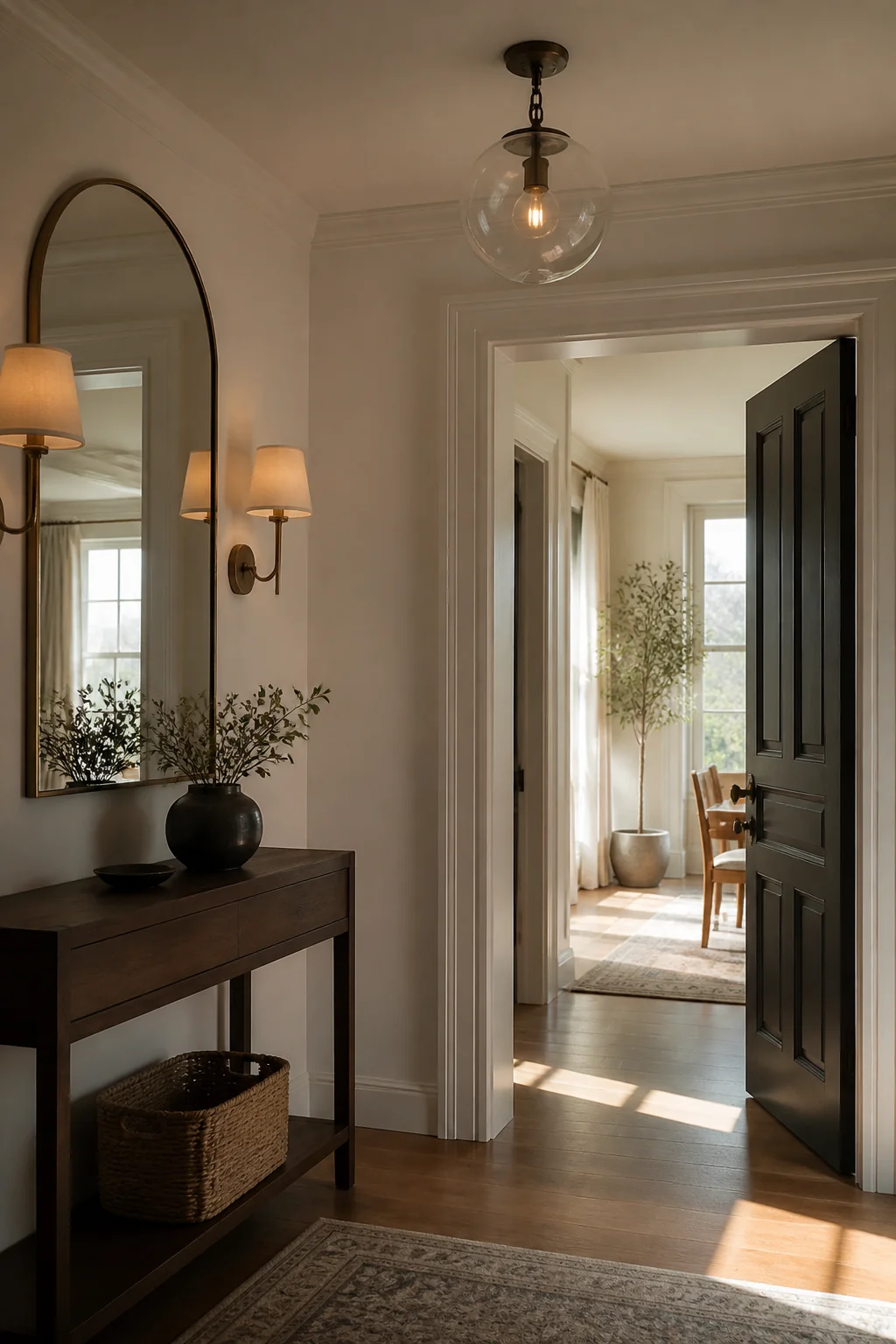
Poor light is what leaves an entryway feeling unfinished, no matter what's hanging on the walls. A single cool-white bulb overhead flattens every texture you just paid for and turns warm jute a dull grey. Warm, low, layered light does the opposite.
Two simple sconces flanking the door, or one centered above the mirror, is the reliable farmhouse move. Clean lines in aged brass, matte black or brushed nickel all belong here. Mount them 60 to 66 inches off the floor and 28 to 36 inches apart so the light reaches faces rather than the tops of heads. Fixtures start around $30 to $60 each, and a pair often turns up near $50 at discount home stores.
The bulb matters as much as the fixture: 2700K, somewhere between 450 and 800 lumens, which is a 40 to 60 watt equivalent. Anything at 4000K reads like a garage. If there's no junction box on that wall, plug-in sconces with a paintable cord cover solve it for renters, while having an electrician add a box runs $150 to $300. When the ceiling is your only option, keep the bottom of a flush mount at least 7 feet up so tall guests don't meet it.
Small Details That Make It Feel Done
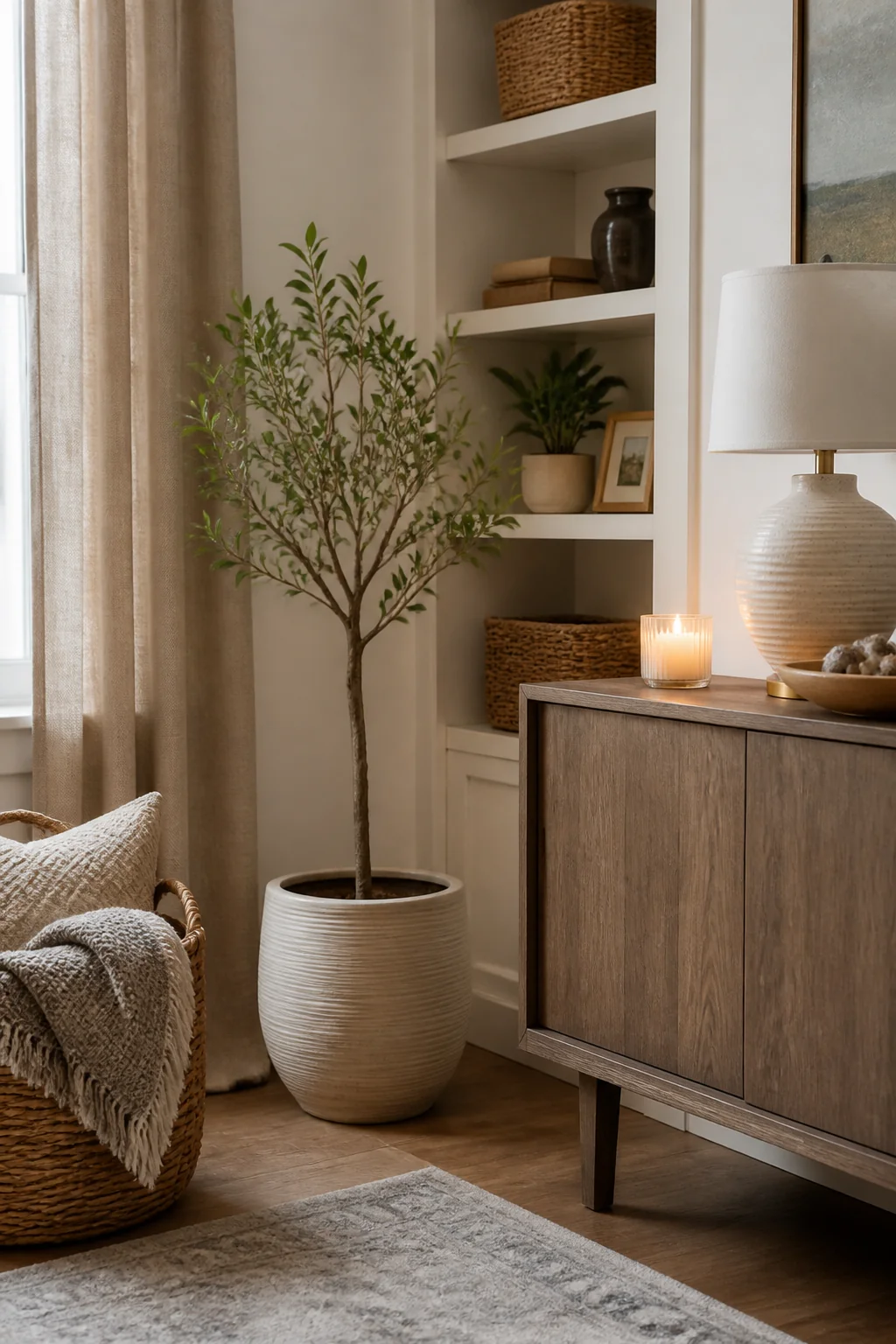
With the rug, the light and the wall settled, the small functional pieces are what make the space look lived in. A basket for shoes or seasonal gear. A coat rack with some character. A tray for keys. One plant.
Size them to the actual job. A woven basket around 16 by 12 by 10 inches holds three or four adult pairs, which is realistic for two people. Go smaller and you get a pile of shoes beside the basket by Wednesday. Set coat hooks at 60 inches for adults, add a second row at 40 inches if kids use this door, and space hooks 8 to 10 inches apart so bulky coats aren't crushing each other. A wet wool coat is heavier than it looks, so drive the rail into studs or use anchors rated 25 pounds and up.
Figure $20 for the basket, $30 for a wooden rack, $10 to $15 for a small tray. Entryways are usually dim, so pick a snake plant or a pothos, which both tolerate low light where a fiddle leaf fig drops leaves within a month. If a piece isn't earning its spot most days, we'd leave the surface empty instead.
Budget Your Money Smartly
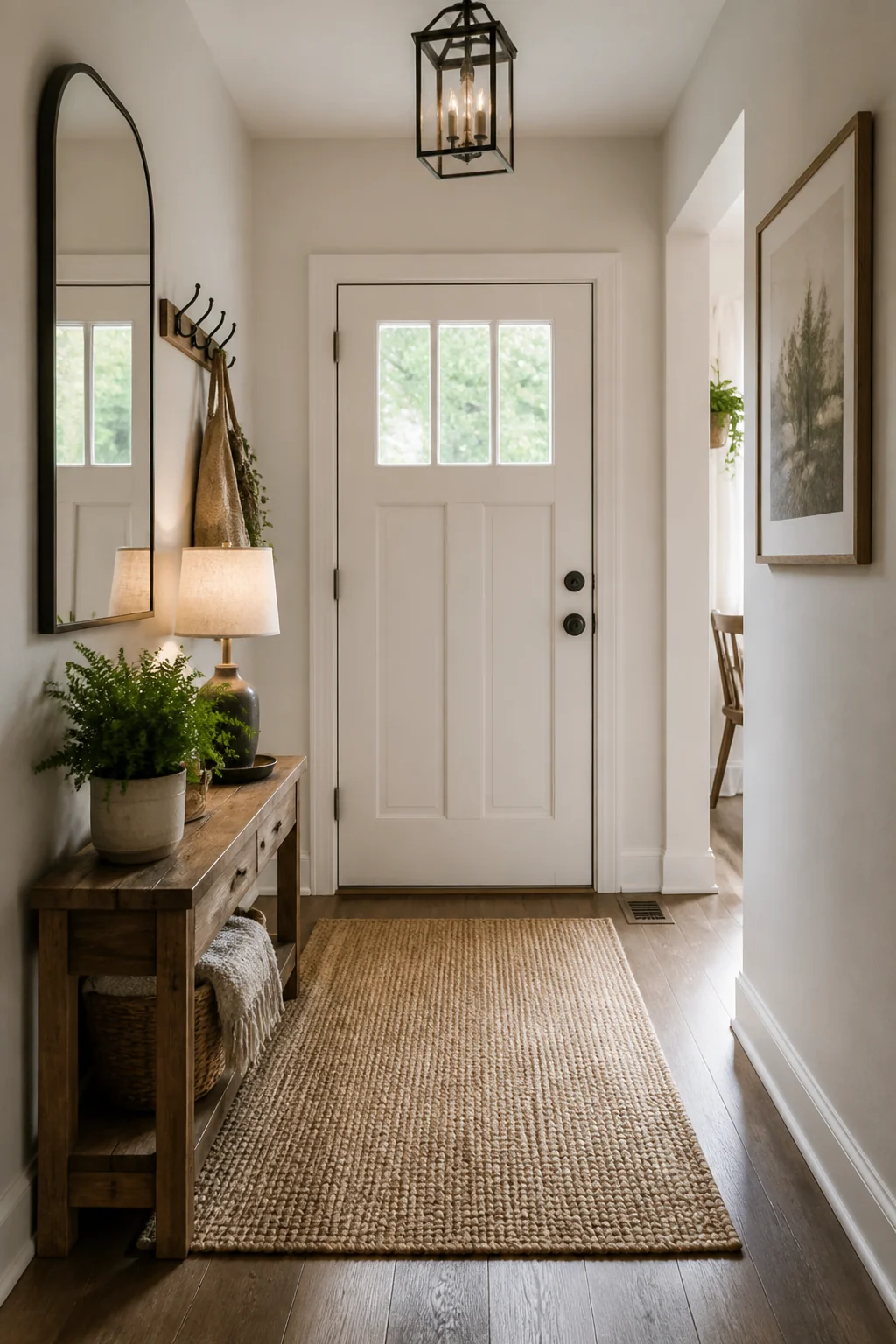
A finished entryway lands under $400, and the arithmetic holds up. A working breakdown: rug $45, paint and supplies $30 to $50 if the door needs it, mirror plus wall art $60, sconces $50, secondhand console and basket $80, small accessories $30 to $40. That leaves room for a delivery fee or a set of anchors without blowing the number.
The order you buy in matters more than the total. Spend on what you touch or stand on daily: the rug, the lighting, the storage that holds real coats and real shoes. Save on whatever is easy to swap later, meaning wall art, plants and seasonal bits. Secondhand is where the one-off pieces live, big box covers the basics, and online marketplaces are best for mirrors and consoles that cost a fortune new and resell for $25.
If your budget is $150 rather than $400, buy the rug and the light and stop there. Those two carry a bare hallway on their own. Starting with accessories is the common mistake, because $150 of small decor scattered across a dark floor still looks like a hallway with clutter in it.
Save this for your next project
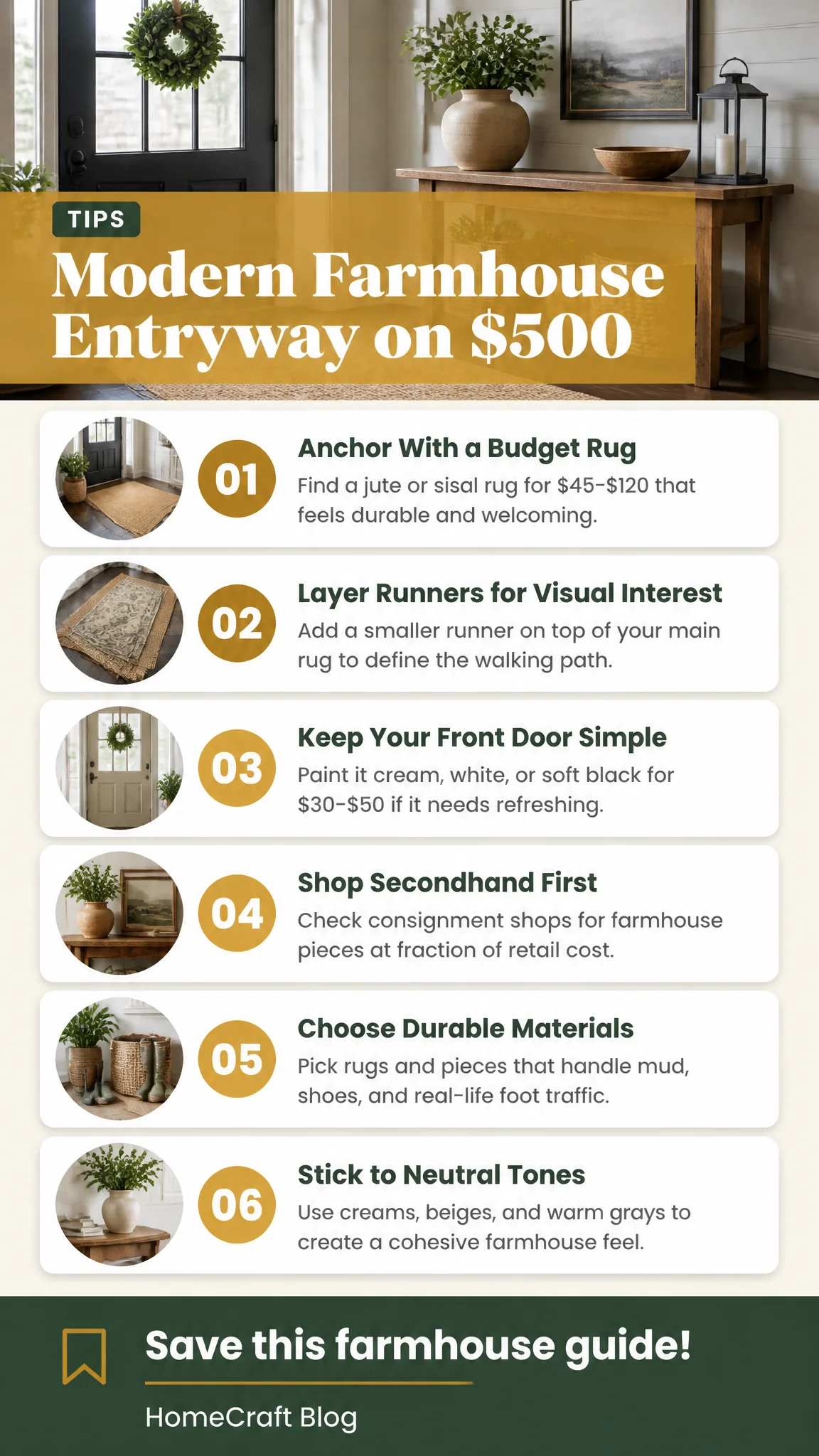
One measurement is worth taking before any of this gets ordered. Open your front door all the way and mark where the leading edge sweeps. The rug edge, the console, the basket and the coat rack all have to sit outside that arc and still leave a clear path through. Get it right and a $400 entryway feels calm every time you walk in. Get it wrong and even the pieces you love become things you step around.
Ideas fade by Friday. A plan finishes the room.
You just read a full guide to your entryway. Saving ideas will not change it; a plan will. The Home Decor Collection is every planning tool we make, for every room in the house, in one download, so the after photos below stop being other people's rooms.
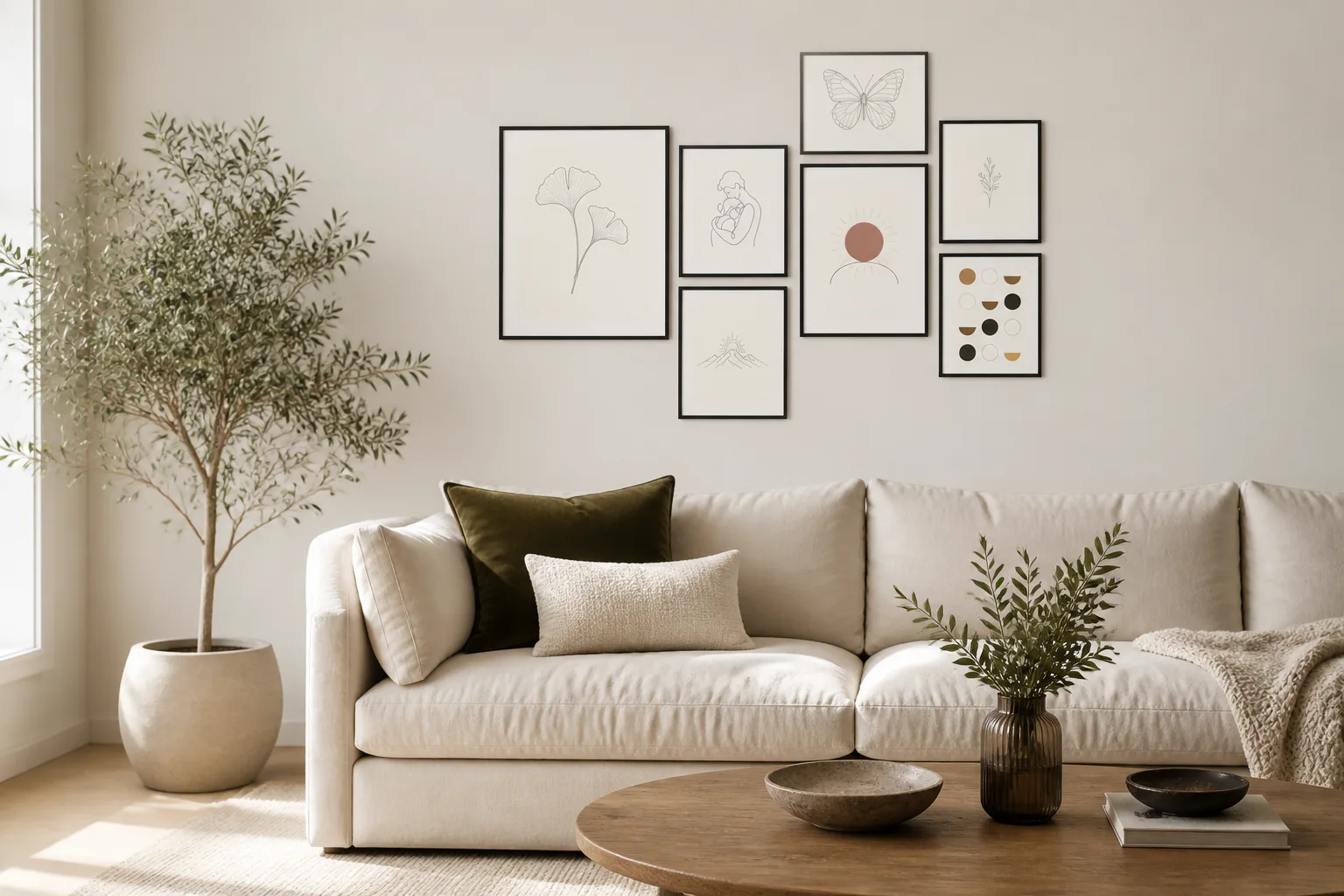
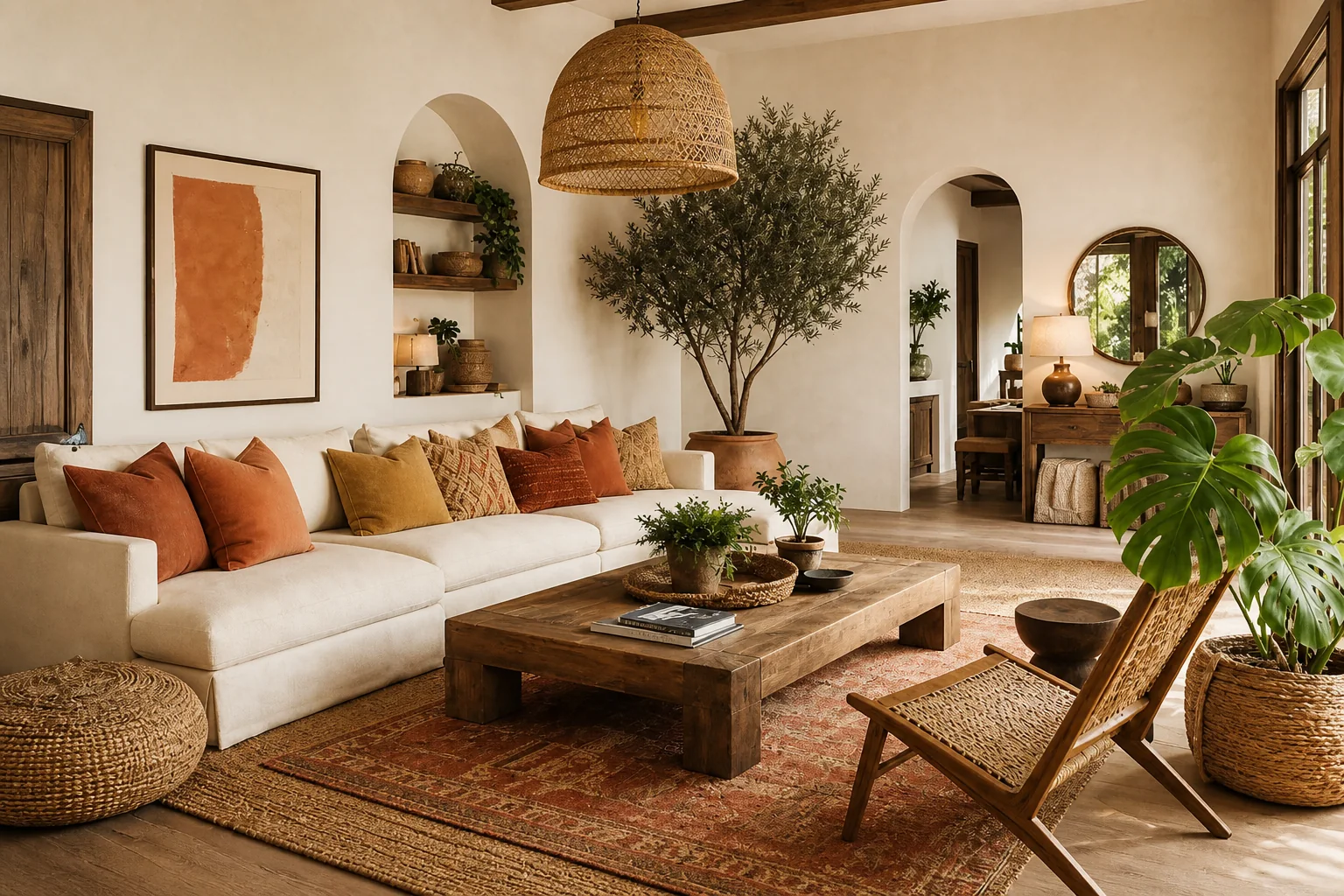
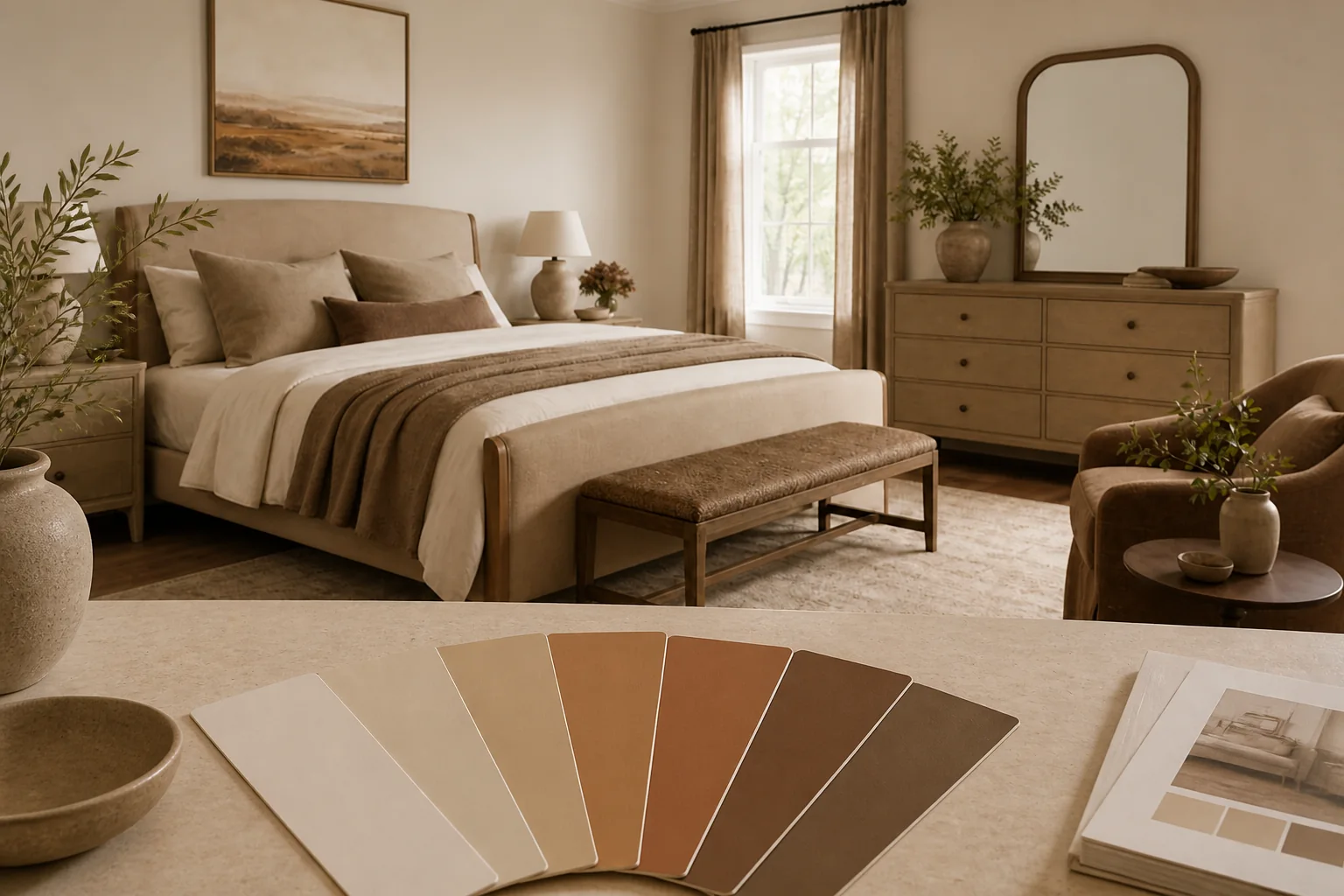
- Six room Style Kits, each with layout, palette and shopping list$114
- The Gallery Wall Studio: 200 prints + 15 measured layouts$29
- The Room Makeover System: 40 solved room layouts + workbook$29
- The Color Palette Handbook: 60 palettes shown in real rooms$19
- The Whole-Home Reset: 40 printable organizing checklists$19
- The Decorator's Cheat Sheets: the 40 measurements that matter$9
- All eleven products, bought separately
$219$97
A single hour with an interior designer costs more than the entire Collection, and this one keeps answering for every room you will ever decorate. Free updates included as the products grow. And if it is not for you, the 14 day money back promise means you simply get a refund.