20 Smart Entryway Shoe Storage Ideas for Small Spaces
Twenty entryway shoe storage ideas that hold up in tight spaces, with real measurements and prices. From wall hooks to under-stair drawers, fix the pile by your front door.
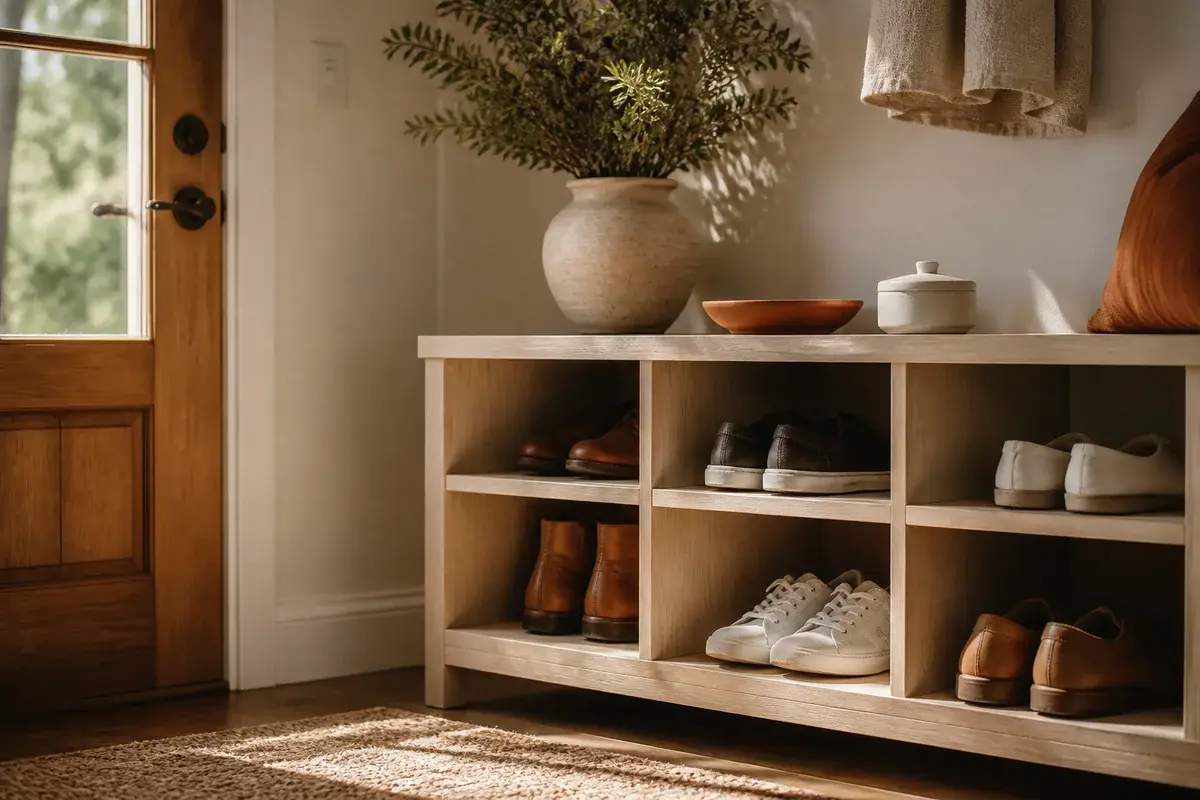
Thirty pairs of shoes and a 4x6 foot entry is a common pairing, and the pile by the front door is what gives first. Small entryways don't have to end up that way. The fix is nearly always vertical, behind a door, or tucked under something you already sit on, and which one suits you comes down to your wall width, your door swing, and how many pairs you genuinely need within reach. Here are twenty solutions that work in tight foyers without a walk-in closet, each with the measurements and prices to check against your own space.
1. Wall-mounted shoe pockets behind the door
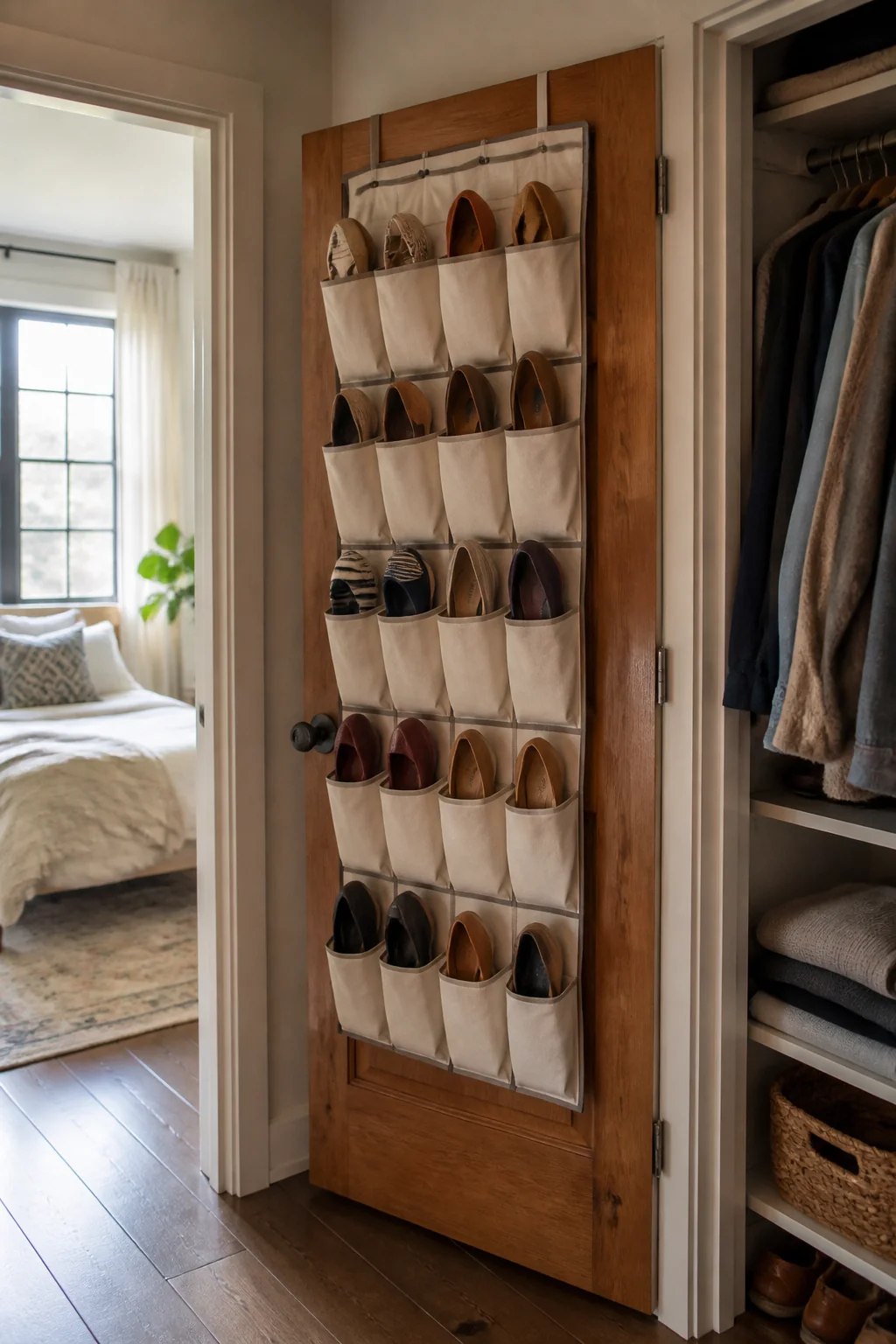
A clear organizer with twelve pockets turns dead door space into storage for $15 to $25. Most measure about 21 inches wide and 64 inches tall, which clears a standard 30 inch interior door with a few inches to spare on each side. Hook it over the top, then slide it sideways until the bottom pocket sits about 4 inches off the floor so it stops sweeping the threshold. The metal hooks add roughly an inch and a half of thickness at the top of the door, so check the door still closes flush against the stop before you load it up. Two limits are worth knowing before you buy. The pockets take up to a men's size 11 sneaker and nothing taller than an ankle boot, and thin vinyl goes brittle and splits in an unheated entry. Breathable mesh pockets cost a couple of dollars more and outlast vinyl by years.
2. Narrow vertical shoe rack against one wall
Twenty inches wide, 12 deep, and 48 tall is the shape that tucks in beside a door frame, and a rack that size holds eight to ten pairs across four or five tiers. Building upward instead of outward is the conventional move in a narrow entry, and the arithmetic backs it up: ten pairs spread on the floor eat roughly 6 square feet, while the rack claims under 2. Leave at least 30 inches of walking path in front of it or you'll clip it every time you come in carrying groceries. Powder-coated steel runs $30 to $50, bamboo a little more. The usual failure is thin soles and ballet flats slipping between wire bars, which a $6 roll of shelf liner cut to width solves in ten minutes. If small kids use the entry, strap the top rail to a stud, because a tall narrow rack tips forward the moment someone tries to climb it.
3. Floating wooden shelves in a corner
Shallow shelves turn an unused corner into vertical storage. Eight inches deep is the sweet spot: enough for a shoe standing on its heel, narrow enough that you don't walk into it. Space the shelves by what will live on them, roughly 7 inches apart for flats and sandals, 9 to 10 inches for sneakers, and 14 to 16 inches if the bottom shelf needs to swallow tall boots. Keep that lowest shelf 5 inches off the floor so a vacuum head fits underneath. Budget $40 to $60 for brackets and a board, plus an hour with a level and a stud finder. Studs sit 16 inches on center in most homes, and where your marks land between them, use toggle bolts rated for 50 pounds rather than plastic anchors, which pull straight out of drywall under a shelf of boots. One catch: a men's size 12 sneaker is about 12.5 inches long, so it overhangs an 8 inch shelf unless you stand it heel-out.
4. Woven baskets on a low bench
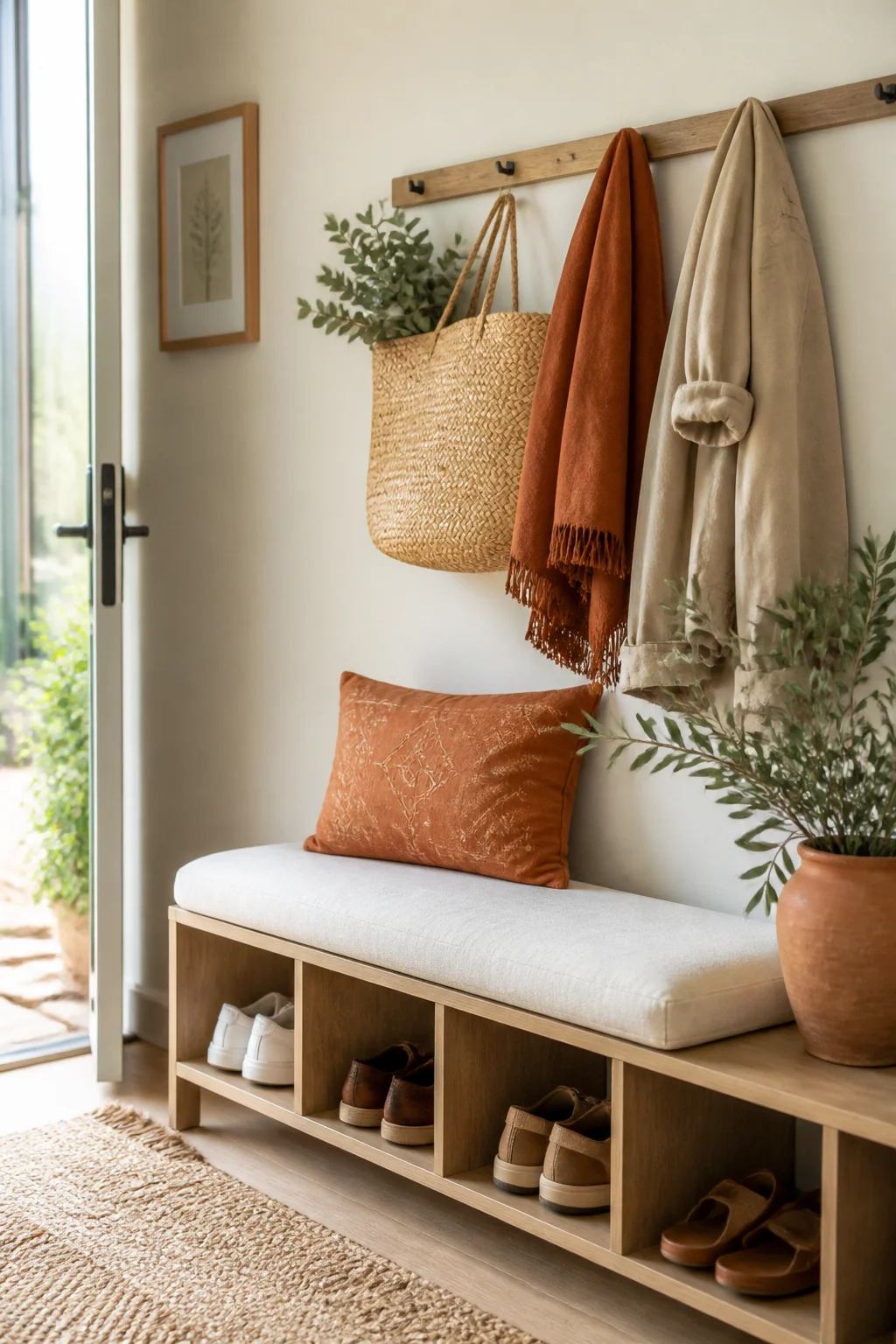
A bench with baskets underneath does two jobs at once: somewhere to sit while you wrestle off boots, and somewhere for the boots to land. Look for a seat height around 18 inches and a depth of 15 to 16 inches, with at least 12 inches of clear opening below so a basket slides in and out without scraping. Two 14 by 11 inch baskets fit neatly under a 36 inch bench and hold about six pairs between them. Seagrass and rattan breathe, which matters more than it sounds: a lined cotton basket presses damp running shoes against fabric and the whole entry smells within the week. Leave them unlined, and let wet shoes dry on the floor first. Expect $80 to $150 for the bench and $12 to $20 per basket. Watch the handles too, since woven ear handles that stick out past the bench frame catch your shins every time you sit down.
5. Wall-mounted rails that hold shoes at an angle
Magnets and clips get suggested for this job and they drop shoes on the floor, so build a rail instead. Two lengths of half-inch copper pipe or hardwood dowel, mounted horizontally about 3 inches apart with the front one sitting roughly an inch lower, hold a shoe at a display angle: the sole rests on the back rail and the toe drops onto the front. Flanges and pipe for three rows run $20 to $35 at any hardware store. Space the rows 10 inches apart vertically so toes clear the shoes below, and drive the flange screws into studs, because a full row of sneakers weighs more than it looks. This works well for anything with a firm sole, so sneakers, loafers, heels, and boots. It does not work for flip-flops, soft slippers, or unstructured canvas shoes, which slide straight off. Keep those in a basket and let the rails handle the rest.
6. Over-the-door hooks with hanging shoe bags
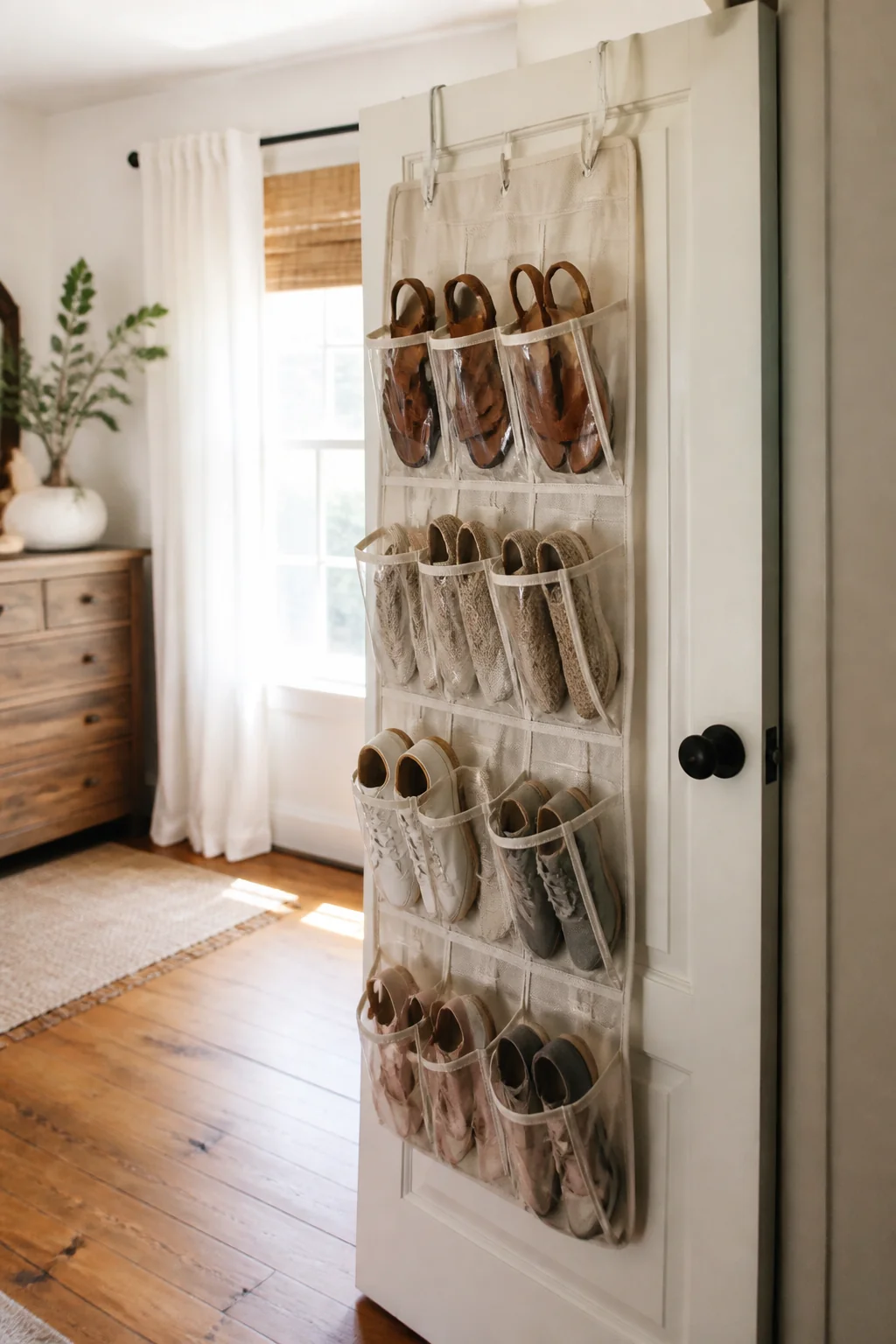
Fabric shoe bags hook over the top of the door and hang down each side, and five of them swallow roughly thirty shoes without touching the floor. Check the hooks before you order. Standard interior doors are 1 3/8 inches thick and most over-door hooks are cut for exactly that, so a solid exterior door at 1 3/4 inches needs the wider version or the hook sits proud and scrapes the frame every time. Cotton or mesh bags beat vinyl here, because your entry door is often the coldest surface in the room and damp shoes sealed in plastic against it turn sour fast. The real nuisance is noise: a loaded bag swings and thumps whenever the door shuts, so stick two adhesive felt bumpers on the door where the bag lands. If there's a lever handle on the inside, hang the bags clear of its arc.
7. Slim ladder leaning in a corner
A blanket ladder leaning in the corner costs $50 to $90 and holds shoes on its rungs without a single screw going into the wall. Set the feet 12 to 18 inches out from the baseboard, which puts the lean at roughly 15 to 20 degrees: steep enough to stay put, shallow enough that nothing slides. Six rungs take two or three pairs each, so figure fifteen pairs at the top end. The honest limitation is shoe shape. Only footwear with a raised heel or a defined arch hooks over a rung and stays there. Flat-soled sneakers and skate shoes slip off within a day, so those need a basket at the base. Add rubber or felt feet if your entry is tile, since bare wood walks slowly across a hard floor every time someone knocks it. With a toddler in the house, run a small L bracket from the top rung into a stud.
8. Bench with built-in shoe cubbies
Cubbies fix the problem a shared shelf creates, which is that nobody's shoes end up buried under anybody else's. A typical three-cubby bench runs about 35 inches wide, with each compartment near 11 inches wide, 12 deep, and 7 tall. That takes an adult sneaker up to roughly a men's 11, but not a work boot. Seat height lands between 17 and 19 inches, the same as a dining chair, so it's comfortable to sit on while you tie laces. Ikea's shoe benches sit in the $60 to $100 range and solid hardwood versions climb past $200. Give the low cubbies to the kids and keep adult shoes up top, since a small child hauling on a full lower cubby pulls the whole bench toward them. If your entry is under 36 inches wide, trace your door swing on the floor first, because a bench that stops the door at 80 degrees is worse than no bench.
9. Shoe cabinet with doors
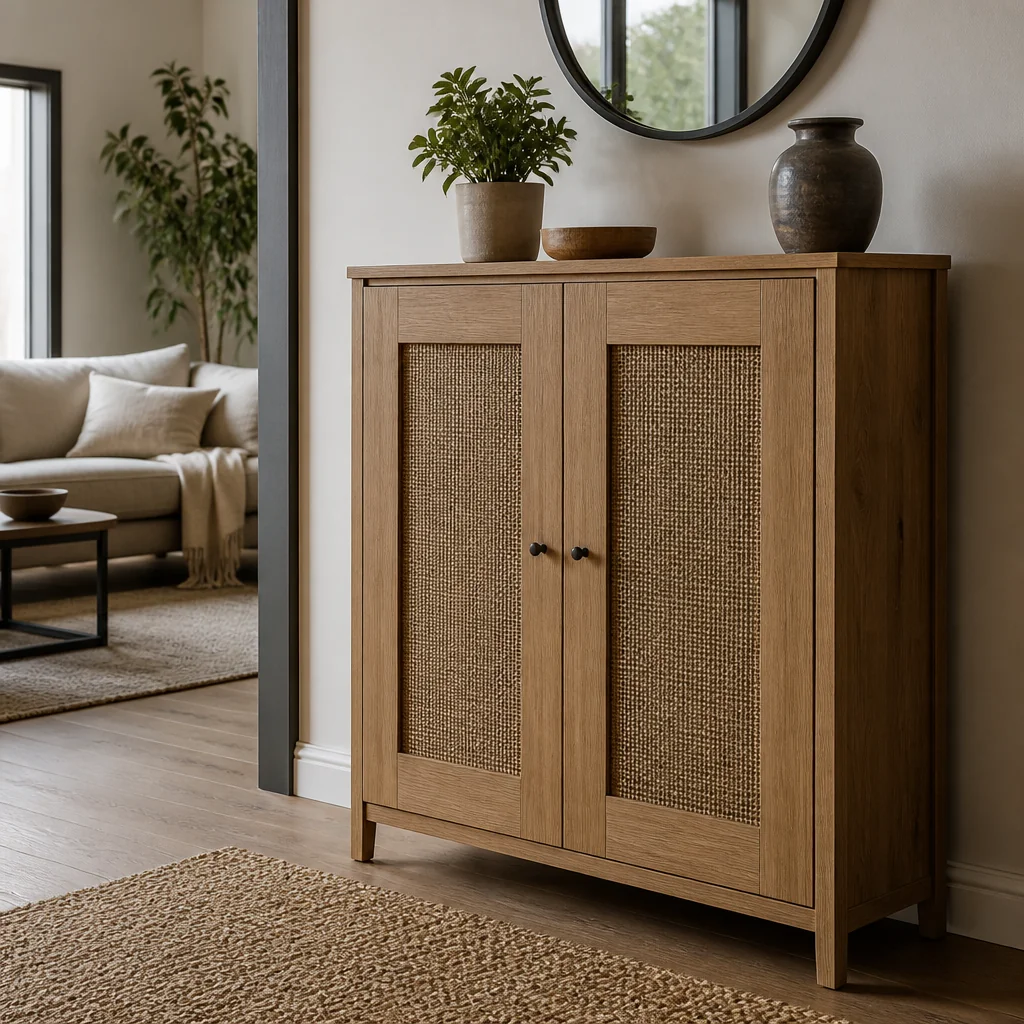
A tilt-out cabinet around 24 inches wide, 30 tall, and 10 deep hides everything behind doors that swing open from the bottom. Each tilting compartment usually takes two rows of shoes, so a two-door unit holds nine to twelve pairs, and prices run $90 to $180.
Pay close attention to that 10 inch depth. Shoes sit on a diagonal inside, so a chunky sneaker or anything past a men's 11 stops the door latching and you end up with a cabinet that never quite shuts. The second trade-off is moisture: a sealed cabinet keeps wet shoes wet, and the smell builds where you can't see it, so let anything damp dry in the open overnight first. Closed storage also puts your shoes out of mind, which is easy to manage if you swap the contents seasonally and keep this week's pairs in a basket on top.
10. Tiered shoe stand for entryway corner
Shaped a bit like plant shelving, a tiered metal stand stacks shoes on three or four levels inside an 18 inch footprint and holds around fifteen pairs for about $35. Tier spacing is usually 7 to 8 inches, which handles sneakers, loafers, and flats comfortably. Ankle boots go on the top tier where nothing sits above them, and tall boots don't go on it at all. If you're pushing one into a corner, measure the diagonal rather than the wall: an 18 inch stand turned 45 degrees needs roughly 25 inches of corner to sit flat against both walls. The bars are typically 3/8 inch tube spaced a couple of inches apart, so stilettos and thin flats drop through unless you lay a strip of shelf liner across the top tier. Nothing about it is pretty, which is why it earns its keep behind a door or beside a coat rack rather than out in the open.
11. Under-stair storage with pull-out drawers
Under-stair space is the largest piece of dead volume in most homes, and drawers on full-extension slides make all of it reachable, including the deep back corner nobody would crawl into. Usable depth typically runs 24 to 30 inches, so specify ball-bearing slides rated for 100 pounds. A drawer of winter boots is heavy, and cheap side-mount slides bind halfway out. Before anything gets cut, locate the stair stringer and check for wiring, a heating duct, or a plumbing stack behind the drywall, since that cavity is exactly where builders route things. A DIY build in birch ply costs $200 to $400 in materials for three drawers. Hiring it out lands between $1,200 and $2,500 depending on the face frames and finish. Label the drawers by category, boots, everyday, guest, and put the shallowest one at the low end of the stairs for kids' shoes, since that's the end small people can actually reach.
12. Shoe silo towers stacked together
Stacked clear boxes give you a tower in a corner where every pair is visible without opening anything. A standard box measures about 13.5 by 10.5 by 7.5 inches and costs $3 to $5. Drop-front versions with a hinged flap on the short end run $8 to $12 and are worth the difference, because you can pull the bottom pair without dismantling the column above it. Four or five boxes is the practical ceiling for one stack; past that it flexes and leans, so run two shorter towers side by side instead of one tall one. The trap with any sealed box is moisture. A shoe that goes in even slightly damp stays damp, and foam midsoles break down faster in still, humid air. Give shoes a full day to dry first, and drop a silica packet in with anything leather.
13. Pegboard wall with custom shoe holders
Pegboard gives you a wall you can rearrange whenever the collection changes. A 24 by 48 inch panel plus hooks and a couple of 6 inch shelves runs $45 to $60 and takes about ninety minutes to hang. The step people skip is the furring strips. Pegboard has to stand off the wall by at least half an inch or the hooks have nowhere to seat, so screw 1x2 strips into the studs first and the panel onto the strips. Hardboard also sags when it's only fixed at the corners, so put a screw every 16 inches along each strip. Its other weakness: standard hooks lift out with the shoe when you grab a pair, which gets old within a week. A pack of hook locks costs a few dollars, or step up to metal pegboard with a locking tab. Angled hooks in pairs cradle a shoe by the sole, and a small shelf catches whatever won't hang.
14. Rolling cart with narrow shelves
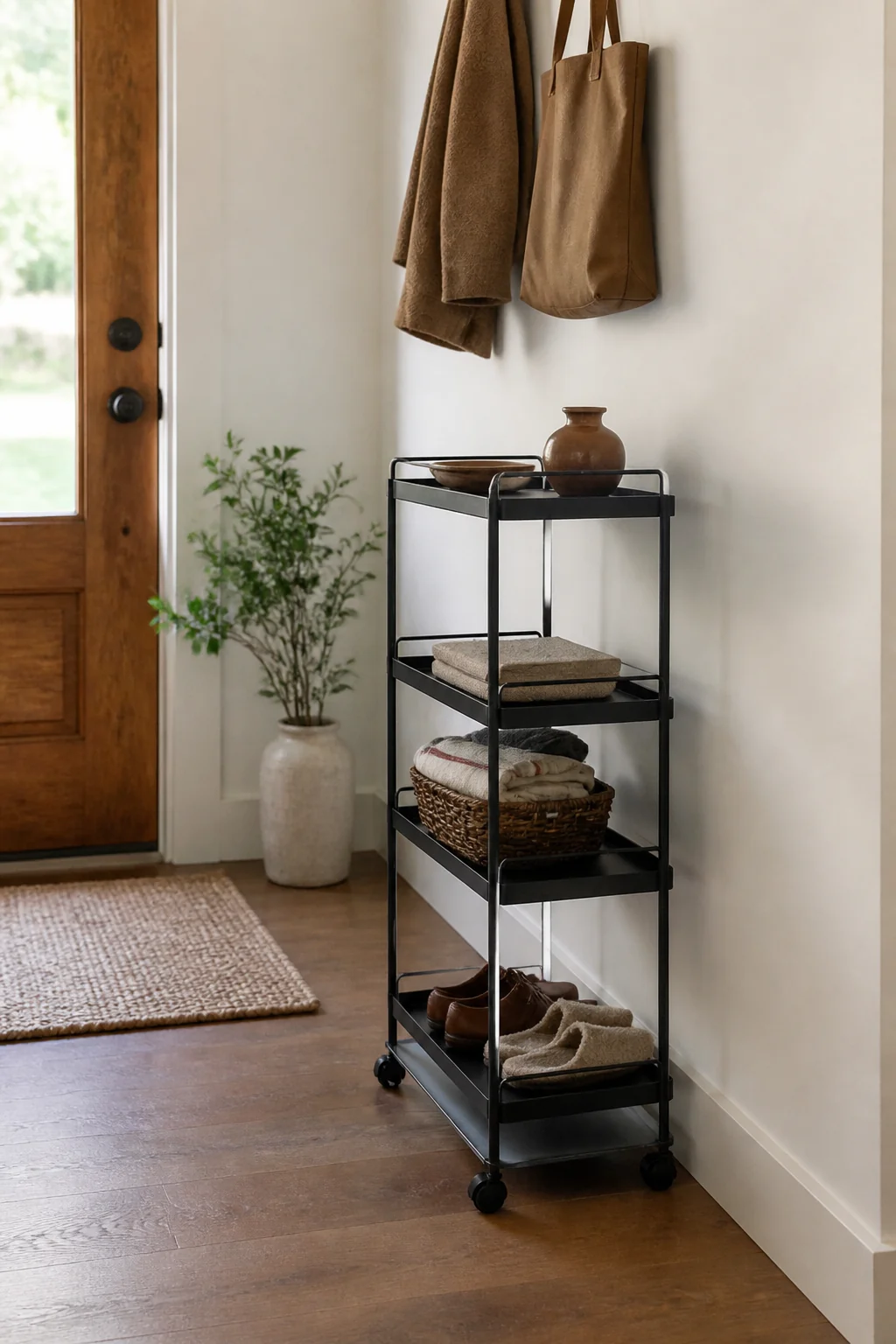
A slim three-tier cart, roughly 13 to 16 inches wide, parks against the wall and rolls out when you need to dig. Ikea's Raskog sits around $45 and measures 13.75 by 17.5 by 30.5 inches, which holds about six pairs with the top tier free for keys and dog leads. Mobility is the whole point: pull it into the room for the seasonal swap, then push it back into a 14 inch gap beside the console. Two caveats decide whether it works for you. Casters this small won't roll over thick pile rugs or a raised threshold strip, so this belongs on tile, wood, or a flat mat. And on hard floors a loaded cart drifts every time the front door opens and the pressure changes, so choose a version with two locking wheels, or swap in braked stem casters for about $12.
15. Hanging shoe organizer from a closet rod
Got a narrow closet by the door? Hang a fabric organizer from the rod instead of standing a rack on the floor, and the closet floor stays free for boots and a vacuum. Ten to twelve compartment models measure about 12 inches wide, 12 deep, and 50 tall, hold eighteen to twenty pairs, and cost $18 to $30. Do the weight sum before you hang one. Twenty pairs comes to 25 or 30 pounds pulling on a single point, which a spring-tension rod will not hold; it slips at the worst possible moment and dumps the lot. You want a fixed rod on brackets screwed into studs or into rated anchors. Measure vertically too. A standard closet rod sits about 66 inches up, so a 50 inch organizer leaves roughly 16 inches beneath it, and whatever still hangs alongside has to be jacket length rather than a long coat.
16. Decorative shoe boxes on open shelving
Labeled boxes on open shelving let shoes read as part of the decor instead of clutter. Useful sizes: 13 by 9 by 5 inches for flats and sandals, 14 by 10 by 6 for sneakers, and a taller 14 by 10 by 9 for ankle boots. Rigid lidded boxes run $30 to $50 for a set of four, while collapsible fabric ones cost less and slump once you stack them, which is visible from across the room. Put the label on the short end that faces out, and use a photo of the shoe rather than words in a shared entry, since nobody else reads your handwriting. Shelf depth matters as much as box size: 14 inches keeps the box from overhanging the edge. The real limit is stacking. Three boxes high is where the bottom one gets annoying enough that you stop putting shoes away, so give the top row to daily pairs.
17. Shoe storage ottoman at the seating area
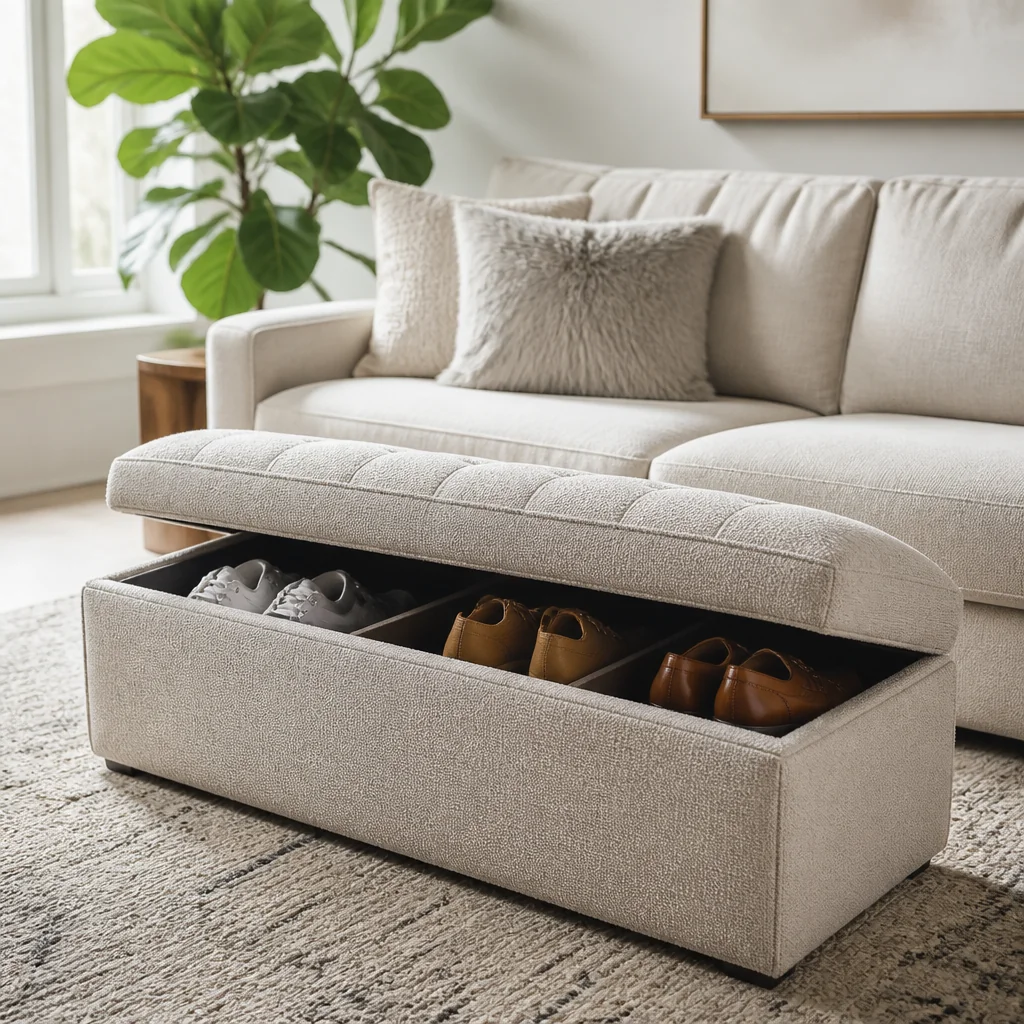
A padded ottoman with a hollow base gives you a seat and a hiding place in the same 30 by 16 inch footprint. At about 18 inches tall it takes eight to ten pairs of flats, ballet slippers, or off-season sandals, and $80 to $120 buys one built well enough to sit on daily. Check two specs before you order. The stated seat weight limit should be 250 pounds or better, and the lid should be hinged with a friction stay rather than lift-off, because a loose lid means holding it in one hand while you rummage with the other, and a plain hinge without a stay catches fingers. Fabric absorbs whatever it's near, so this is storage for clean, dry shoes only, and a cedar block inside costs a few dollars and keeps it fresh. Since you have to stand up to open it, treat it as the home for weekly shoes, not daily ones.
18. Wall-mounted wooden crate shelves
Wooden crates screwed to the wall make open cubbies for $25 to $60, depending on how many you use. Craft store crates measure roughly 18 by 12.5 by 9.5 inches at $13 to $15 each, and each one takes two or three pairs lying flat. Sand the raw pine, wipe on a stain or a coat of matte polyurethane, and let it cure a full day, because untreated pine picks up black scuff marks from soles almost immediately. Mounting is where these go wrong. The slats are only about a quarter inch thick and will not hold a screw under load, so drive 2.5 inch screws through the solid corner blocks into studs, or hang the whole cluster on a French cleat. Keep each crate to about 15 pounds. Staggering them in a loose grid at 30, 45, and 60 inches off the floor looks deliberate and leaves the lowest run within a child's reach.
19. Vintage ladder shelf as shoe display
An old ladder shelf leaning against the wall makes a display out of footwear you don't mind showing off. The graduated shelves are why it works: the bottom one usually runs 10 to 12 inches deep and takes a full row of shoes, the middle shelves at around 8 inches hold a pair each, and the narrow top shelf is for a plant rather than a boot. Arranging by color reads as deliberate and disguises the fact that the whole piece holds maybe eight pairs. Genuine vintage ladders carry one caution: paint made before 1978 may contain lead, so don't sand it. Wipe it down, seal it with a clear water-based poly, and leave the patina alone. Flea market finds run $60 to $150. Whatever the age, run a strap or an L bracket from the top rail into a stud, because a leaning shelf on a hard floor creeps outward at the base over time.
20. Under-bench shoe cubbies with removable inserts
A long bench with removable dividers underneath gives every pair its own slot, and the dividers come out when the slots stop matching what you own. Aim for a 48 inch bench with cubbies around 11 inches wide, 14 deep, and 9 tall, which takes four adult pairs or six kids' pairs across. The dividers ride in shallow grooves cut into the top and bottom panels, so they lift straight out: pull two in November and you have a boot bay, slot them back in April. A custom build in oak or maple runs $150 to $300, while a flat-pack version with fabric bins lands nearer $90, though the bins are the part that gives out first. Two details decide whether it stays tidy. Leave a 3 inch toe kick at the base so you can stand close without kicking the front edge, and set it on a hard floor rather than a rug, since dividers on a soft surface shift and jam.
The whole guide in one image
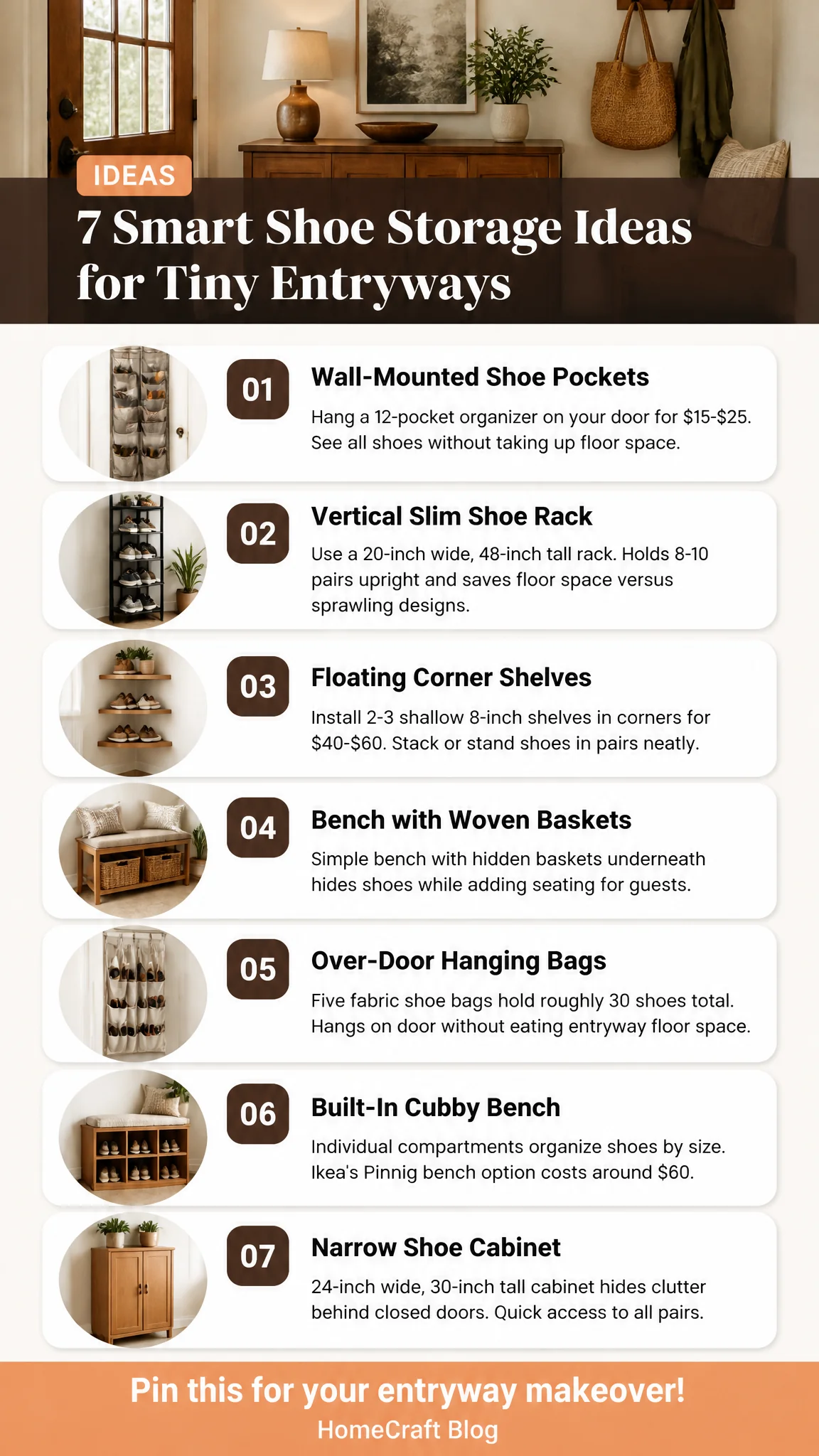
One last thing worth measuring before you buy anything: the width of the wall you're working with, the depth left over once the front door has swung past, and the height of your tallest boot. That third number is the one people forget, and it's the one that decides whether a cabinet door closes. Leave somewhere open for wet shoes to drain and dry too, because every enclosed option on this list will hold that damp in and hand it back to you as a smell.
Ideas fade by Friday. A plan finishes the room.
You just read a full guide to your entryway. Saving ideas will not change it; a plan will. The Home Decor Collection is every planning tool we make, for every room in the house, in one download, so the after photos below stop being other people's rooms.
- Six room Style Kits, each with layout, palette and shopping list$114
- The Gallery Wall Studio: 200 prints + 15 measured layouts$29
- The Room Makeover System: 40 solved room layouts + workbook$29
- The Color Palette Handbook: 60 palettes shown in real rooms$19
- The Whole-Home Reset: 40 printable organizing checklists$19
- The Decorator's Cheat Sheets: the 40 measurements that matter$9
- All eleven products, bought separately
$219$97
A single hour with an interior designer costs more than the entire Collection, and this one keeps answering for every room you will ever decorate. Free updates included as the products grow. And if it is not for you, the 14 day money back promise means you simply get a refund.