Home Entryway Ideas on a Budget: What to Do With a Bare Wall
Home entryway ideas on a budget, with real prices and clearances: what to repurpose from other rooms, where the mirror goes, and how to store coats in a narrow hall.
This post contains affiliate links. As an Amazon Associate I earn from qualifying purchases. If you buy through our links, we may earn a commission at no extra cost to you.
Plenty of entryways start life as a wall with nothing on it. No mirror, no hooks, not even a console table, so visitors stand there holding their coats while you pretend the emptiness was a decision.
The fix almost never requires a renovation or a design plan. A secondhand mirror, a roll of clearance peel-and-stick wallpaper, and a handful of hardware store hooks will change how the space works over a single weekend, and everything below adds up to less than $200 if you shop carefully.
So here's what to do with that bare wall, roughly in the order that gets you the most for the least.
Start With What You've Already Got
Before you spend a dollar, walk the rest of the house and look for pieces that could migrate. Most budget wins in an entry come from repurposing things that were sitting unloved in other rooms rather than from a shopping trip.
The number to carry with you is depth. A hallway wants about 36 inches of clear walking width, so in a 48-inch hall you have roughly 12 inches to hand over to furniture. That rules out the 18-inch-deep dresser and rules in a narrow bookcase, a wooden crate stood on its end for shoes, a kitchen stool, a slim side table with the leaves folded down. A spare bedroom lamp gives you warm low light for nothing.
Editing what you own also keeps finishes consistent, since every piece already shares a wood tone or metal with the rest of the house. The catch is that anything you pull out leaves a hole behind. Move it, live with both rooms for a week, then decide whether the swap really worked.
Hang a Mirror Where It Catches the Light
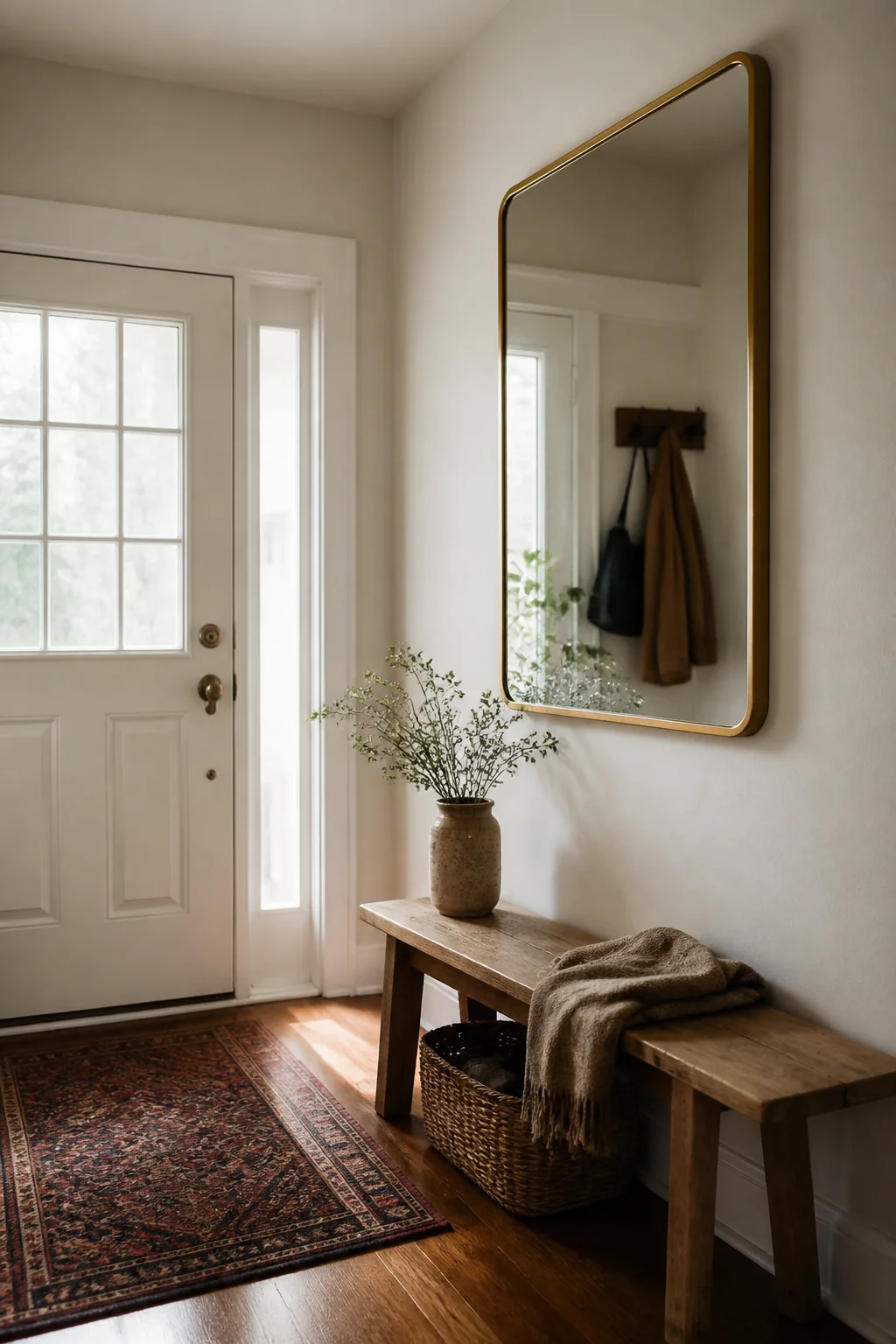
A mirror does three jobs at once here. It throws daylight further down a dark hall, it gives the eye somewhere to travel so a narrow space stops reading like a corridor, and it lets you check your collar on the way out the door.
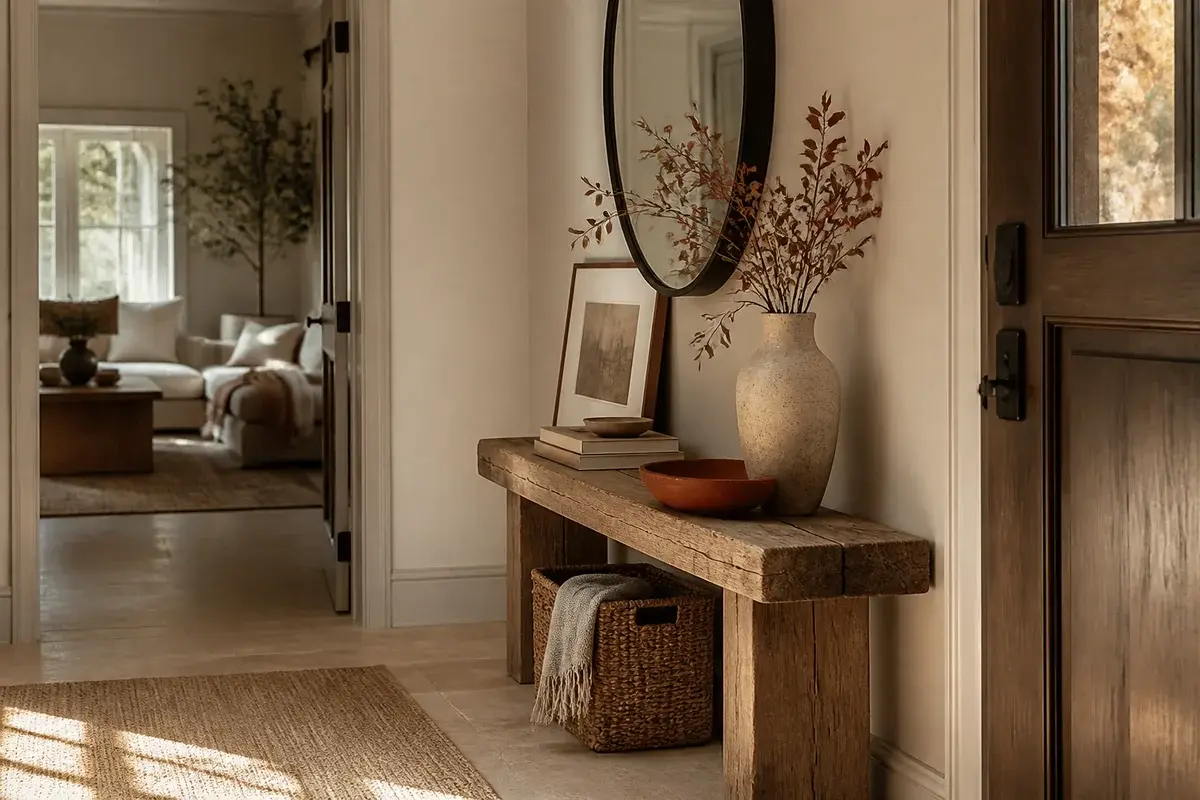
Nothing about that requires an expensive frame. Thrift stores and Facebook Marketplace list usable framed mirrors from $25 to $40, and new ones at big-box shops run $30 to $80. Scuffed gilt frames are worth grabbing, because on a mirror that wear reads as age rather than damage.
Placement does most of the work. Put it on the wall opposite your front window, or at right angles to it, so it picks up daylight instead of reflecting a blank wall back at you. Hang the center of the glass around 60 inches from the floor, which is eye level for most adults. A tall mirror leaning instead of hanging needs 6 to 8 inches of floor depth at the base and a safety strap screwed into a stud, or it creeps forward every time the front door slams. The same goes for any tall bookcase you move into the hall; the CPSC's Anchor It campaign exists because furniture with shelves and drawers tips onto children. Leaning is the renter's answer anyway: no holes, no patching at move-out.
DIY a Coat Rack From Things You Can Buy Separately
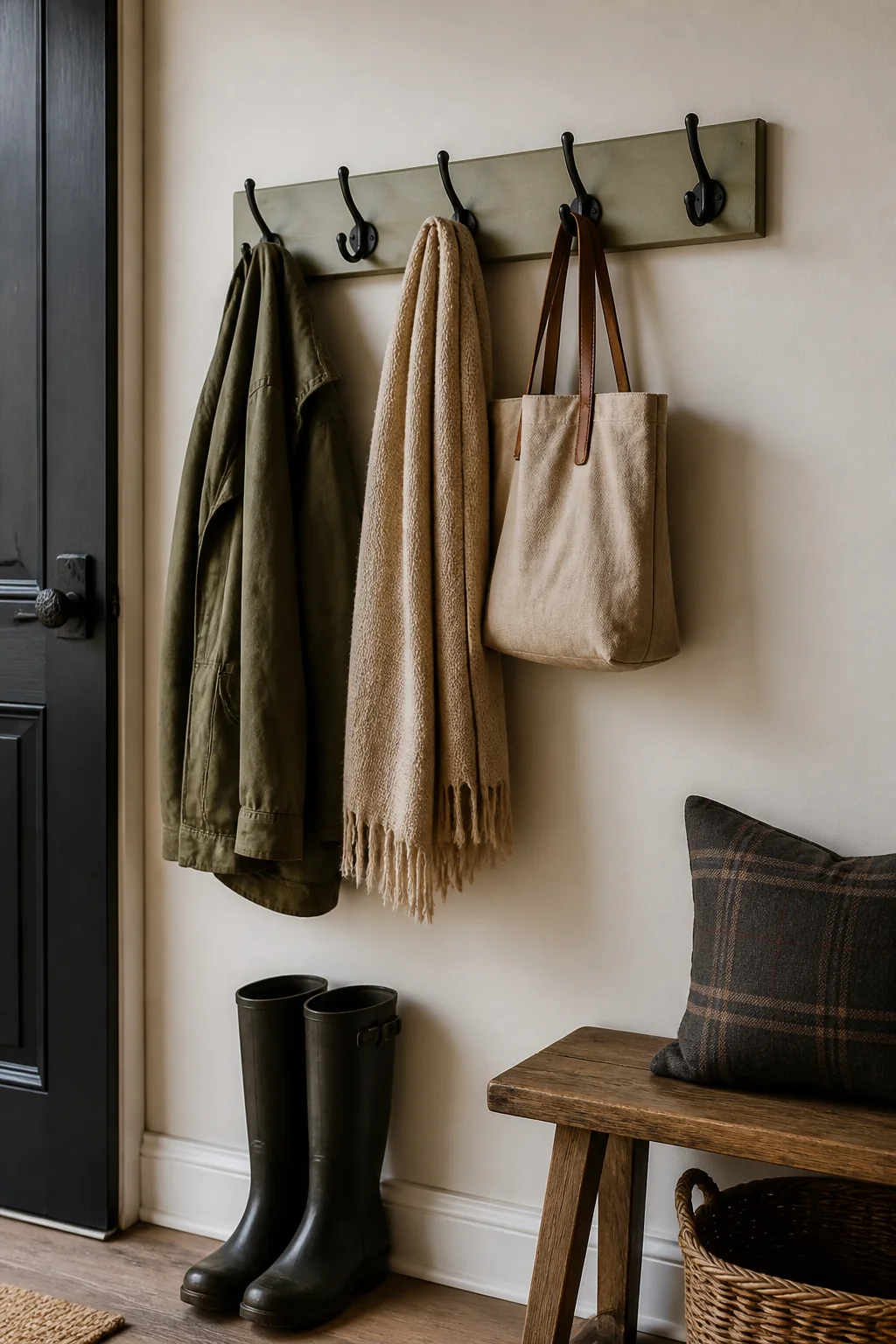
Parts for a dowel-and-hook rack come to roughly $28, and the build fills one evening plus overnight drying.
The list: a 36-inch wooden dowel or a length of 1x3 pine ($6), five hooks ($2 each), a sheet each of 120 and 220 grit sandpaper ($4), and a small can of wood stain or whatever paint is left over from another room ($8). If the stain is oil-based, open a window while it goes on and spread the used rag flat outside to dry, because a balled-up oily rag can heat up and catch fire on its own (NFPA on oily rags). Most hardware stores will cut wood to length free at the counter, so ask before you buy a saw you'll use once.
Work in this order. Cut, then sand with the 120 and finish with the 220 until the edges feel rounded, wipe the dust off with a damp cloth, stain, and leave it overnight before you touch the hooks. Mark hook positions 6 to 7 inches apart so two bulky coats don't fight each other. Drill pilot holes slightly narrower than the screw shank; skip that step on a dowel and it splits along the grain almost every time.
Mount the board 60 to 65 inches from the floor, high enough that a long wool coat clears a bench underneath. Hit studs where you can. Where you can't, use toggle anchors rated for 25 to 30 pounds rather than the plastic cone kind, because a rack of wet winter coats is heavier than it looks. Building it yourself also means you set the hook spacing, which no off-the-shelf rack lets you do.
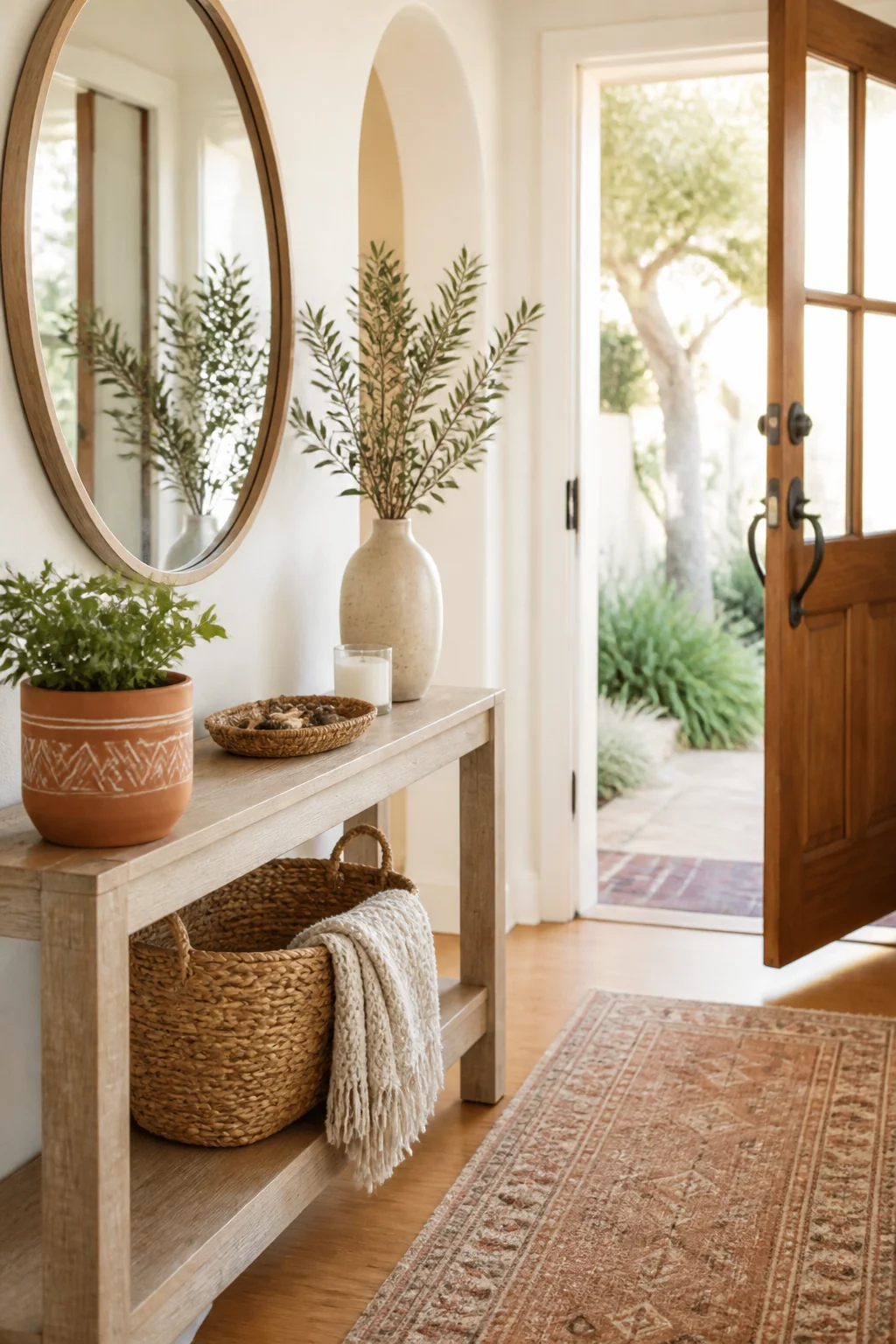
Create a Small Seating Nook (Yes, Even in a Tiny Space)
A bench earns its floor space the first time someone has to pull off wet boots standing on one leg. Kids get a spot to dump a backpack, and you get somewhere to sit while you dig for keys.
Numbers first. New benches run $50 to $100, and used ones turn up on Facebook Marketplace between $40 and $60. Look for a seat height of 17 to 19 inches, the same as a dining chair, and a depth of 14 to 16 inches so the seat doesn't eat your walkway. Below about 36 inches of remaining clear width, skip the bench entirely: a single 12-inch stool or a pair of stacked ottomans ($30 to $50 each) gives you the same perch without turning the hall into an obstacle course.
Two checks before money changes hands on a used piece. Sit on it hard and listen for a creak at the leg joints, which usually means old glue has let go and the whole frame needs re-clamping. Then measure your door swing. A bench parked inside the arc of the front door gets clipped daily, and the trim splits long before the bench does.
Add Greenery Without Breaking Your Budget
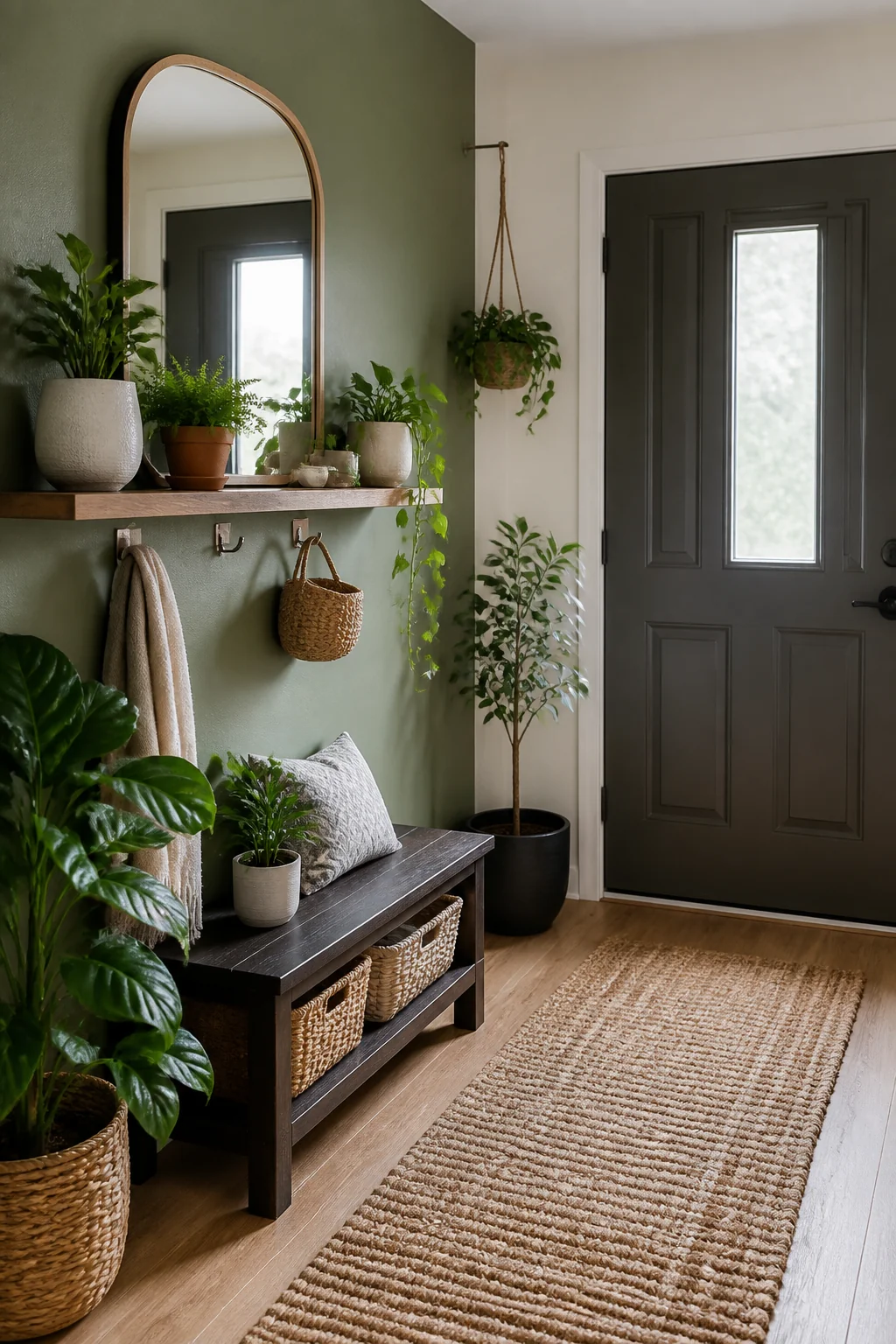
Plants are the cheapest way to stop an entryway reading like a corridor. Pothos, snake plants and spider plants all cost $5 to $15 in a 4-inch nursery pot, and all three cope with the poor light most entries get. If the dog greets visitors in the hall, check the ASPCA's list first: pothos and snake plants are toxic to cats and dogs, while the spider plant is listed as non-toxic.
Match the plant to the light honestly, though. A snake plant will sit in a windowless hall for months without complaint. A pothos wants some indirect daylight and tells you when it isn't getting any by stretching, leaving 6 or 8 inches of bare stem between leaves. Water when the top inch of soil is dry, which in a cool entry can mean every two or three weeks rather than weekly. Far more entryway plants drown on a generous schedule than starve on a forgetful one.
A terra cotta pot costs $2 to $4 and breathes, so it dries faster than plastic, which suits anyone who tends to overwater. Wrap it in jute twine or hit it with a $4 can of flat white spray paint, outdoors on a sheet of cardboard, if the orange fights your color scheme. A pothos trailing from a shelf above head height softens a hard corner and uses no floor at all.
Think Vertical, Think Storage
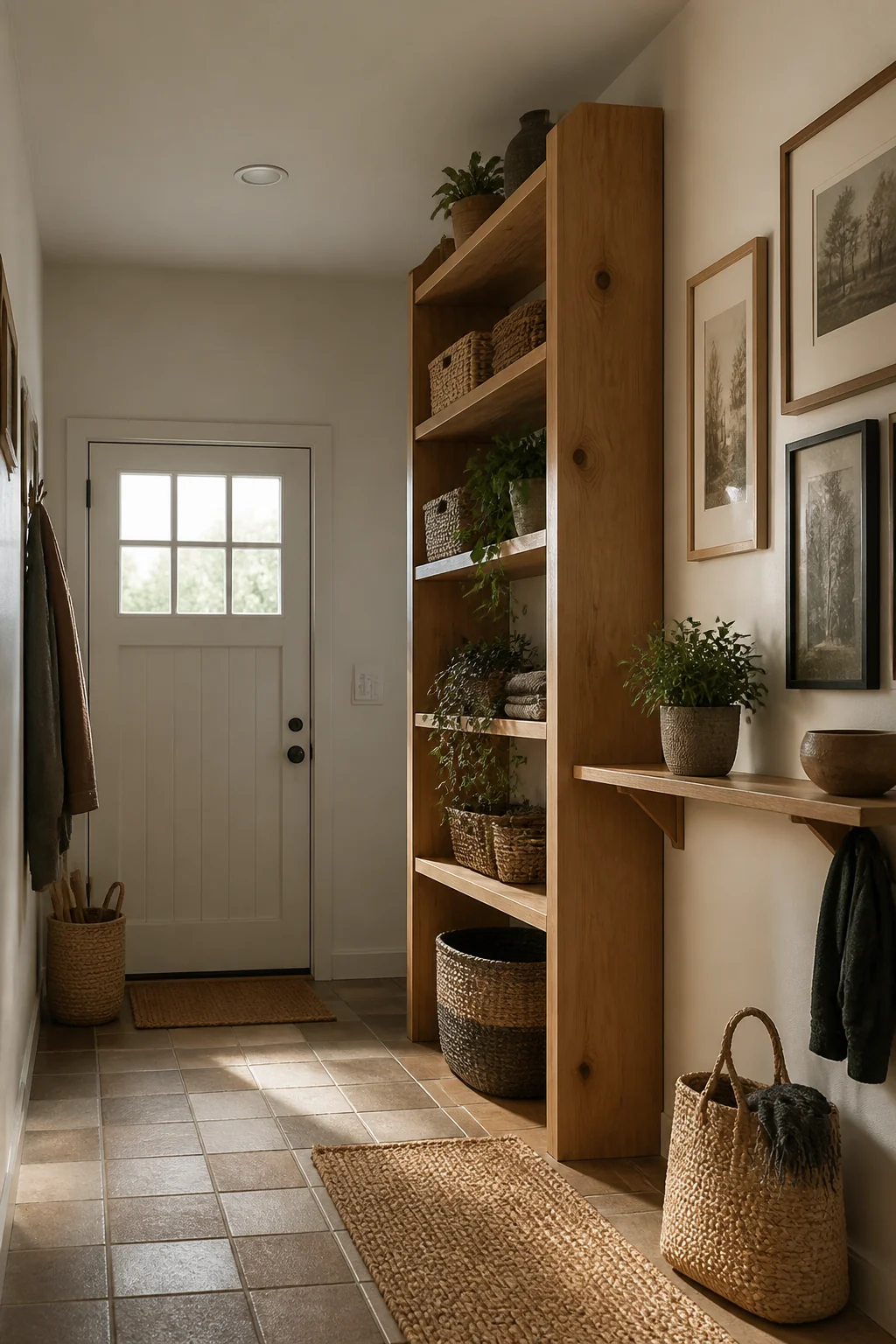
Floor space is the one thing an entryway never has, so the storage has to go up the wall.
Floating shelves cost $15 to $40 each at Target or IKEA. Set the lower one around 48 inches from the floor so a basket underneath still clears your shoes, then space a second shelf 12 to 14 inches above it, which is enough headroom for a stack of mail and a small plant. Woven or fabric baskets sit below at $10 to $25 depending on size, and they swallow the things that otherwise breed on a console: gloves, the dog leash, sunscreen, unopened bills.
Check what the wall is made of before you commit to a bracket. A shelf fixed into bare drywall holds a picture frame and little else. Fixed into studs, or with proper toggle bolts, that same bracket carries 30 to 50 pounds, which is closer to what a basket of shoes really weighs.
The reason this suits a small budget is that it's additive. One shelf now, a basket next month, a pair of cheap frames painted a matching color after that. Nothing has to arrive at once for the wall to look finished at every stage along the way.
The same vertical approach carries over to any small room, and our small living room ideas use it to fit storage into 200 square feet.
The Finishing Touch: Lighting and Accessories
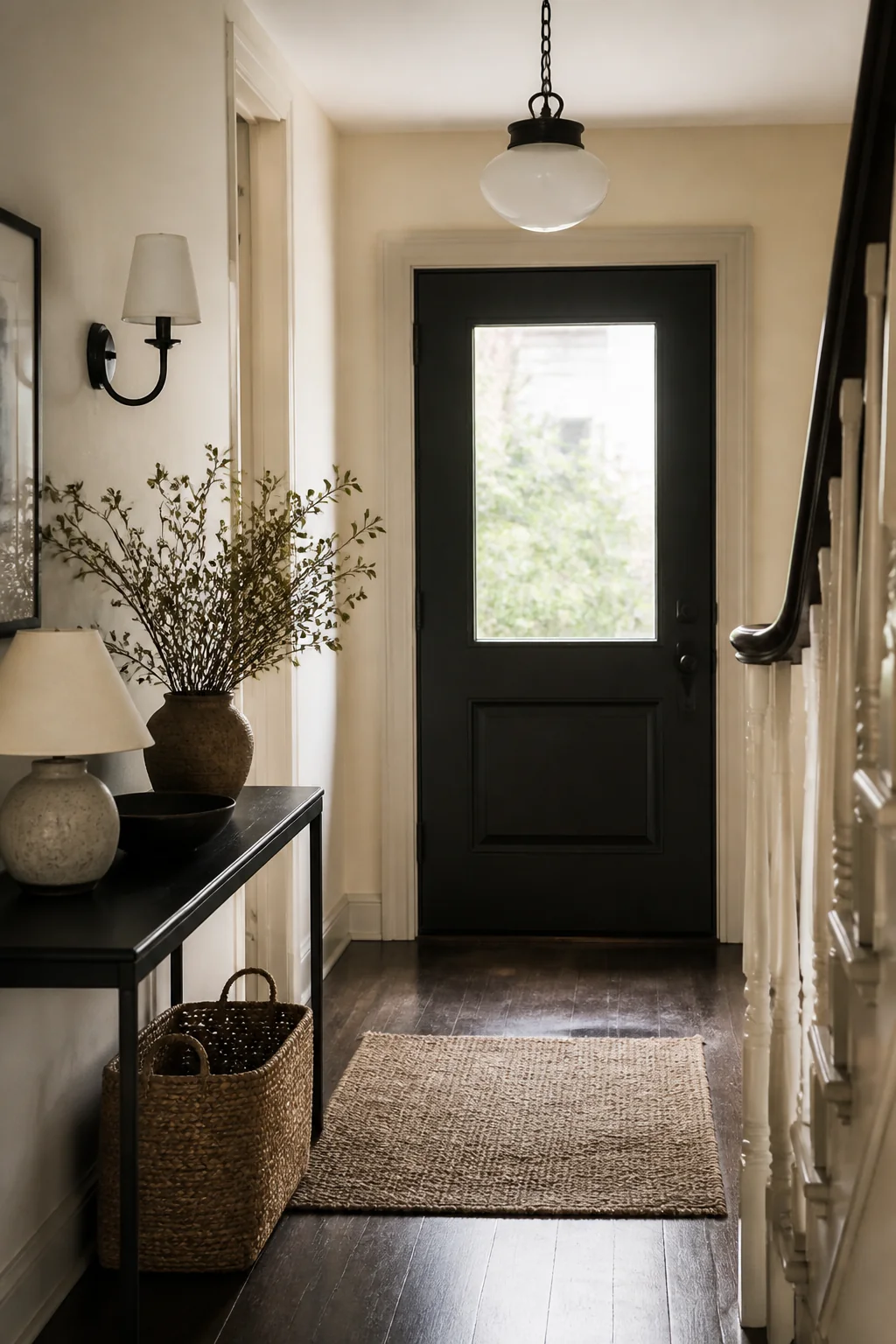
One ceiling fixture on its own flattens a small entry, and a single flush-mount is exactly what most builders leave you with. Add a second light source lower down and the space stops feeling like a passage after dark. A plug-in wall sconce runs $25 to $45 and needs no electrician, just a cord clip or two. A hardwired sconce starts around $30 plus whatever an electrician charges to fit it. A small lamp on a console does the same job for less.
Bulb choice matters more than the fixture does. Look for 2700K on the box, sold as warm white, at somewhere between 450 and 800 lumens. Anything rated 4000K or higher turns a welcome into a bathroom.
Accessories can stay few and useful: a tray for keys and sunglasses ($8 to $20), a candle, one piece of art you like. The tray is the piece that quietly stops the clutter, because loose keys spread across a surface and a bounded one won't let them. We'd skip a gallery wall in a narrow entry; you can never stand far enough back to take it in.
What to Do First
Order matters when the budget is small. Light comes first, because a dim entry makes everything else in it look cheap, and a $10 warm bulb plus a $25 plug-in sconce fixes more than a $200 console ever will. Storage second: two hooks at $2 apiece keep the coats off the newel post. The mirror third, for the daylight it moves around. Decorative pieces last, once you've lived with the space enough to know what it's for.
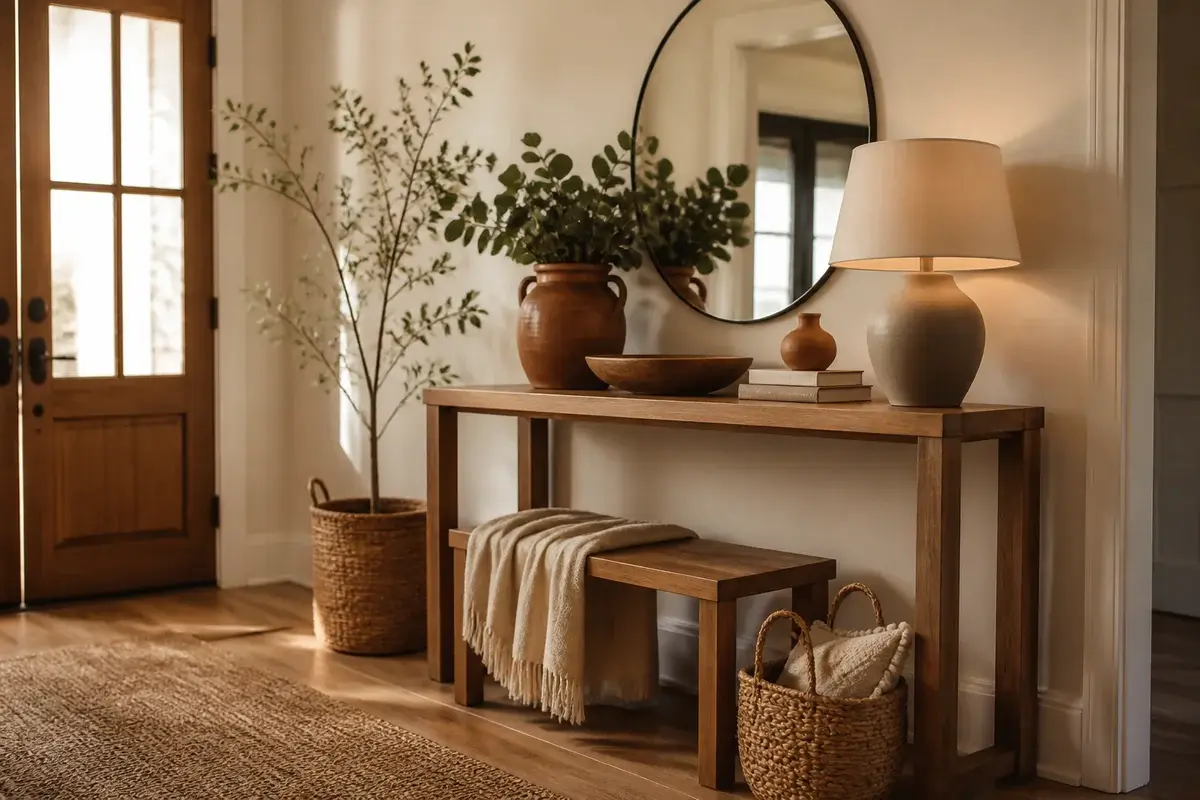
The whole guide in one image
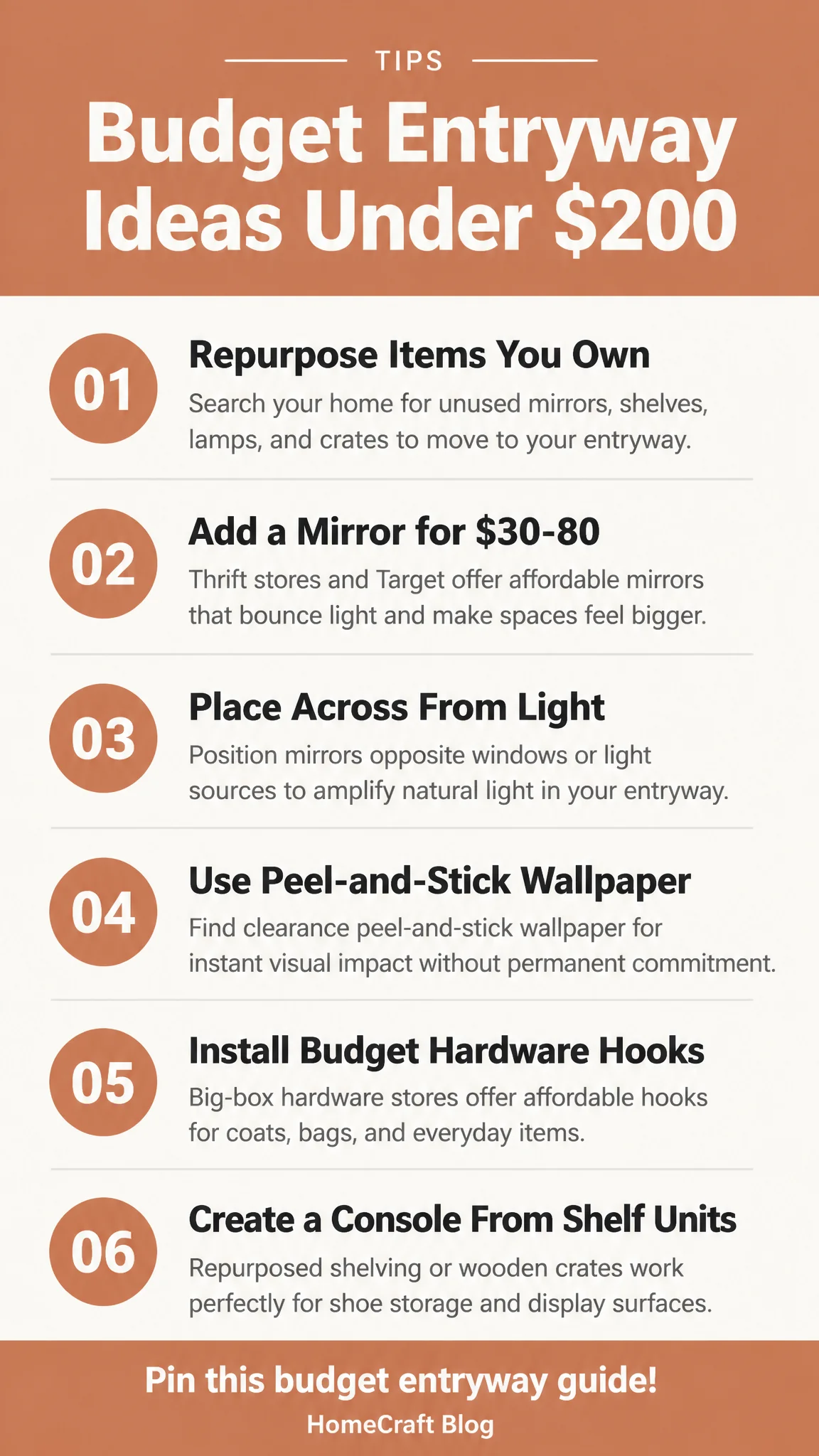
One caution outweighs every idea above. Measure your clear walking width before you buy anything at all. A piece that drops the hall below roughly 36 inches will irritate you every single morning, however good the price was, and the handsome bench that catches your hip on the way out usually gets resold inside a year.