Outdoor Patio Ideas on a Budget: What Holds Up Outside
Outdoor patio ideas on a budget with real prices and measurements, from rugs and string lights to the one concrete project worth skipping.
This post contains affiliate links. As an Amazon Associate I earn from qualifying purchases. If you buy through our links, we may earn a commission at no extra cost to you.
A bare concrete patio is a hard space to love. It's flat, it's gray, and it tends to sit unused all summer while you keep meaning to do something with it. Budget upgrades work because of what they change physically: a rug gives the slab an edge, warm light makes the space feel enclosed, and pots break up the hard lines. Figure on $300 to $500 for the whole lot if you shop the end-of-season sales.
Below is each idea with the prices and the measurements attached, plus one popular project that's worth skipping entirely. If you're working on the inside too, the same restraint pays off when you're decorating an apartment on a budget.
Start with a Budget Outdoor Rug
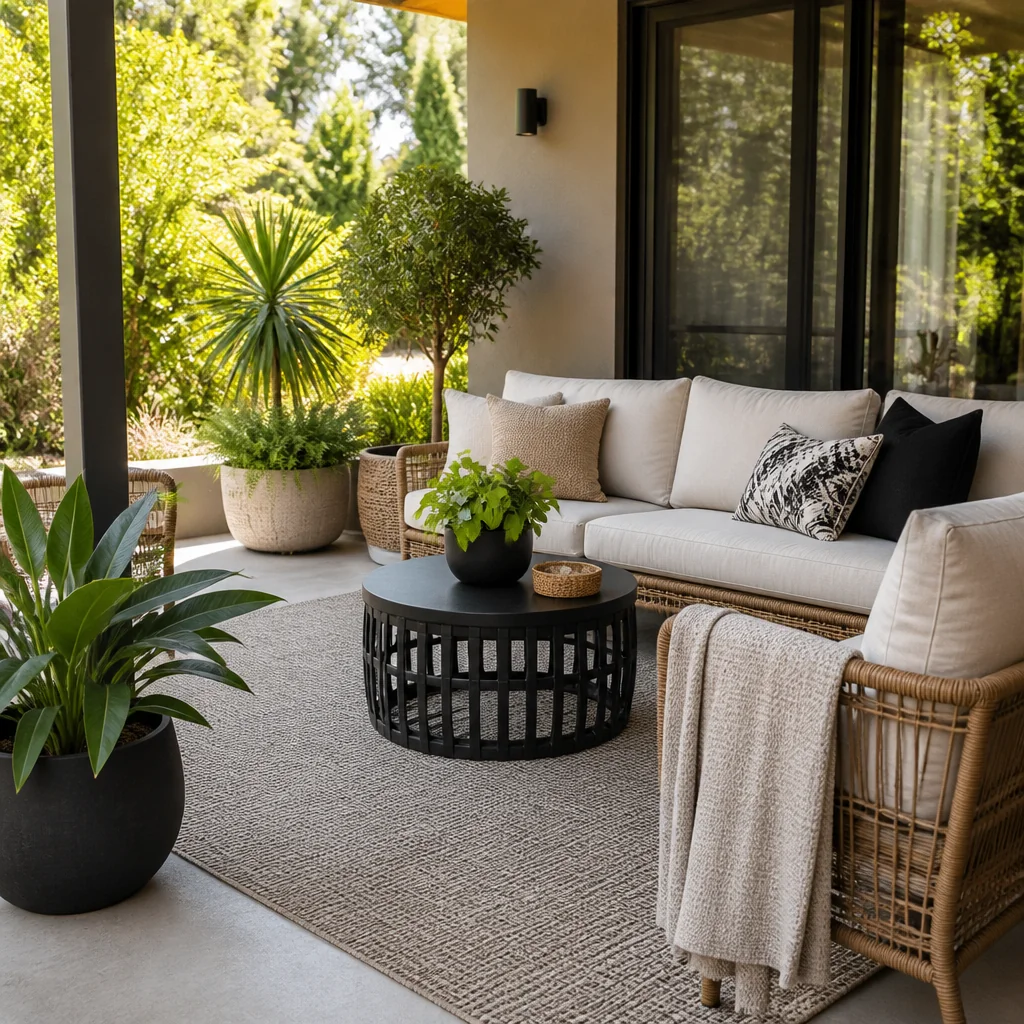
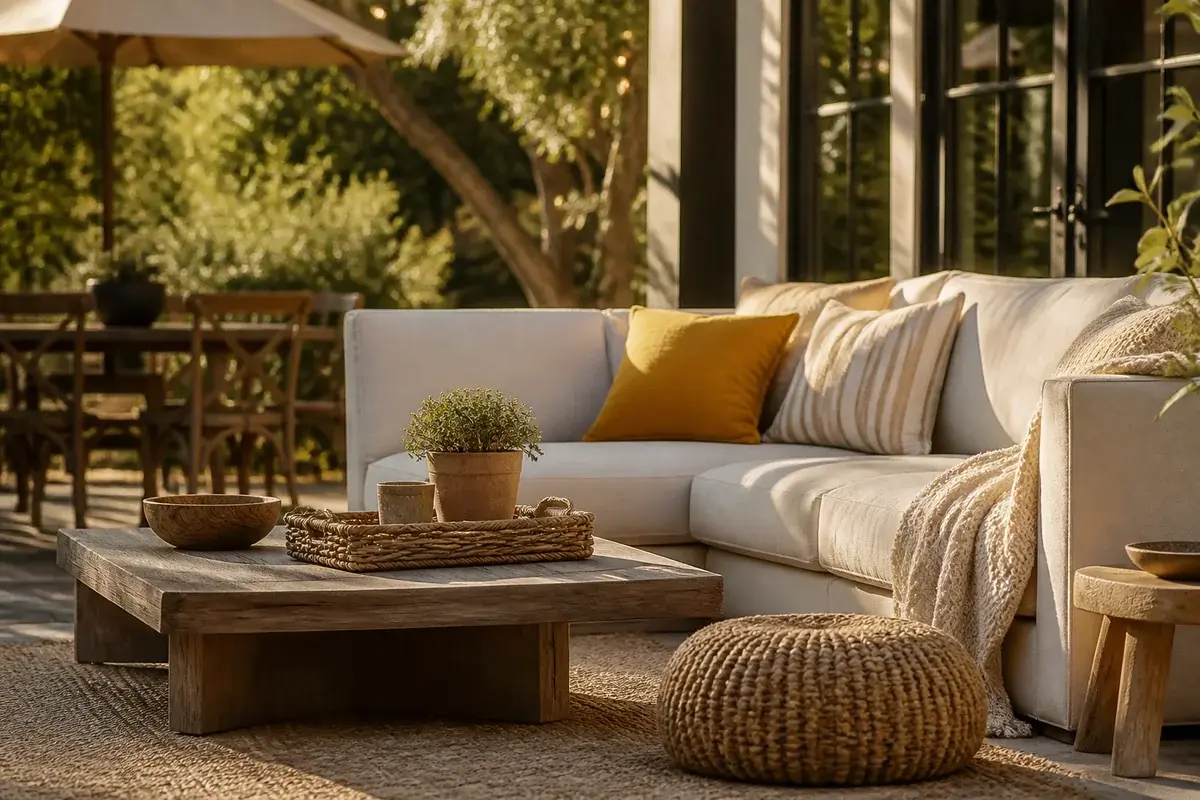
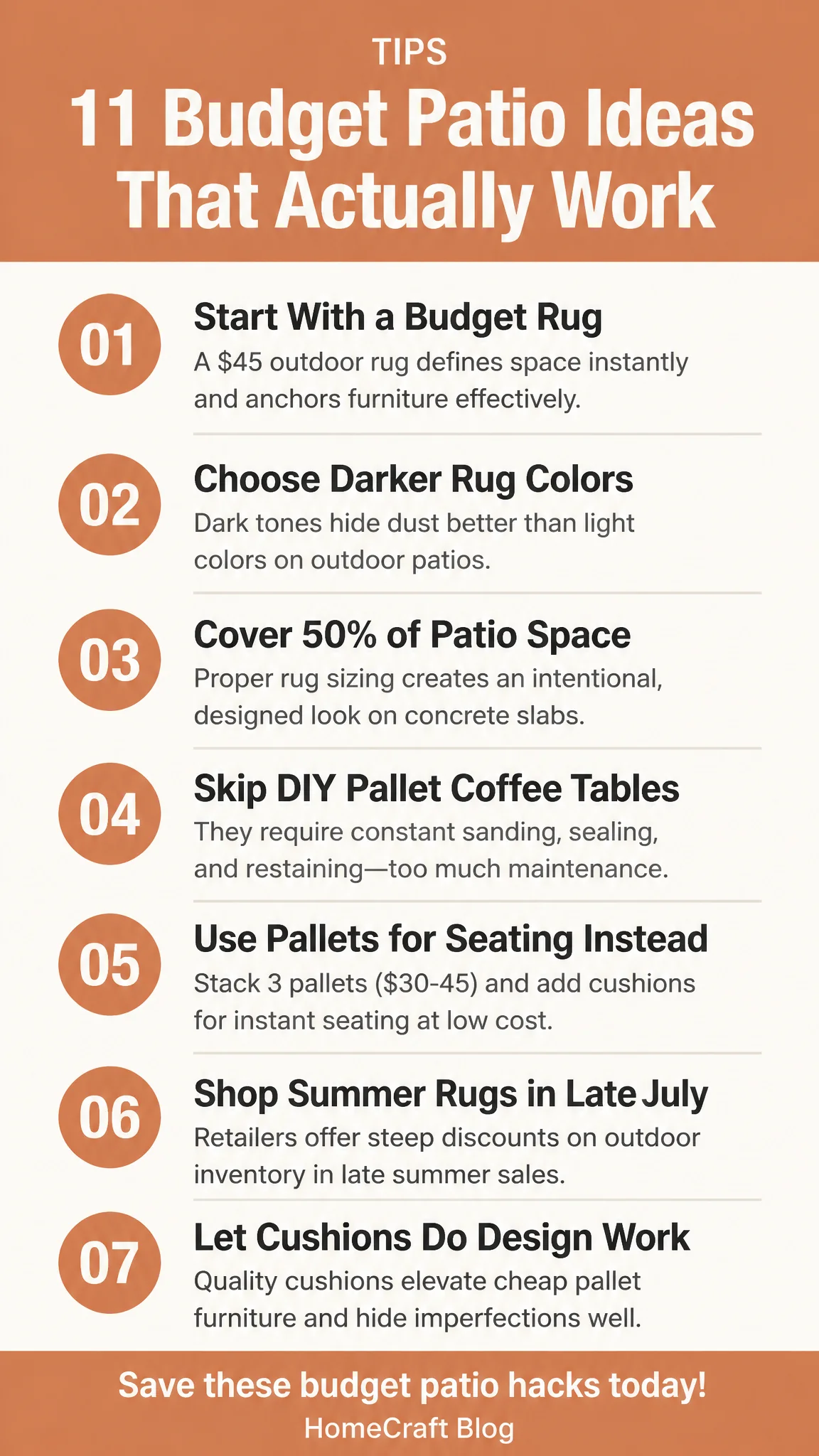
A rug is the cheapest way to make a concrete slab read as a room rather than a leftover pour. Flat-woven polypropylene is the material you want out here. It sheds water, dries in an afternoon, and runs roughly $30 to $60 for a 5x7 and $45 to $90 for a 6x9. Jute and sisal look lovely for about a month, then hold damp and start to smell.
Size the rug to the furniture, not to the slab. A 6x9 handles two chairs and a small table; step up to 8x10 once a loveseat is in the mix. Let it run about 6 inches past the furniture footprint on every side so no chair leg ends up teetering half on, half off. That's the same rule that keeps a small living room from feeling chopped up.
Skip pale cream and light gray. Pollen, dust and grill spatter show on them within a day, while terracotta, rust and deep olive hide all three. Sweep the grit out from underneath a few times a season, because trapped sand works like sandpaper on the backing every time someone walks across it.
Late July and August is when retailers clear summer inventory. That's your cheap window.
DIY Pallet Furniture Isn't Terrible (If You Know What to Avoid)
Seating is the part of this that genuinely works. A standard GMA pallet measures 48 by 40 inches and stands about 5.5 inches tall, so two stacked with a 4 inch outdoor cushion on top lands near a 15 inch seat height: low and loungey, within an inch or two of what most patio sofas give you. Pallets run $10 to $15 each at a home center, and the cushions do all the design work while the wood disappears underneath.
Check the stamp before anything else. You want HT burned into the side, meaning heat treated, not MB, which is methyl bromide. That fumigant has no business under anyone's legs. Then sand to 120 grit, ease the sharp edges, and put two coats of exterior sealer on every face including the bottom, since that's where moisture wicks up from the slab.
Coffee tables are where pallet builds go wrong. A flat top collects standing water in every gap between boards, so the finish lifts and it wants sanding and resealing a couple of times a season. A plain metal side table for around $25 asks nothing of you, which is the same logic that keeps a first apartment affordable: buy the boring durable thing, spend the money on what you sit on.
String Lights Are Nonnegotiable (Even if You Think They're Cliché)
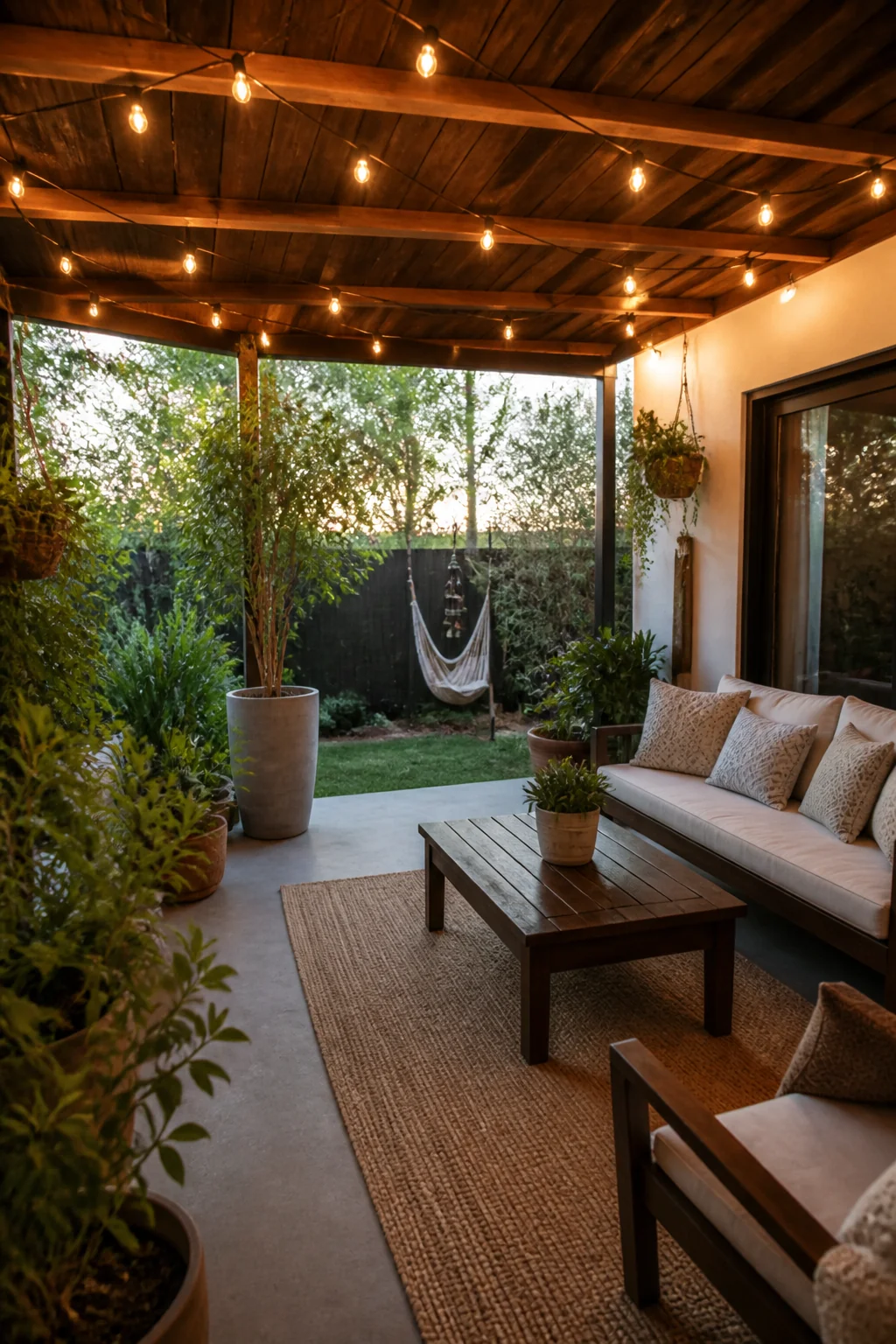
Yes, everyone has them. They still earn their place, because a patio lit only by whatever spills out of the kitchen window reads like a parking lot after dark.
Buy commercial-grade S14 strands rather than the thin decorative kind. A 48 foot run with sockets every 12 to 24 inches costs around $40, and those sockets are rated for wet locations, which is the difference between a set that lasts four seasons and one that corrodes by October. Warm bulbs are the whole point: 2200K to 2700K. Anything cooler looks like security lighting. Shatterproof LED bulbs cost slightly more and survive being knocked off a ladder.
Hang the strand 8 to 9 feet above the floor so nobody walks into it, and let it sag 12 to 18 inches between anchor points. That droop is what turns the light into a canopy instead of a fence line. Run 1/8 inch stainless steel cable with a turnbuckle first and zip-tie the strand to it, because a cord left carrying the tension stretches and eventually pulls its own sockets apart.
One thing to check on the box: how many strands you can safely connect end to end. Most commercial sets cap out around three runs.
Potted Plants Do the Heaviest Lifting
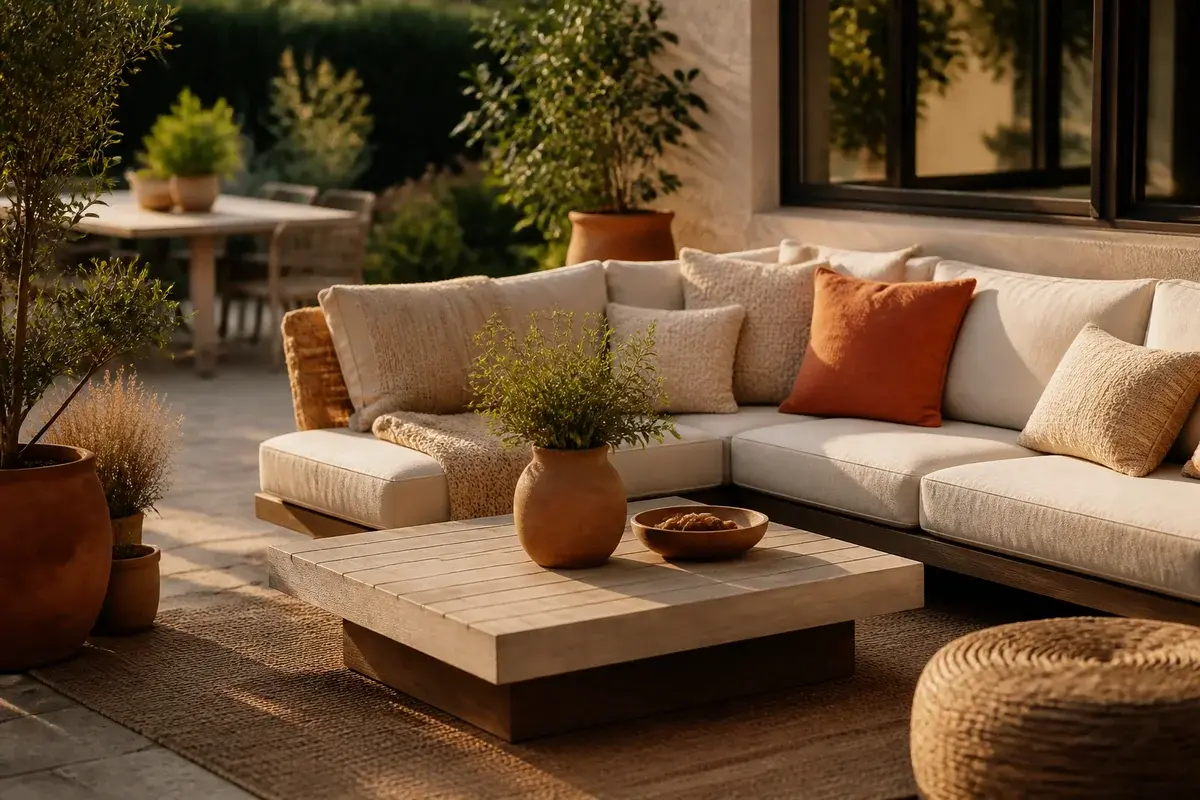
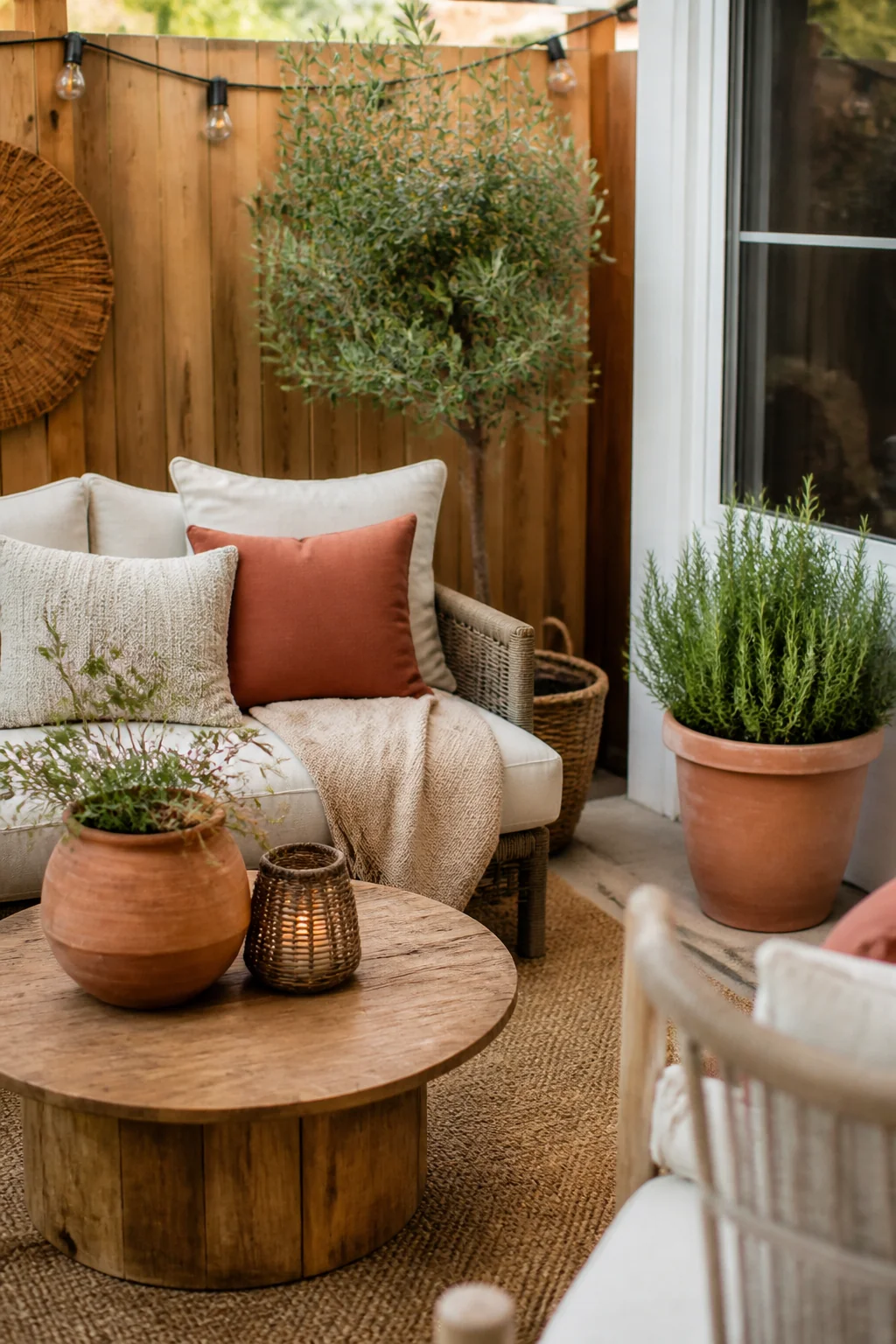
Buy small and let them fill in. A 1 gallon shrub costs $8 to $15 against $35 to $50 for the same plant in a 5 gallon pot, and after one growing season you'd struggle to tell them apart. Trailing jasmine, sedum, lantana, rosemary and black-eyed Susan all shrug off heat and a forgotten week of watering, which matters more on a patio than any of them being fashionable.
Every pot needs a drainage hole. No exceptions, and a layer of gravel is not a substitute. Terra cotta breathes, which is a gift in a damp climate and a punishment in a dry one: above 90F, a 12 inch terra cotta pot can want water daily, while glazed ceramic or a plastic liner buys you two or three days.
The thing that kills more patio plants than neglect is standing pots straight on concrete. The slab holds heat well past sunset and cooks the roots from below. Set them on $4 pot feet and cluster three or four together so they shade each other's sides.
Exterior paint on plain terra cotta, about $8 a can, ties the pots to your rug for almost nothing. Small touches like that do more than one expensive specimen.
Create Zones Without Spending Money
Zones cost nothing. They're furniture moved on purpose, and they're the difference between a patio that seats people and one where everybody drags a chair around on arrival.
Three moves do most of it. First, pull the seating off the walls, because a ring of chairs around the perimeter turns any space into a waiting room. Second, set the conversation seats within about 8 feet of each other and angle them roughly 45 degrees rather than squaring them off, so nobody has to raise their voice across the slab. Third, leave 18 inches between the coffee table and the fronts of the seats: enough to put a drink down, close enough to reach without standing.
Then keep one clear route from the door across the patio, 30 to 36 inches wide. That path is the reason a deliberately empty corner earns its keep more than one extra chair would.
A limit worth knowing: on a slab under roughly 10 by 10 feet, stop at two zones, somewhere to sit and somewhere to set things down. Three zones on a small patio just gives you three cramped ones.
DIY Concrete Patio Painting Is the One to Skip
Floor and porch paint on an outdoor slab is a dependable way to lose a weekend and $50. Two forces work against it. Ground moisture rises through the concrete as vapor and pushes the paint film off from underneath, and a hard-troweled or previously sealed surface gives the paint very little to grip in the first place. It lifts in sheets, usually inside the first few weeks, and taking it back off means renting a pressure washer or a grinder at $40 to $75 a day.
Penetrating concrete stain behaves differently. It soaks into the pores and colors the slab instead of coating it, so there is no film to peel. A gallon costs $30 to $40 and covers 200 to 400 square feet depending on how thirsty the concrete is. The slab has to be clean and unsealed for it to take, and the test is free: drip water on it. If the water beads instead of darkening the surface, stain will not penetrate.
The cheapest good-looking version is a stained border. Tape a band around the perimeter in two tones and leave the middle bare. Plain concrete under a rug is a perfectly respectable finish.
Add Ambient Lighting for Evening Use
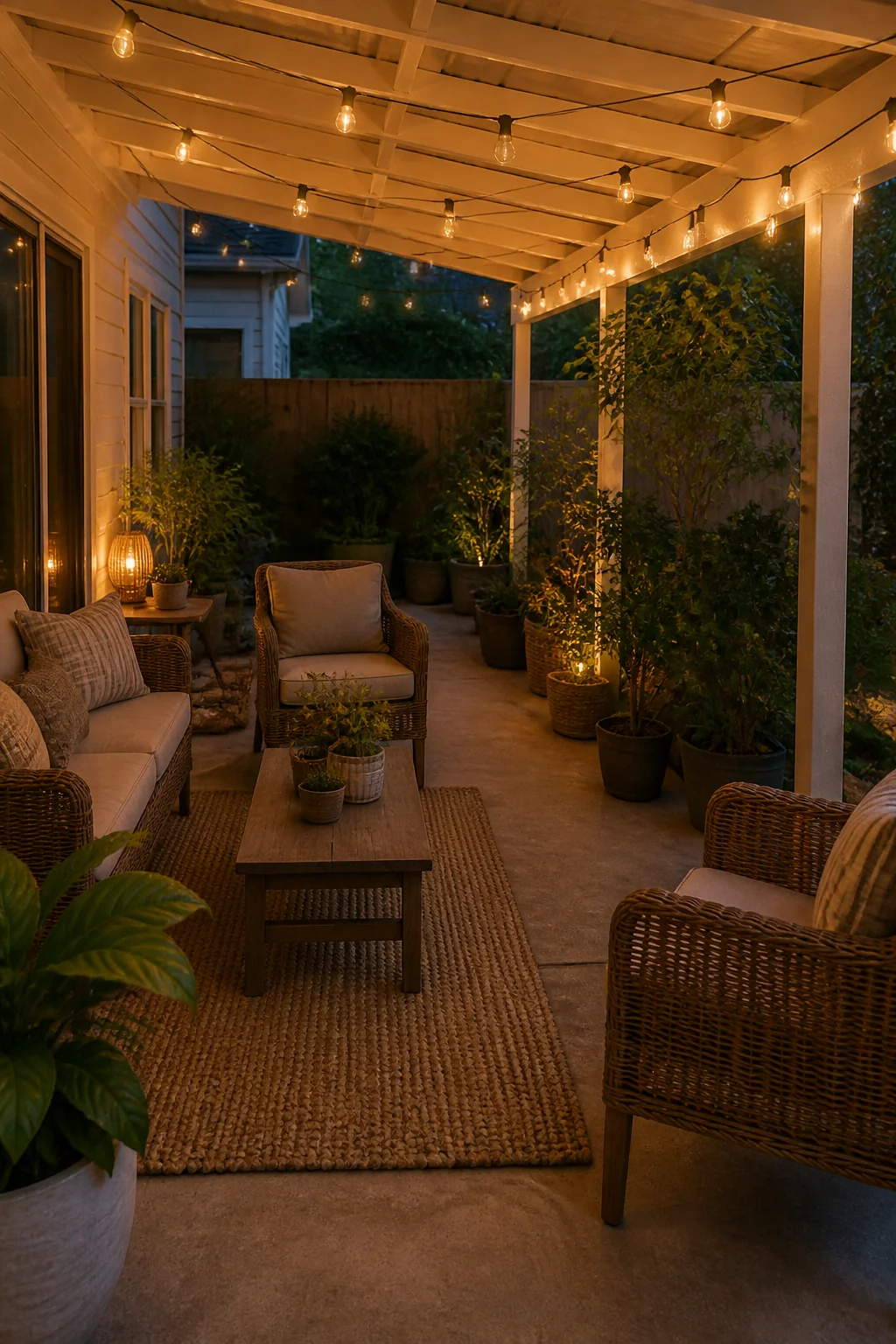
String lights handle the canopy. What's still missing after that is light lower down, at the height of a face rather than a ceiling, and that's what makes a patio usable after nine o'clock instead of merely lit.
Solar is the low-risk place to start. A $25 solar lamp needs 6 to 8 hours of direct sun on its panel to run through an evening, so one tucked under the eaves or behind a shrub will disappoint you no matter how good the reviews were. Expect runtime to shorten noticeably in winter when the days get short.
A weather-resistant floor lamp, roughly $60 and up, needs an outdoor-rated GFCI outlet and a 16 gauge outdoor extension cord if the outlet isn't nearby. Rechargeable LED table lamps split the difference at $30 to $50, with a USB-C port and 6 to 10 hours per charge, and they let you move the light to wherever people end up sitting.
Keep every bulb warm and keep them all dim. One cold, bright fixture flattens the whole patio and cancels out what the string lights are doing. Three small warm sources beat one strong one out here.
One caution before you start spending. Everything here lives outdoors year round, and cheap only stays cheap if it survives a second summer. That's why the rug is polypropylene, the pallets are heat treated and sealed on all six faces, and the string lights hang off a steel cable. A $45 rug you replace every May costs more than a $90 one you don't.
Save the full guide
Order matters more than the total, too. Light and a rug change how the patio feels after dark and underfoot, which is most of what decides whether anyone goes out there. The furniture can wait for the end-of-season sale.