11 Master Bedroom Decor Ideas, and What Each One Costs
Eleven master bedroom decor ideas with the costs, sizes and trade-offs behind each one: lighting, paint, headboards, rugs, curtains and bedding.
This post contains affiliate links. As an Amazon Associate I earn from qualifying purchases. If you buy through our links, we may earn a commission at no extra cost to you.
The bedroom is usually the last room to get any attention. The kitchen gets new hardware, the living room gets a gallery wall, and the room you sleep in keeps the builder-beige walls and the bed frame that was on sale three years ago. It works, but it doesn't feel like anything, and it tends to look like a hotel room nobody was especially keen to stay in.
Eleven changes are grouped below, from a $25 plant to a headboard you save up for. For each one you'll find what it costs, what size it needs to be, and where it stops working. That last part matters more in a bedroom than anywhere else in the house, because most of the mistakes made in here are scale mistakes rather than taste mistakes: the rug that's too small, the art hung too high, the curtain rod screwed to the window frame.
Layered Lighting Instead of One Ceiling Fixture
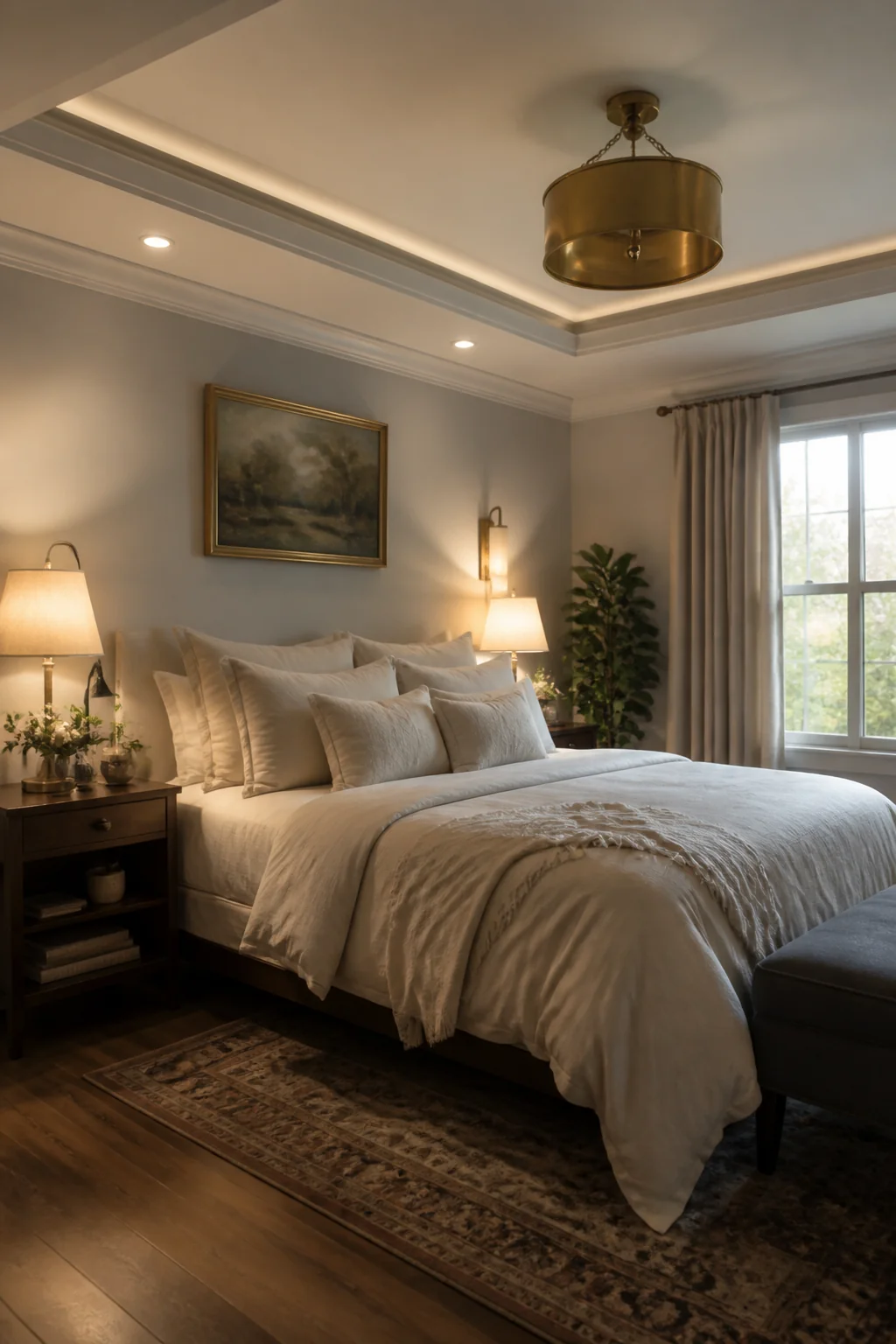
A single ceiling fixture is what makes a bedroom feel institutional. It drops light from one point, flattens everything underneath it, and gives you no way to soften the room at ten at night. The fix is three sources at different heights.
Start with a lamp on each nightstand, tall enough that the bottom of the shade sits near eye level when you're sitting up in bed. On a 24 to 26 inch nightstand, that's usually a lamp of 26 to 30 inches. Add a floor lamp of roughly 58 to 64 inches beside a chair or in whichever corner always goes dark. Then something low and warm behind the bed: a plug-in sconce, a picture light, or string lights on a dimmer. Low, layered light like this is where our cozy bedroom ideas begin, before any bedding or pillows.
Buy every bulb at the same color temperature, around 2700K, or the room reads patchy. A pair of table lamps runs $60 to $90, a floor lamp $80 to $150, and plug-in dimmer cords about $15 each.
Wall Color Sets Up Everything Else
Beige is safe, and safe is what keeps a room from feeling like anywhere in particular. A soft grayish green or a muted clay does more work than any object you could put in the room, because it changes how every other color in there looks. White bedding reads crisper against a low-saturation wall. Brass stops feeling cold.
Test before you commit. Paint two coats onto a 12 by 12 inch board rather than straight onto the wall, where the old color bleeds into your judgement, then move that board around: by the window in the morning, next to the bed at night. North-facing rooms pull greens and grays cooler and grayer than the chip suggests, and south-facing rooms warm them up.
Eggshell or matte hides the drywall patches that satin will highlight. Budget two gallons for a 12 by 14 foot room, since one gallon puts down 350 to 400 square feet per coat, and expect $100 to $140 with supplies. Going darker than the color you are covering is when you buy a third, because deep bases need an extra pass before the wall stops looking patchy. Hiring a painter for the same room usually runs $300 to $600.
A Real Headboard is Worth the Investment
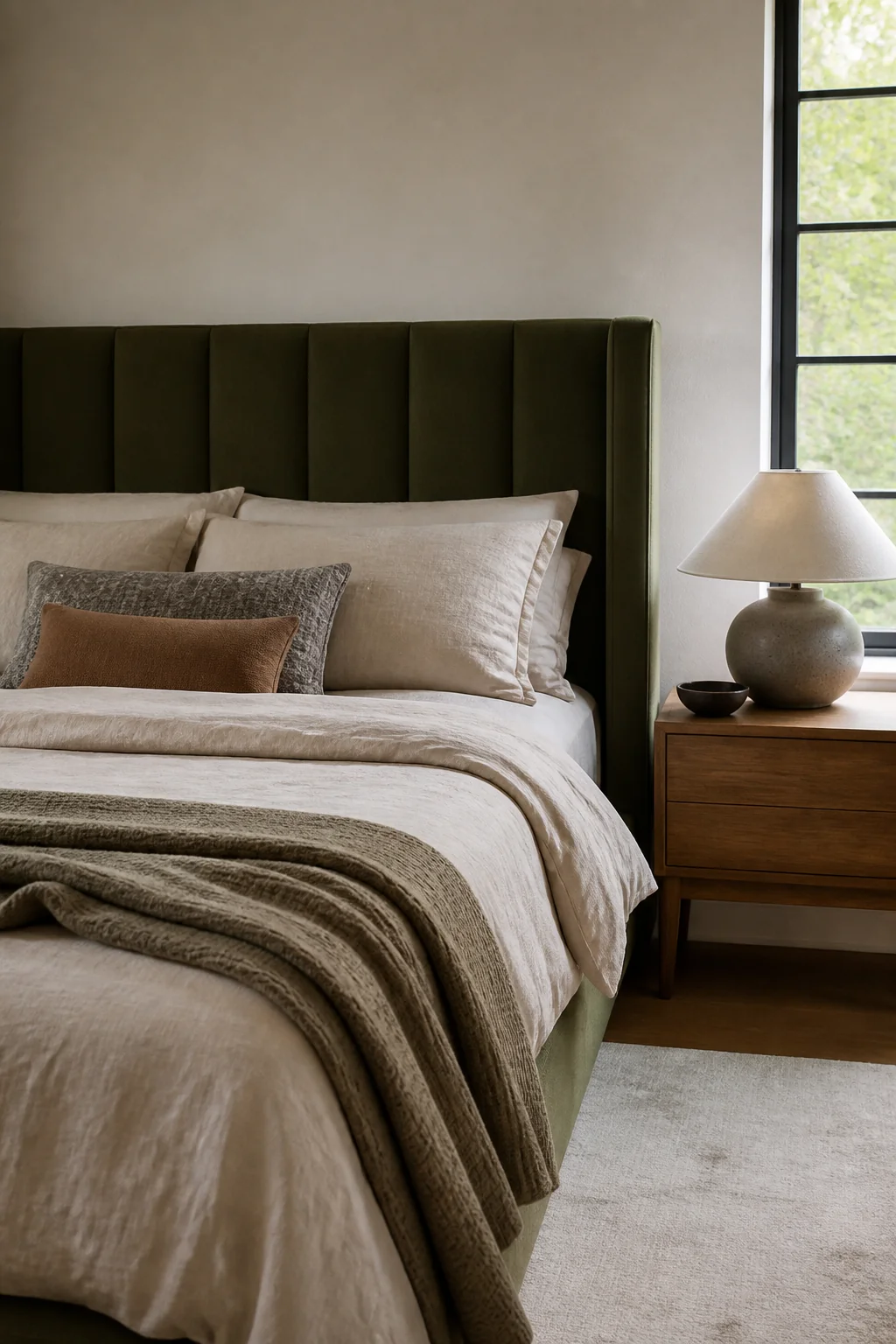
A bed with a blank wall behind it reads unfinished no matter what else is in the room. A headboard gives the bed a top edge and a focal point, and it also lets throw pillows make sense, since they finally have something to lean against.
Size comes first. The headboard should be at least as wide as the mattress, so 62 to 64 inches for a queen and 78 to 80 for a king, and 48 to 56 inches tall from the floor under a standard 8 foot ceiling. Anything shorter vanishes behind the pillows once the bed is made. Check that your frame has pre-drilled bolt holes before you order, because the alternative is wall-mounting into studs with rated hardware.
Upholstered linen runs $250 to $500 for a queen. The trade-off is upkeep: pale linen collects hair oil and product exactly where your head rests, and the cover usually doesn't come off to be washed. If you read in bed most nights, a performance weave or a darker mid-tone is the version you won't resent in two years.
Nightstands Don't Have to Match
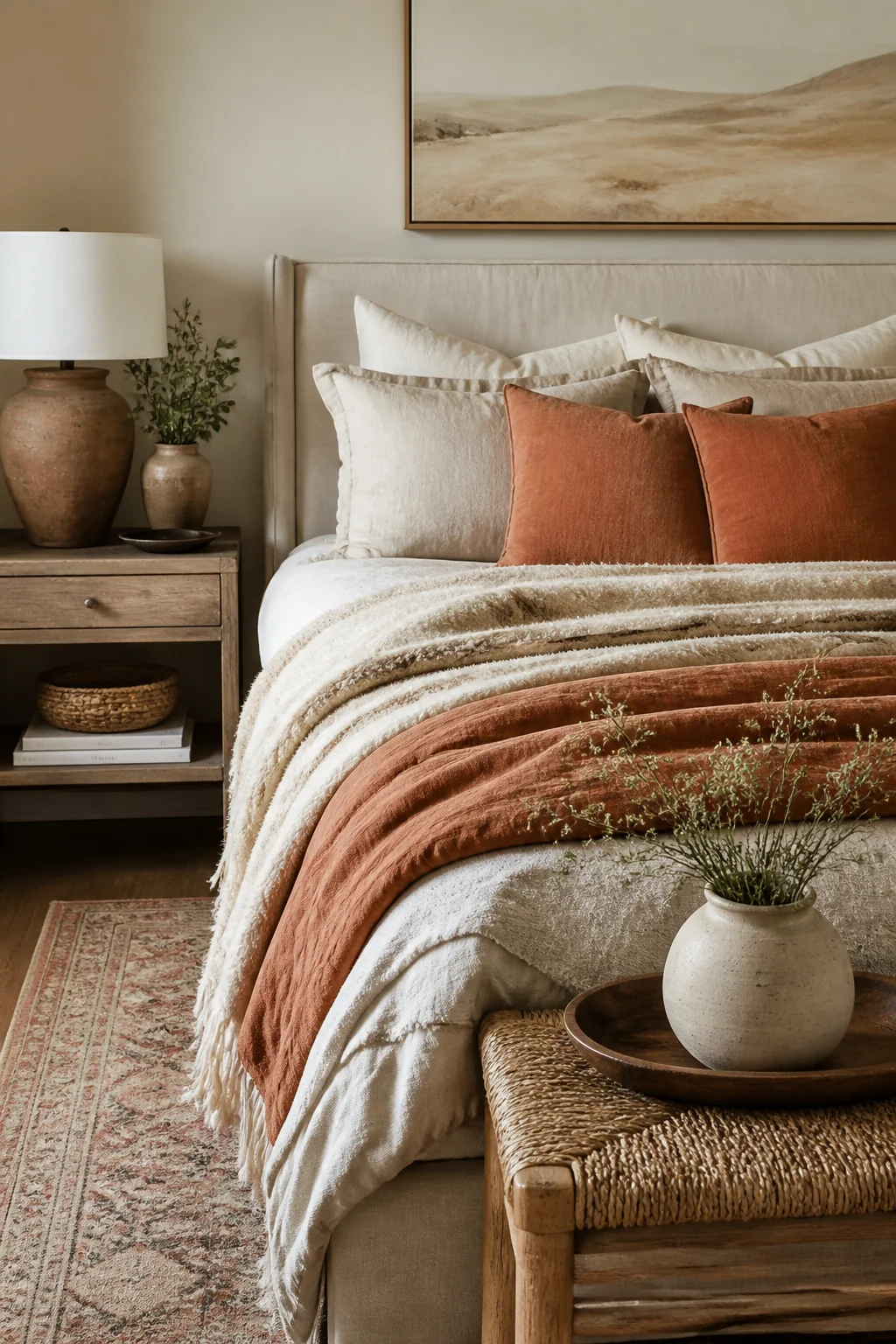
A matched pair from a bedroom set is the quickest way to make a room look ordered and slightly anonymous. Two different pieces read as collected instead, and the mismatch works as long as they agree on two things: height and visual weight.
Keep both tops within 2 or 3 inches of each other, at roughly the height of the top of the mattress, which usually means 24 to 28 inches. Much lower and you're reaching down for a glass of water in the dark. Give each one at least 18 inches of width so a lamp, a book and a glass aren't competing, and leave a 2 to 3 inch gap between the nightstand and the bed frame so sheets don't catch on the corner.
Then let them differ. One closed with drawers and one open with a shelf gives you somewhere to hide things and somewhere to leave things out on purpose. Repeat a single element across both, the wood tone or the hardware finish, and the pairing looks deliberate rather than leftover. Secondhand pieces typically run $40 to $120 each.
Layering Rugs Sounds Bougie But Works
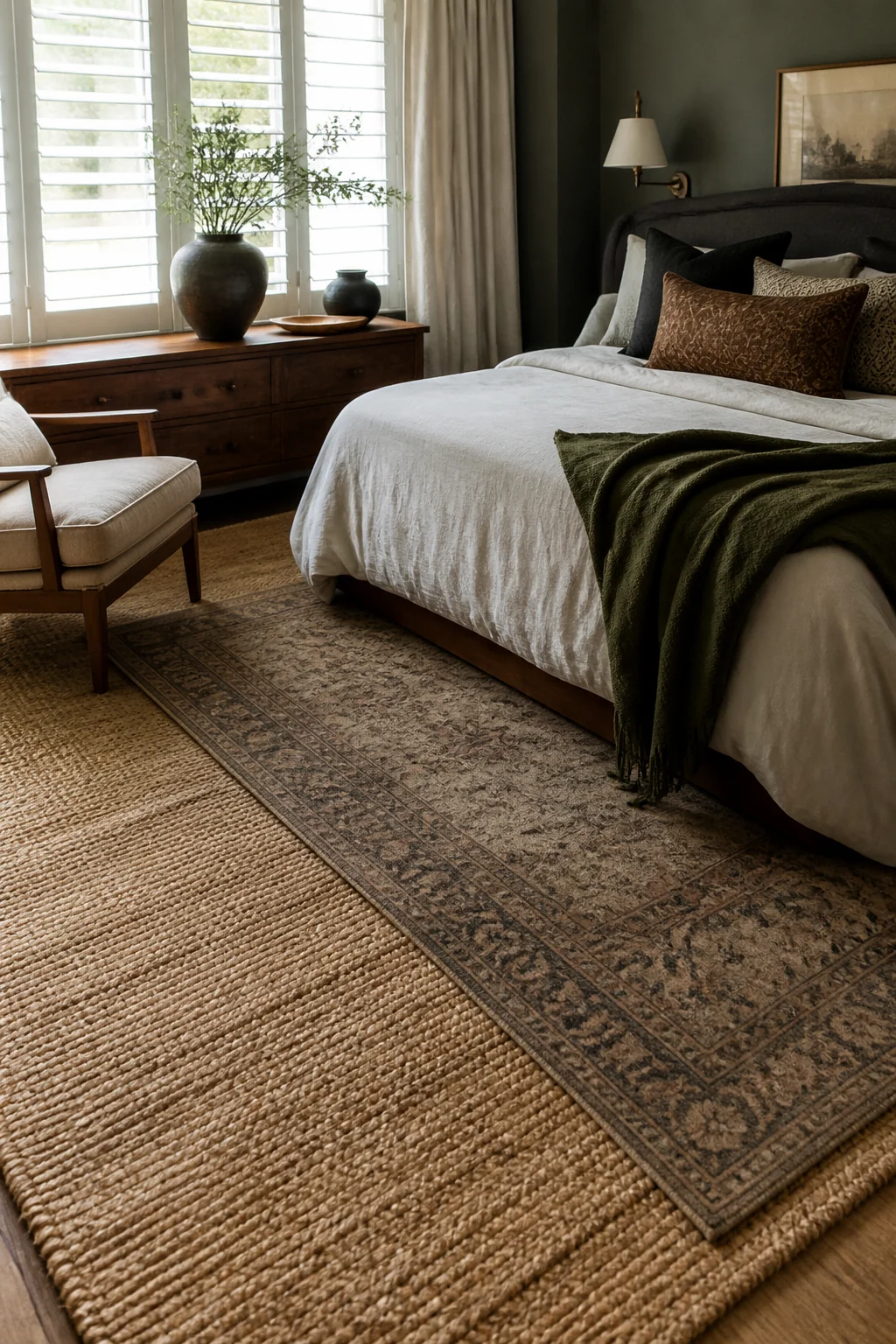
A rug that's too small is the most common bedroom mistake, and layering is the cheap way around it. The base layer does the sizing work: a jute 8 by 10 under a queen, or a 9 by 12 under a king, set so it begins just in front of the nightstands and runs 18 to 24 inches past the sides and the foot of the bed. That margin is the part your bare feet land on getting out of bed, and its absence is why a lone 5 by 8 leaves the bed looking like it's floating.
The smaller rug on top handles comfort and pattern, which matters because jute is rough underfoot and sheds fibers for the first few months. A 5 by 7 wool or vintage-style rug across the foot of the bed does it, or a pair of runners down each side.
Budget $150 to $250 for a jute 8 by 10 and $80 to $200 for a secondhand wool rug in decent condition. Put a felt pad under the base and double-sided rug tape between the layers, or the top rug will creep and its corners will curl.
Window Treatments That Frame the Window
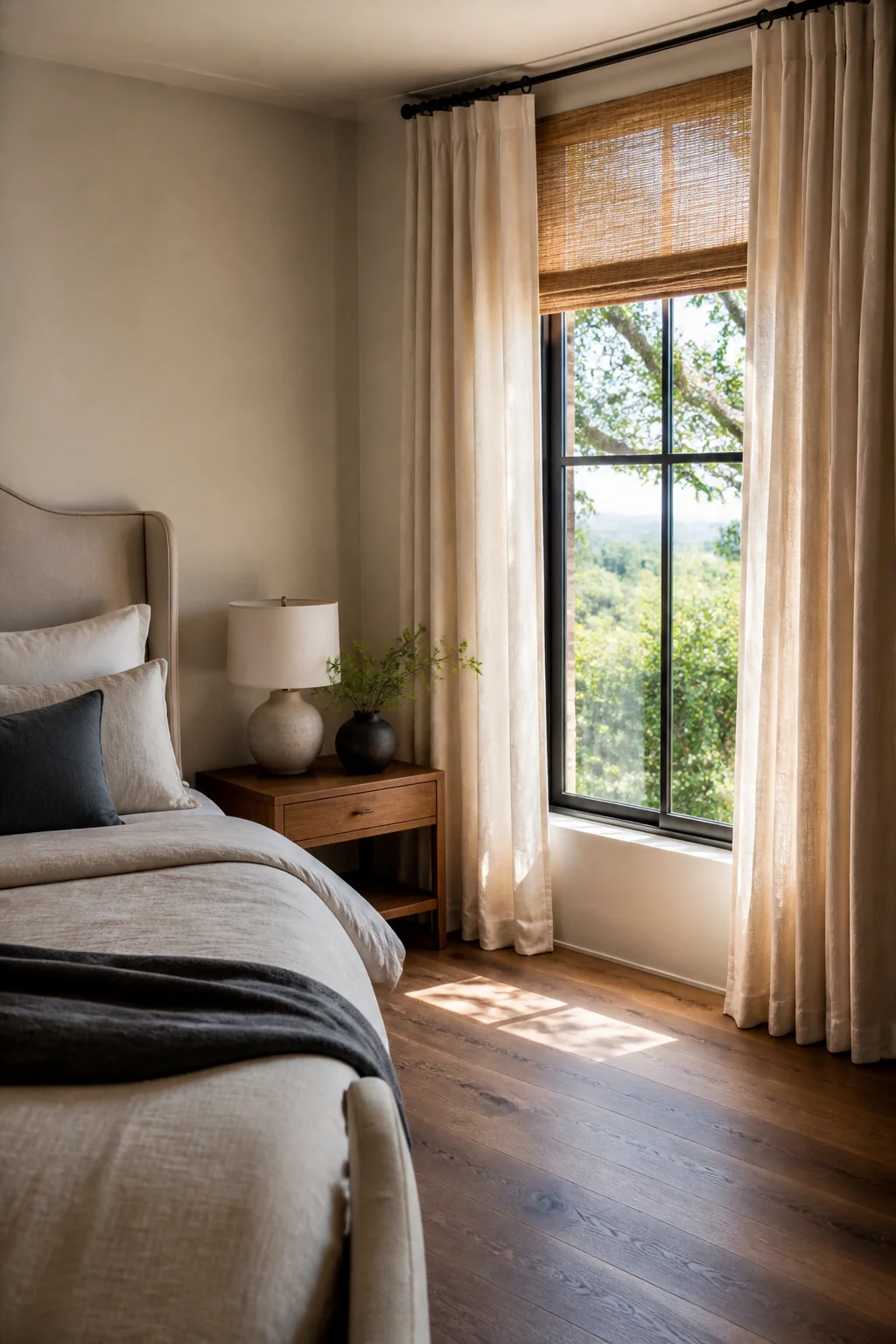
Aluminum blinds on their own make any room look like a rental. Curtains fix that, but only when they're hung well outside the window, which is where most people go wrong.
Four to six inches of wall above the frame is the normal spot for the rod, with 8 to 12 inches of rod running past each side so the open panels have somewhere to sit clear of the glass. Ceilings of 9 feet or more are the exception: take the rod higher, roughly halfway between frame and ceiling, or the window looks stranded under all that bare wall. Either way the window reads larger and you get noticeably more of the morning light. Panels should reach the floor, either breaking half an inch above it or pooling by about an inch, and their combined width wants to be roughly twice the width of the window so they still look full when drawn.
Linen and cotton-linen blends drape well at $60 to $150 a pair, with rods at $25 to $40. Unlined linen filters light rather than blocking it, so order a blackout lining if a 5:30 sunrise wakes you. Linen also creases, and it wants a steamer rather than an iron.
One Statement Piece Per Wall
Restraint is harder than filling, and it's what keeps a bedroom calm: one thing per wall, sized properly, with the rest left alone.
Above the bed, two-thirds of the headboard width is the working target, so 40 to 48 inches over a 62 inch queen, hung 6 to 10 inches above the top edge so the two read as one block rather than two objects. A tall upholstered headboard is where that ratio stops helping: it already fills the wall, and a smaller frame with air around it holds up better than a wide piece pressed on top of it. On the wall opposite, a single floating shelf of 36 to 48 inches holds books and a small plant without turning into a display cabinet. The remaining walls stay bare, and that emptiness is what lets the two pieces land.
One practical note: anything over about 20 pounds hanging above a bed needs two D-rings into studs, or toggle bolts rated for the weight, not a single picture hook. Prints from independent sellers start around $45, and the frame is usually the larger cost at $60 to $120 for a 24 by 36. A secondhand frame with a new print swapped in is the inexpensive route.
Fresh Bedding Is the Obvious Upgrade
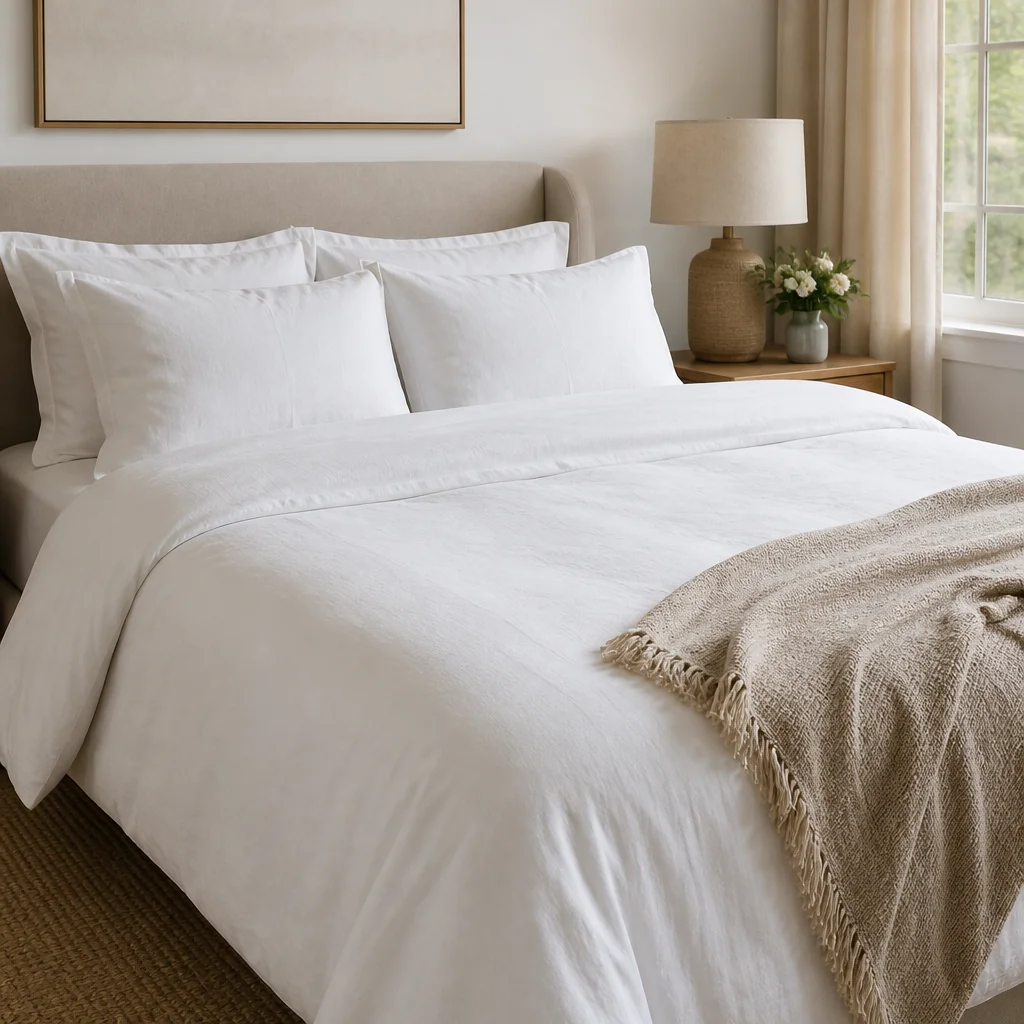
Bedding is the one thing in the room you're in contact with for eight hours a night, so it's where a price difference is easiest to feel.
Weave tells you more than thread count. Percale is the crisp, cool, hotel-sheet finish and sits comfortably between 200 and 400 threads; sateen is smoother and sleeps warmer. Anything advertising 1,000 threads is generally multi-ply yarn counted twice. What to look for instead is long-staple cotton, which pills far less than the short-fiber cotton in cheap sets. Skip microfiber altogether if you sleep hot.
A good set runs $100 to $150, and owning two is the quiet upgrade, because the bed gets remade the day it's stripped instead of three days later. If you use a duvet, going 2 to 4 inches over the cover on the insert keeps the corners full rather than collapsing into flat triangles. Stay at the low end of that when the cover has no corner ties, since the extra inches just drift and bunch toward one side.
Wash new sheets before the first night to soften the factory finish, then weekly on warm. Linen costs more, $200 and up, and improves with every wash instead of degrading.
Small Final Touches (Plants, Books, Candles)
The last layer is what makes a bedroom look lived in rather than staged, and most of it is cheap.
Choose the plant for the light you have, not the photo you liked. A fiddle leaf fig wants hours of bright indirect light and drops leaves within a month anywhere else. A bedroom with one curtained window does better with a snake plant, ZZ plant or pothos, all of which take low light and forgive irregular watering. Expect $25 to $40 in a 10 inch pot.
Hold the nightstand to three objects: the lamp, whatever you're reading, and one dish or tray of 8 to 12 inches to catch rings, hair ties and lip balm. Past three it reads as clutter however nice the objects are.
Candles are worth spending on for scent throw, but burn the first one for two to three hours so the wax melts all the way to the edges, otherwise it tunnels and you lose half the jar. Trim the wick to a quarter inch each time, keep it well clear of bedding, and never leave one lit as you drift off.
The whole guide in one image
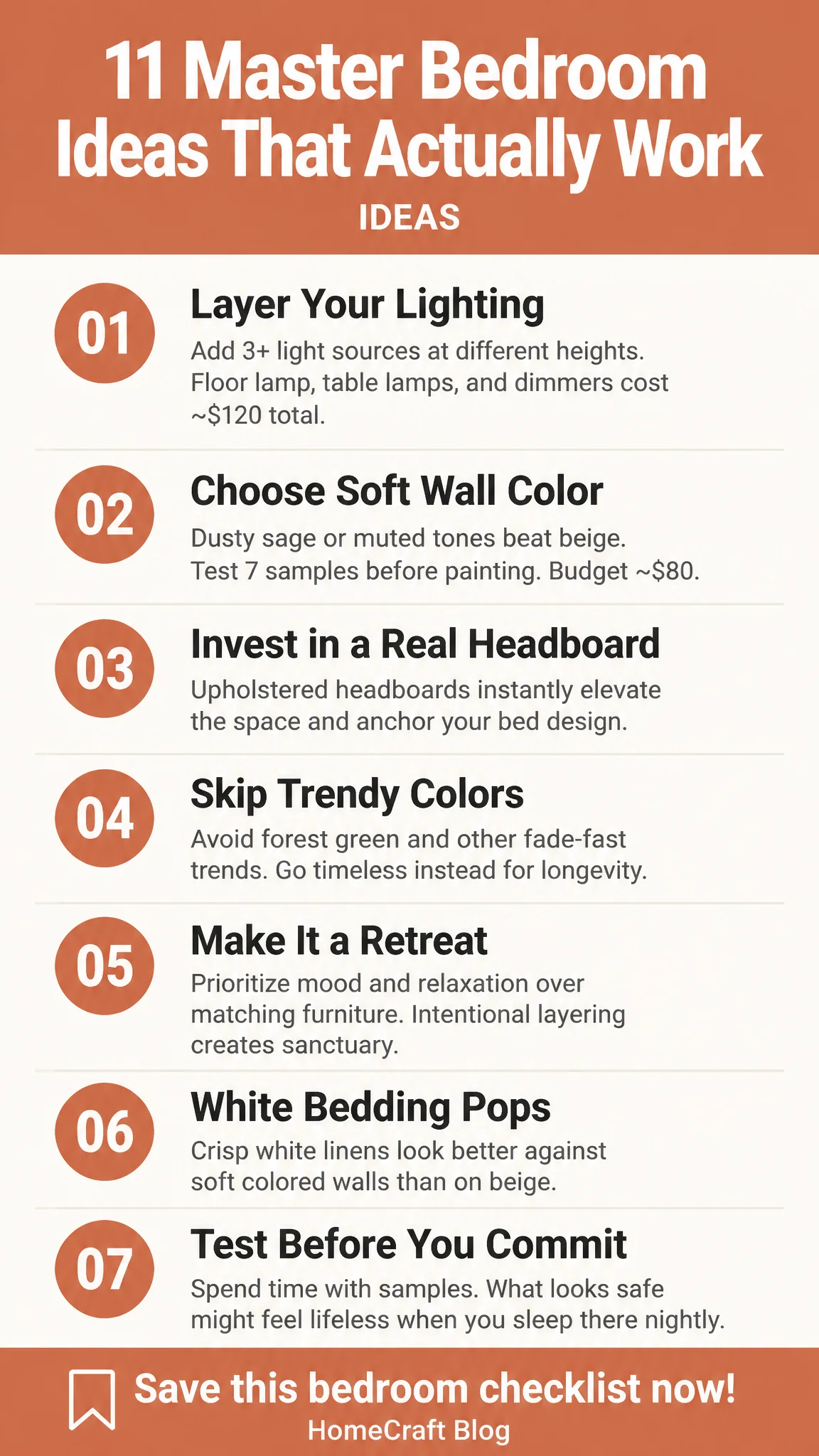
Nearly everything here is reversible. Paint gets repainted, a rug rolls up, a print comes off the wall. The two that are expensive to undo are the headboard and the bedding, and those are the ones worth slowing down for: measure the wall, check the frame's bolt holes, order a fabric swatch and put it next to the paint board before anything ships. A bedroom is small and you're never far enough from any surface to lose sight of it, which is why the size of a thing tends to matter more in here than the style of it.