Gallery Wall Ideas: Spacing, Height, and Frame Rules That Work
Gallery wall ideas that hold up in a real room: hanging heights, frame spacing, which frame mixes work, and how to plan the whole layout on paper first.
This post contains affiliate links. As an Amazon Associate I earn from qualifying purchases. If you buy through our links, we may earn a commission at no extra cost to you.
A blank wall and a stack of frames is a peculiar kind of stuck. You know roughly what you want the wall to feel like. Then you pick up the hammer and every decision starts to feel permanent.
It isn't, and that's the useful part. Nearly everything that goes wrong with a gallery wall is a height problem or a spacing problem, and both get solved on paper before a single nail goes in. The rest comes down to a handful of numbers: how high the center of an arrangement should sit, how much air to leave between frames, and how much weight your wall will carry without complaint.
Here's how those pieces fit together, starting with the step most people skip.
Start with a Theme, Not Pinterest Perfection
Scrolling for inspiration is the fastest way to stall out. The wall you saved probably uses eight frames in sizes you'd have to order, and at $25 to $60 a frame that's a $300 shopping trip before anything touches the wall.
Work the other direction instead. Pull out everything you already own that could hang: prints, photographs, a small mirror, a piece of framed fabric, a kid's drawing worth keeping. Spread it on the floor or the bed. That pile tells you two things immediately. It tells you roughly how many pieces you have, and it shows you the largest one, which becomes the anchor the rest of the layout organizes around.
Now you're only shopping for gaps. Maybe you need two vertical pieces to balance a wide horizontal photo, or one big print to hold the middle. Buying three deliberate pieces beats buying twelve hopeful ones, and it's the difference between a wall that reads as a collection and one that reads as a clearance shelf.
The constraint is doing you a favor. A wall built from things you already chose once will look more like you than any layout you copy.
Measure Twice, Hang Once
The kraft paper template is the step that saves the spackle. A 30 inch roll costs around $15 and covers several walls, so it's cheaper than one wrong frame.
Here's the order that works:
- Trace each frame onto the paper and cut out the shapes.
- On the back of every frame, pull the hanging wire taut toward the top edge and measure the gap between the wire and the top of the frame. Write that number on the matching cutout.
- Tape the cutouts to the wall with painter's tape, holding 2 to 3 inches between them.
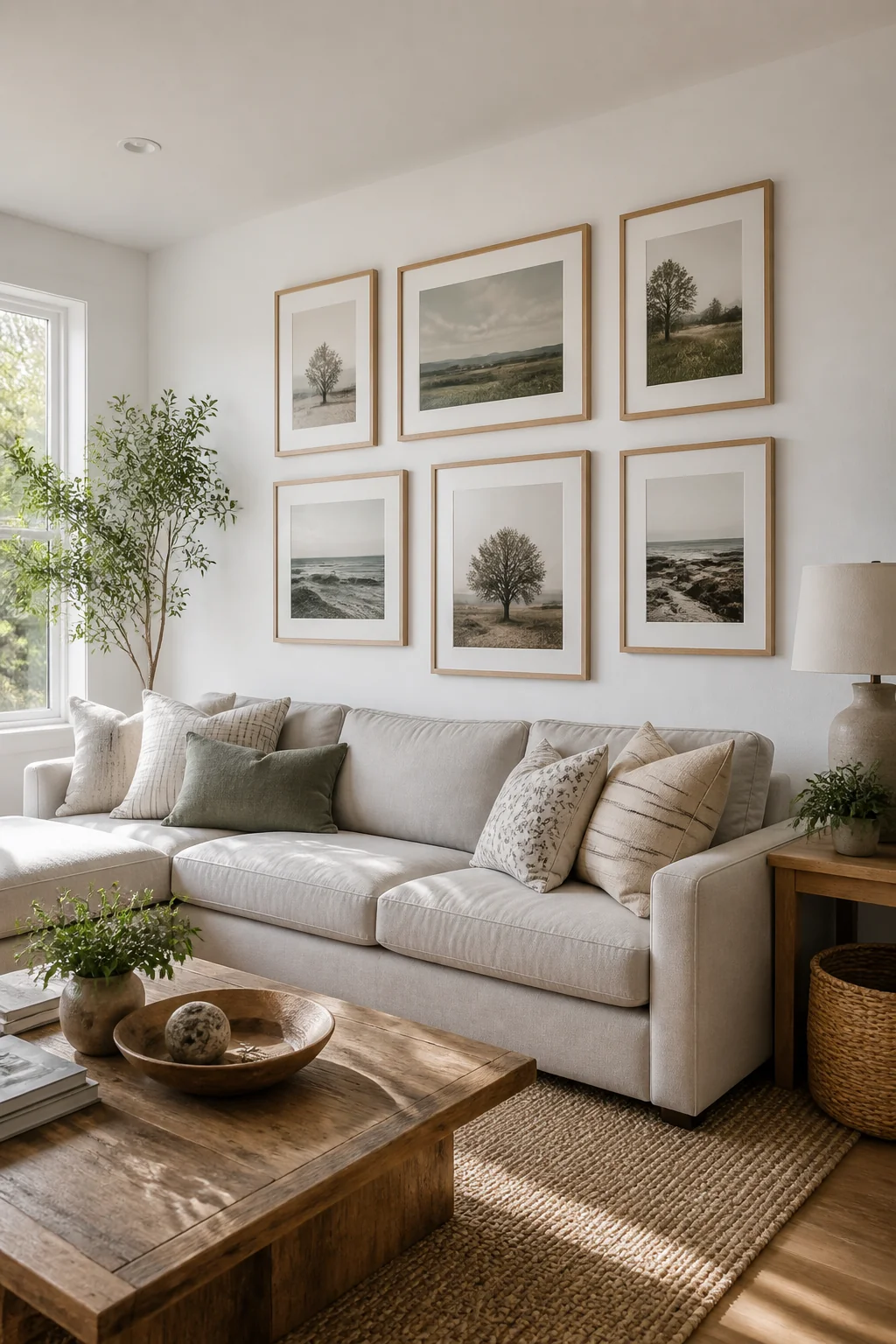
- Check the height before you commit to it. Run a tape up the wall, pencil a light mark at 57 inches and another at 60, then slide the cutouts until the middle of the whole arrangement sits inside that band. It's the same band a gallery hangs to. Over a sofa, measure off the furniture instead and start the lowest frame 6 to 8 inches above the back cushions.
- Walk to the far side of the room and photograph it. The camera flattens the wall and shows you the crooked line your eye had been forgiving.
- Mark the hook point on each cutout using the number from step two, drive the nail straight through the paper, then tear the paper off the wall.
With the paper right, hanging eight frames runs about half an hour.
Mix Frame Styles (But Not Too Many)
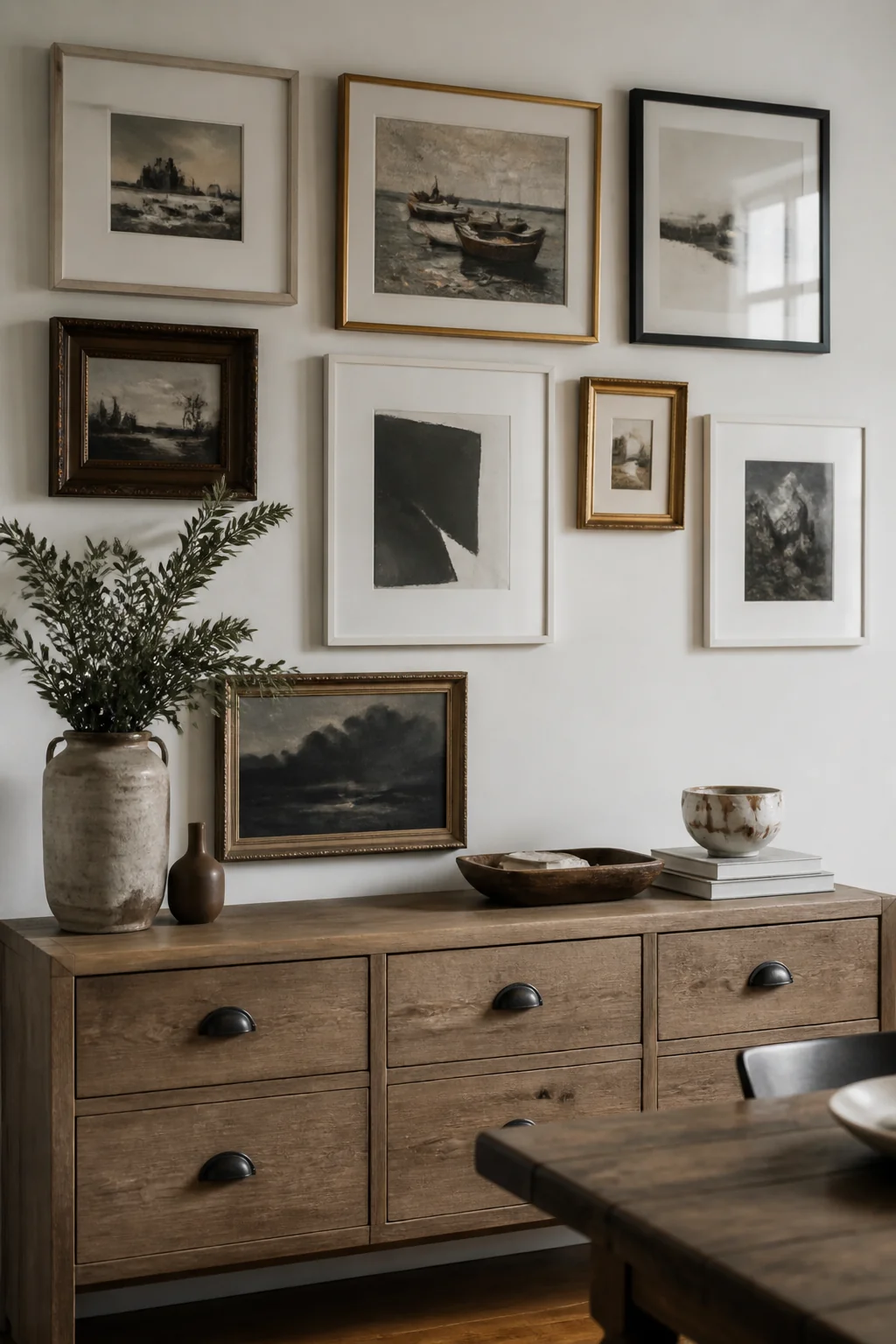
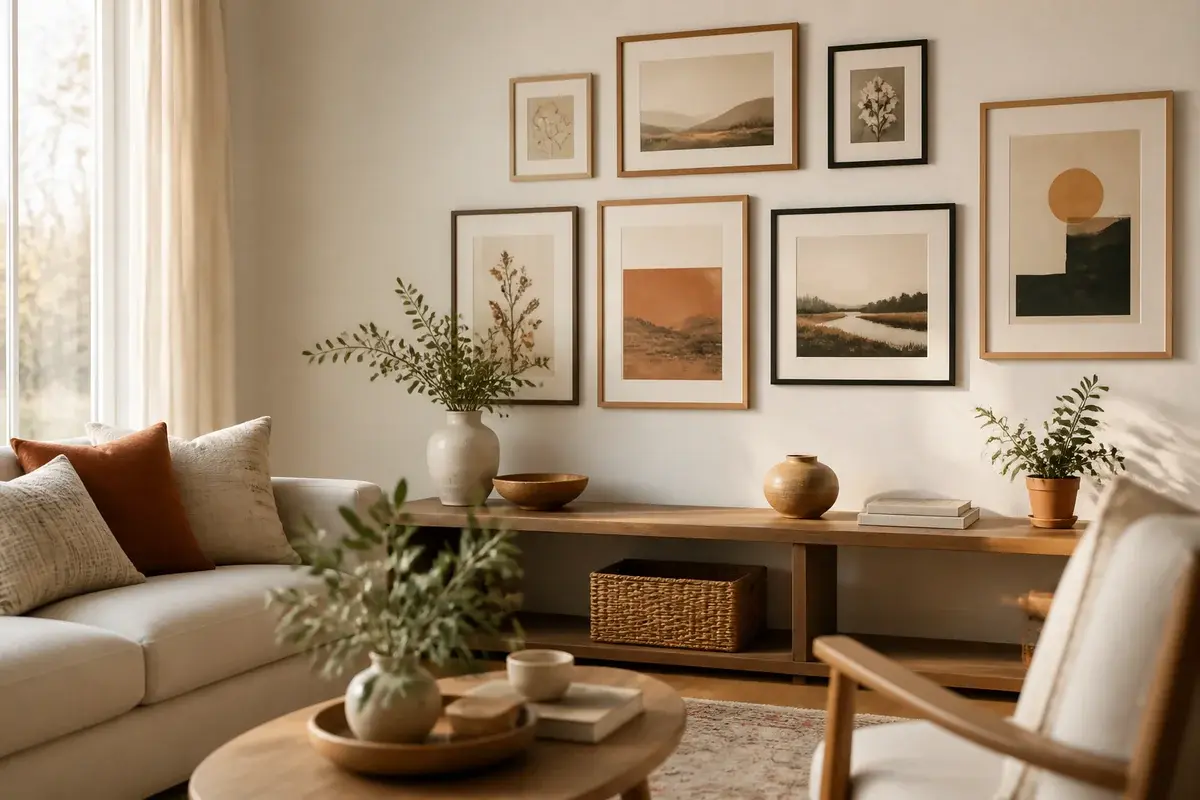
Three frame colors is the ceiling, and each one needs to show up at least twice. A single silver frame among blacks and woods reads as a mistake. Two silver frames read as a decision.
Within a color you have plenty of freedom. A thin half-inch black metal frame beside a chunky 2 inch black wood one gives the wall texture without introducing a new tone, and open-back or float frames sit happily next to traditional ones for the same reason. A workable mix: mostly black frames, two natural wood ones that echo a gallery wall ledge underneath, and one frame painted to pick up a color already in the room, say the throw pillows on the sofa.
Mats carry more weight than people expect. A 2 to 3 inch mat gives an 8x10 print the presence of an 11x14, so a few matted pieces let you fill space without buying larger art. Keep the mat color consistent across the wall, usually a warm off-white, or the eye goes hunting for the pattern.
One combination to skip: warm brass beside cool chrome in the same group. Under warm bulbs they read as two different metals having an argument, and no amount of spacing settles it.
Consider a Gallery Wall Ledge
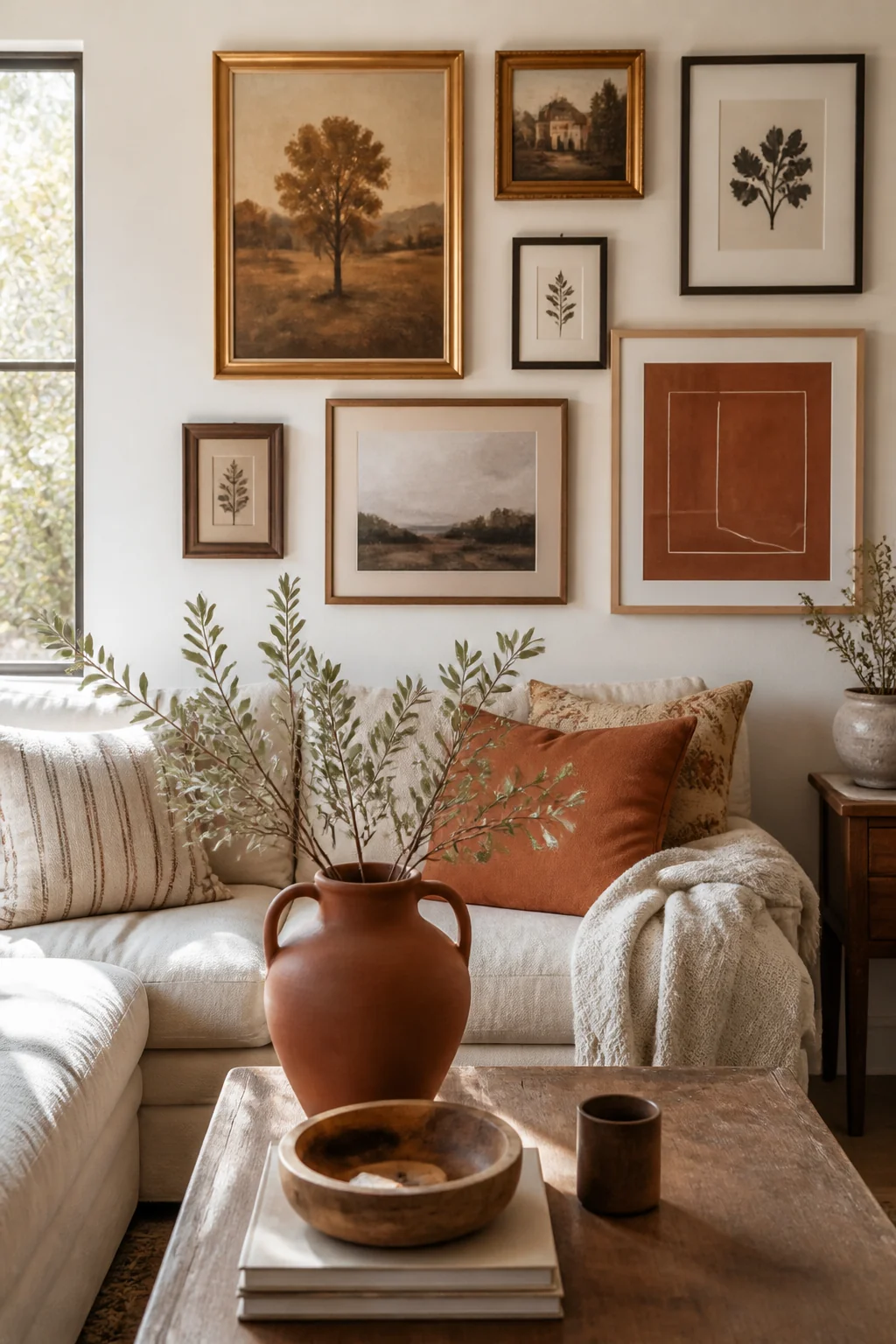
A picture ledge under the arrangement buys you something the nails can't: frames lean on it rather than hanging from it, so swapping a print takes ten seconds and leaves no hole to patch. It's also where you park the prints you're still deciding about.
Sizes and prices stay modest. IKEA's MOSSLANDA runs roughly $10 for the 22 inch and $15 for the 45 inch, while big-box versions land nearer $25 to $35. The lip is about 2 inches deep, which suits frames up to an inch thick leaning back at a slight angle. Deeper pieces, boxy shadow frames especially, tip forward off it.
Mount it 8 to 10 inches below the lowest frame so the two groups read as related but separate. Hit studs where you can, 16 inches on center, or use toggle anchors: a 45 inch ledge holding framed glass and a few books gets to 10 pounds without much effort, and plastic expansion anchors start easing out of drywall right around there.
Where a ledge fails is a narrow hallway. A 2 inch shelf at shoulder height in a 36 inch hall is something you'll clip with your elbow every trip.
Think About Negative Space (Your Wall Needs to Breathe)
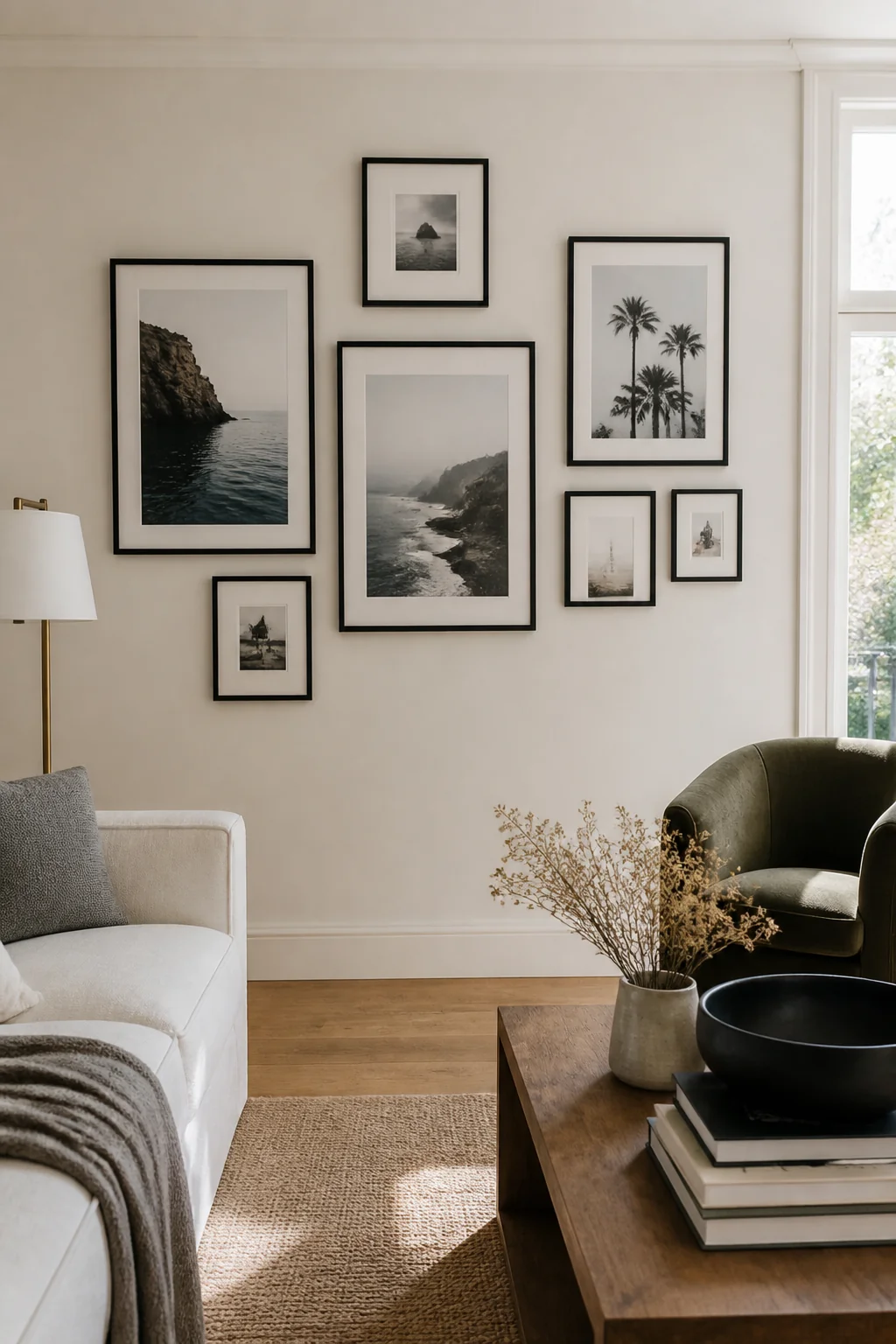
Crowding is the most common gallery wall mistake and the easiest one to undo. You take pieces down until the arrangement loosens up, and no repair work is involved.
A few numbers worth holding onto. Keep the outer edge of the whole group 4 to 6 inches clear of a door casing, window trim, or a corner, so the composition doesn't look like it ran out of wall. Above furniture, run the tape across the sofa or console first and take two thirds of that number, then hold your taped outline against it. If the paper is wider than the piece underneath, pull a column of frames before the hammer comes out. Wider than the furniture and the group floats; much narrower and it looks stranded in the middle of nothing.
Inside the group, those consistent 2 to 3 inch gaps are what let it breathe. Tighter than 2 inches and separate frames start merging into one blurry mass, particularly from across a room where the individual mats stop registering.
Here's a quick test. Squint at the wall. If it reads as a single dark rectangle instead of a set of distinct pieces, you've got too many frames or too little gap. Pulling three or four usually solves it, and the empty wall left behind is doing real work.
Play With Symmetry Versus Asymmetry
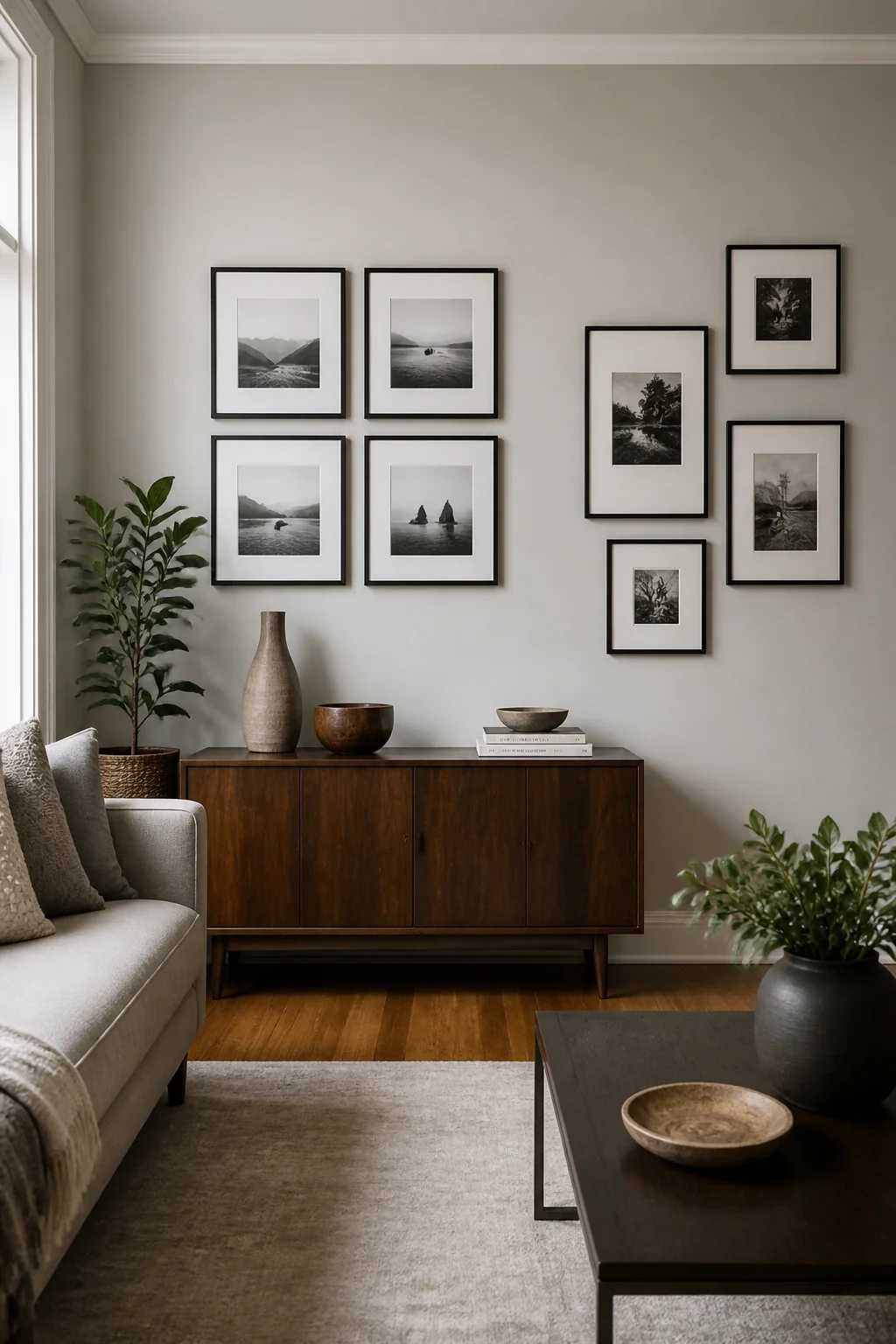
A symmetrical grid is the low-risk route and it's genuinely hard to get wrong. Nine 11x14 frames with 3 inch gaps make a block about 39 inches wide by 48 inches tall, which suits most sofas and almost any wall you want to look orderly. Matching frames and matching mats are what sell a grid, though. Put mismatched frames in one and it just looks like a cluster that failed.
An asymmetrical cluster asks more of you up front. Place your largest piece slightly off center and a little below the horizontal midline of the group, then build outward, alternating orientations so two verticals never stack directly above each other. Hold one invisible line through the whole arrangement, usually a shared top edge or a shared centerline, or the thing drifts as you go.
Neither approach is more correct than the other. Grids suit hallways, stairwells, and rooms where the architecture is already symmetrical. Clusters suit odd-shaped walls, sloped ceilings, and any wall with a thermostat or light switch you're working around.
Add Unexpected Elements
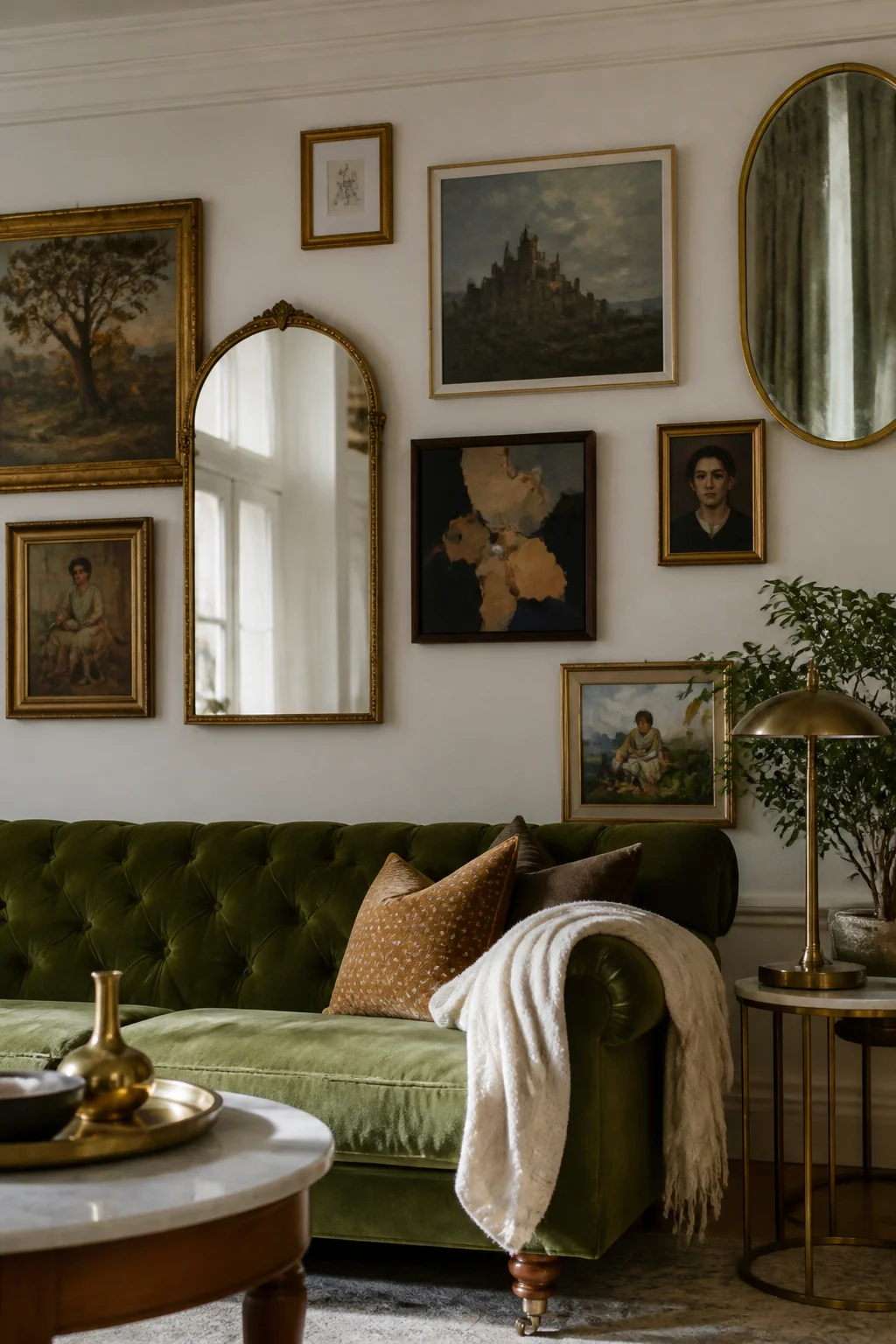
Framed prints don't have to be the whole story. A small woven hanging, a brass mirror, a ceramic plate, a pressed botanical, even patterned wallpaper offcuts mounted on foam core will hold their own beside art, and the non-frame pieces are usually the ones people ask about.
Weight is the thing to check before you get attached. A 24 inch round mirror runs 8 to 12 pounds, well past what a bare nail in drywall will hold. That needs a picture hook rated for 30 pounds or more driven into a stud, or a toggle anchor. Textiles are the opposite problem: a $12 market weaving weighs almost nothing and hangs on a single brad.
Mirrors come with one extra rule. Whatever sits opposite gets doubled, so stand where the mirror will hang and look behind you first. A mirror pointed at a cluttered kitchen counter puts that counter on your wall permanently.
A shallow 4 inch shelf worked into the middle of the group can work too, as long as its finish matches at least two of the frames. Otherwise it reads as furniture that wandered in.
Edit Ruthlessly
A gallery wall isn't finished on hanging day. Live with it a few weeks and one piece will start bothering you every time you walk past. Take it down and leave the gap; the composition usually improves.
The repair is quick enough that this shouldn't frighten you. A picture nail leaves a hole the width of a pin, and lightweight spackle pressed in with a fingertip or a flexible putty knife dries in roughly 30 minutes. Sand it flush with 220 grit, then dab touch-up paint with a small artist's brush rather than a roller, which leaves a halo of fresh sheen around the spot. Anchors are the bigger job: pulling one takes a dime-sized chunk of paper facing with it and needs two thin coats with sanding between.
That gap in effort is worth planning around. Anything under 10 pounds can hang on a nail, which keeps editing cheap, so save the anchors for the few genuinely heavy pieces.
Building in a ledge makes rotation easier still. Swap the print, keep the holes you already have.
If one thing here is worth carrying to your wall, make it the paper. Every expensive part of a gallery wall, the surplus frames, the patched holes, the Saturday lost to a level and a pencil, comes from committing to a layout on drywall instead of on kraft paper first.
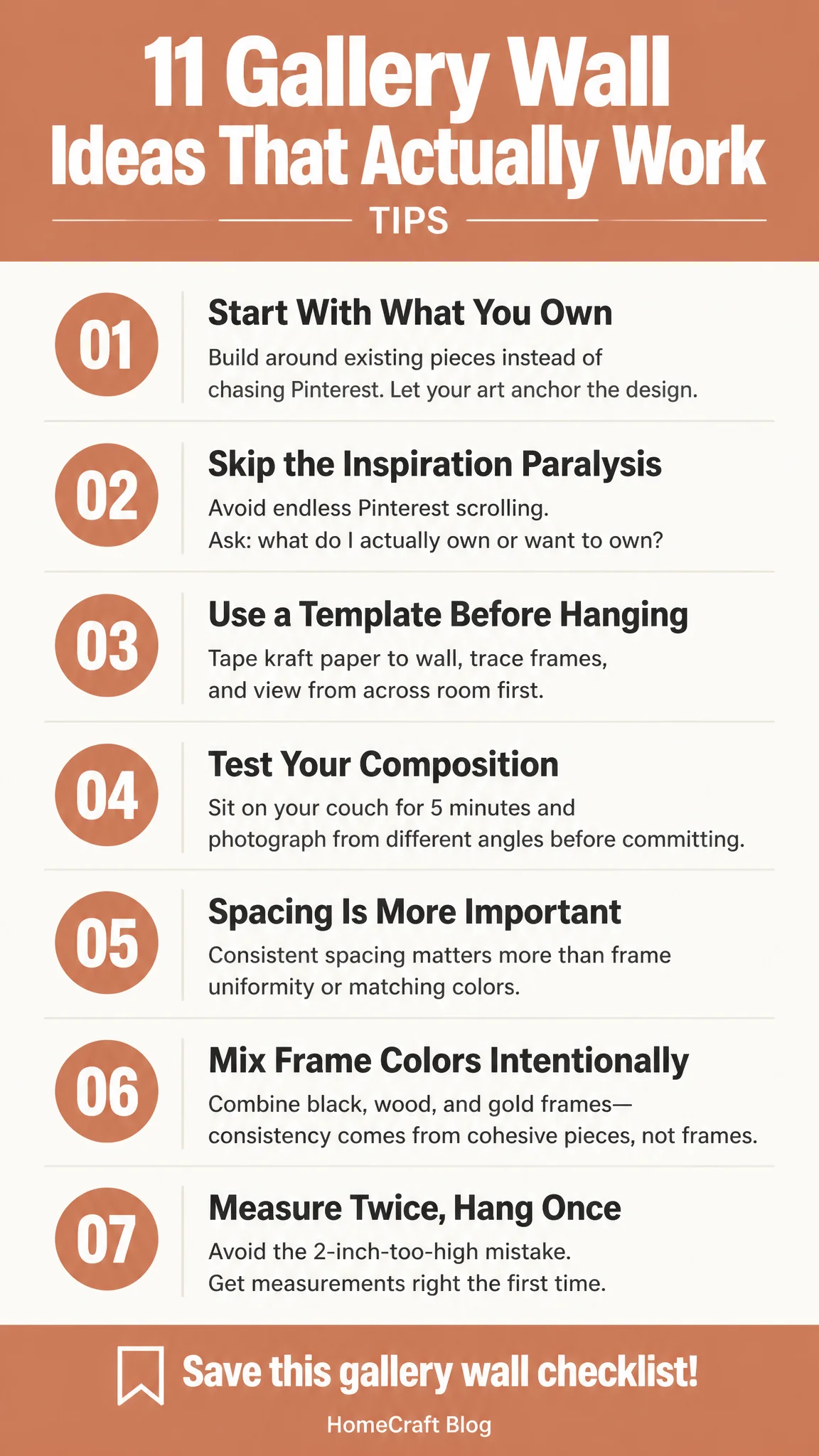
Take the guide with you
And the wall can change later. That's the part worth remembering while you're standing there with a hammer, treating a pin-sized hole like a decision you can never take back.