How to Get the Art Deco Bedroom Look for Less
Create an art deco bedroom that feels luxe without the price tag. Learn affordable design ideas, geometric patterns, and styling tricks for 1920s glamour.
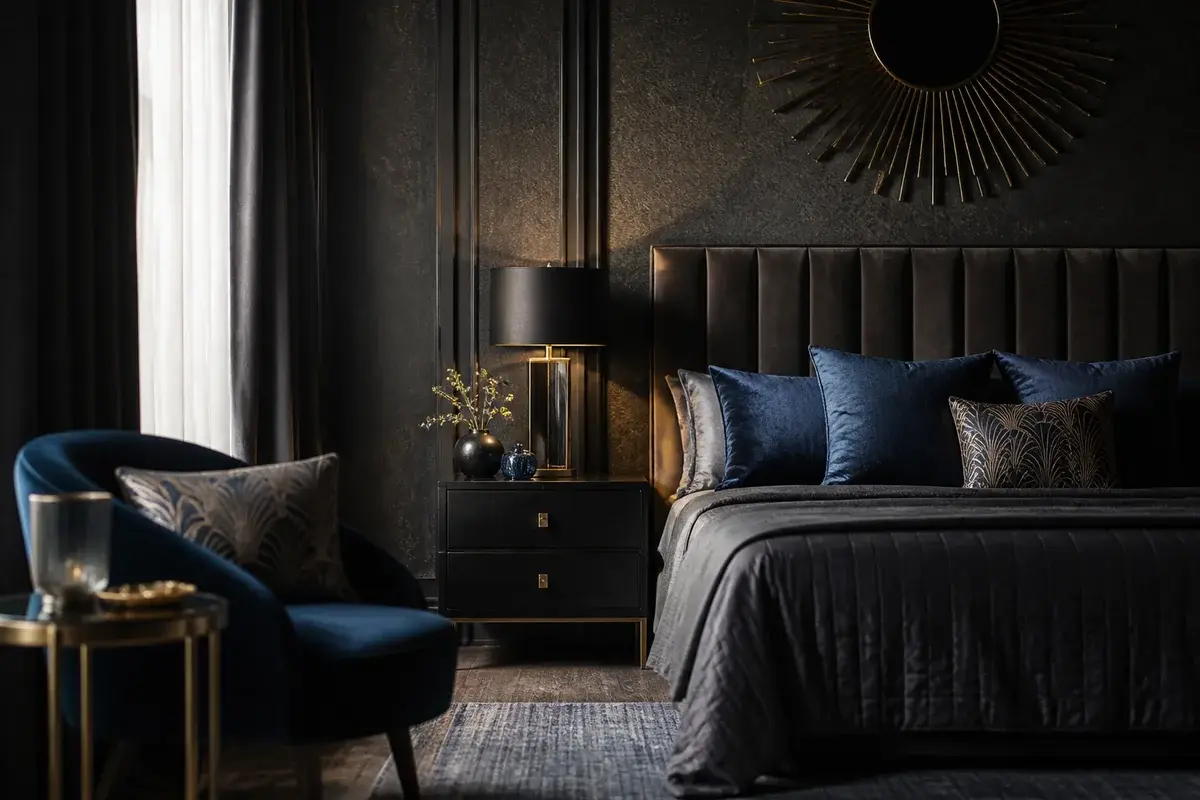
Most bedrooms trying for art deco end up looking like a costume party went wrong. Too much gold leaf. Too many tassels. The room feels cluttered instead of curated, loud instead of luxe. The problem is that people throw every sparkly, geometric thing they find at the walls and hope it sticks. Art deco isn't about maximalism for its own sake. It's about clean lines, bold geometry, and intentional color. You don't need a trust fund to pull off authentic art deco bedroom design ideas, but you do need to be selective.
Start With Color, Not the Bling
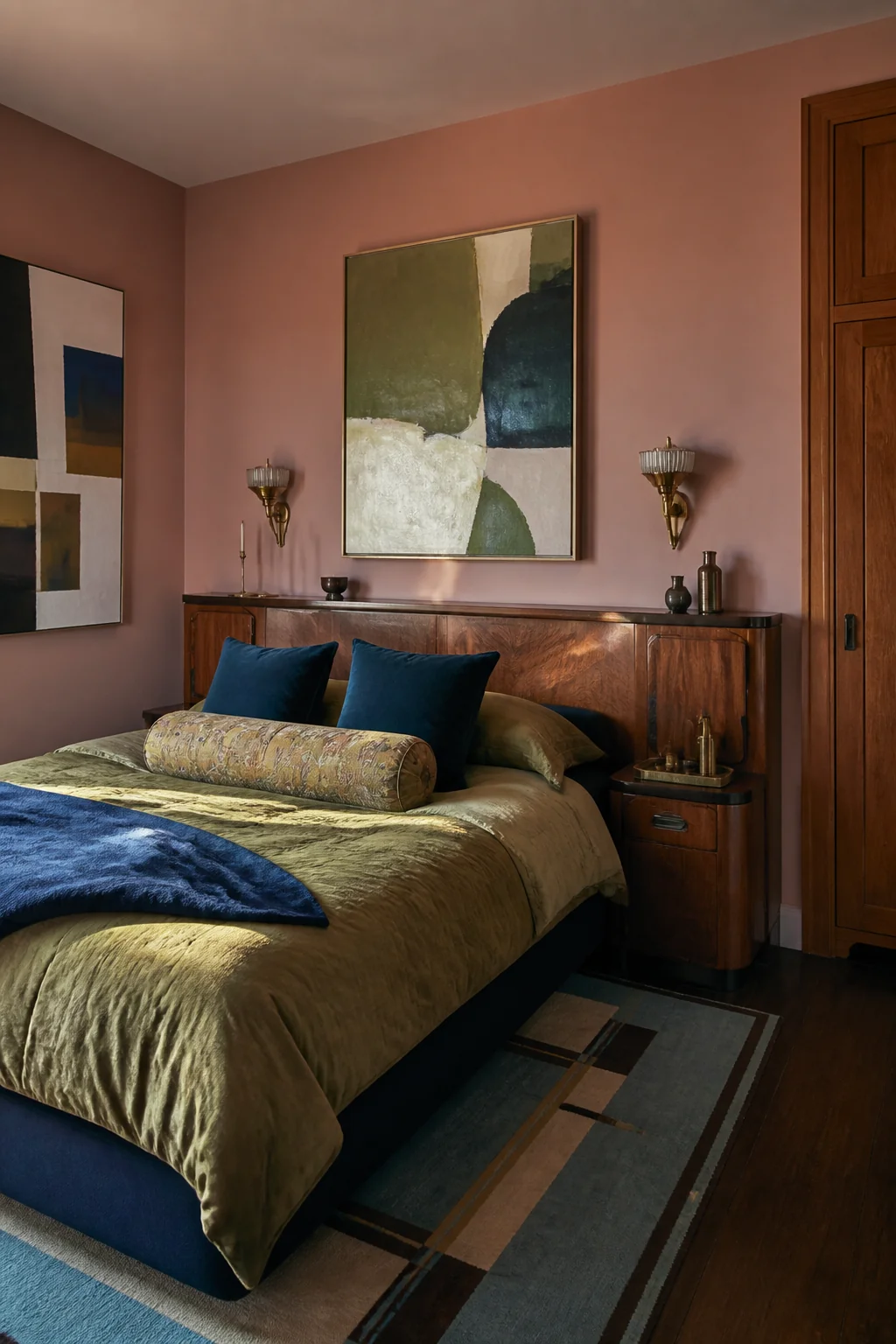
Forget gold as your default. Real art deco bedrooms lean into jewel tones: deep emerald, sapphire blue, or burgundy. These colors cost the same as beige but feel far more intentional. Paint an accent wall, or better yet, paint all four walls if the color is rich enough. Color goes first, metal second. You paint, let it cure, then add brass hardware and mirrors where they'll catch light, not everywhere at once.
Run the numbers before you commit. A standard 12x12 bedroom with 8-foot ceilings gives you roughly 380 square feet of wall, minus about 40 for a door and a window. Pick up a quart for one accent wall, or two gallons to carry all four through two coats, working from 350 to 400 square feet of reach per gallon per coat. Figure $40 to $80 for the accent wall, $90 to $140 for all four.
Buy a sample pot first, around $6 to $9, and paint a 12-inch square on the wall beside the bed. Deep emerald in a north-facing room with one small window reads nearly black after 4pm, and that's the failure you want to find before you've opened a full gallon. Use a grey-tinted primer under any dark color or you'll be rolling three coats to kill the streaking. Eggshell hides wall texture; satin bounces more light but shows every roller mark.
Geometric Patterns Go on Textiles, Not Walls
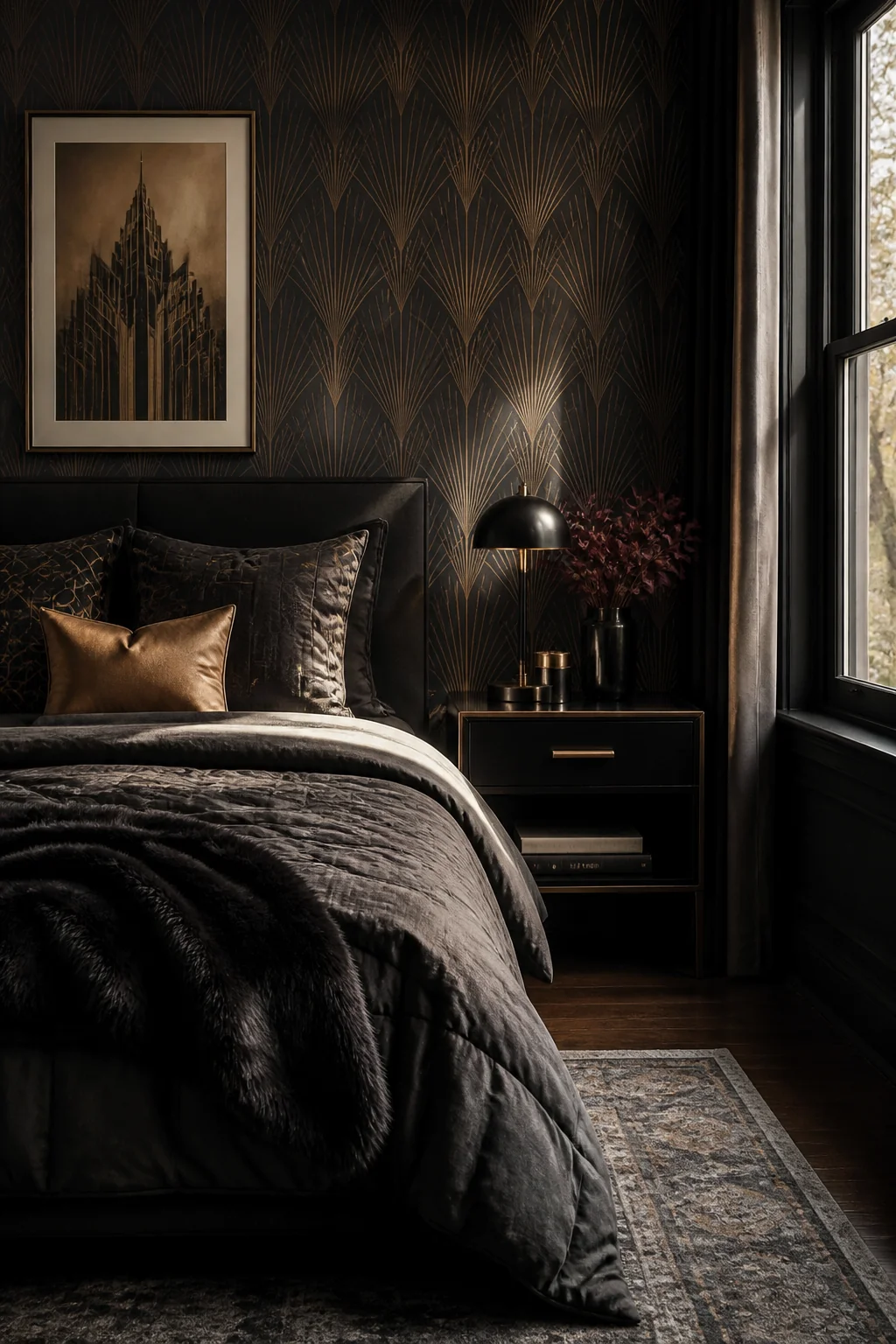
Deco tempts you into stacking geometry. A chevron wallpaper goes up, a patterned duvet joins it, then a patterned rug lands on the floor and every surface is arguing with the next one. Pick one geometric element, not three.
If you want pattern, put it on the bedding. A duvet cover with subtle geometric shapes, a chevron or a single sunburst rather than a dozen competing motifs, sets the tone and runs about $60 to $120. Watch the scale while you shop: a repeat under 4 inches reads as texture from across a 12-foot room, while a 10 or 12-inch repeat reads as a statement and needs everything around it to go quiet. Keep the walls solid. Keep the rug a flat neutral or a simple stripe.
If wallpaper is the piece you love, flip the rule instead of abandoning it. Paper only the wall behind the headboard, then go solid on the duvet, the shams and the rug. One patterned plane per room is the whole trick. Check the repeat against your bed size before ordering, because a bold motif that centers on a king headboard usually lands off-center on a queen, and once you've seen it you can't unsee it.
The mistake isn't buying geometric things. It's buying too many of them at once.
Brass and Chrome Hardware Carries the Look
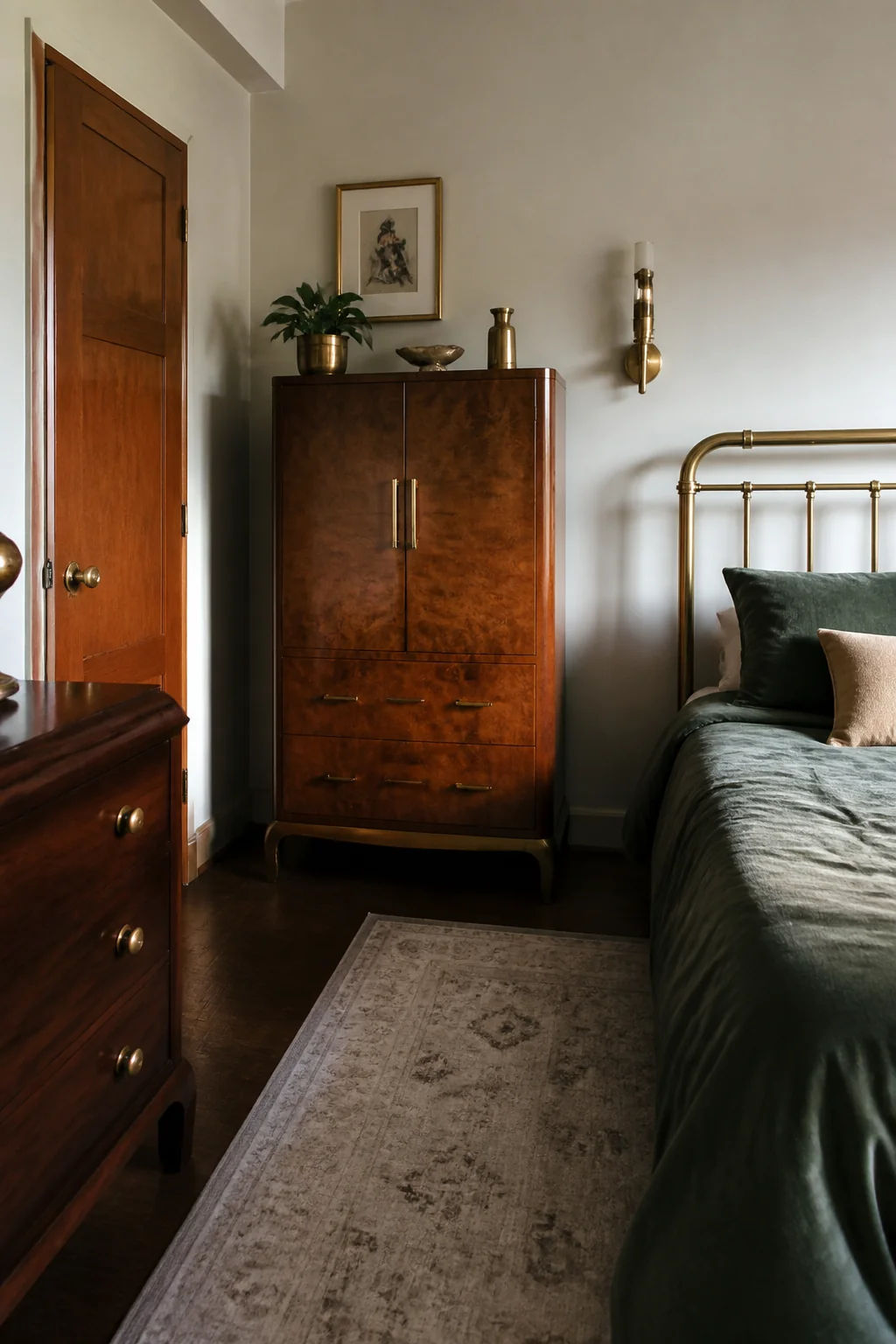
Light switch plates, drawer pulls, and cabinet handles are the details people skip, and they sit exactly where your eyes land all day. Swapping white plastic for brushed brass or polished chrome takes about ten minutes a piece with one screwdriver. Solid brass knobs run $6 to $18 each; heavier deco-style bar pulls with fluting or stepped edges run $25 to $40. A door handle, two dresser pulls and four drawer pulls comes to seven pieces, so figure $70 to $200 depending on weight.
Measure before you order. Pulls are drilled on center-to-center spacing, commonly 3 inches on older dressers and 3.75 inches on newer ones, and a pull that misses by a quarter inch leaves you filling two visible holes with wood putty. Single-hole knobs sidestep that problem completely.
One thing worth knowing before you pick a finish: unlacquered brass darkens over a year or two into a warm patina, while lacquered brass stays bright but chips if you scrub it with anything abrasive. Choose one and use it throughout the room. Mixed finishes on the same dresser read as leftover parts rather than layering.
Mirrors Create Depth and Reflect Light
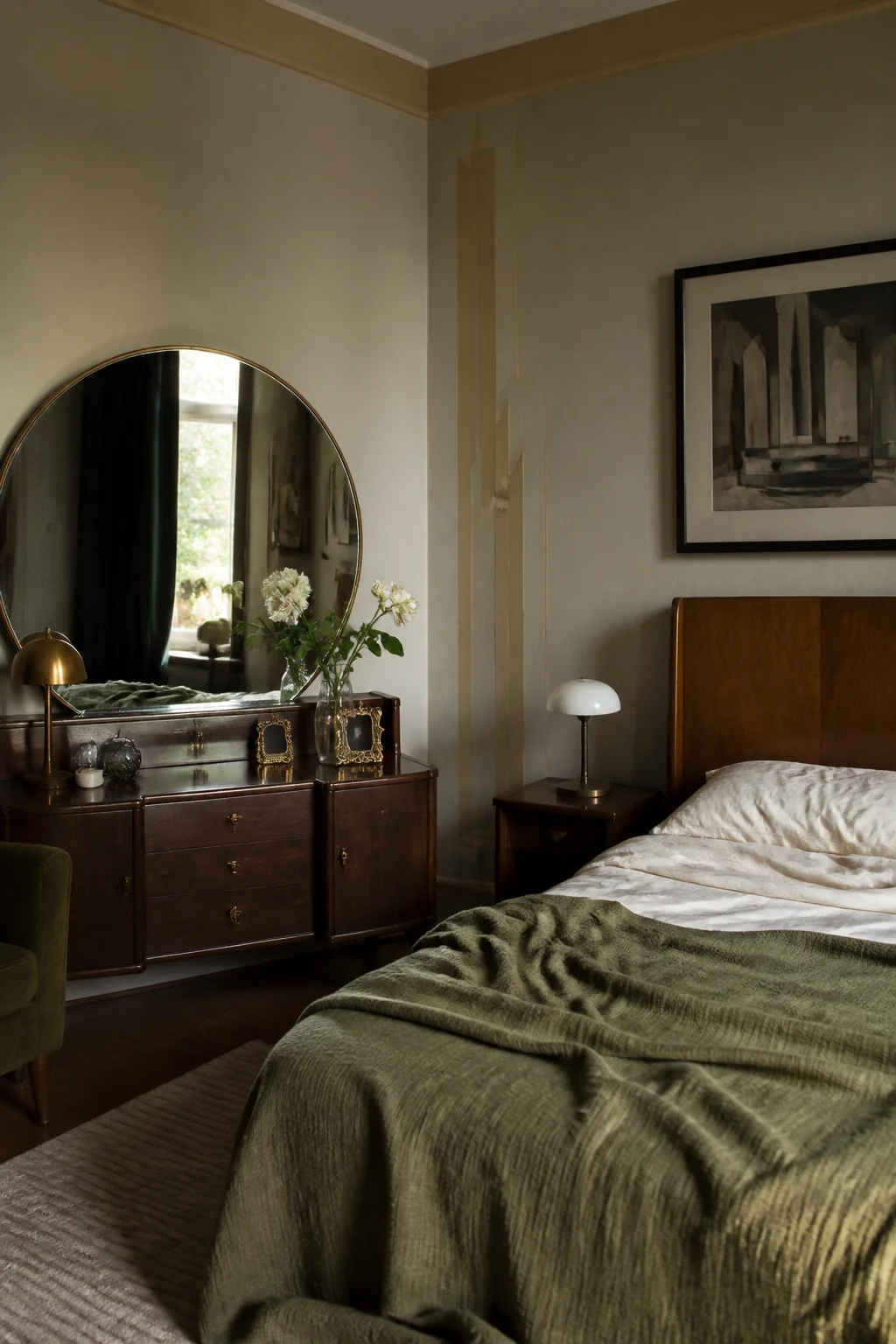
Art deco loves mirrors, but not random ones. You want geometric frames, stepped edges or a sunburst, sized to the furniture underneath. Above a dresser, hang glass that spans about two thirds of the piece below it, so a 60-inch dresser takes a 36 to 40-inch mirror, and leave 6 to 8 inches of open wall between the dresser top and the bottom of the frame. On a bare wall, bring the middle of the mirror up to about 57 to 60 inches and it meets a standing eye without anyone stooping.
Placement does more than size. A mirror set opposite or perpendicular to your window pushes daylight into the darker half of the room; the same mirror facing a cluttered corner just gives you twice the clutter. That single choice is the difference between a mirror that opens the room and one that only takes up wall.
Thrift stores turn up genuine deco frames for $20 to $50, and new ones run $60 to $150. Hang carefully: anything over about 15 pounds needs a stud or a toggle bolt rated to 50 pounds, not a drywall nail. Old mirrors are heavier than they look because the glass is thicker than modern stock.
Lighting Sets the Mood More Than Any Decor
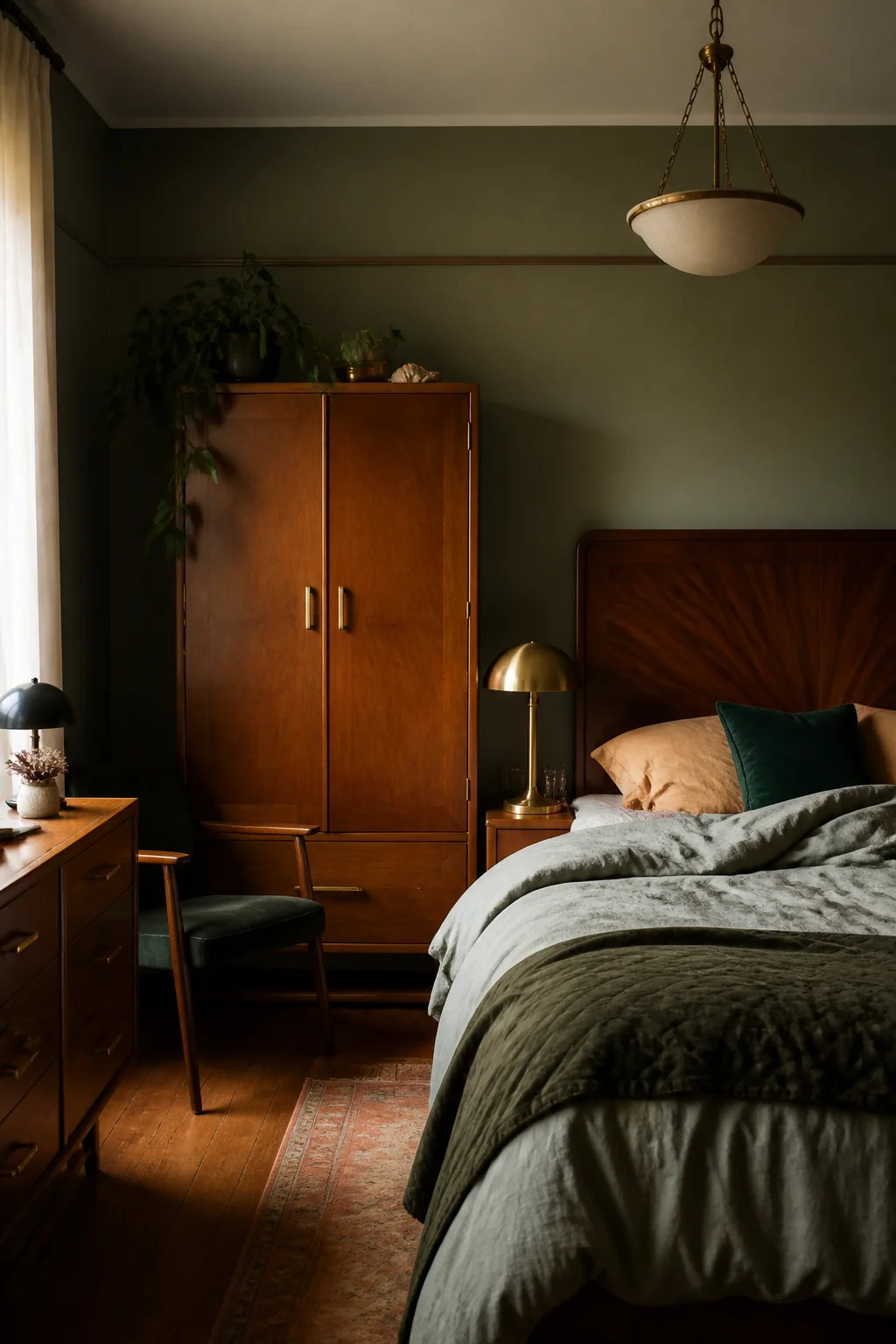
A single pendant or a table lamp with a geometric brass base does more for the mood than most decor pieces. Harsh overhead light flattens the geometry you just paid for. Go warm and soft instead: bulbs in the 2400K to 2700K range, around 450 to 800 lumens at the bedside, which is enough to read by without washing the color off your walls. A lamp with a tapered brass base and a cream or black shade costs about $50 to $100.
Match the lamp to the nightstand it stands on. With a top 24 to 26 inches off the floor, a lamp of 26 to 30 inches brings the bottom of the shade level with your eye when you sit up in bed, so you see the pool of light rather than the bulb. Anything shorter aims the filament straight at your face on every page you turn.
Ceiling fixtures come down to clearance. Under 8 feet, use a flush or semi-flush mount; a hanging brass chandelier wants at least 7 feet of headroom beneath it, and more if it sits over a walking path rather than the bed. Put whatever you install on a dimmer if the wiring allows, because a warm bulb at full output still reads like a hotel corridor at 10pm.
Small Accessories Add Personality Without Clutter
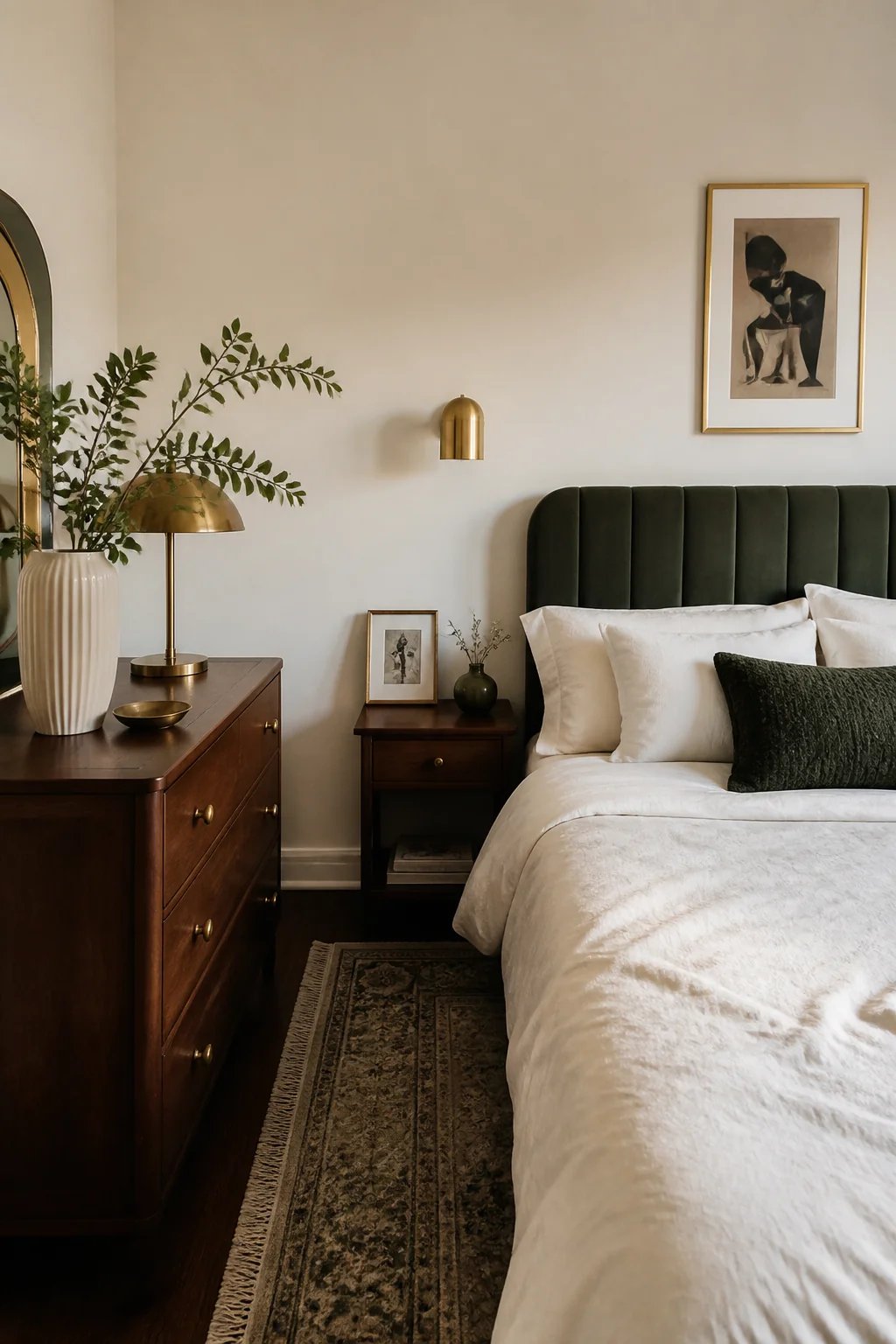
Now for the little touches: a lacquered jewelry box on the dresser, a vase with a stepped geometric profile, a framed print with a sunburst design. Keep it to three or four pieces, not twelve. Group them in odd numbers on a tray so the dresser still reads as a surface, and vary their heights by at least 2 or 3 inches so your eye travels instead of scanning a flat line. On a typical 60 by 18-inch dresser top, leave about two-thirds of it bare.
Thrift stores, estate sales and vintage shops are full of real pieces from the 1920s through the 1940s. A sunburst clock runs about $30 to $100, a small brass figurine $10 to $25, a bakelite box $15 to $40. Check the base and the back before you pay: genuine bakelite feels heavy and slightly warm in the hand, and old chrome shows fine pitting rather than the flawless mirror finish of a reproduction.
The practical catch is dust. Every fluted brass edge and every carved bakelite corner holds it, so keep the count low enough that wiping them stays a two-minute job. You're curating a room, not filling a display case.
Skip the Dramatic Headboard Unless It Fits Your Budget
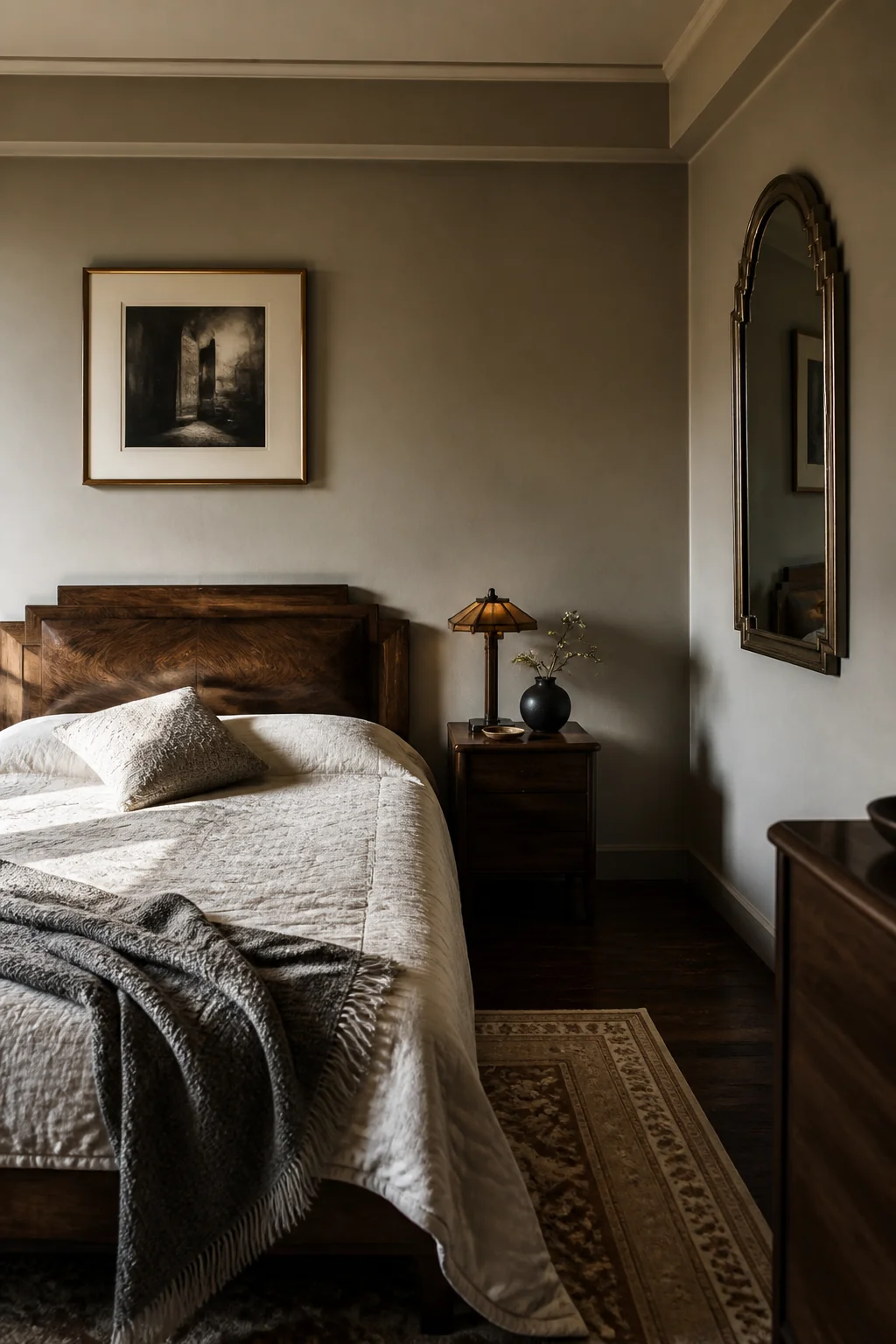
The usual instruction is to upholster a headboard or buy one with geometric detailing. You don't need one. A platform bed with clean lines lets the wall color and the mirror do the talking, and that low horizontal profile is closer to period-correct than a towering tufted panel. If you do want a headboard, keep it minimal: a wooden frame in a natural finish, or fabric in a solid jewel tone pulled from your wall color. Skip ornate upholstery with tassels and piping. That's not art deco, that's Victorian cosplay.
Sizing is straightforward. On a queen, a headboard standing 14 to 24 inches above the mattress top looks balanced; go much taller and it starts competing with the mirror for attention. A basic upholstered headboard costs $200 to $500, a wooden frame $100 to $250, and a DIY panel of half-inch plywood, 2-inch foam and 2 yards of fabric lands around $80 to $120.
One warning if you go with fabric: the patch where heads rest picks up hair oil within a few months, and light linen shows it fast. Choose a performance weave, or a cover you can unzip and wash, or accept that you'll be spot-cleaning a jewel-tone stain that never quite lifts.
Take the guide with you
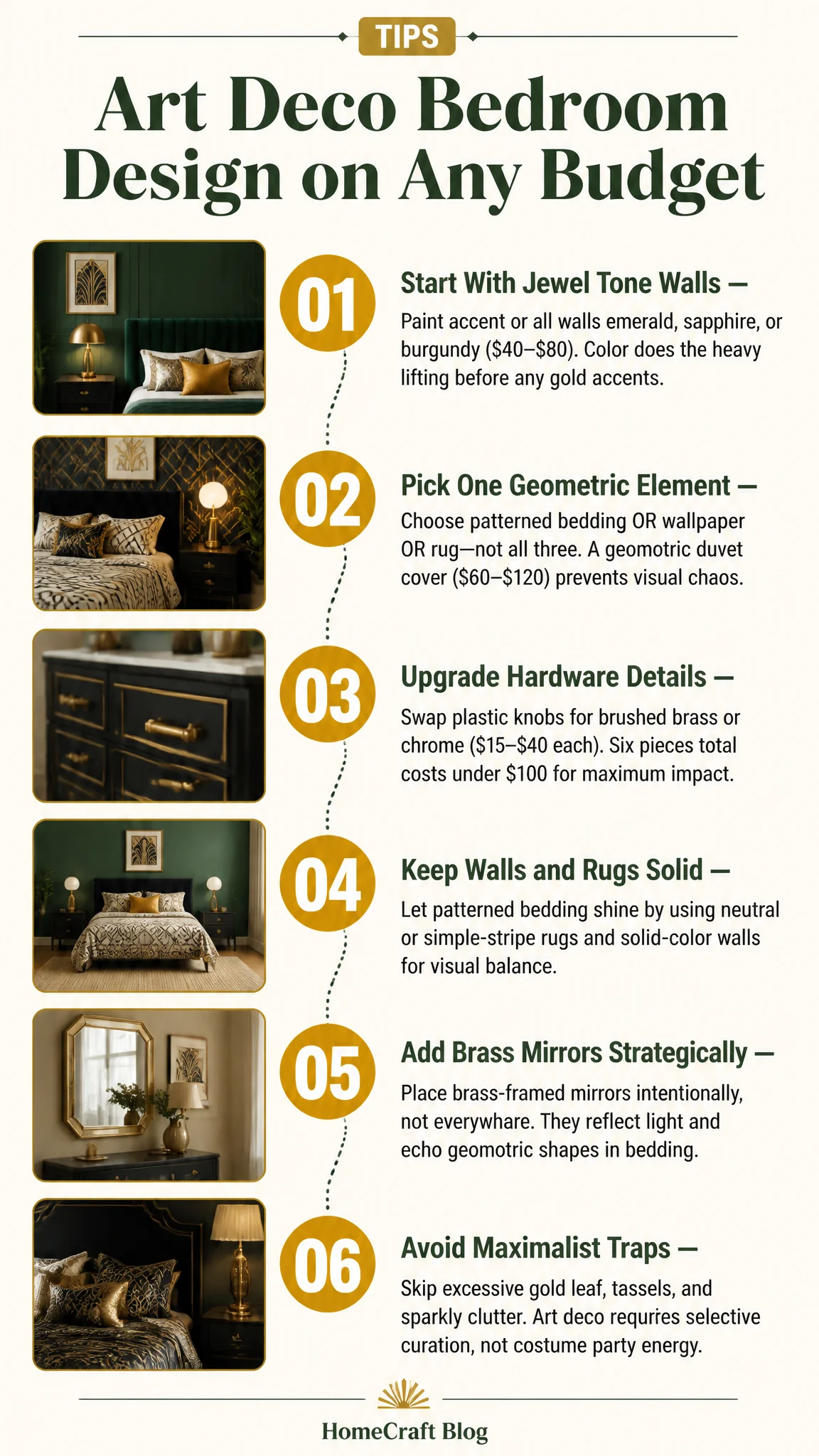
Of everything here, the wall color is the piece that carries the rest. Brass, mirrors, a sunburst clock: those are details sitting on top of a base, and details have never rescued a beige room. Live with the paint for a week before you buy anything shiny. Emerald in afternoon daylight and emerald under a 2700K bulb are two different rooms, and the one you should decorate for is the one you spend your evenings in.
Ideas fade by Friday. A plan finishes the room.
You just read a full guide to your bedroom. Saving ideas will not change it; a plan will. The Home Decor Collection is every planning tool we make, for every room in the house, in one download, so the after photos below stop being other people's rooms.
- Six room Style Kits, each with layout, palette and shopping list$114
- The Gallery Wall Studio: 200 prints + 15 measured layouts$29
- The Room Makeover System: 40 solved room layouts + workbook$29
- The Color Palette Handbook: 60 palettes shown in real rooms$19
- The Whole-Home Reset: 40 printable organizing checklists$19
- The Decorator's Cheat Sheets: the 40 measurements that matter$9
- All eleven products, bought separately
$219$97
A single hour with an interior designer costs more than the entire Collection, and this one keeps answering for every room you will ever decorate. Free updates included as the products grow. And if it is not for you, the 14 day money back promise means you simply get a refund.