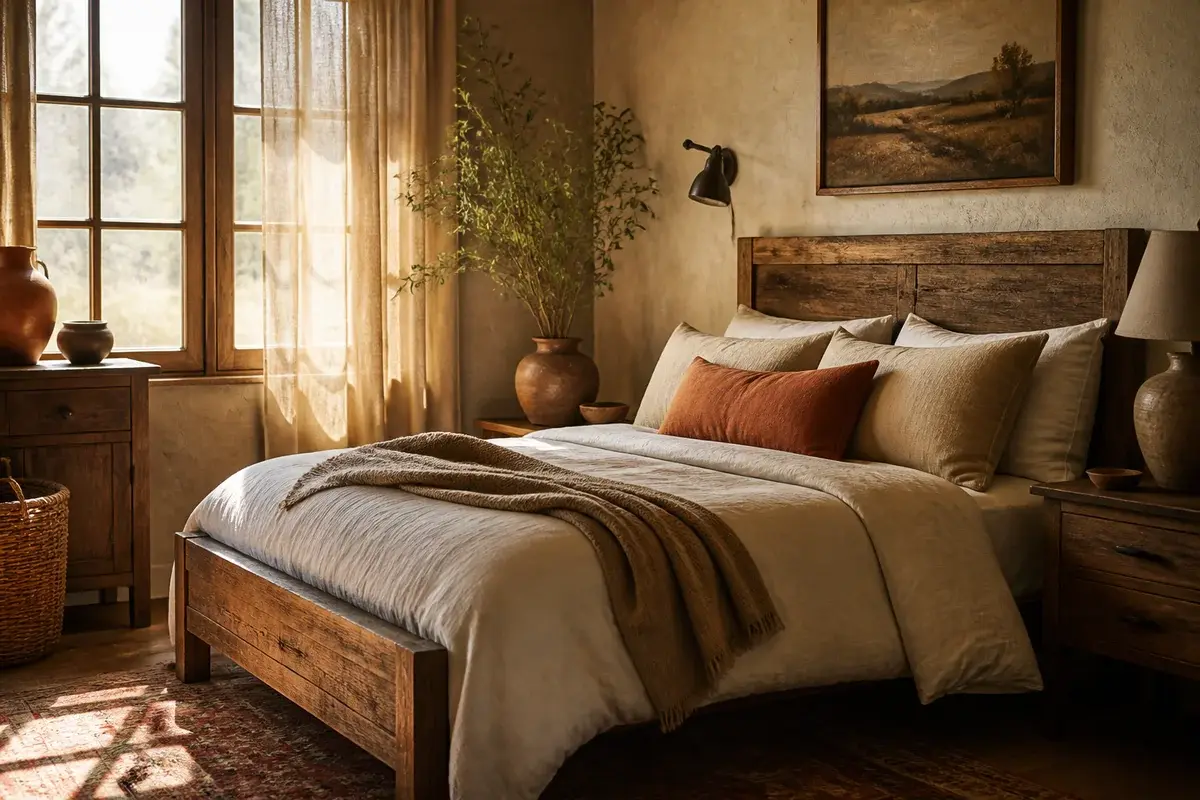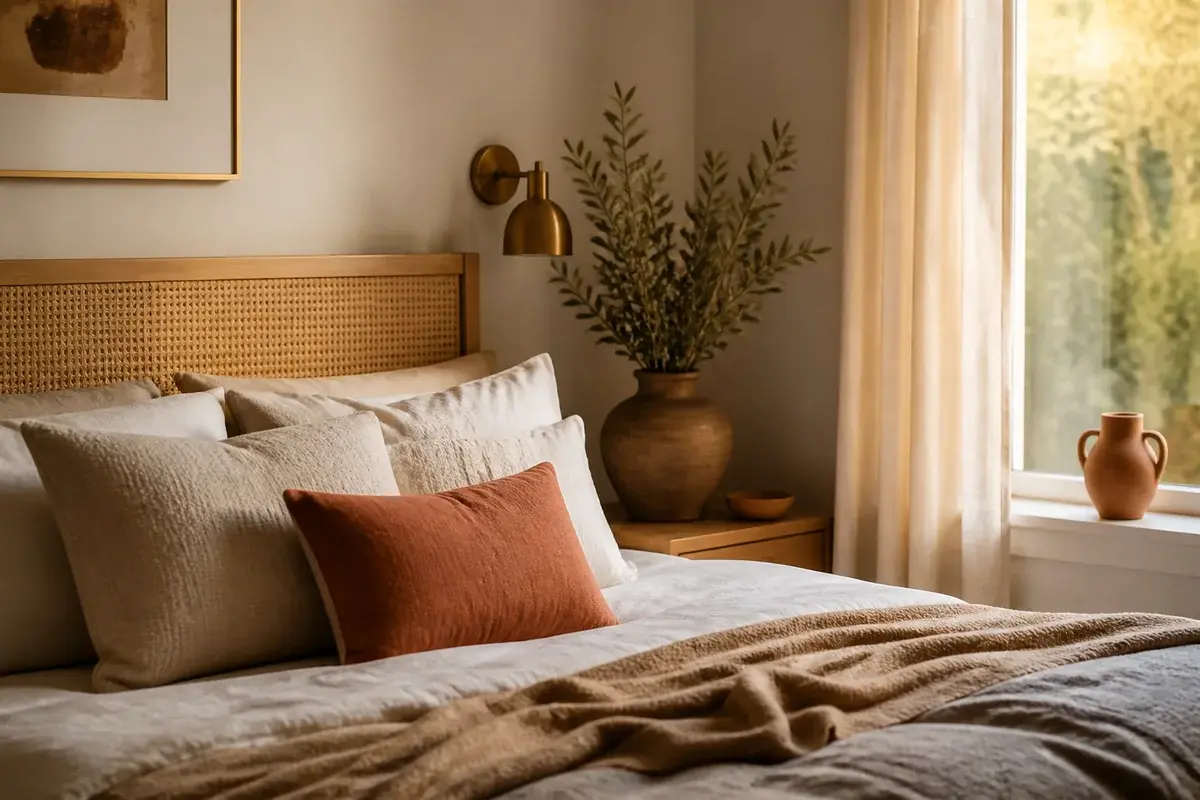
26 Fall Bedroom Decor Ideas That Warm Up the Room
26 concrete fall bedroom decor ideas with real prices, real measurements, and the mistakes worth avoiding before you buy.

This post contains affiliate links. As an Amazon Associate I earn from qualifying purchases. If you buy through our links, we may earn a commission at no extra cost to you.
Most bedrooms go flat in fall. The sun drops lower, it comes in at a harder angle for fewer hours, and the room that felt fine in August suddenly reads thin and a little cold. You don't need to gut anything or spend a fortune. Deeper bedding tones, warmer bulbs, and two or three real texture layers compound faster than one expensive purchase does. Everything below comes with a price and a measurement, because that's usually where these projects go sideways: the rug that's a size too small, the shelf that can't carry books, the throw that strands itself across the middle of the mattress.
1. Layer a linen throw at the foot of the bed
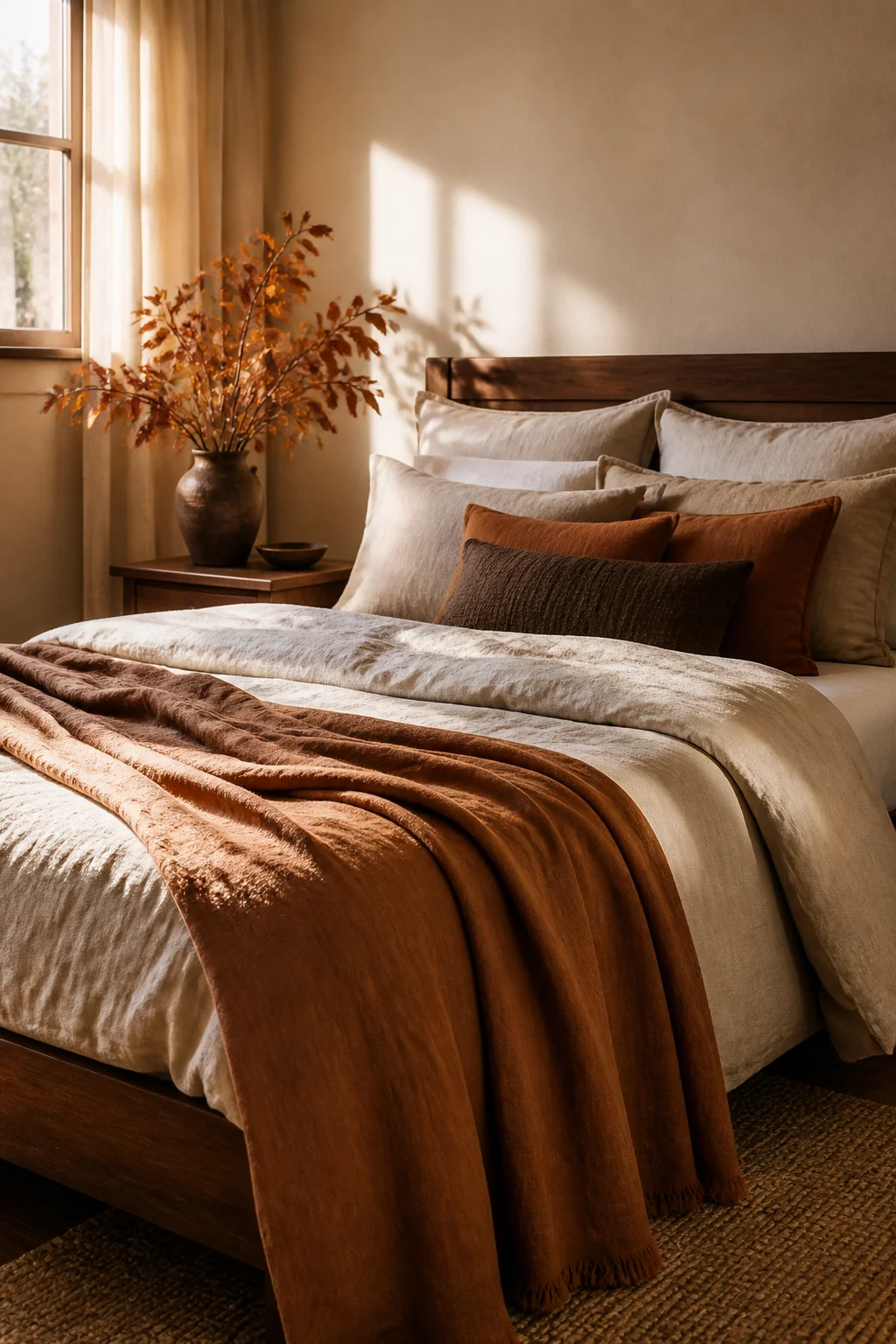
Drape a natural linen throw across the bottom third of your bed in cream, oatmeal, or tan. Sizing is what most people get wrong. A 50 by 60 inch throw covers the foot of a queen with about 8 inches hanging on each side, while a king needs 60 by 80 or the throw strands itself in the middle of the mattress and looks like a dropped towel. Fold it in thirds lengthwise, lay it across, then push a soft fold into the center with your hand so it doesn't sit pressed flat. Washed linen in the 150 to 190 gsm range holds that fold and softens with every wash. Fleece and poly blends cost less, but they go shiny under lamplight and flatten out within a season. Plan on $35 to $60 for real linen, and buy one size up from what looks right online.
2. Swap out the overhead light for a dimmer
A dimmer costs $15 to $30 and takes about twenty minutes. Kill the breaker first, confirm the wires are dead with a non-contact voltage tester (about $15), then note which wire is line and which is load before you pull anything loose. Most standard dimmers need line, load, and ground; smart dimmers usually want a neutral wire too, so open the box and look before you order. Here's the part people skip: the bulbs have to say dimmable on the package. Cheap LEDs that don't will buzz or strobe at low settings, and you'll blame the switch. If you rent, or the wiring in the box looks brittle, a plug-in lamp dimmer or a dimmable smart bulb runs $12 to $25 and needs no tools at all. Once the ceiling fixture can sit at a quarter brightness, it stops being an on-or-off decision and the room reads softer after dark.
3. Add a rug under the bed
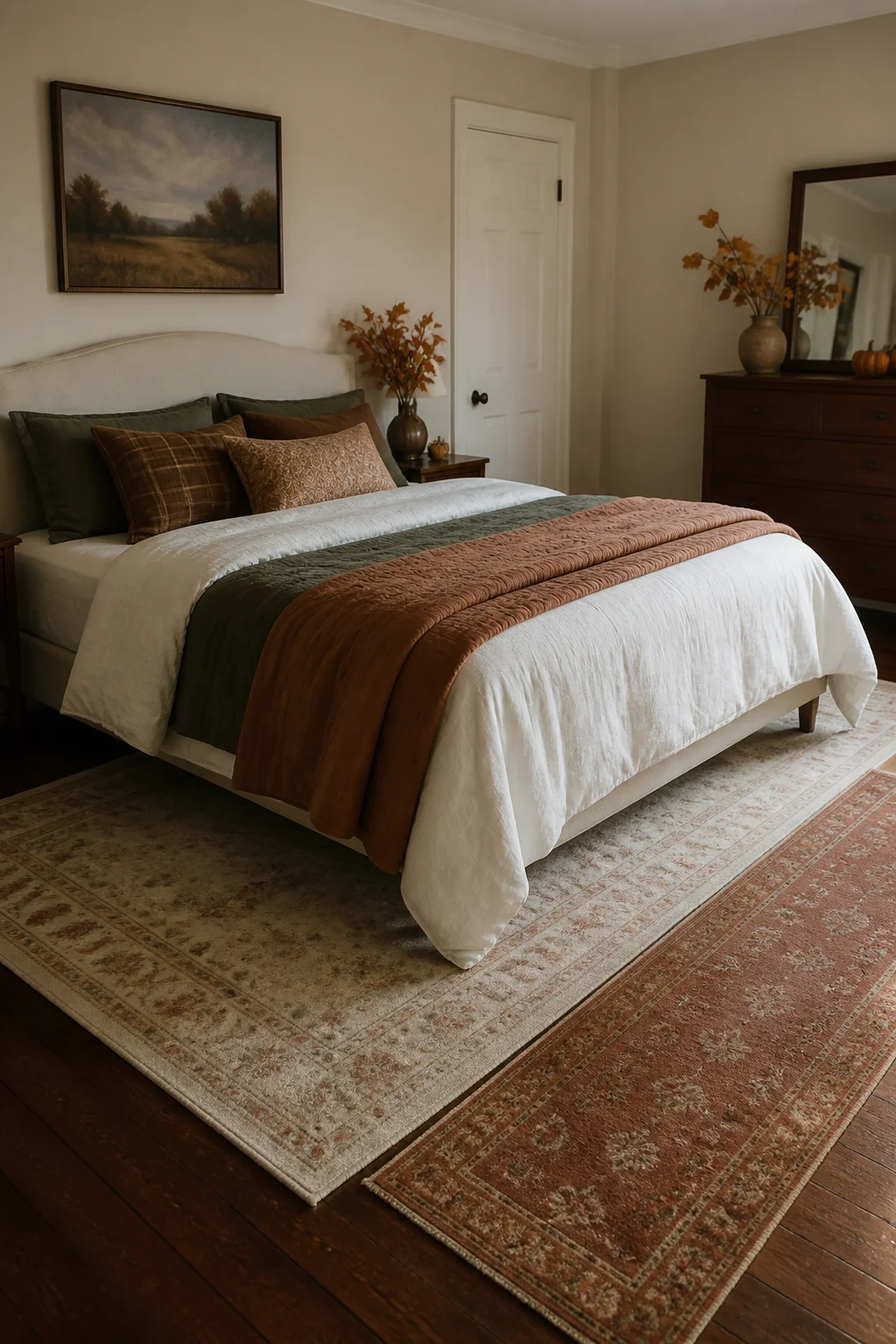
Size the rug to the bed, not to the room. Under a queen, an 8 by 10 slides beneath the lower two thirds of the frame and still leaves 18 to 24 inches of rug on both sides and at the foot, which is exactly where your feet land on a cold morning. A 5 by 7 works if you push its top edge just past the nightstands. Short on floor or budget? Two 2.5 by 8 runners flanking the bed do the same job for less money. Jute costs $120 to $250 and looks right for the season, but it's scratchy under bare feet, sheds fiber for the first month, and stains if a glass tips. Wool or a wool blend costs more and feels considerably better in October. Whichever you choose, add a rug pad at $30 to $50. It stops the creep, adds cushion, and keeps bed legs from grinding the pile flat.
4. Swap pillows for textured, neutral covers
Budget $20 to $40 per cover. Those sad flat ears at the top of a pillow are a sizing mistake rather than a quality one: an 18 inch cover wants a 20 inch insert, two inches up, and then the fill reaches the corners on its own. Down-alternative inserts are $10 to $15. A queen handles two 26 inch euro squares against the headboard, two 20 inch standards in front, and one 12 by 20 lumbar. Vary the weave rather than the color: washed linen is matte, wide-wale corduroy has ridges that catch low light, and a nubby boucle reads warm from the doorway. Matched sets fall flat because every surface bounces light the same way. Look for hidden zips so the covers can be washed, and hold the palette to warm gray, taupe, and cream so nothing competes with the bedding underneath.
5. Introduce a wood headboard or wall paneling
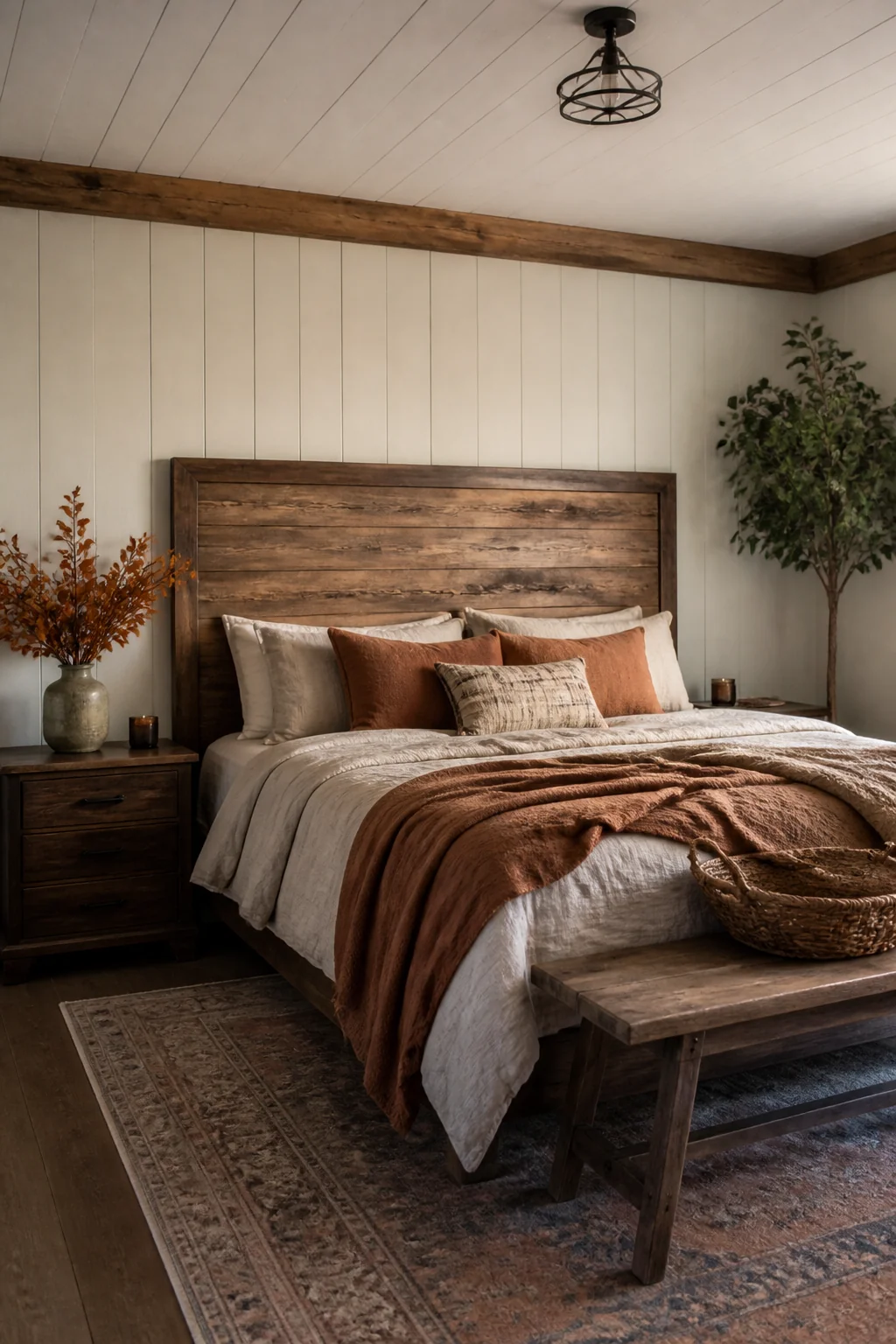
If you have a basic upholstered headboard, a simple wood frame behind it or plank paneling on the wall above does more for the room than a new bed would. What stops most people is picturing joinery and a table saw, when the whole job is adhesive, brad nails, and boards cut straight. Quarter-inch plywood ripped into strips, or nominal 1x6 shiplap boards that measure 5.5 inches wide, gets you there for $80 to $150 in materials. Find the studs first, usually 16 inches on center, then run construction adhesive down the back of each board and set it with 18-gauge brad nails. You can stop the paneling at 48 to 54 inches and cap it with a thin ledge, or carry it to the ceiling behind the bed only. Prime and paint the boards before they go up; cutting in around installed planks takes twice as long. Drywall is rarely flat, so scribe the bottom board or hide the gap behind baseboard.
6. Hang linen curtains in a warm neutral
Panels parked over the glass all day are why a curtained bedroom goes dim by three in the afternoon, and the cause is a rod that stops at the frame. Give it 8 to 12 inches past each side so the open panels have wall to stack against, and set it 4 to 6 inches above the frame, or halfway between frame and ceiling in a tall room. Buy enough fabric while you're at it: combined panel width should be roughly twice the window width, otherwise the drapes hang like flat bedsheets no matter what they cost. Hem so the fabric clears the floor by half an inch, or let it break by an inch if you prefer the softer pool and don't mind vacuuming around it. Cream, taupe, and soft gray in cotton or linen filter afternoon light without darkening the room. Expect $50 to $100 per panel. Pure linen wrinkles and always will, so steam it on the rod; if that irritates you, a cotton-linen blend holds its line better. Add blackout lining if you sleep past sunrise.
7. Layer in brass or brushed copper hardware
Chrome and polished nickel throw a cool, faintly blue cast under lamplight. Brass, bronze, and brushed copper throw a warm one, and pulls cost $8 to $20 apiece. Measure before you order: the center-to-center distance between the existing screw holes on a dresser is usually 3 inches (76mm) or 96mm, and those two are not interchangeable, so guessing means drilling fresh holes in a drawer front you like. Unlacquered brass arrives bright and darkens to a soft brown over roughly six months as it oxidizes, which is either the appeal or the problem depending on your patience. Lacquered brass holds its color, but the coating wears through at high-touch spots like a door handle. We'd hold a room to two warm metals and let them differ slightly rather than hunting for an exact match across lamps, pulls, and curtain rods. Perfect matching is where this starts looking like a showroom.
8. Place a wooden storage bench at the foot of the bed
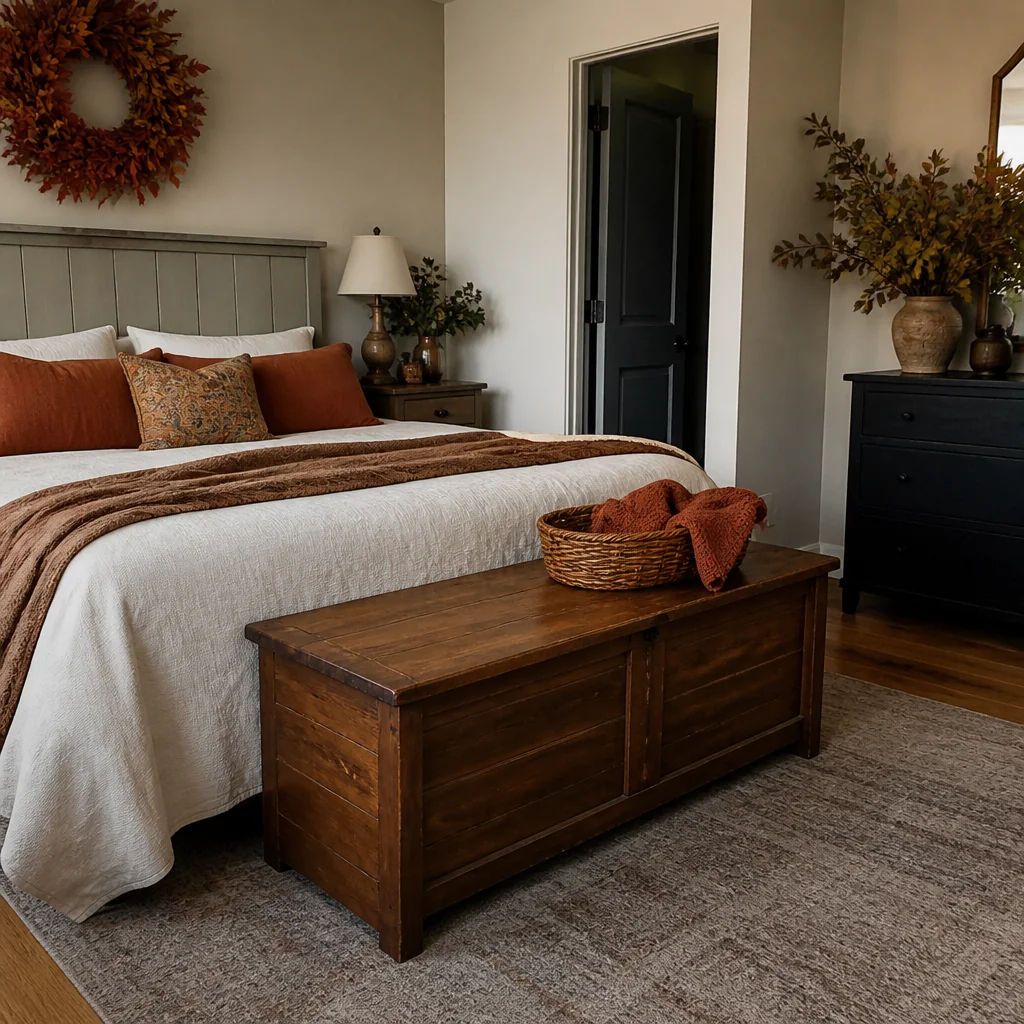
A bench in solid wood or a walnut finish adds storage plus a warm horizontal line where the bed ends, $150 to $300 depending on size. Width should land near two thirds of the bed: 40 to 48 inches for a 60 inch queen, 48 to 54 for a king. Seat height of 18 to 20 inches sits comfortably against most mattress heights, and 14 to 18 inches of depth is enough to perch on and pull boots without swallowing the walkway. Leave 24 to 30 inches of clear floor between the bench and whatever stands behind it, or the room becomes a shin hazard at 2am. If you'll sit on it daily, check the load rating; 250 pounds and up usually means real joinery instead of staples through particleboard. On lift-top models, look for slow-close hinges or a lid stay, because an unsupported solid lid comes down hard on fingers.
9. Add a tall wooden nightstand
Height matters more than style here. Mattress tops usually sit 24 to 27 inches off the floor, and the nightstand should land within a couple of inches of that, which puts the sweet spot at 25 to 28 inches tall. Go shorter and you're groping downward for the lamp switch in the dark every night. Give yourself at least 16 by 16 inches of top surface, enough for a lamp base, a book, a glass of water, and a phone without stacking them. Wood reads warmer than glass or metal and hides fingerprints and water rings far better, especially in an oiled finish you can touch up with a rag and a bit more oil. Budget $80 to $150. A single drawer is worth the extra $30 for chargers and earplugs, and if the back panel is solid, drill a one inch cord notch near the bottom so the cable exits cleanly instead of holding the table an inch off the wall.
10. Hang framed botanical or fall-toned prints
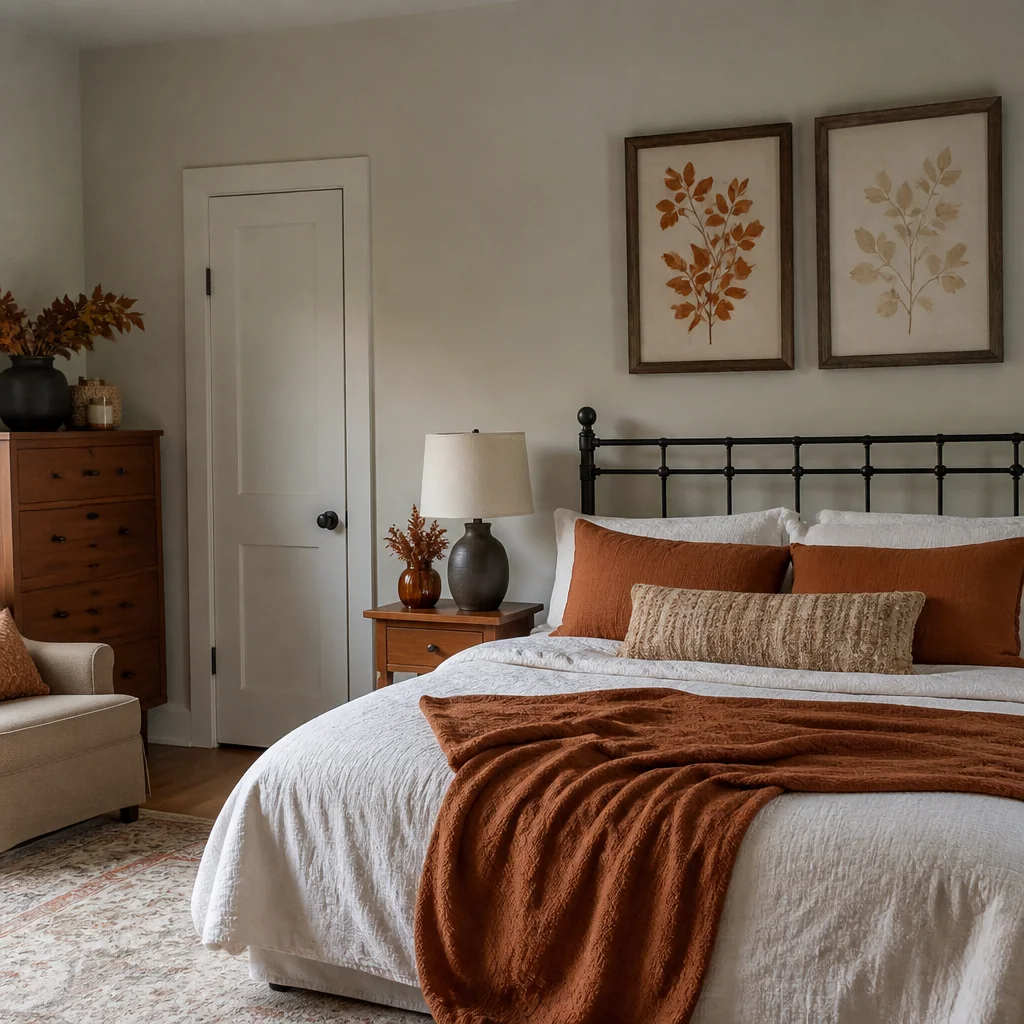
Three to five pieces in plain wood frames give the wall a focal point without turning it into a gallery. Hang the bottom edge 8 to 10 inches above the headboard so the art reads as part of the bed. With no headboard there's nothing to measure from, which is how prints end up drifting toward the ceiling, so anchor the center of the group at 57 to 60 inches off the floor instead. Keep the gaps between frames consistent at 2 to 3 inches, because uneven spacing is what makes a grouping look accidental rather than composed. Lay the arrangement out on the floor first, trace each frame onto kraft paper, then tape the paper to the wall and live with it for a day before you drill. Frames run $15 to $30 each, and a $6 mat inside a cheap frame does more for the result than an expensive frame with no mat. Skip saturated orange and red prints. Olive, dusty rust, and sage carry the season without dating the room by November.
11. Layer multiple blankets across the bed
Build it in order and the depth takes care of itself: fitted sheet, flat sheet folded back about 12 inches, a cotton quilted coverlet, then the duvet folded across the bottom third, then a wool throw laid at a slight angle. That's roughly a 5 to 7 pound quilt plus a 3 to 4 pound throw, enough weight to look substantial without turning the bed into an oven. Mix the hands as well as the colors: matte linen, nubby wool, smooth quilting. Layering reads best from the doorway, so set the heaviest fold on whichever side you see first walking in. Heat is the real failure mode here. If you already sleep warm, keep one heavy layer as a fold at the foot rather than a full cover, and pull it off entirely on mild nights. That's cheaper and more comfortable than buying thinner bedding and losing the look.
12. Install wooden wall shelves for books and decor
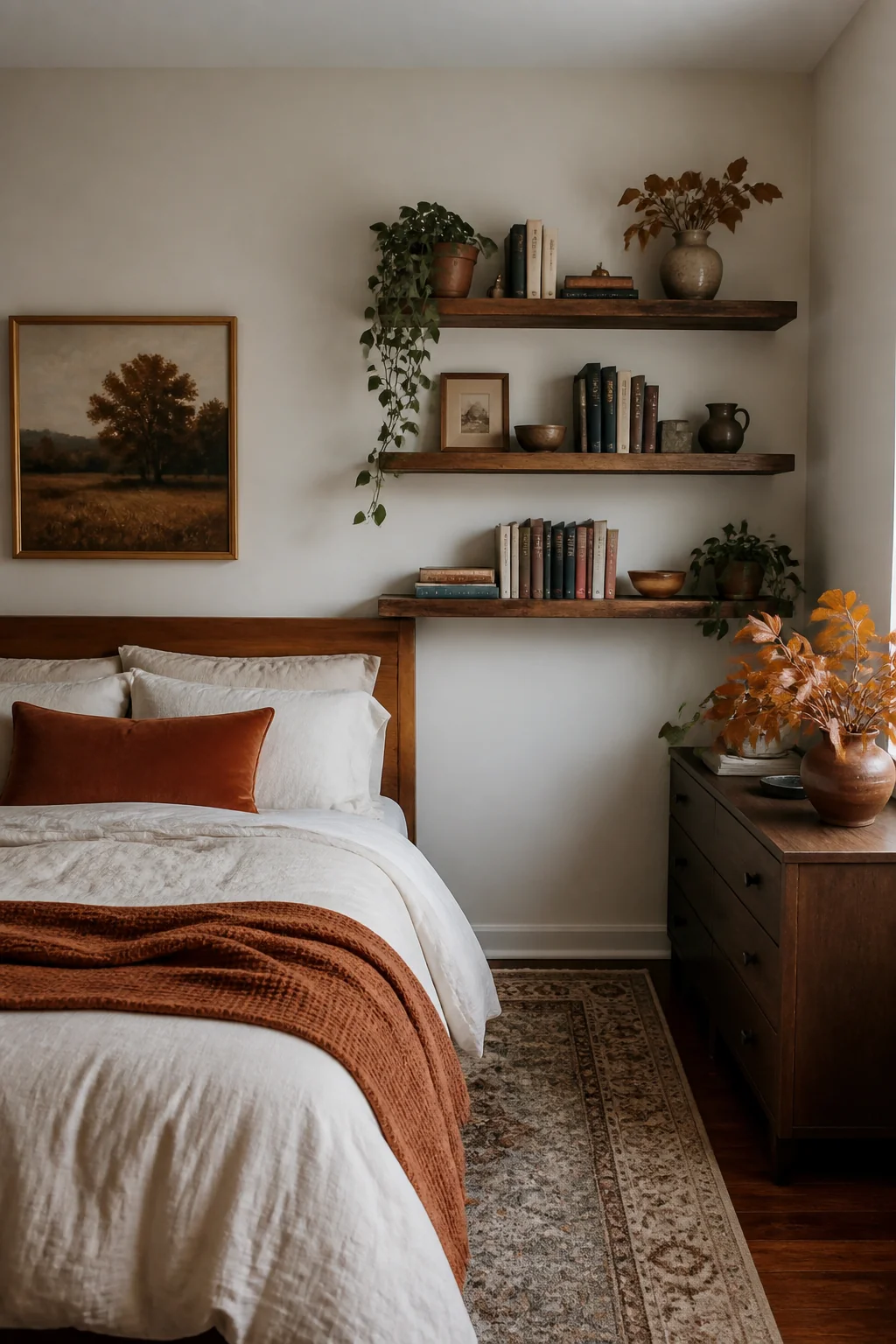
Two or three floating shelves at staggered heights break up a blank wall and keep seasonal objects off the floor. Depth decides what they can hold. Six to 8 inches takes most hardcovers, which run around 6.5 inches deep, while baskets and propped frames want 10 to 12. Space them 10 to 14 inches apart vertically so a short stack of books and a small vase both fit underneath the next shelf. Weight is where these fail publicly. Hardcover books average close to a pound per inch of shelf, so a 36 inch run of them hangs about 35 pounds off your drywall. Hit studs at 16 inches on center wherever the layout allows; everywhere else use toggle bolts rated for 50 pounds rather than the plastic anchors that came in the box. Shelves cost $30 to $60 each. Load heavy items near the brackets, never out at the free ends.
13. Use a heavy linen duvet in warm white or sand
Your base layer does the most work, and linen is the piece worth spending on: $120 to $200 for a good cover. Look for 150 to 190 gsm European flax, stonewashed, in warm white, cream, or sand. Lighter than that and the fabric goes translucent over a dark insert. Heavier and it stays stiff for most of a season before it gives. Size the insert to the cover rather than to the bed. A 90 by 90 queen insert inside a cover of the same dimensions fills the corners properly, and interior corner ties stop the whole thing migrating into one end by February. Wash cold, tumble low, and take it out while it's still slightly damp, since linen sets its creases permanently once it dries in a heap. Those soft wrinkles are the look. If you want a smooth, pressed bed instead, buy a cotton-linen blend and skip the argument with the fabric.
14. Add a woven wall hanging in natural fiber
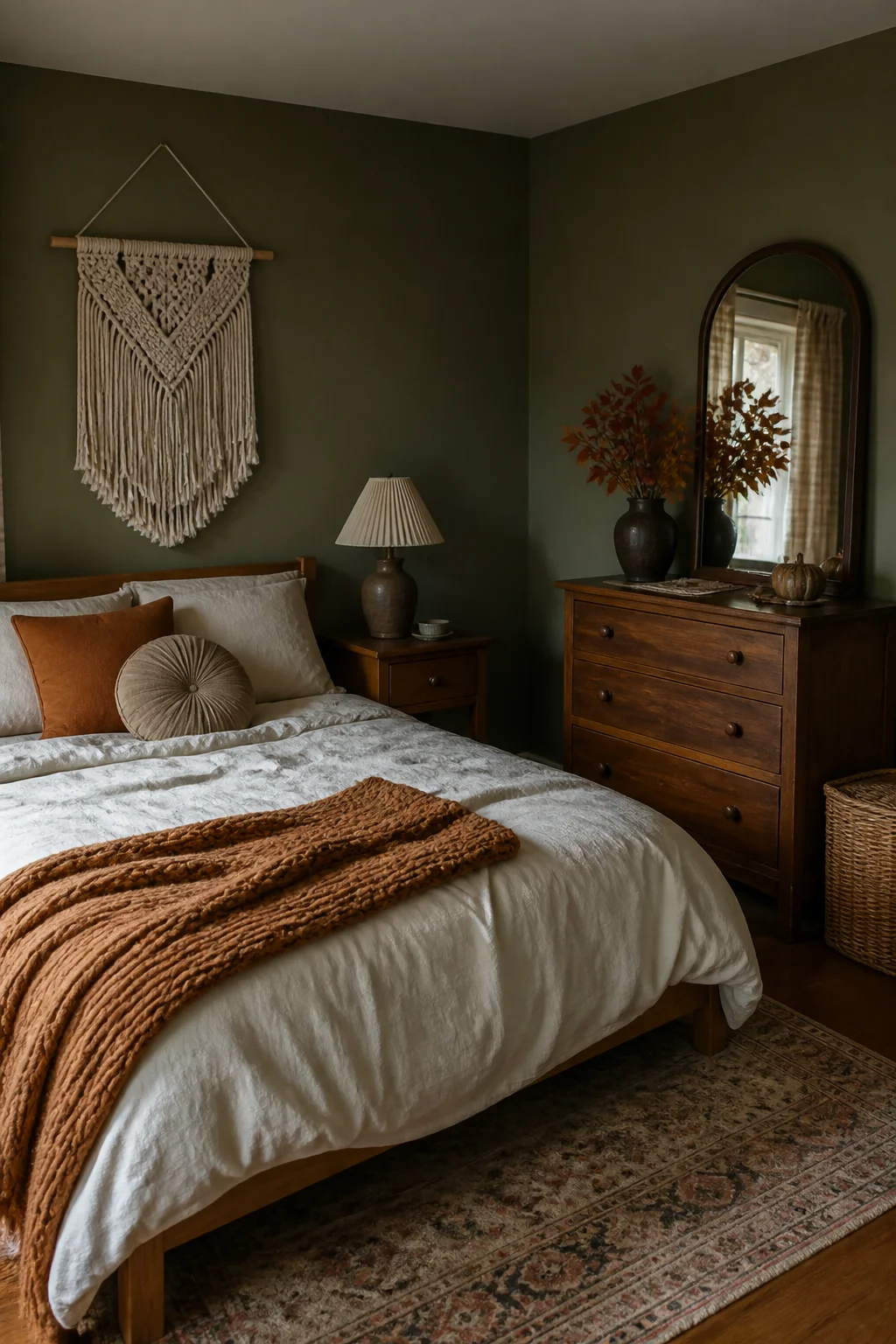
A macrame, jute, or handwoven textile softens a wall in a way framed art can't, because the fiber absorbs sound and light instead of bouncing both back at you. Hand-woven pieces run $40 to $100. Scale it to whatever sits below: something around 36 inches wide over a 54 inch dresser, with the bottom edge 6 to 8 inches above the surface so the two read as one group rather than two unrelated objects. Most hangings arrive on a wooden dowel heavier than it looks, so use two anchors spread near the ends. A single nail in the middle lets the dowel pivot and it hangs crooked within a week. Two things to know before committing: woven fiber collects dust and wants a pass with the vacuum brush attachment every month or so, and both cotton and jute fade in direct afternoon sun, so keep it off your brightest wall.
15. Place a wooden ladder as a decor piece
Lean a blanket ladder near the bed and hang a throw or two over the rungs. A 5 to 6 foot ladder at $30 to $80 is the useful size; taller ones want to tip forward once a heavy blanket goes over the top rung. Set the feet 12 to 16 inches out from the wall, which puts the lean at roughly 10 to 15 degrees: stable under weight, but not so far into the room that you catch it with a hip on the way past. Two or three throws is the limit before it reads as laundry rather than storage. With kids or a cat in the house, a small L bracket or a strap into a stud takes five minutes and removes the only genuine hazard here. Raw reclaimed wood looks great and destroys knits, so sand the rungs to 220 grit and wipe on a coat of hardwax oil before anything wool touches them. Hang the oily rag outside to dry afterward; scrunched up in a bin, oil-finish rags can heat up enough to catch fire.
16. Swap bedside lamps for warmer bulbs and ceramic bases
Swap thin metal lamp bases for ceramic, terracotta, or turned wood, then put 2700K bulbs in them. That number is the whole point. 2700K is the warm, slightly amber light people associate with lamplight, while 3000K and above starts reading clinical once the sun is down. Want it warmer still? Filament-style bulbs at 2200 to 2400K sit close to candlelight. Aim for 450 to 800 lumens per bedside lamp, enough to read by without lighting the ceiling, and look for CRI 90 or higher so wood tones and bedding colors don't go muddy. Position matters too: the shade's bottom edge should sit near your eye level when you're propped up against the headboard, roughly 24 to 26 inches above the tabletop, or you get the bulb straight in the face. Expect $40 to $80 per lamp, and check the bulb says dimmable if the lamp has a dial.
17. Layer a quilted throw pillow in a warm neutral
One quilted pillow in cream, oatmeal, or soft taupe, $25 to $45, does something no flat cover manages. The stitch lines pull the fabric into shallow ridges, so raking light from a bedside lamp lands as a grid of soft shadows instead of one flat plane. Go 18 by 18 or 20 by 20. Set it off center, in front of the shams rather than dead middle, which keeps the bed from looking symmetrical to the point of stiffness. Fiber matters more here than usual: polyester quilting picks up a sheen under lamplight and works directly against the matte look you're building, while cotton or washed cotton-linen stays dull in the good way. Hand-quilted pieces cost more and show slightly uneven stitching, and that irregularity is exactly what keeps them from looking mass produced.
18. Install warm-toned wall sconces flanking the headboard
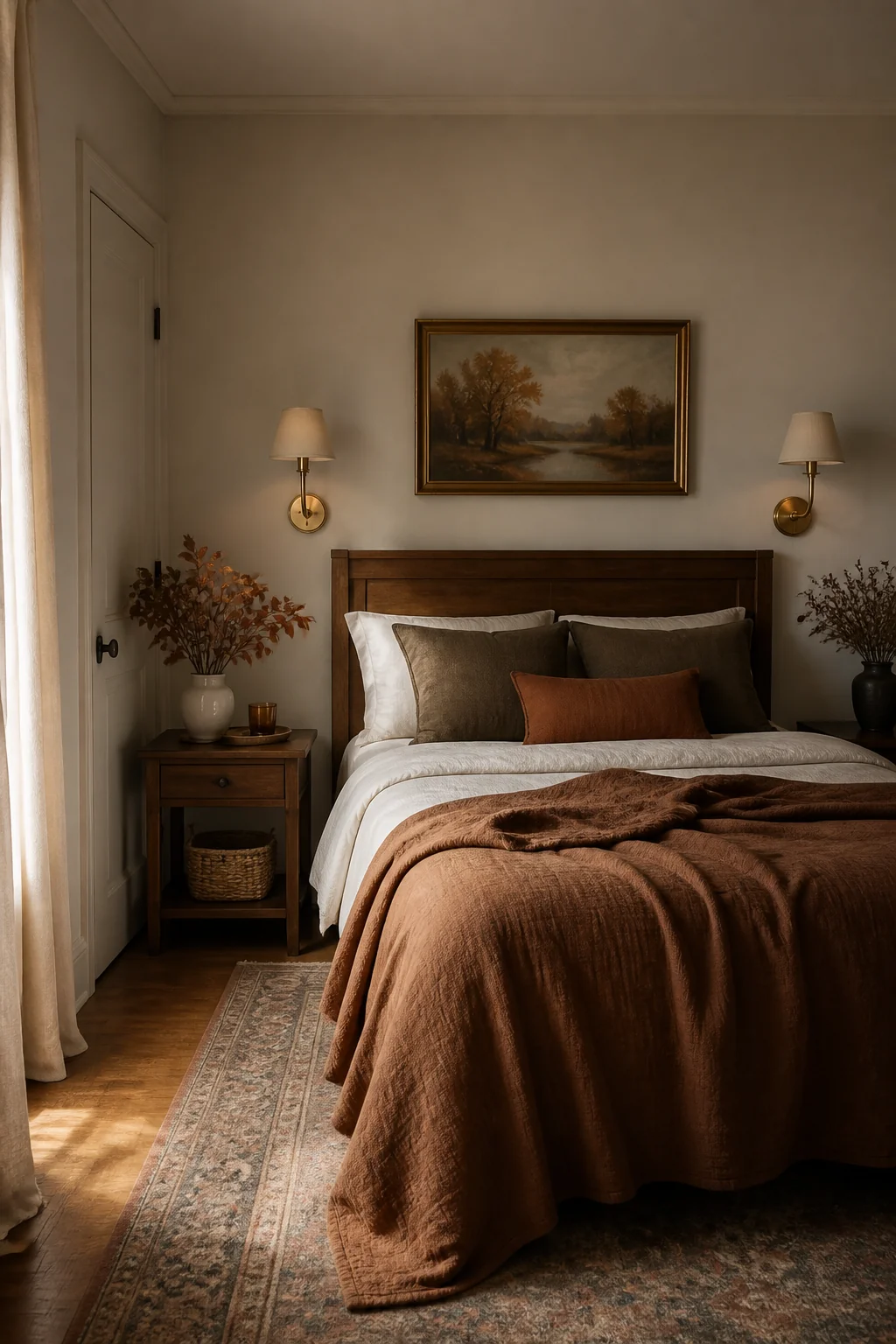
Two sconces flanking the headboard clear both nightstands and put light exactly where you read. Mount them 30 to 36 inches above the top of the mattress, which usually works out to 58 to 62 inches off the floor, and set them 6 to 10 inches outboard of the bed's edges so the pool of light falls on the page rather than on the person next to you. Swing-arm models let each side aim independently and are worth the extra $20. Fixtures themselves run $60 to $120 each. Hardwiring means an electrician cutting in a box, typically $100 to $200 per fixture, so price the install before you fall for a sconce. Plug-in versions with a fabric cord and a slim cord cover are the renter's answer and leave nothing behind. Choose an opaque shade over a clear glass globe, since a globe lights the whole wall and defeats the purpose.
19. Add a simple wooden mirror with a warm frame
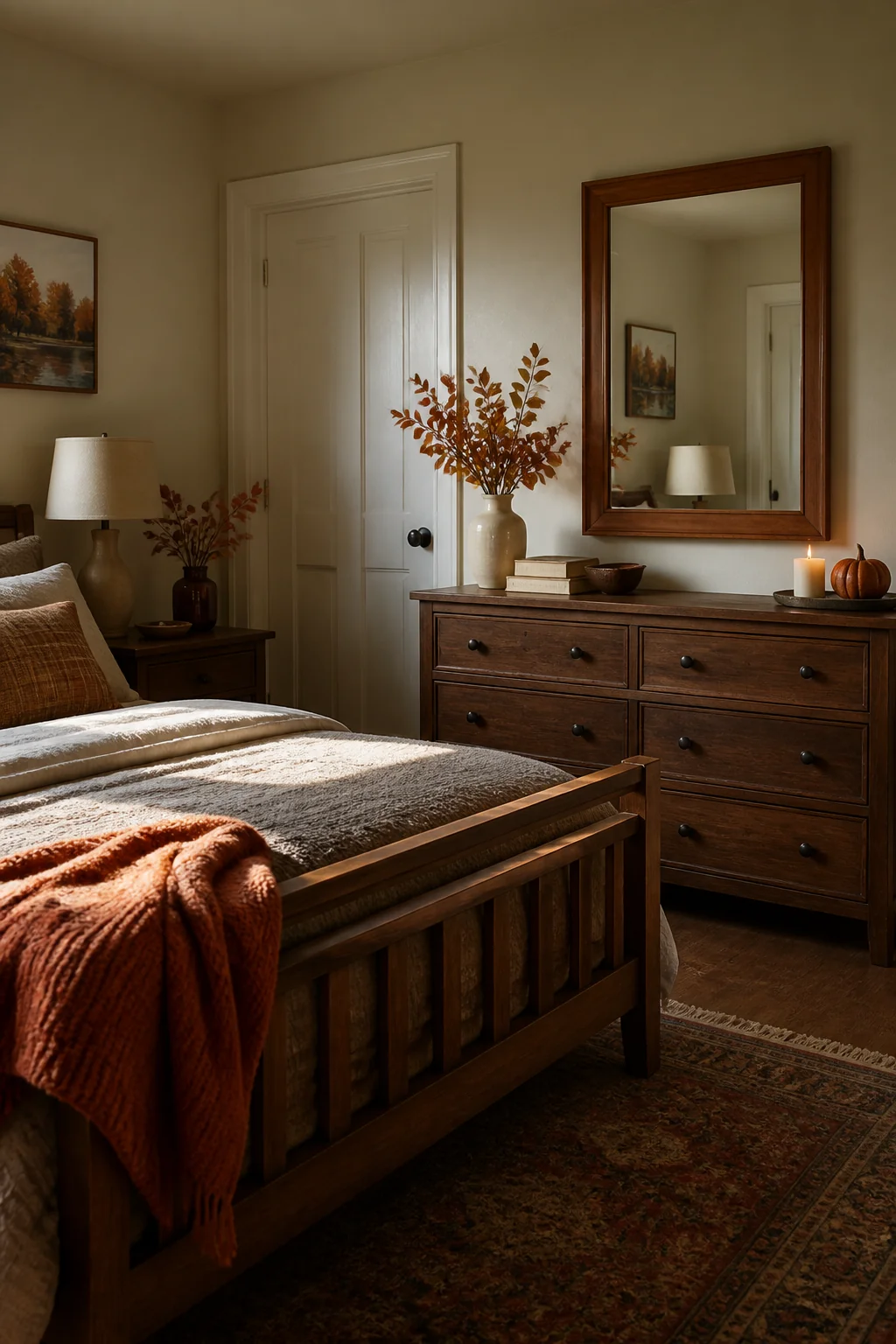
A wood-framed mirror bounces daylight into the darker half of the room, which counts for more once the sun sits low and the window only reaches one corner. A mirror that spans only half a dresser leaves bare wall showing on both sides and the whole top looks unfinished, so size it to roughly two thirds the width of the piece underneath and hang it with the center 57 to 60 inches off the floor. Opposite or perpendicular to a window is where it earns the wall space. Expect $50 to $150. Weight is the part people underestimate: a 25 pound framed mirror on one drywall nail will come down eventually, usually at night. Use a French cleat screwed into a stud, or two D-rings on toggle bolts rated well above the mirror's weight. One caution before you commit to a spot. A mirror facing the bed catches movement and streetlight after dark, and a lot of people find that quietly unsettling. Angle it or move it to a side wall.
20. Use warm white or cream bedding instead of bright white
The simplest change on this list costs nothing extra if you were replacing sheets anyway. Optic white bedding is treated with optical brighteners that fluoresce slightly blue, which is why it looks cold under 2700K lamplight and slightly off next to warm oak or walnut. Cream, sand, and oatmeal hold their color under the same bulbs. A decent cotton or linen-blend sheet set runs $60 to $120. Test before you commit: hold a swatch or a spare pillowcase against the headboard at night, under the lamp you use, not in a store under fluorescent tubes. The mistake worth avoiding is running three different whites at once, a bright duvet with cream shams and a stone-colored throw, which reads as mismatched rather than layered. Choose one warm white and let all the variation come from texture. Nothing new enters the room here. You're changing the temperature of what's already on the bed.
21. Place a wooden side table with woven baskets underneath
A small table with open storage beneath turns a dead corner into somewhere the spare blankets actually live. Measure the clear opening under the table before buying anything: 14 to 18 inches of height is typical, and baskets around 14 by 14 by 12 inches slide in with room to spare. Seagrass and water hyacinth cost $20 to $40 each and keep their shape for years; wire-framed fabric bins sag the moment anything heavy goes in. Figure $60 to $120 for the table and two baskets together. Give one basket to blankets and one to books or magazines so you aren't digging through both. Two details save frustration later. Leave an inch of clearance on each side or the baskets bind against the legs every time you pull them out, and choose lined baskets if wool throws are going in, because raw seagrass snags loose knits on the way past.
22. Add wood paneling or shiplap to one accent wall
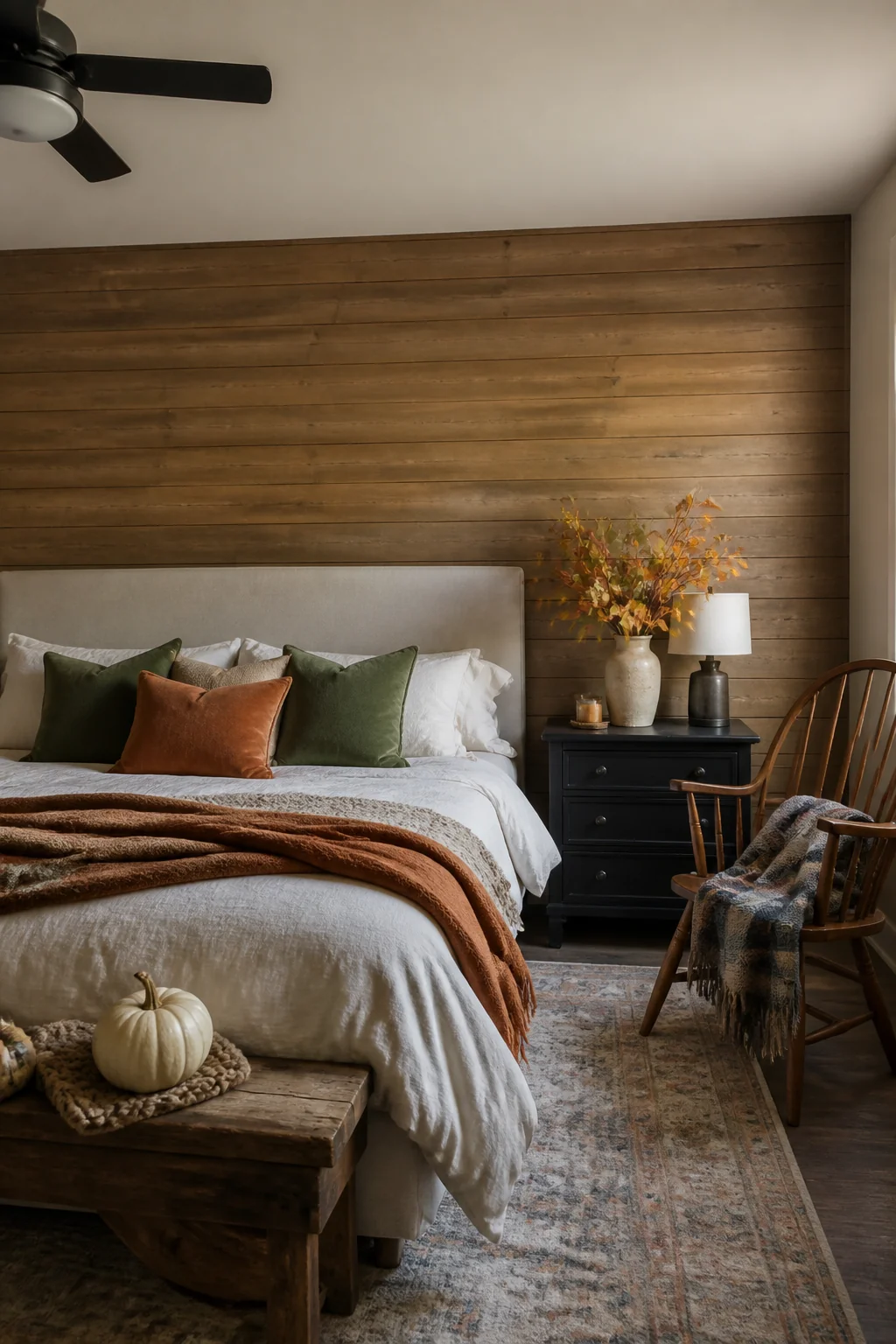
When the headboard wall reads bare, thin paneling gives it a texture paint alone can't fake. Material runs $2 to $5 per square foot, so a typical 12 by 9 foot wall is 108 square feet and lands between $100 and $300, more if someone else is installing it. Do the arithmetic before you cut: measure the wall height, divide by your board width, and shift the starting course so you don't finish with a one inch sliver at the ceiling. Nail into studs at 16 inches on center with 18-gauge brads, backed with construction adhesive. Seal or paint the boards on all four sides before they go up, the back included, or humidity will cup them within a year. Leave an eighth of an inch of expansion gap at the edges in any room that swings between damp and dry. Warm white, soft gray, and clear-sealed natural wood all suit fall. High gloss does not.
23. Layer a chunky knit throw blanket across the seating area
Where there's a chair or bench, a chunky knit thrown over one arm is the quickest way to make the seat look used rather than staged. Merino or a wool blend at $40 to $80 keeps its loft for years. Acrylic chunky knits cost less, stretch out within a season, and pill wherever they rub against an arm. Four to six pounds is the weight that drapes properly instead of sliding onto the floor every time you sit. Fold it over one arm and let the rest pool across the seat; a perfect square looks like a display. Care is where these get ruined. Hand wash cold or use the wool cycle, then dry flat, because a wet wool throw hung over a rail can stretch several inches longer and stay that way. Watch the chair too: cable knit catches on rattan, wicker, and exposed staples, so a smooth upholstered or wood frame is the safer host.
24. Hang curtains from a brass or wooden rod
The rod is structural, not decorative, and cheap hardware shows within a month. A 1 inch to 1 3/8 inch diameter rod in brass or turned wood carries the weight of lined linen panels. Three-quarter inch rods visibly bow across anything over 60 inches, and once they bow the curtains never hang straight again. For spans past 60 inches add a center support bracket, even though it means unhooking a ring to slide the panels past it. Brackets go into studs where you can find them and toggle bolts everywhere else, because curtains pull outward as well as down each time you draw them. Remember that finials add 3 to 4 inches per side, so measure rod and finials together against the wall you have before ordering. Budget $30 to $60 for rod and hardware. Match the metal to your drawer pulls and lamp bases rather than to the curtain fabric.
25. Place dried pampas or wheat stems in a glass vase
Dried stems in a plain glass vase, about $15, handle the seasonal impulse with nothing to water and nothing to throw out in a week. Cut the stems so they stand roughly one and a half to two times the vase height, then trim a few shorter so the bunch has a varied top line instead of a flat hedge. Fewer stems in a narrow neck looks better than a fat bundle jammed into a wide one. Pampas is the popular pick and it sheds constantly; a light pass of unscented hairspray from about arm's length seals the plumes and stops most of it landing on the nightstand. Wheat, bunny tails, and dried grasses shed far less and cost less as well. Keep the vase out of direct afternoon sun, since UV bleaches dried material to pale straw within a couple of months. Treated that way the same stems carry through to spring.
26. Layer a low-profile area rug under a wooden bench at the foot of the bed
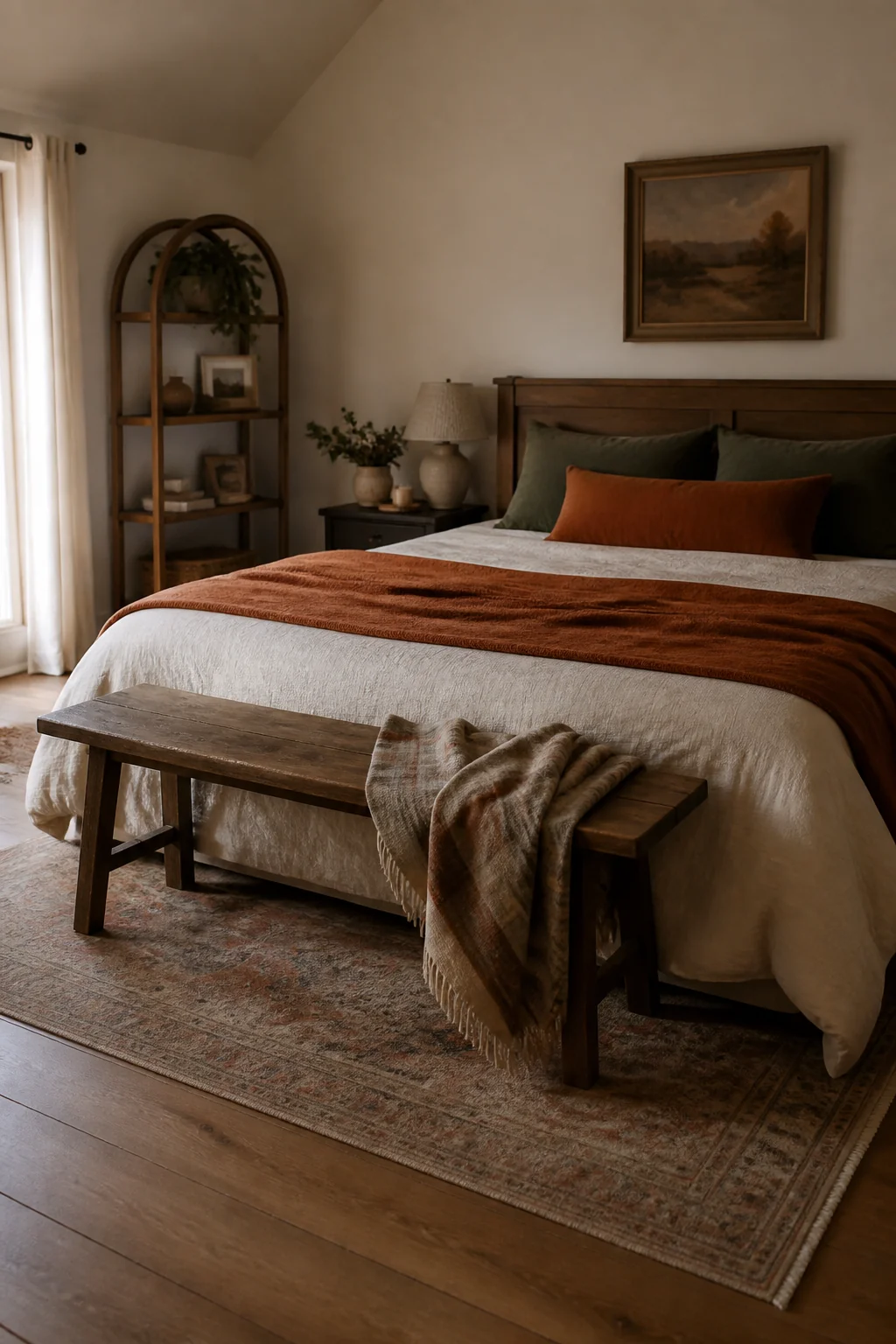
A 2 by 3 or 3 by 5 rug under the bench gives the foot of the bed its own footprint and adds one more texture where the room usually goes flat. Let it run 4 to 6 inches past the bench on each side so the bench looks placed rather than parked. Keep the pile under half an inch and check the door swing first: most interior doors clear the floor by half to three quarters of an inch, and a plush rug in that arc means planing the bottom of the door later. Flatweave wool and jute blends run $60 to $120 in these sizes and both take daily traffic. A thin pad underneath stops the rug creeping every time you sit down to tie a shoe. One exception: if a large rug already sits under the bed, leave this one out. Two rugs competing for the same stretch of floor reads as clutter, not layering.
Save this for your next project
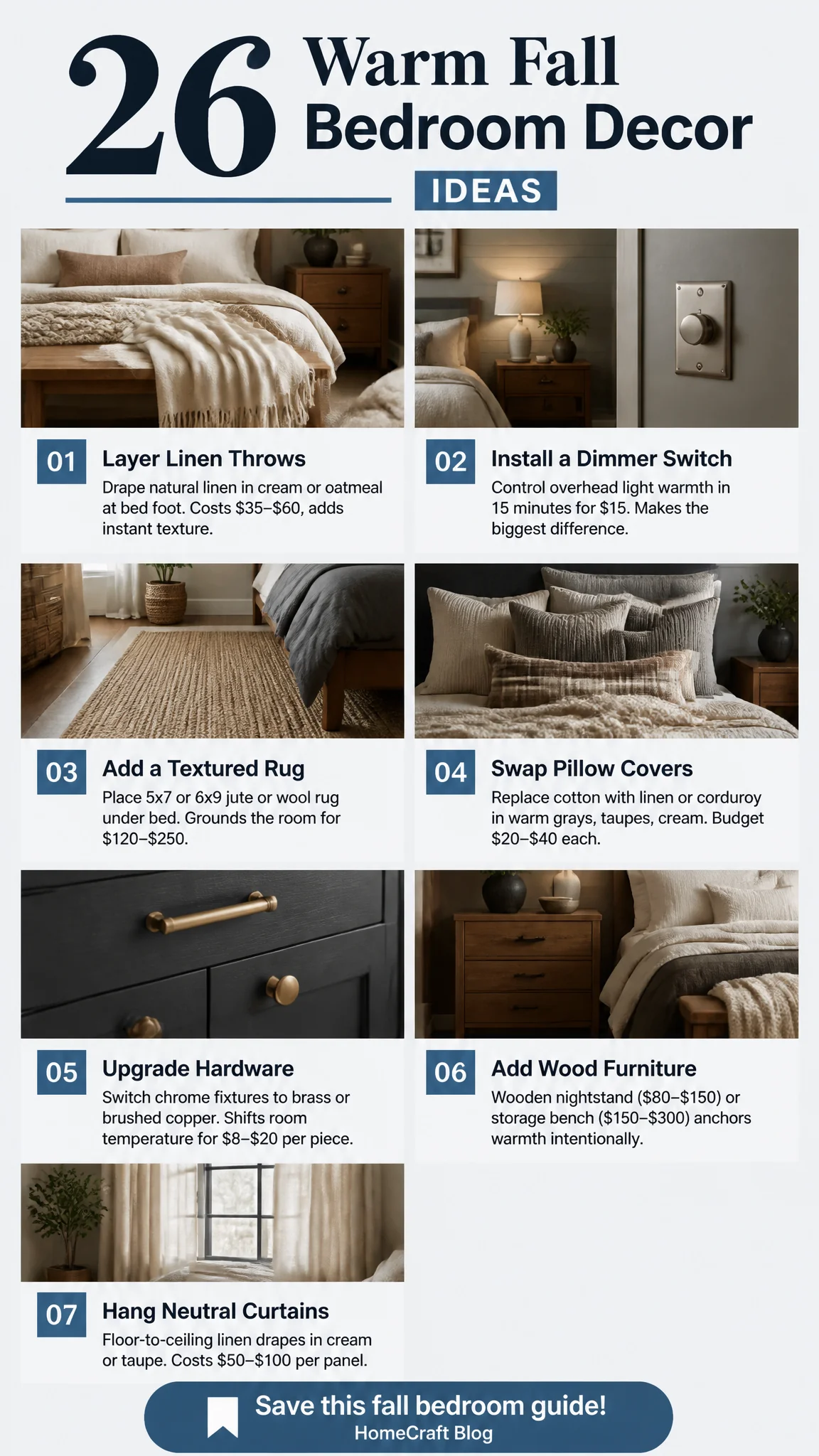
If you only get to two things here, make them the light and the base layer. Warm 2700K bulbs on a dimmer, plus one heavy matte textile on the bed, will do more for how the room feels at 7pm in October than a dozen seasonal objects sitting under a cold ceiling fixture. Texture can arrive slowly. It usually does.