14 Inviting Rustic Bedroom Decor Ideas That Feel Warm, Not Themed
14 rustic bedroom decor ideas with real sizes, price ranges, and the mistakes to avoid, from reclaimed frames and linen bedding to lighting that keeps wood warm.
This post contains affiliate links. As an Amazon Associate I earn from qualifying purchases. If you buy through our links, we may earn a commission at no extra cost to you.
Most rustic bedrooms fail because they lean too hard one way: either they feel like a cabin that time forgot, or they're so polished they've lost the warmth that makes rustic work. What works is texture, natural materials, and a few solid anchors that ground the room without making it heavy or dated. You don't need to strip wallpaper or install shiplap to get there. Small choices about fabric, wood, color, and layering can take a bedroom from bland to inviting.
Here are fourteen ways to build rustic bedroom decor that holds up past the first week.
1. Start with a reclaimed wood bed frame
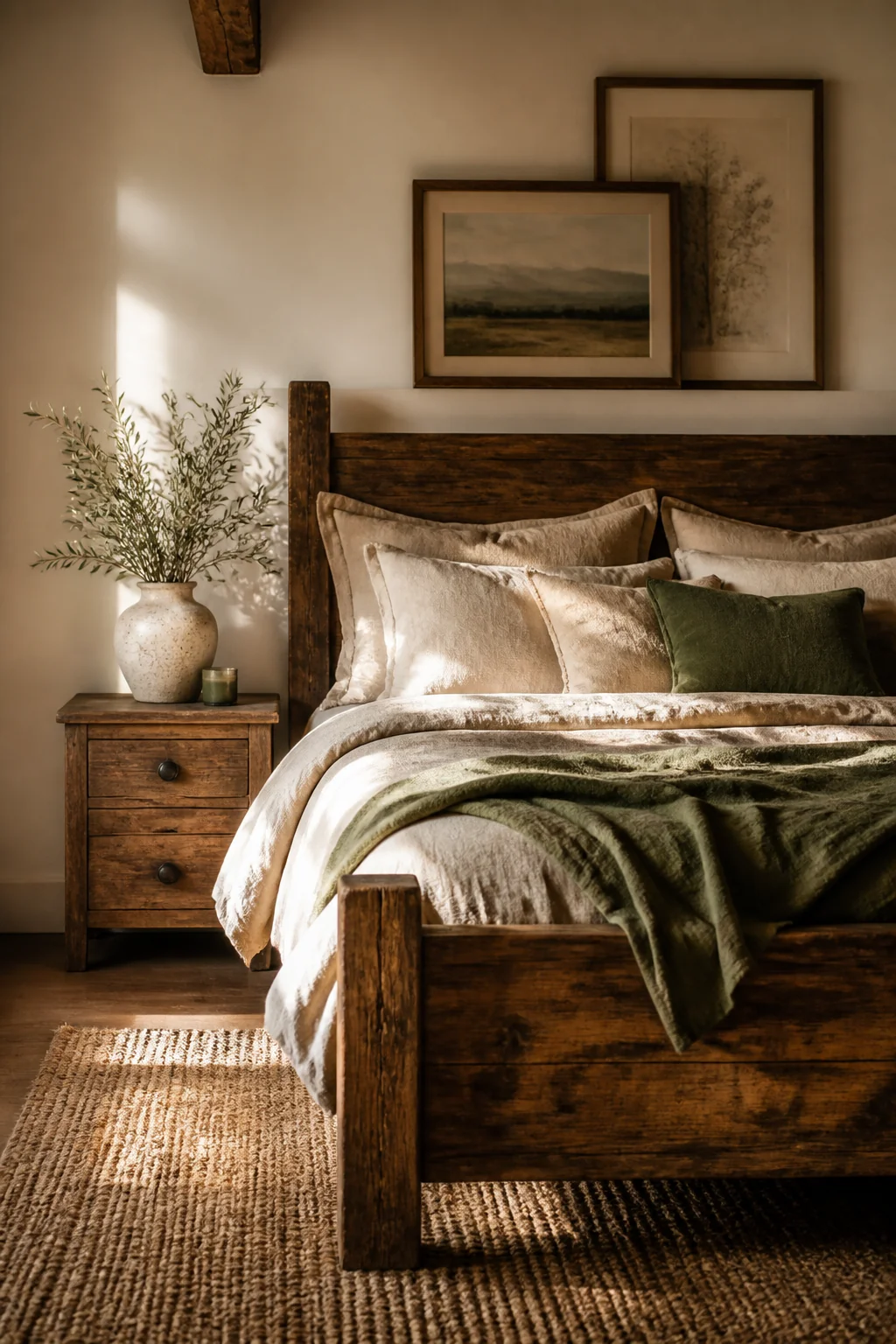
A wood bed frame anchors everything else in the room, so it's worth settling first. Look for salvaged barn wood, hand-hewn beams, or solid oak and pine with a weathered finish. Expect $600 to $2,000 for a queen depending on the wood and the joinery. The frame doesn't have to be expensive; it needs visible grain and an honest finish rather than a stain sprayed on to imitate age. Check the end grain and the panel edges before you buy, because a laminate photo-print surface gives itself away exactly where two panels meet. Ask whether reclaimed stock was kiln dried too, since untreated barn wood can carry insects and will keep moving as it dries out in a heated room. Plan the footprint while you're at it. A queen frame occupies roughly 63 by 84 inches, and you want 24 to 30 inches of walking room on any side you use. Solid hardwood gets heavy, often 150 pounds and up, so line up help before it reaches the stairs.
2. Layer a chunky knit throw across the foot
Texture on the bed does more work than another cushion ever will, and it costs you no floor space. A cable-knit or waffle-weave throw in cream, oatmeal, or soft gray belongs across the bottom third of the mattress, folded in thirds lengthwise with one side left to spill over. Size is the part that gets skipped. A 50 by 60 inch throw looks like a napkin on a king; you want something nearer 60 by 80 so it clears the mattress edge by 8 to 10 inches on both sides. Budget $60 to $150 for wool or a wool blend. Acrylic costs less, but it pills along the fold line and picks up a plasticky sheen under a warm bulb, which is the opposite of what you're after. Cotton chenille is the forgiving middle ground because it survives a washing machine. Chunky wool does not: wash it cool by hand and dry it flat, or the weight of the water stretches it out of shape for good.
3. Hang a wrought-iron or wooden headboard
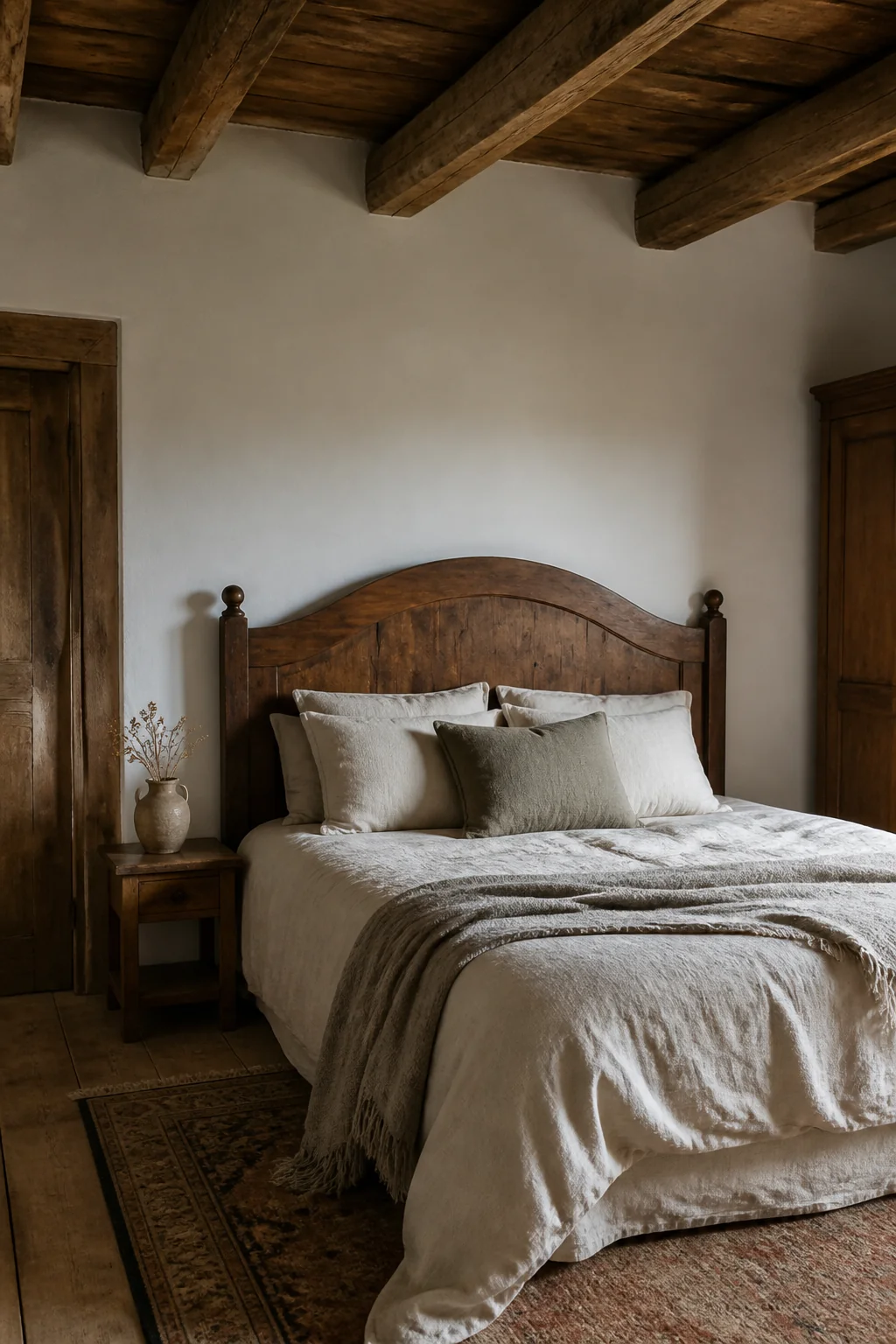 If your frame came without a headboard, mount one on the wall behind the bed instead. Wrought iron with geometric bends, an arched wood panel, or plain vertical slats all read rustic, and the choice mostly comes down to how much shine you want in the room. Iron runs $300 to $800 for a queen; wood often costs less, especially if you build it from reclaimed boards. What shifts here is the vertical line. A headboard that ends well above the pillows pulls the eye upward and keeps an eight foot ceiling from feeling squat. Height is the detail worth measuring twice. With a mattress surface around 25 inches off the floor, the top edge of a headboard usually lands between 48 and 58 inches. Hang it on a French cleat screwed into studs at 16 inch centers, or use toggle bolts rated well past the panel's weight when the studs fall in the wrong place. The common mistake is mounting it low, where the pillows swallow the panel and you've paid for six inches of visible wood.
4. Choose linen bedding in natural tones
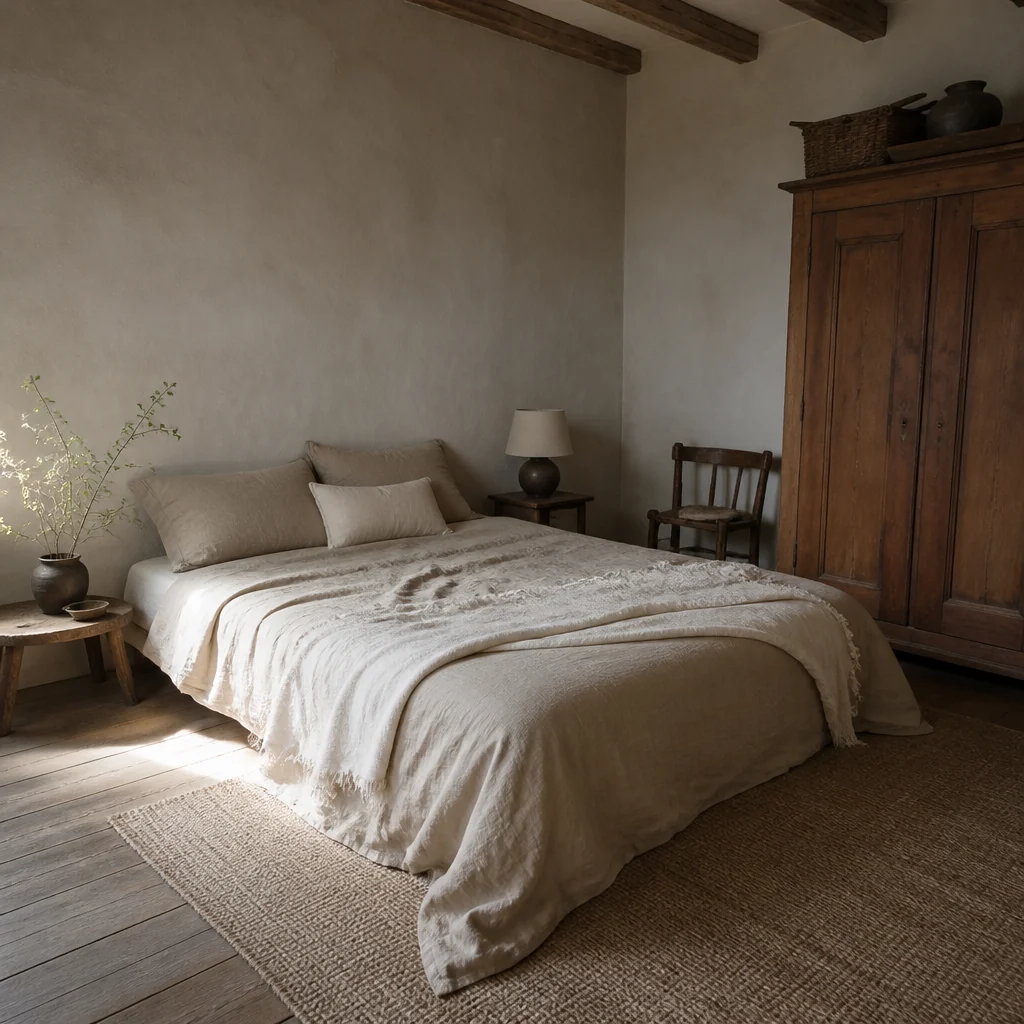 Linen wrinkles, and that's the point. Cream, oatmeal, or soft gray linen reads lived-in the moment you pull the duvet up, and it keeps reading that way at the end of a long week. Budget $150 to $350 for a good queen set. Look for European flax around 150 to 190 GSM with a stonewashed finish, which takes the initial board-stiffness out; the rest of the softness arrives over the first ten or fifteen washes. Be wary of anything sold as a linen blend where cotton makes up more than half the weave, since the cotton smooths away the texture you paid for. Check the fitted sheet's pocket depth against your mattress too: 15 to 16 inches covers most pillow tops, and a shallow pocket pops off the corner at 3 a.m. One honest trade-off. Linen breathes and feels cool against skin, so if you run cold through winter, put brushed cotton or flannel underneath and keep the linen on top. You get the look without lying awake shivering under it.
5. Add a vintage area rug with muted patterns
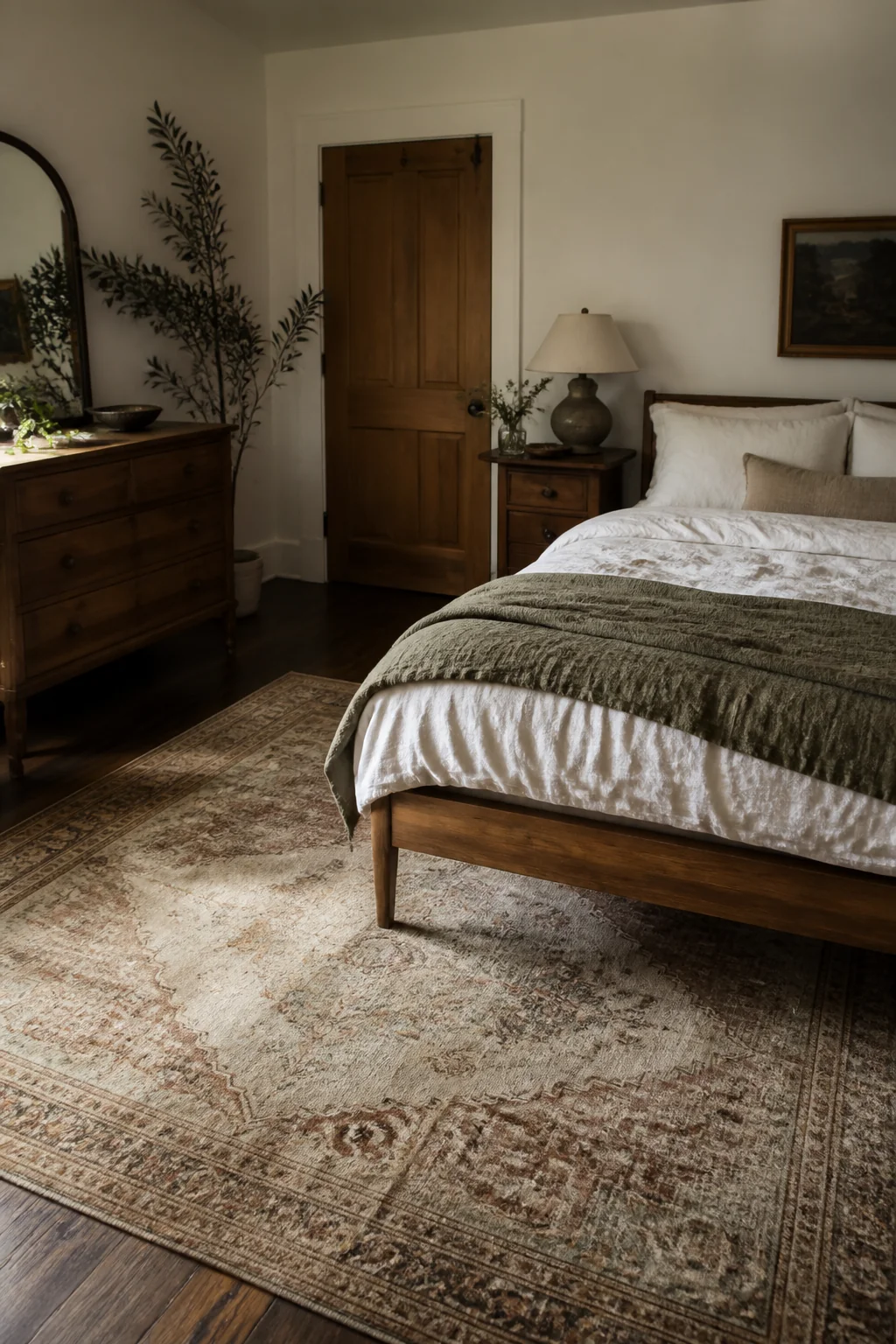 A wool rug softens a hard floor and gives the bed something to sit on instead of float above. Rust, cream, and soft brown all work, as do faded Turkish and Persian patterns where age has already dulled the contrast for you. Expect $300 to $800 for genuine wool. Size it to the bed rather than to the room. A queen mattress measures 60 by 80 inches, so an 8 by 10 rug leaves roughly 24 inches of softness on both sides and at the foot, which is precisely where your feet land in the morning. A 5 by 7 only really works turned sideways under the lower half of the bed. Check door clearance before ordering: interior doors typically swing with half an inch to three quarters of an inch underneath, so keep the pile between a quarter and half an inch. Add a rug pad at $40 to $80, which stops the rug creeping and keeps the corners from curling. The usual misstep is a rug too bright or too graphic, fighting everything else in the room for attention.
6. Install simple wood shelving above a dresser or desk
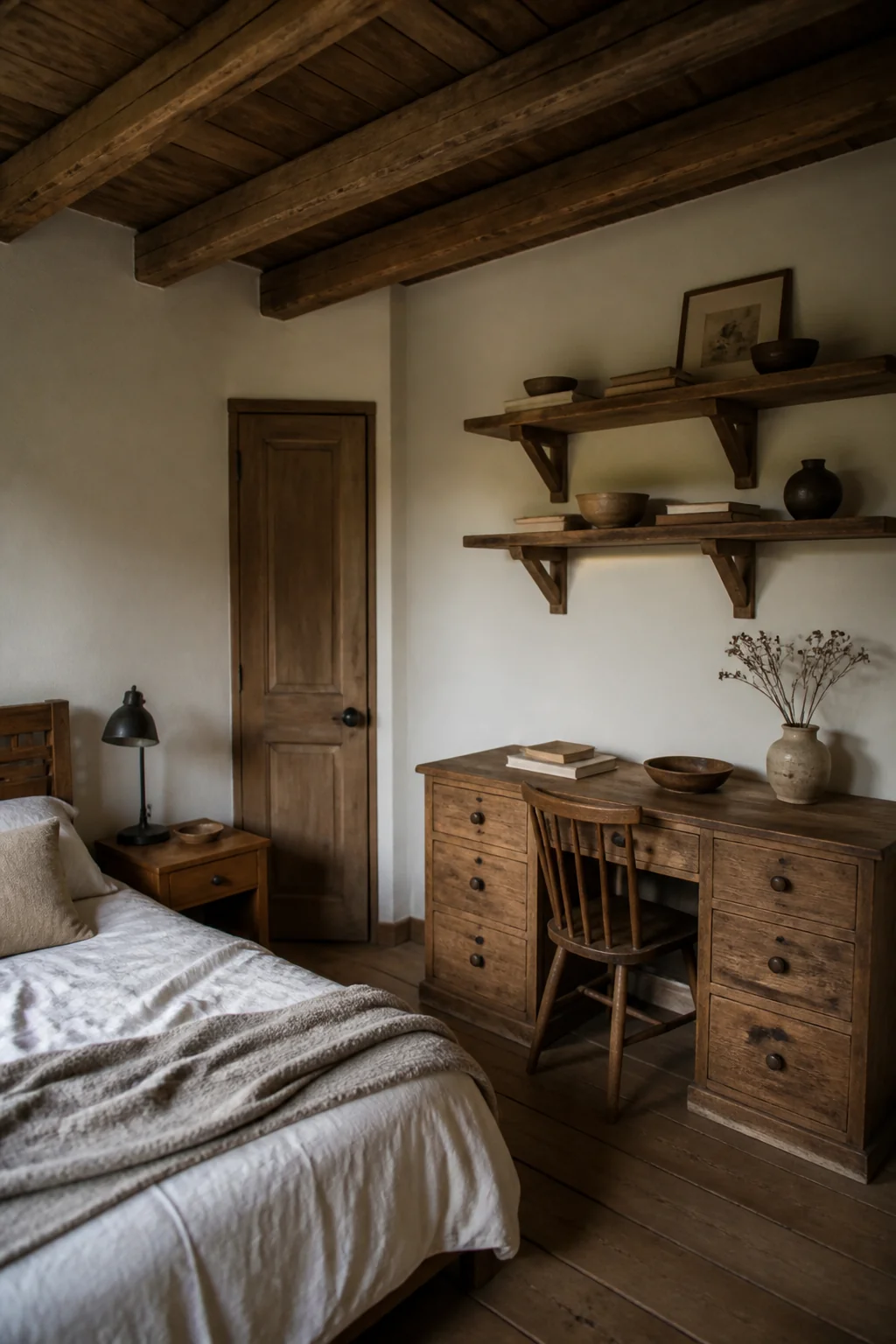 Floating shelves in reclaimed or stained wood give a dresser wall some structure without adding another piece of furniture. A pair of 36 inch shelves runs $80 to $200 with hardware. Mount the lower one 18 to 24 inches above the dresser top so a lamp or a tall pitcher still fits underneath, then set the second one 12 to 14 inches above that. A depth of 8 to 10 inches holds books and a small plant comfortably; go deeper and the shelf starts reading as storage rather than a surface. Anchor into studs wherever the layout allows. Floating hardware sold with a 40 to 50 pound rating assumes the steel rod is seated 3 to 4 inches into a solid shelf and screwed into framing, and drywall anchors on their own will sag under a row of hardbacks inside a year. Then keep the styling sparse: a small plant, one ceramic piece, a short stack of books. Clutter on an open shelf reads as mess far faster than the same clutter in a drawer.
7. Bring in a wood nightstand with a single drawer
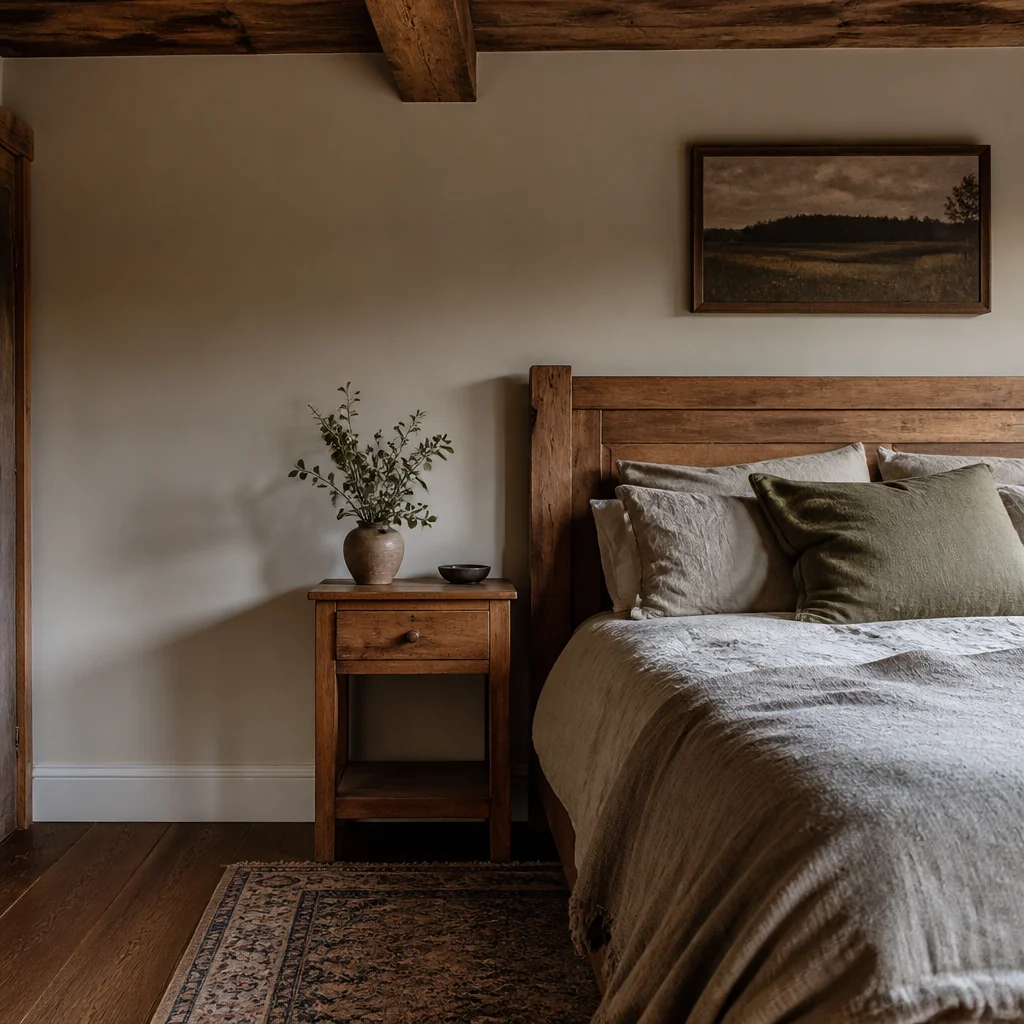 Skip the matched pair. One solid nightstand in walnut, oak, or pine with real metal hardware looks gathered rather than ordered, and it costs $150 to $400. Height is the measurement that decides whether you like it: aim for a top within a couple of inches of the mattress surface. Most mattresses sit 24 to 26 inches off the floor, so a nightstand 24 to 28 inches tall keeps the lamp switch and a glass of water in reach while you're lying down. A width of 18 to 24 inches leaves the walkway clear. Wood choice carries a real consequence here. Pine is soft, so it dents under a dropped phone and rings under a warm mug, while oak and walnut shrug both off. If you love a pine piece, plan on coasters or an oiled finish you can touch up in ten minutes. And if you do want a nightstand on each side, let them differ in shape and match on one thing only: height, wood tone, or hardware finish.
8. Hang a large mirror in a distressed wood or metal frame
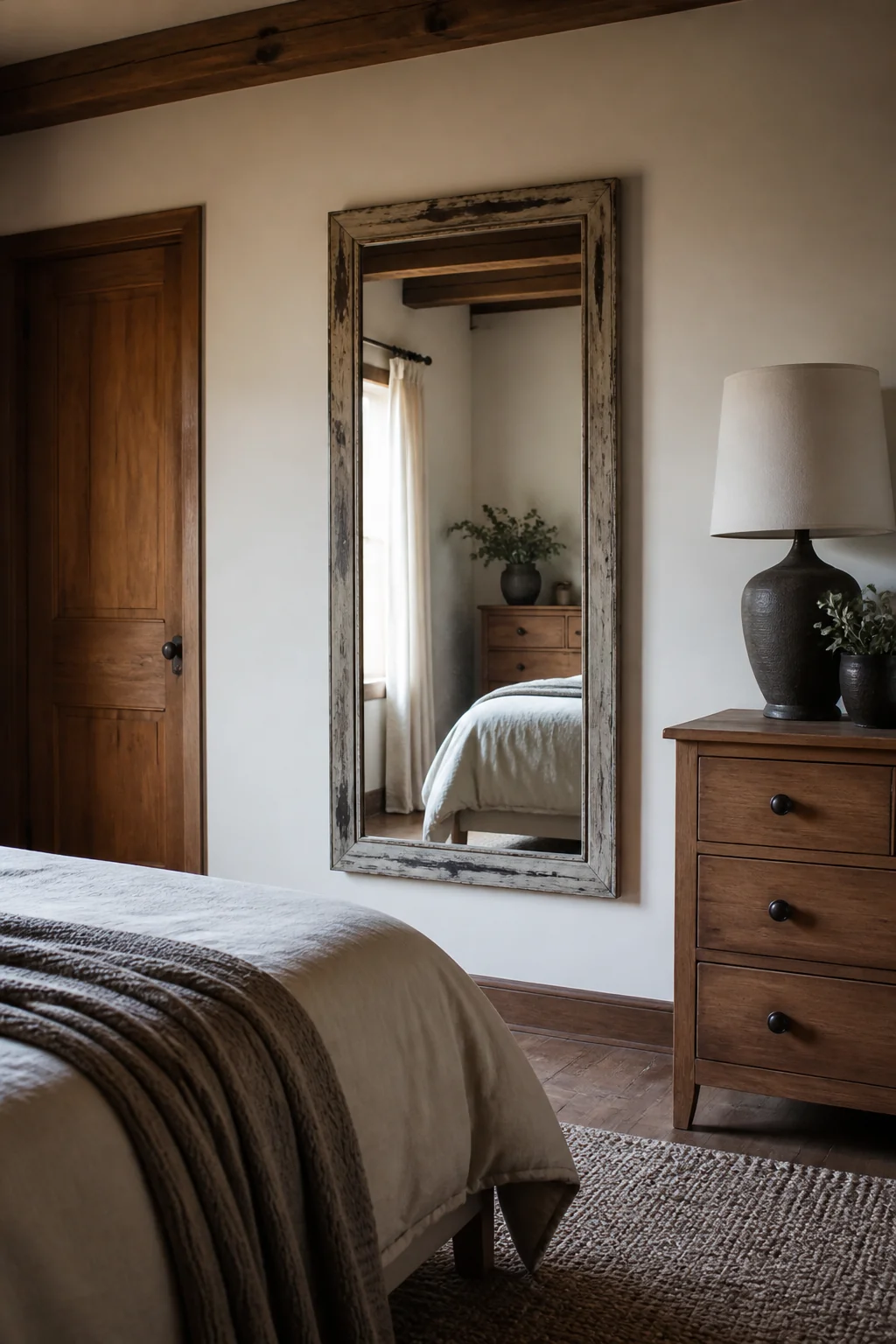 A mirror above the dresser bounces daylight deeper into the room and gives you somewhere to check an outfit that isn't the back of a closet door. Around 32 inches wide suits a standard 48 inch dresser, and $80 to $300 covers most distressed wood or oxidized metal frames. Leave 6 to 10 inches between the dresser top and the bottom of the frame, and hang it so the center sits near standing eye level rather than centered on the wall. Weight is what catches people out. A 32 inch framed mirror often runs 25 to 40 pounds, which means D-rings into a stud or two rated toggle bolts, never the sawtooth hanger that came stapled to the back. Before you drill, stand where you'll be standing and look at what the glass returns. A mirror aimed at a cluttered closet or a blank stretch of ceiling only doubles the thing you'd rather not look at. Bright new gilt sits badly with weathered wood; waxed or lightly worn finishes settle in better.
9. Use warm, dimmable lighting with vintage-style fixtures
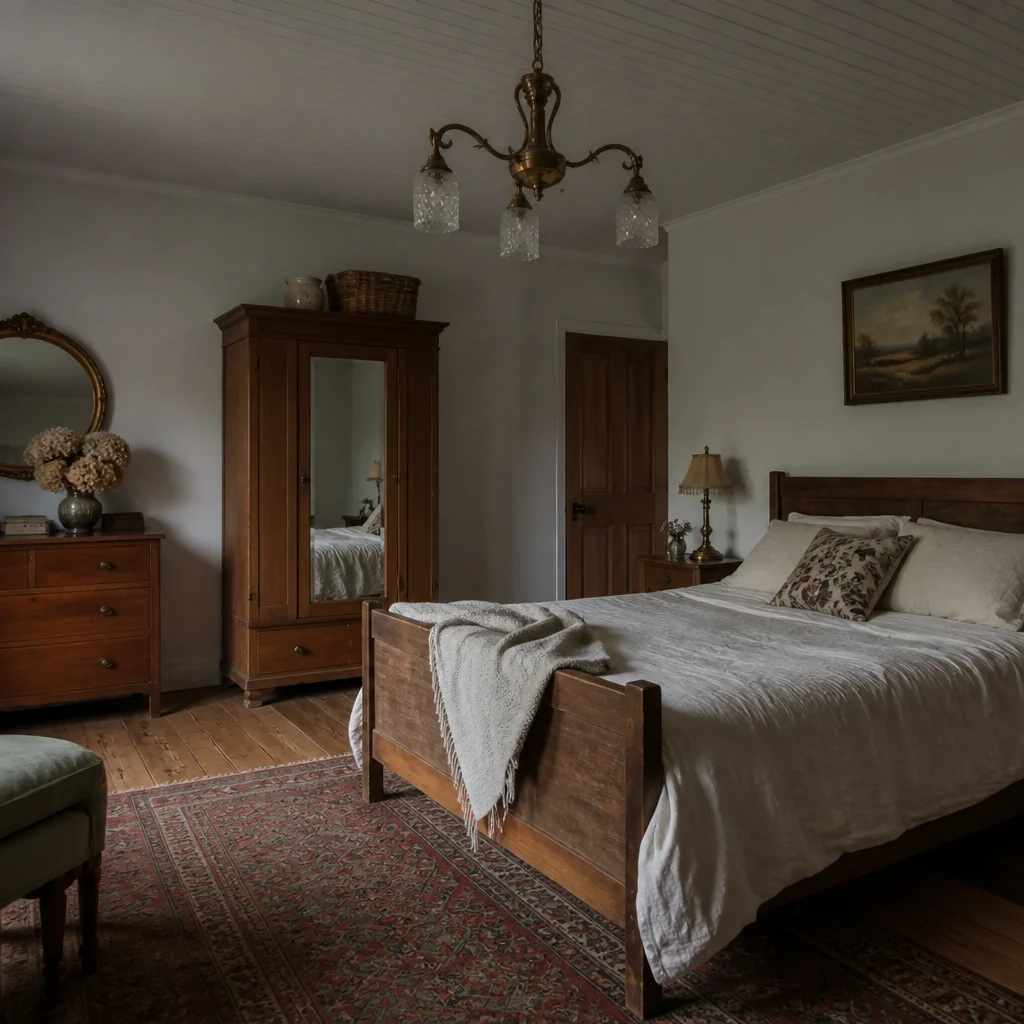 Overhead light on full blast undoes most of what the wood and linen are doing. Pendants with exposed filament bulbs, an iron or aged brass chandelier, and sconces with fabric or paper shades all belong here, at roughly $120 to $400 per fixture. Bulb color temperature is where the mood really lives: 2200K to 2700K keeps oak and pine warm, while 3000K and above pushes the same wood toward gray. For reading in bed you want something near 400 to 450 lumens landing at the pillow, which a single dimmed pendant across the room will never manage. Mount sconces about 30 to 36 inches above the mattress surface and 4 to 6 inches out from the edge of the bed, so the light falls on the page instead of your shoulder. A pendant over a nightstand hangs best 20 to 24 inches above the surface. Budget for one catch: LED bulbs need a compatible LED or CL rated dimmer, roughly $20 to $35, or you get an audible buzz and a stubborn flicker at low settings.
10. Paint walls in warm neutrals with a matte finish
White walls are the reflex, but warm grays, soft taupes, and pale ochre give a rustic room somewhere to sit between cabin and blank box. Price the job in coats rather than in walls. A 12 by 14 foot room with eight foot ceilings gives you around 400 square feet of wall, which is what a single $30 to $60 gallon will do exactly once, so two gallons is the honest number to leave the store with and a can of primer belongs on the same receipt if you're going lighter than what's up there now. Matte is the finish to reach for. It scatters light instead of bouncing it, which hides the small waves and patched nail holes in older plaster that satin puts a spotlight on. The trade-off is genuine: flat paint scuffs and won't survive scrubbing, so use eggshell behind an upholstered headboard and anywhere hands land regularly. Test before you commit to five walls. Paint a two foot square, then look at it in morning light and again under lamplight at night, because warm grays turn faintly green under a cool north-facing window. Reading the darkest chip on the strip tells you the undertone the pale version is hiding.
11. Add woven baskets for storage and texture
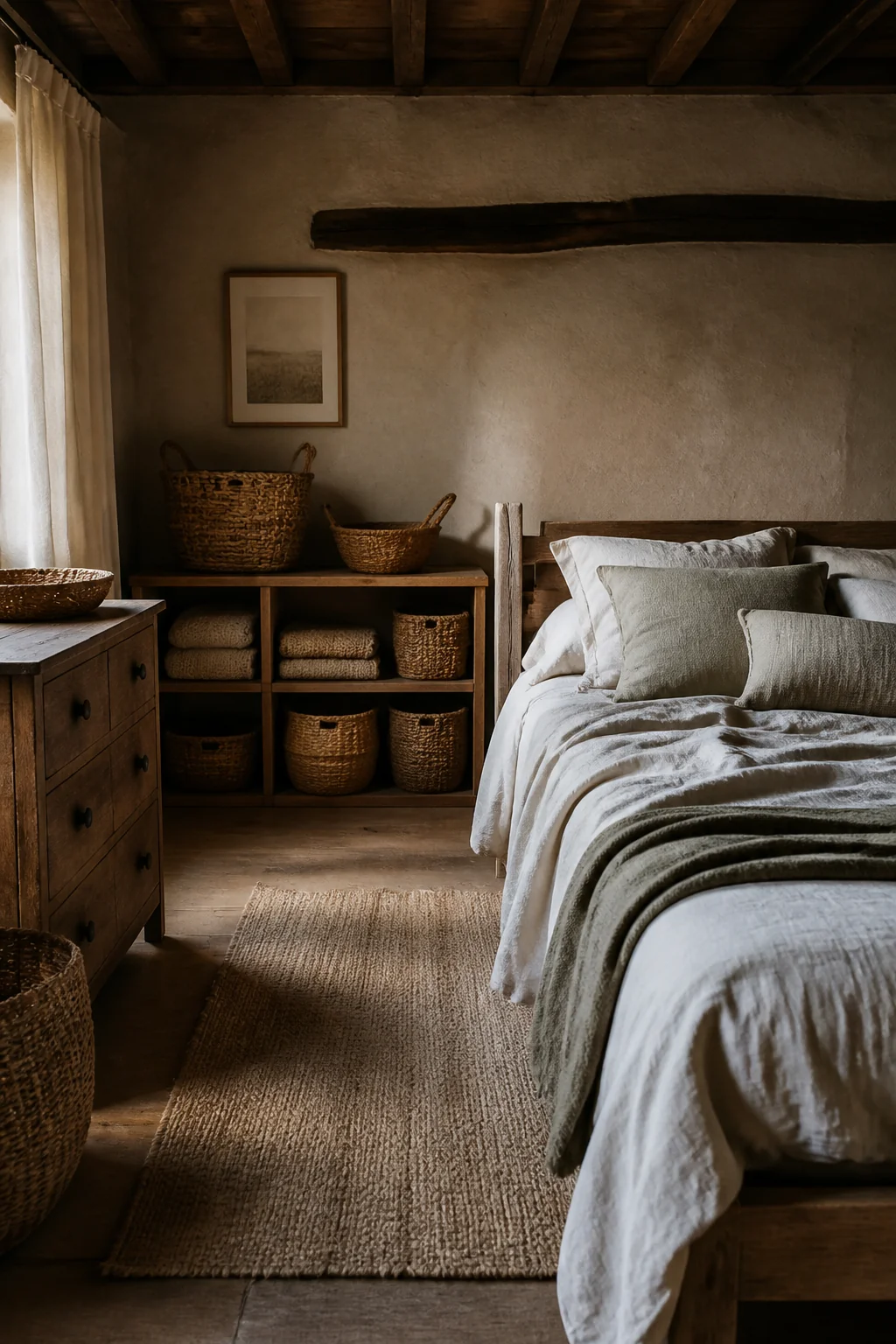 Baskets in jute, seagrass, or rattan absorb the storage a bedroom needs without adding another cabinet, and a large one runs $40 to $120. Size them to the job rather than to the gap. A basket 16 to 18 inches across and 14 to 16 inches tall swallows a folded queen duvet; a 12 inch one is right for throws, magazines, or a rolled yoga mat. Measure the space first, whether that's under a floating shelf or beside the nightstand, and leave a couple of inches of clearance so you can lift it out one-handed. The materials behave differently, which matters more than the look. Seagrass is stiff and holds its shape when empty, jute slumps the moment it isn't full, and rattan keeps structure but goes brittle and cracks if it sits next to a radiator all winter. An unlined weave snags fine knits, so line one with an old pillowcase if it's holding sweaters. Give each basket a single job, or it becomes the place clutter goes to hide.
12. Incorporate a wooden ladder for blankets or as decor
Lean a wooden ladder against the wall and blanket storage stops needing a bulky chest at the foot of the bed. Five to six feet is the useful height, and $50 to $150 covers most of them, whether from a hardware store or a flea market stall. Set the feet 12 to 16 inches out from the baseboard so the lean is stable and the draped fabric hangs clear of the wall instead of dragging down it. Rungs spaced 10 to 12 inches apart let a folded quilt hang without brushing the one below. Two blankets is the sensible limit on a five foot ladder; a third turns the whole thing into a drying rack. Screw a small L bracket or a strap into the top rail if the floor is slick or a child uses the room, because a leaning ladder walks forward every time something is pulled off it. One caution on genuine vintage orchard ladders: paint from before 1978 may contain lead, so seal it under a clear coat rather than sanding it indoors.
13. Display botanical or nature prints in simple frames
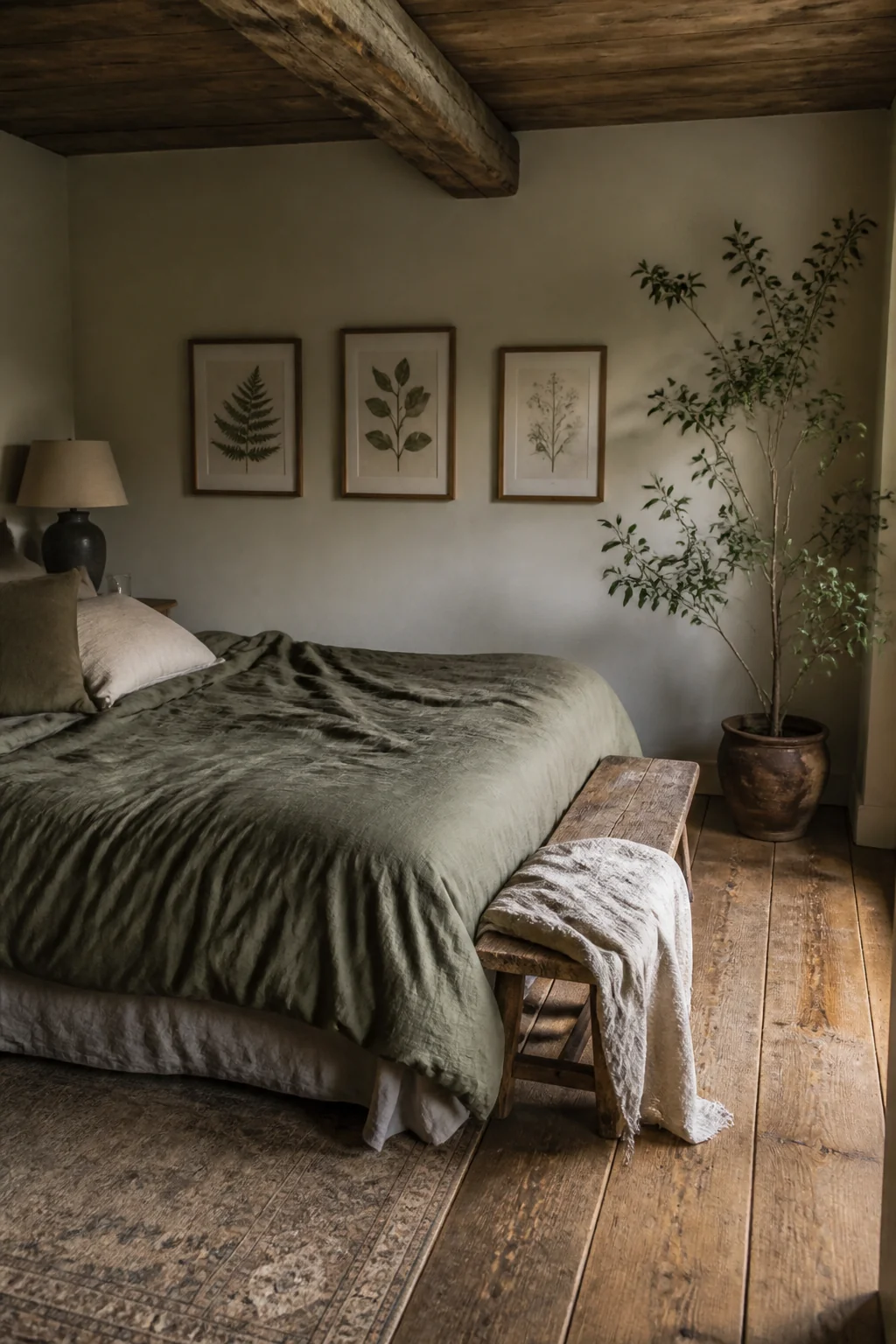 Framed botanicals bring the outdoors in without committing to a feature wall. Prints run $15 to $40 and simple wood or thin metal frames add $20 to $50 each, so a group of five lands somewhere near $200 all in. Hang three to five as a single block with 2 to 3 inches between frames, and work the sizes backward from where the middle of the block will sit, 57 to 60 inches up from the floor, the band that reads correctly whether you're sitting on the bed or standing at the dresser. Measure from that line down to the dresser top before you order anything, because the gap you find is what decides whether you're buying five 8 by 10s or three 16 by 20s. Keep the group narrower than the dresser or headboard beneath it, or the prints stop belonging to the furniture. Matting is what separates a framed print from a poster. An 8 by 10 print with a 2 to 3 inch mat inside an 11 by 14 frame gives the image room to breathe. Ask for matte cotton rag paper over glossy stock, since glossy throws glare from a bedside lamp at exactly the angle you'll be reading from. Mixing frame widths across one group reads accidental rather than collected.
14. Layer in vintage textiles like quilts or woven throws
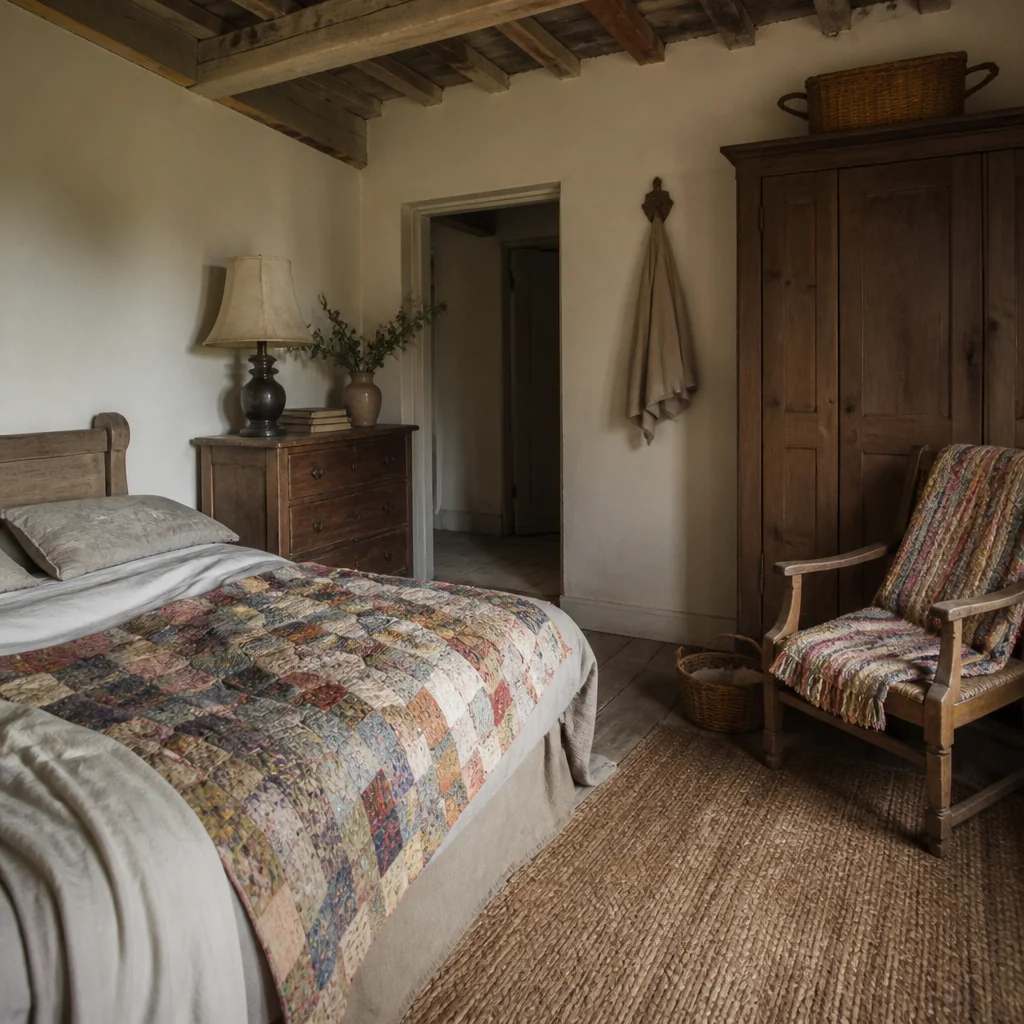 Handwoven blankets, old quilts, and market textiles carry color and wear that nothing new can fake, and they run $40 to $200 depending on age and condition. Fold one across the foot of the bed, where a queen needs roughly 60 to 70 inches of width to look deliberate rather than dropped, or drape another over a chair back. Inspect carefully before buying: hold the piece up to a window to find thin spots where the batting has migrated, check the binding for fraying, and trust your nose about mildew, which almost never washes out. Cleaning is where good finds get destroyed. A cotton quilt wants a cold soak in the bathtub with a mild detergent and then drying flat on a sheet, because a top-loader agitator tears old stitching and a washing line stretches wet fabric out of square. Wool takes a cool hand wash with wool detergent, or a dry clean. Keep either out of direct afternoon sun, which fades old dyes unevenly within a single season.
The whole guide in one image
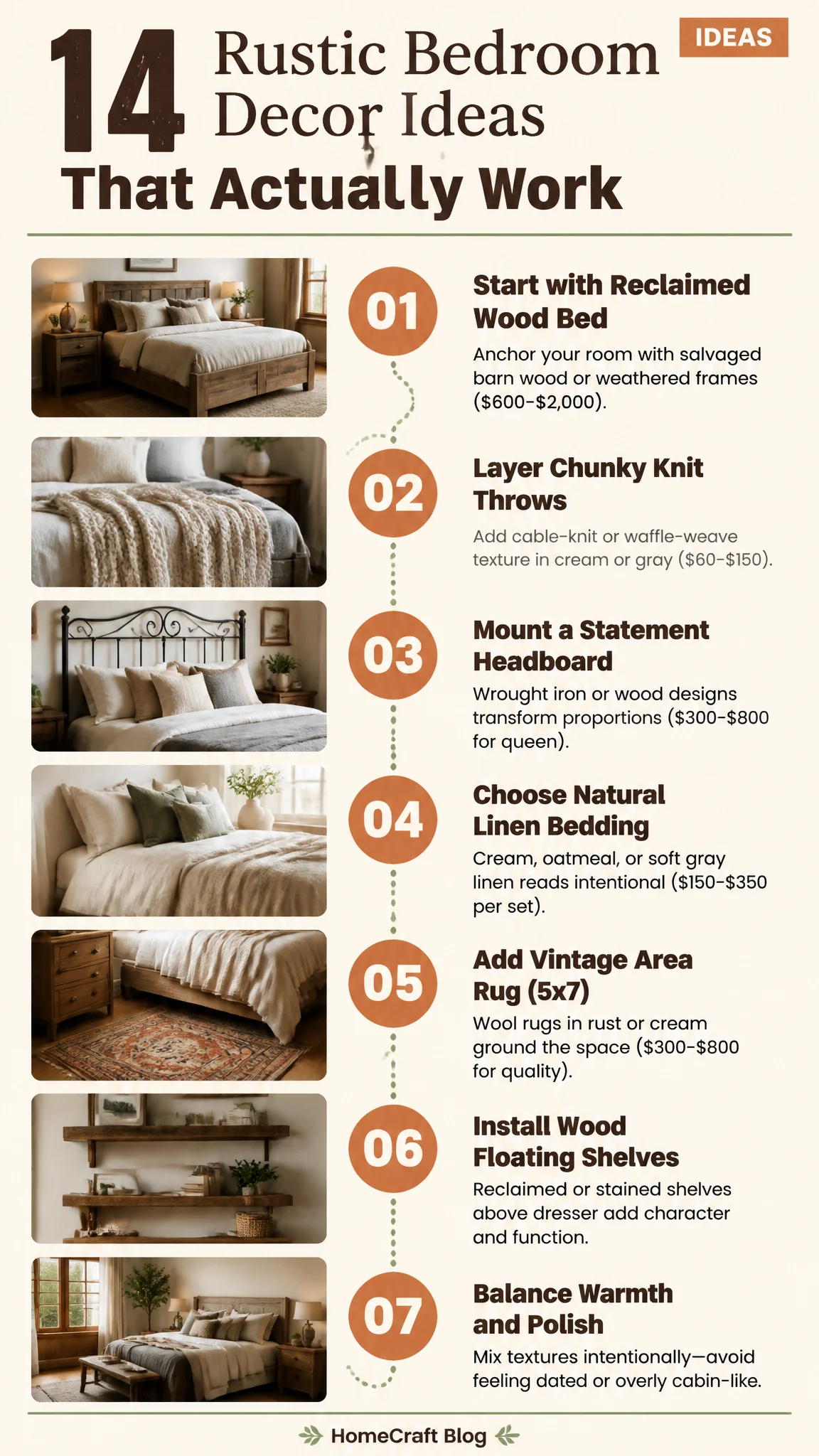
The order matters more here than the list does. A frame, the bedding, and the lighting carry most of the room, and everything after that is layering onto a base that already works. Buying all fourteen at once is how a bedroom ends up looking like a themed set rather than somewhere a person sleeps, and the pieces worth having tend to turn up on their own schedule anyway.