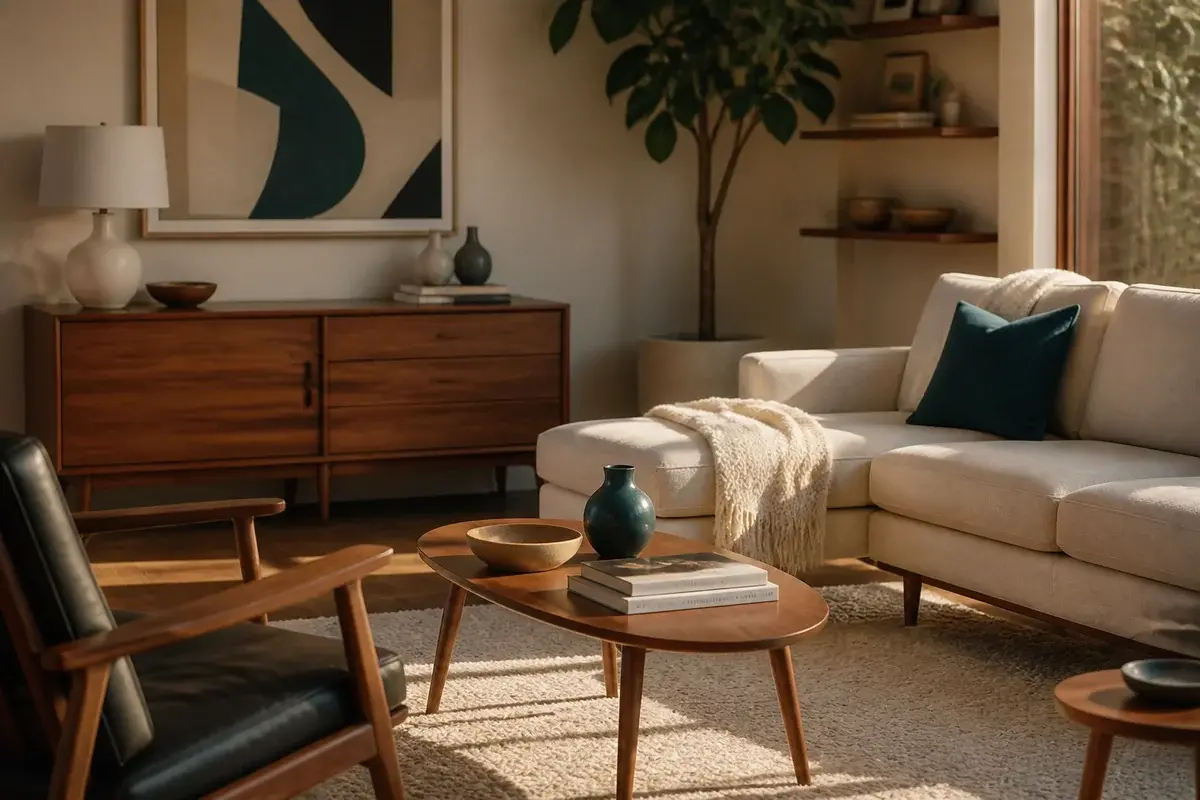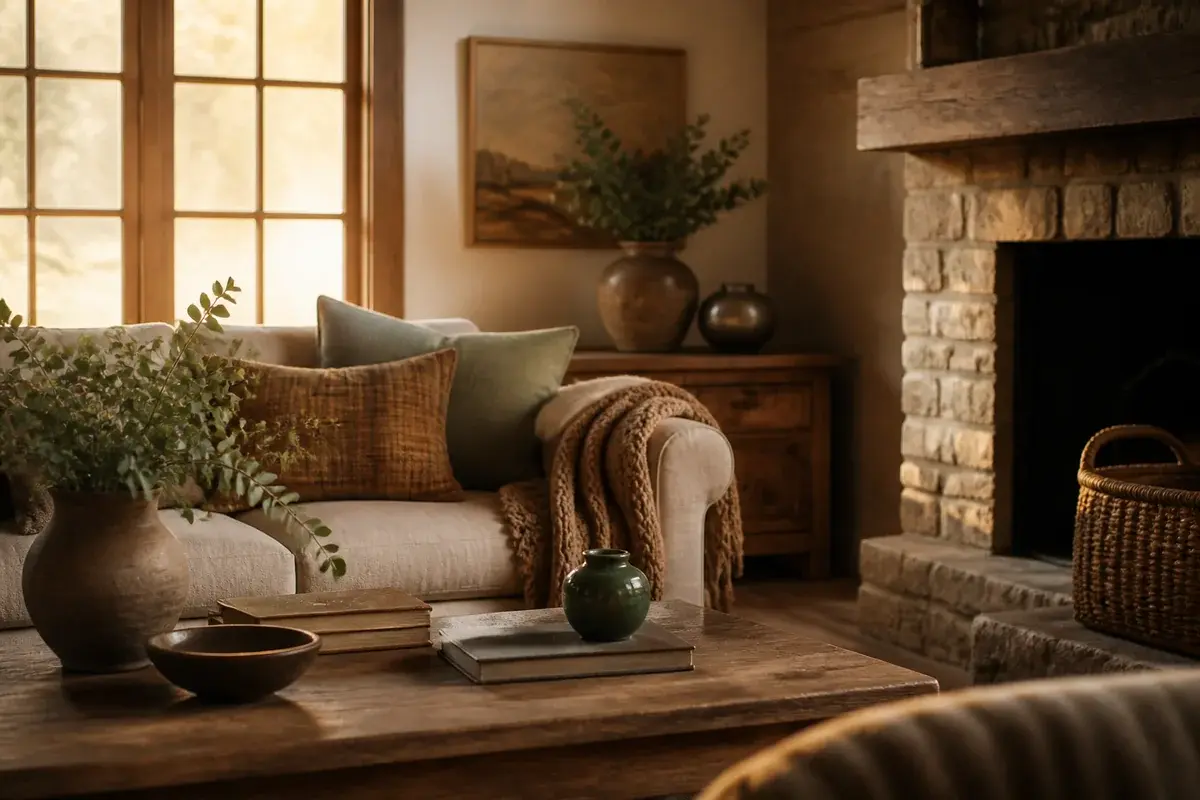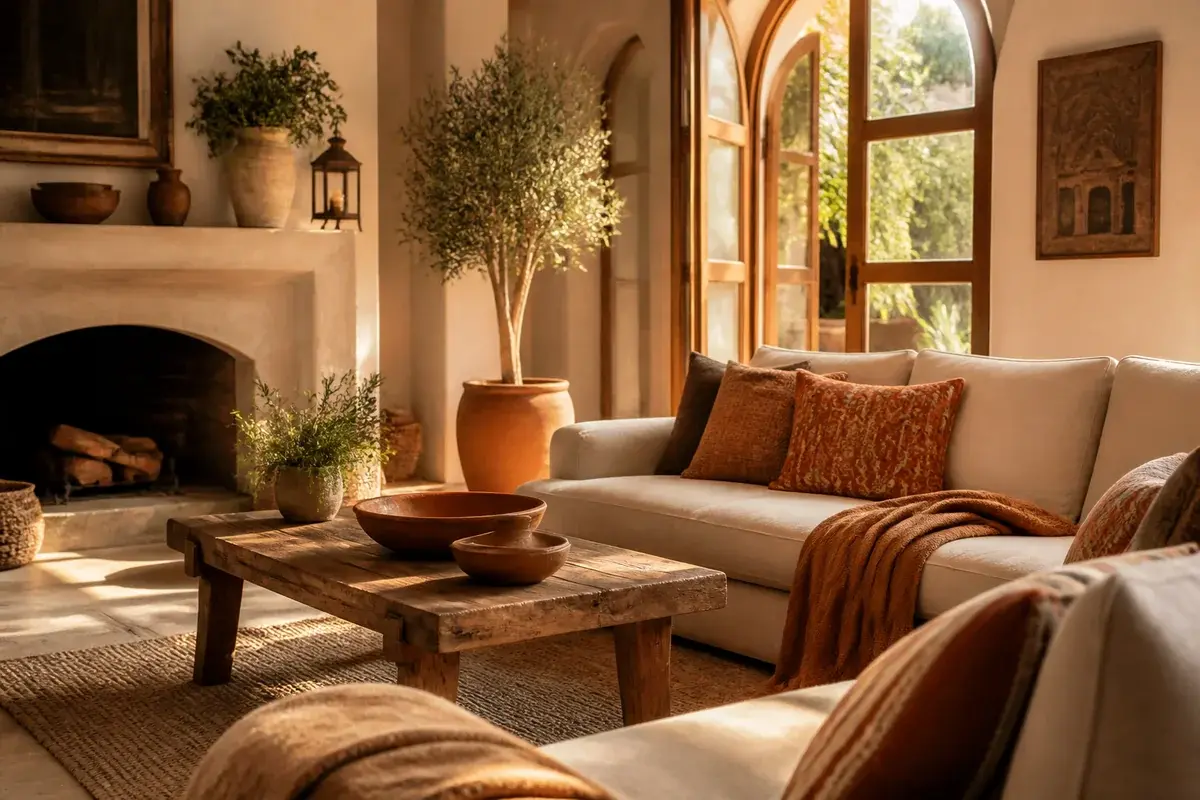
How to Get That Coastal Living Room Look for Under $900
Coastal living room decor ideas with real prices and measurements: warm off-white paint, a jute rug, linen panels and 2700K lighting that add up to about $850.
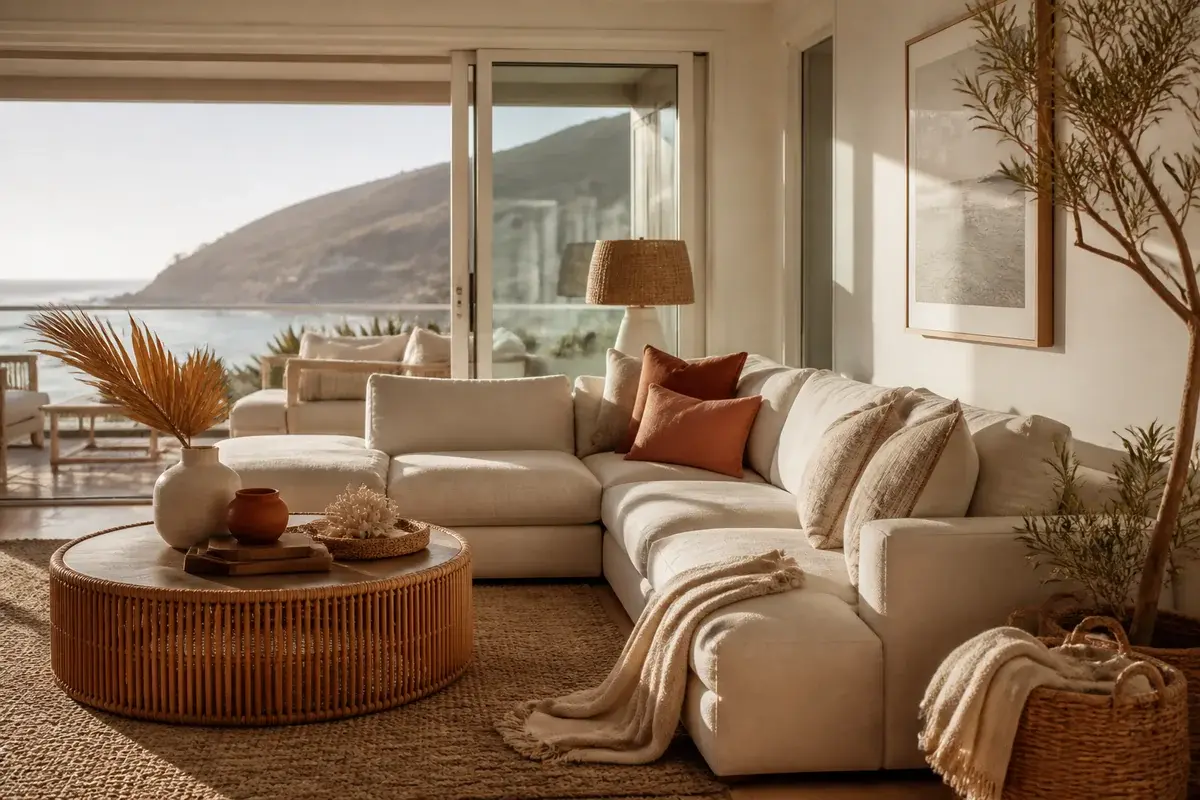
Coastal style gets sold with a beach-house price tag: bleached oak floors, custom built-ins, a linen sofa that costs more than a used car. Almost none of that is where the feeling comes from. Four cheap things carry the look: a warm off-white on the walls, natural fiber underfoot, light fabric at the windows, and bulbs that aren't blue. Everything after that is decoration.
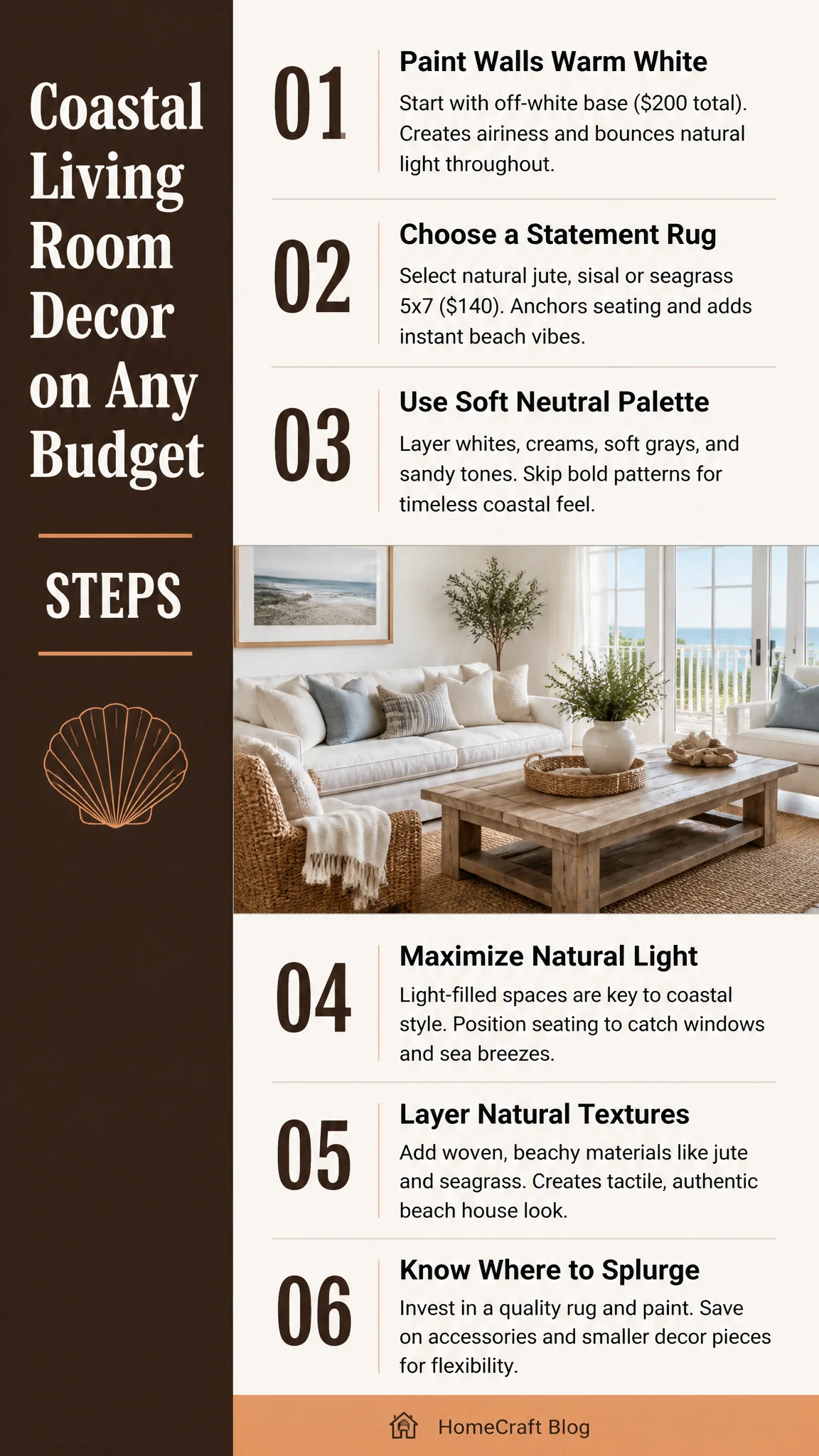
The seven moves below add up to roughly $850 at big-box and mid-range home store prices, so treat that as a planning number rather than a quote. What matters more than the total is the order. Paint first, then the rug, then the lighting, then the small stuff. Do it backwards and you'll buy accessories twice, once to match walls you haven't chosen yet and again after you paint.
Start With White and Soft Neutrals as Your Base
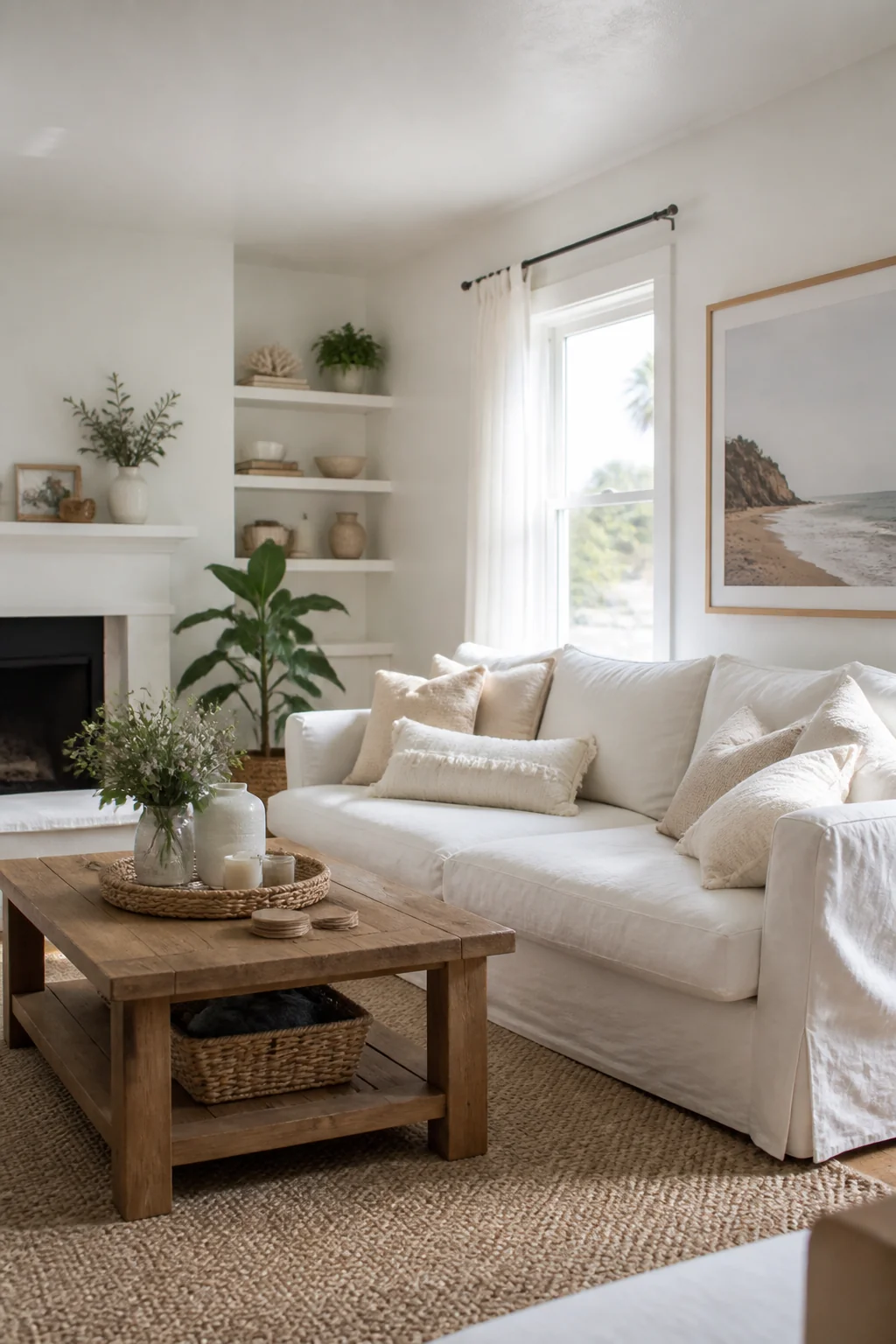
The cheapest way to make a room read coastal is color restraint. Whites, creams, soft grays and warm sandy tones do the heavy lifting, and every other color in the room is a small accent sitting on top of them.
Walls come first. Four walls add up faster than a floor plan suggests: a 12 by 14 foot room with 8 foot ceilings puts about 400 square feet of surface in front of you, and one coat drains most of a gallon's 350 to 400 square foot reach, so plan on two gallons, plus a gallon of primer if you're covering anything dark or glossy. That runs about $120 in paint and $80 in supplies: a roller frame, two 3/8 inch nap covers, a 2.5 inch angled sash brush, tape and a drop cloth. Choose eggshell over flat, because eggshell wipes clean where hands and furniture meet the wall.
Pick warm, not crisp. A cool "designer white" reads gray or faintly blue in a north-facing room and pulls the sand tones out of everything else you buy. Get two sample pots, paint a piece of poster board about 12 by 12 inches with each, prop them against the wall, and look at them in morning light and again under your lamps at night before you commit.
If you rent and can't paint, neutral peel-and-stick wallpaper runs $35 to $45 a roll, and floor-length cotton panels hung wall to wall will quiet a bad wall color without you touching it.
Find Your Statement Rug
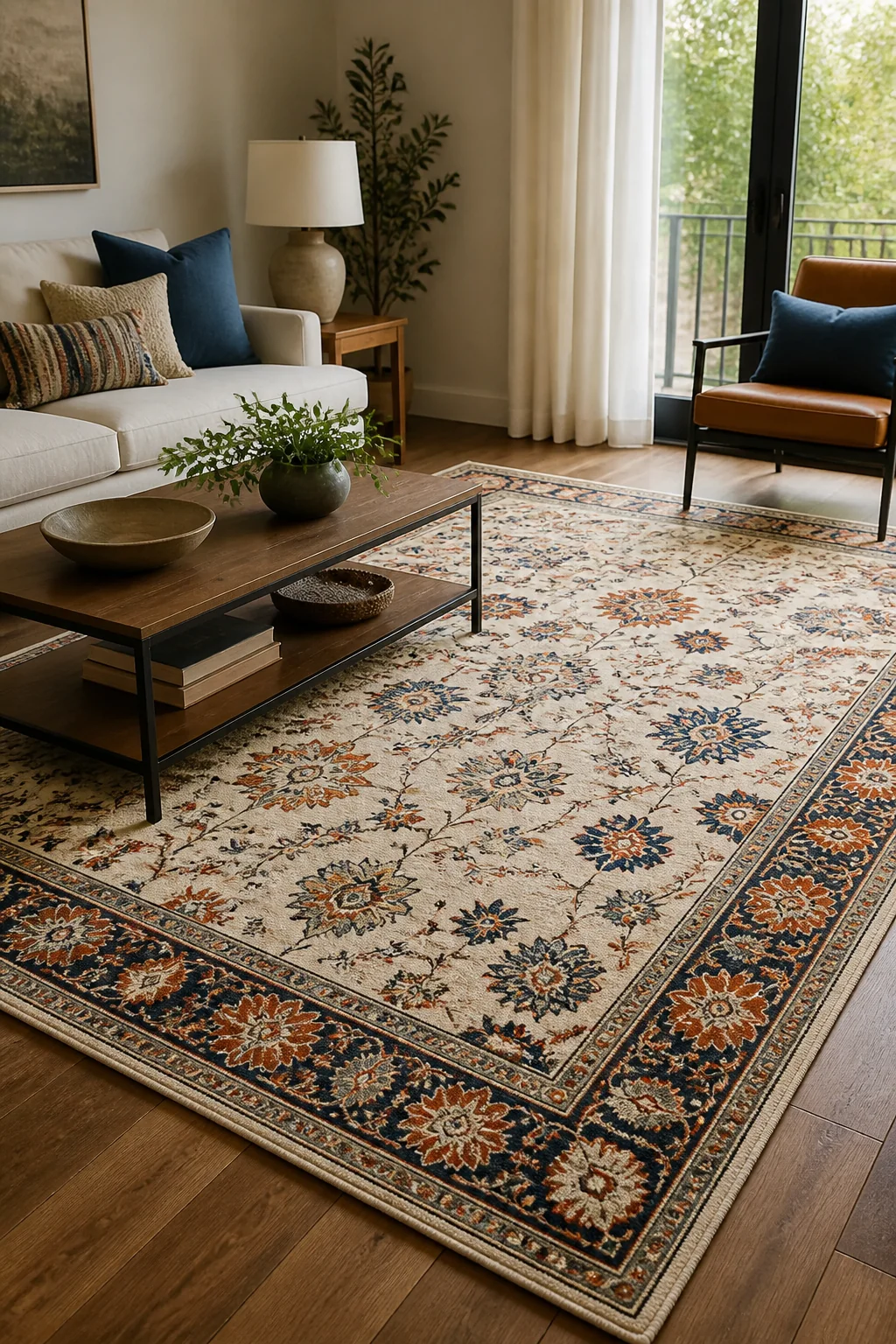
Size it before you shop, because the wrong size is the expensive mistake here. The rug needs to sit under the front legs of every seating piece, so push the sofa and chairs where they'll live, measure the outside edges, and add 12 to 18 inches all around. An 84 inch sofa with two chairs almost always lands on an 8 by 10, not a 5 by 7. A 5 by 7 is right when the sofa is the only large piece in the room, and a natural jute that size runs about $90 to $180. Step up to 8 by 10 and you're at $250 to $400.
Jute gives you the sandy, woven texture people read as coastal on sight, and it's the cheapest route to it. It's also scratchy under bare feet, it sheds for the first month or two, and it can't be wet cleaned, so a knocked-over glass of red wine is permanent. Sisal is flatter and tougher but harsher to sit on. Seagrass has a faint sheen, shrugs off stains better, and won't take dye, which is why it only ever comes in its own greenish tan.
Budget another $40 to $60 for a quarter-inch felt-and-rubber pad. Without one the rug creeps and grinds grit into the floor underneath. Skip bold patterns. Stay with natural textures, whites, grays and warm tans. If jute is too rough where you actually put your feet, layer a 4 by 6 cotton flatweave on top for softness and a little quiet color.
Light the Room in Layers, Not From the Ceiling
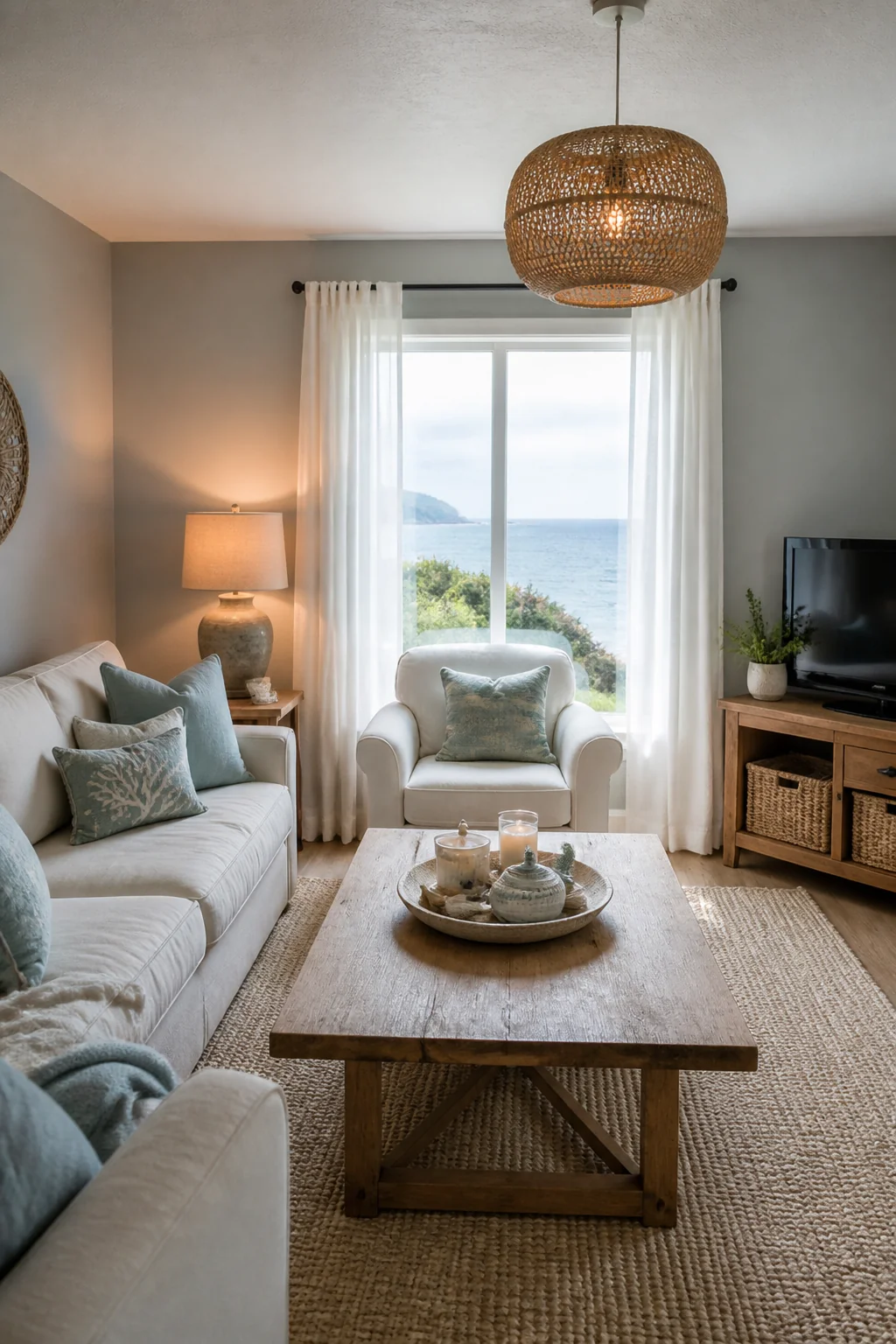
One ceiling fixture doing all the work is what makes a room feel like a rental at 7pm. You want three sources going: something overhead, a pair of table lamps at seated height, and one low light for the evening.
A simple pendant or flush mount runs about $45 at a mid-range store. If it hangs anywhere you walk, keep the bottom of the shade at least 7 feet off the floor. The table lamps do more for the mood than the ceiling ever will. Aim for the top of the shade to land 58 to 64 inches from the floor, which a 26 to 28 inch lamp on a standard 24 inch end table hits almost exactly. Two at roughly $60 each flank a sofa nicely.
Then the part nobody budgets for: the bulbs. Use 2700K, around 800 lumens (the 60-watt equivalent), with a CRI of 90 or better. Anything at 4000K and up turns your warm off-white walls a flat gray and undoes the paint decision you just made. Fabric shades in linen or off-white diffuse the light; black or metallic-lined shades throw it downward like a spotlight instead.
Dimmers cost $15 to $25 each and earn it, but buy one rated for LED. A standard incandescent dimmer paired with LED bulbs gives you flicker and a faint buzz at the low end of the dial.
Bring in Natural Textures Without Overspending
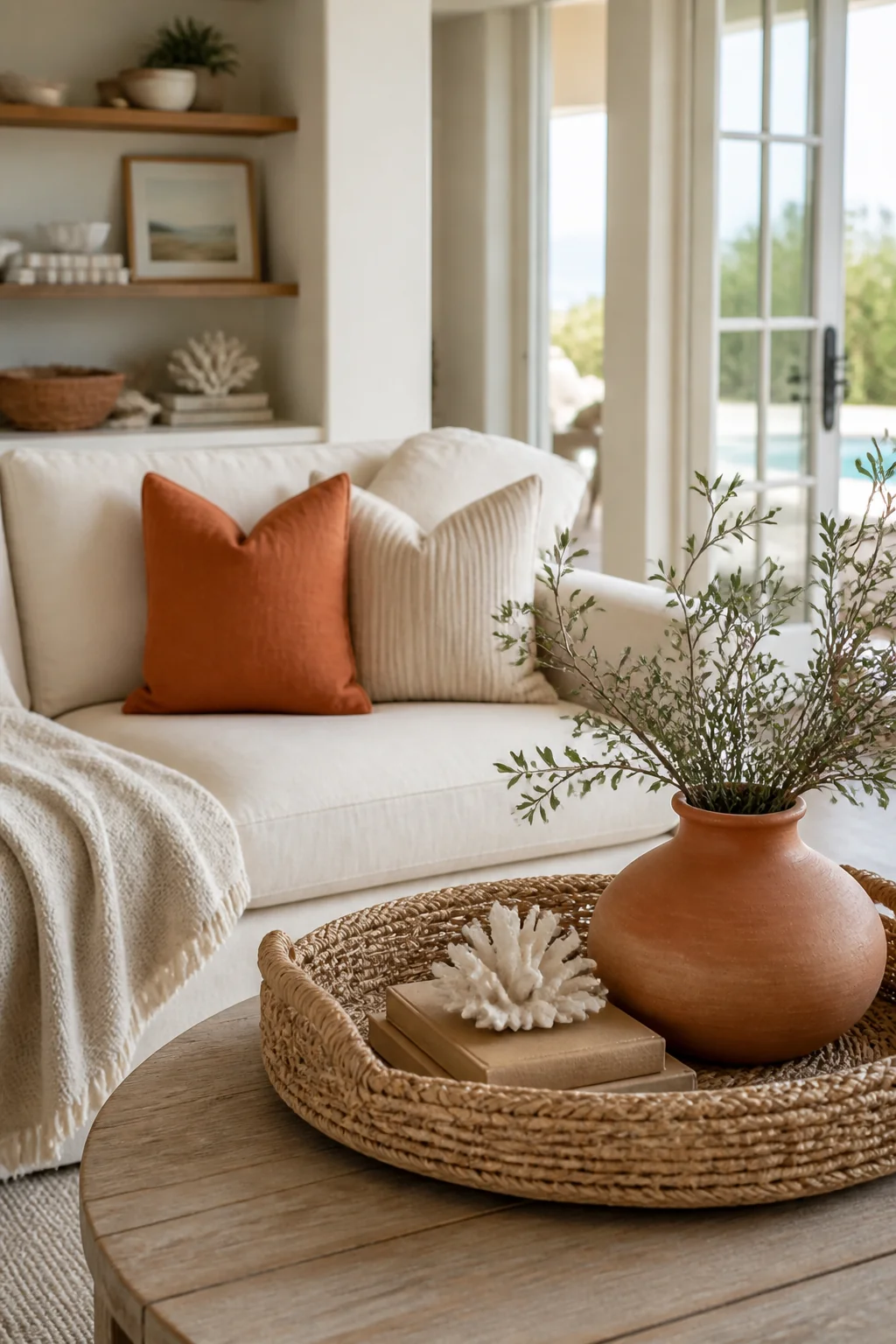
This is the cheap, enjoyable part, because the materials are already good-looking before anyone does anything to them. Three woven baskets run about $35 total at a home goods outlet, and they earn their keep holding throw blankets, remotes and the drift of charging cables. A side table in weathered wood sits around $70.
Check the shelf before you buy the basket. A floating shelf needs to be 8 to 10 inches deep to hold a standard storage basket without it hanging off the front lip, and a 24 inch shelf takes two small ones side by side with room to breathe.
Know what you're actually buying. Seagrass is stiff and holds its shape under weight. Water hyacinth is softer, paler and dents more easily. Abaca is the finest weave and the priciest. On furniture, look for solid wood or a wire-brushed veneer; printed woodgrain laminate chips at the corners within a year and shows the particleboard underneath.
Two cautions. Natural fiber baskets will mildew in a damp room, so keep them off a cold exterior wall and away from anything that stays humid. And repeat each material at least twice across the room. Seven different weaves in one sightline stops looking collected and starts looking like a basket display. Thrift stores and Facebook Marketplace beat full-price retail here, and older pieces tend to have better proportions anyway.
Accessorize With Coastal Elements That Tell a Story
This is where the money quietly leaks: anything sold with the label "coastal decor" attached. Rope-wrapped mirrors, nautical signs, decorative oars, a plaque with a wave on it. They read as gift shop, not beach house, and they're the first thing a visitor's eye lands on.
A handful of real pieces does more work for less. A chunk of driftwood at a local shop is around $15, a plain white ceramic vase about $12, and a pair of framed botanical or ocean prints roughly $25 each. Prints, not originals.
Hang them properly or you've wasted the money. A blank wall invites you to fill the top of it, and art placed to balance the wall ends up above the people looking at it, so take the height off a standing sightline instead and the center lands 57 to 60 inches up. Over a sofa there's a second pull: a narrow piece above a wide frame looks stranded, and width is the cure, roughly two thirds of the sofa, dropped to within 8 to 10 inches of the back cushions so the two read as one arrangement rather than a picture floating on its own.
Be honest about your light before you buy plants. A snake plant or ZZ plant will sit happily in a north-facing corner for years. The olive tree everyone wants needs something like six hours of direct sun and will shed leaves steadily in a dim living room until it's a bare stick in a pot. And if you're filling a glass vessel with shells, check the local rules before you collect: plenty of state and national park beaches prohibit taking them.
Curtains That Feel Light and Breezy
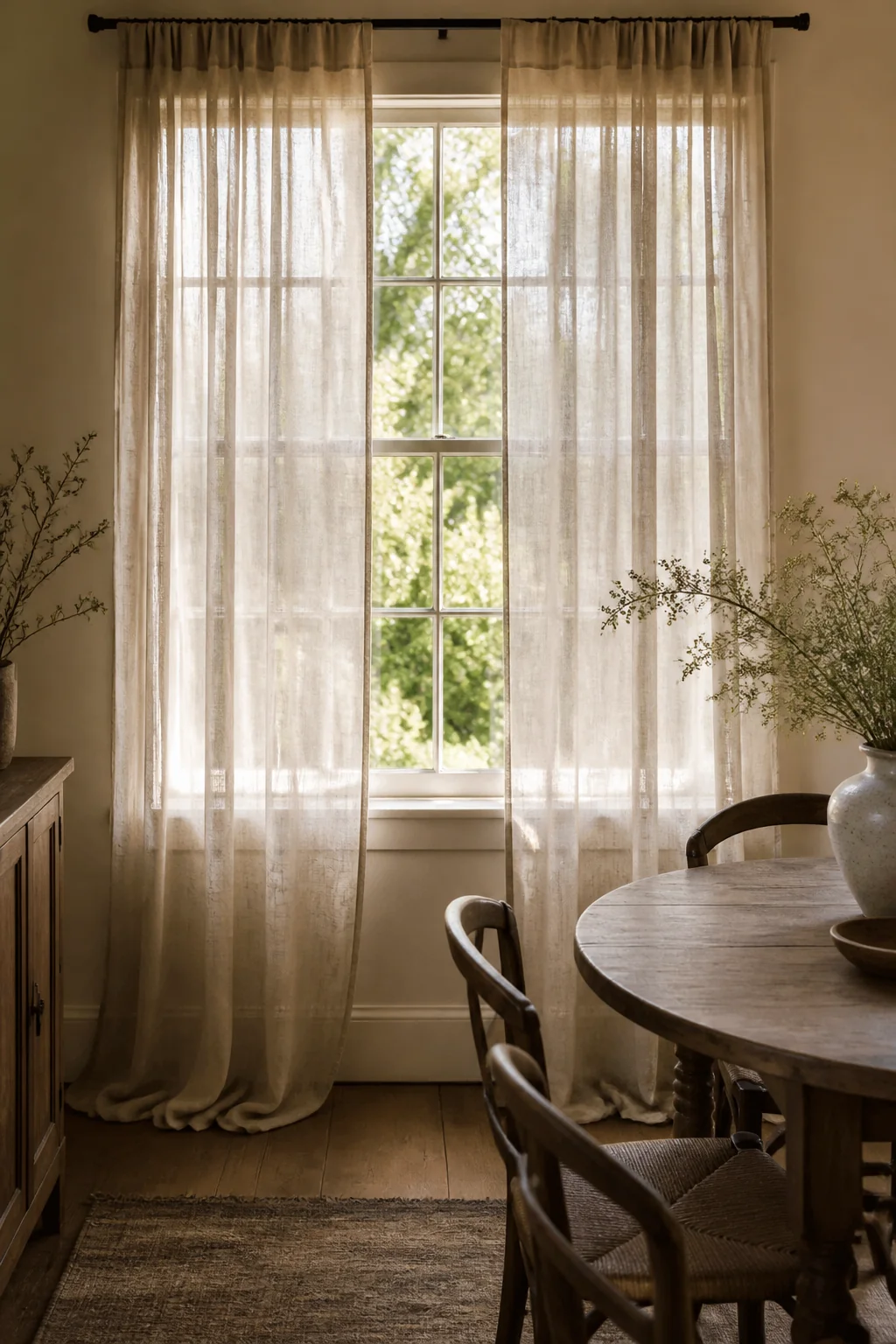
Heavy, dark drapes are the enemy of this look. You want fabric that moves in a breeze and filters daylight instead of blocking it.
Linen panels run about $60 a pair at an affordable home store, and that slightly rumpled surface is exactly the texture that reads coastal. The catch is fullness, and it's where most curtains go wrong. Your combined panel width should be two to two and a half times the width of the window, so a 36 inch window wants roughly 90 to 100 inches of fabric across it. Two skimpy panels hung flat with no folds are the single most common reason curtains look cheap, regardless of what you paid.
An open curtain has to go somewhere, and if the rod stops at the casing then somewhere is your window. Give it 8 to 12 inches of overhang on each side and lift it 4 to 6 inches above the frame, or up to the midpoint between casing and ceiling on a tall wall, and the daylight comes back. For length, half an inch off the floor gives a clean line; two inches of puddle looks softer but collects dust.
One trade-off worth knowing: pure linen relaxes and sags a little in humidity and shrinks if you wash it warm, so a cotton-linen blend is the more forgiving choice near the coast or in a basement-level room. Off-white with a whisper of gray beats bright white. Natural wood or matte white rods, simple rings, nothing shiny.
Use Color Sparingly and Intentionally
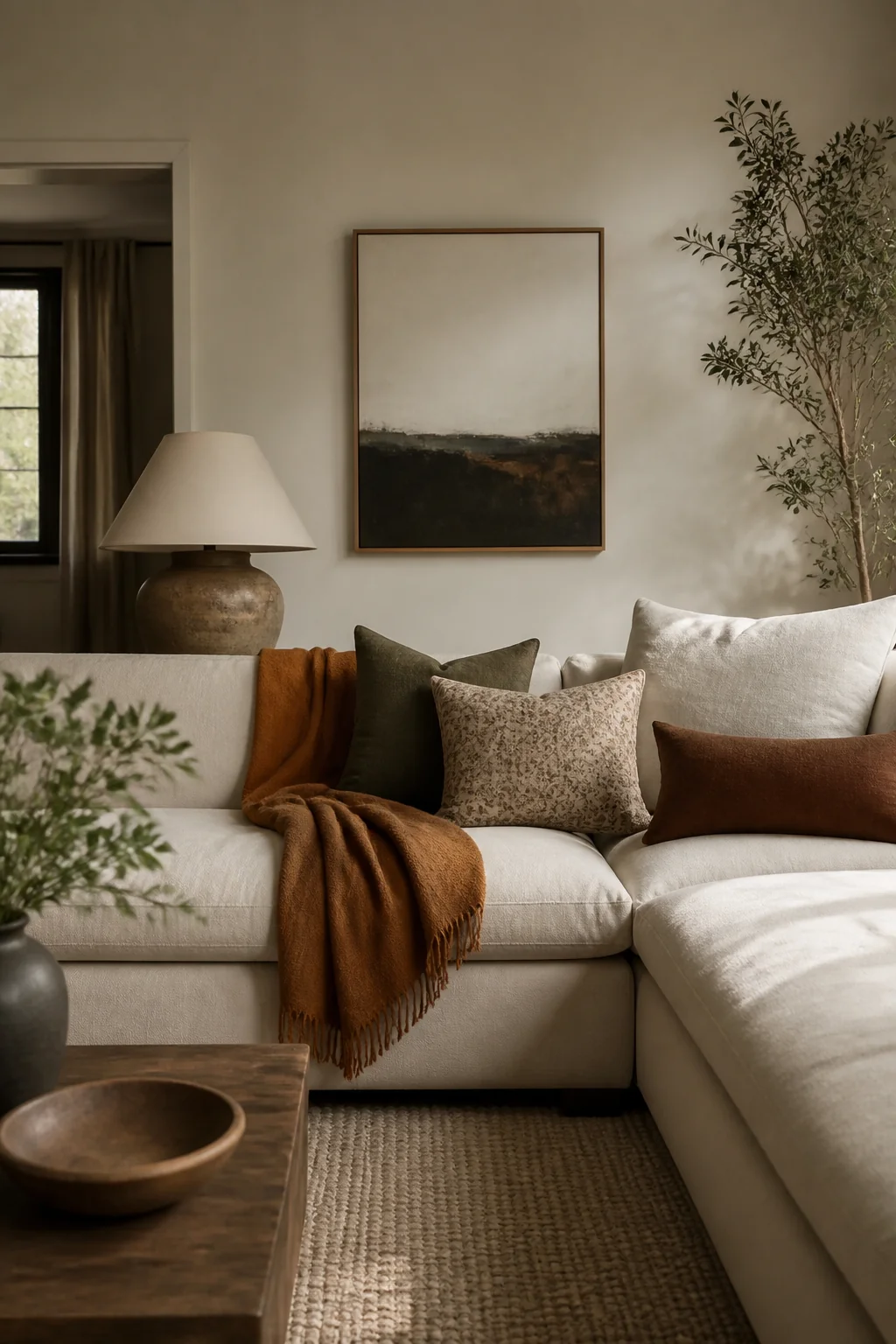
Coastal color is not turquoise, coral and navy everywhere. It's a mostly neutral room with a few small things that look like they wandered in from outside: a pillow in soft blue, one piece of art with ocean tones, maybe a lamp base in warm terracotta.
Four throw pillows in cream, soft blue and sandy tan run about $50 as a set, and one piece of subtle ocean-toned art around $30. That's the entire color budget for the room, and it's enough.
If your pillows look sad and flat, the cover is rarely the problem. Fill holds a shape only while it's under a little compression, and it gets that from an insert bigger than the cover around it, so a 20 inch insert goes in an 18 inch cover, and $15 to $20 each on feather-down beats the $8 polyester. Polyester fill compresses permanently after a few months and won't fluff back no matter how you karate-chop it.
Cap the color count on purpose: two accent colors, each repeated in at least two places so they look chosen rather than left over. And if you're eyeing a turquoise accent wall, sit with it a while first. A saturated wall pulls every other surface in the room toward it, the calm goes, and repainting costs you another $60 and a weekend. A $20 pillow lets you change your mind for free.
Pin this for later
The rooms that miss this look are almost never the ones that spent too little. They're the ones bought in a single afternoon, where nothing has any relationship to anything else. Get the walls and the rug settled, live with them a couple of weeks, and the room will be fairly specific about what it still needs.
Ideas fade by Friday. A plan finishes the room.
You just read a full guide to your living room. Saving ideas will not change it; a plan will. The Home Decor Collection is every planning tool we make, for every room in the house, in one download, so the after photos below stop being other people's rooms.
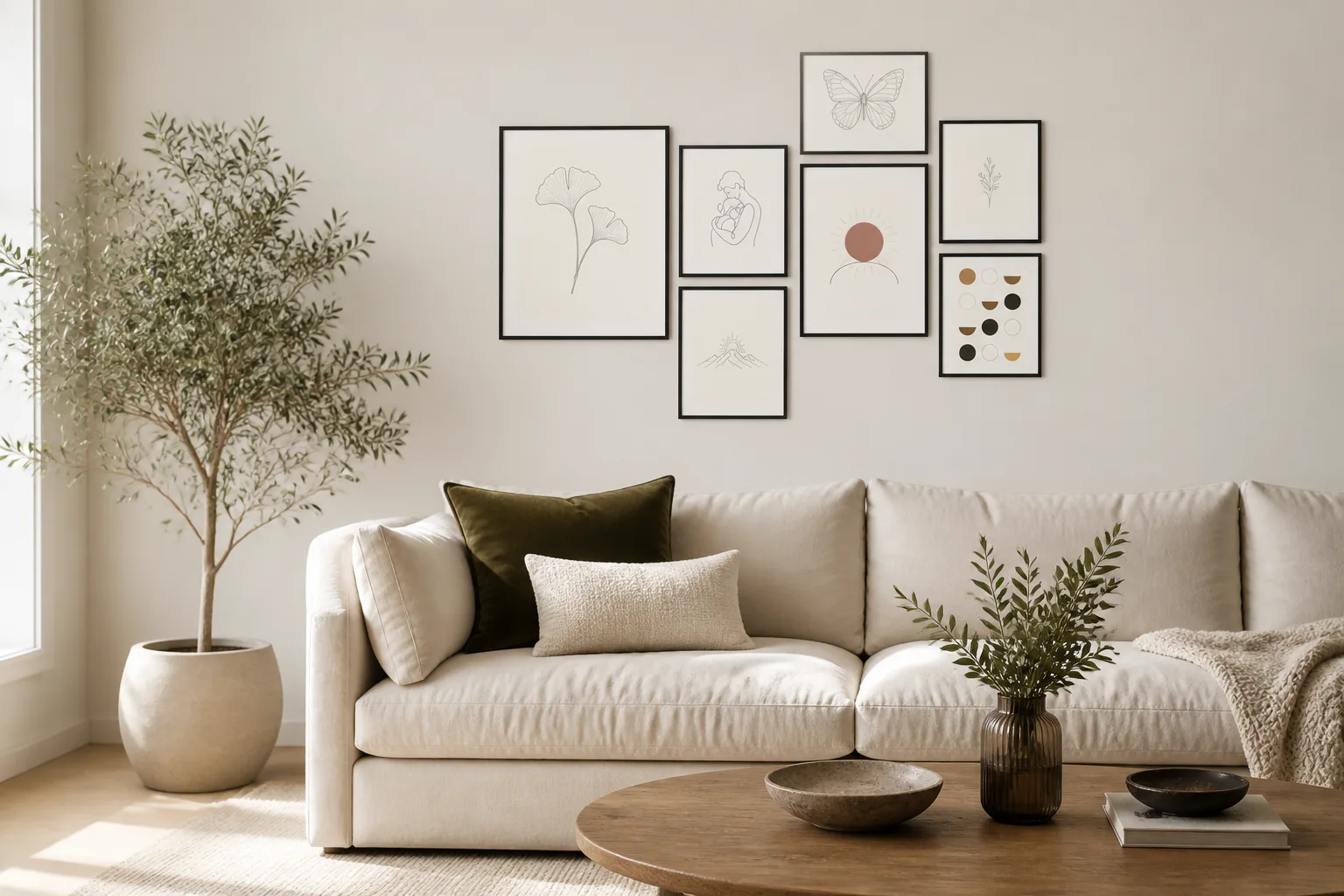
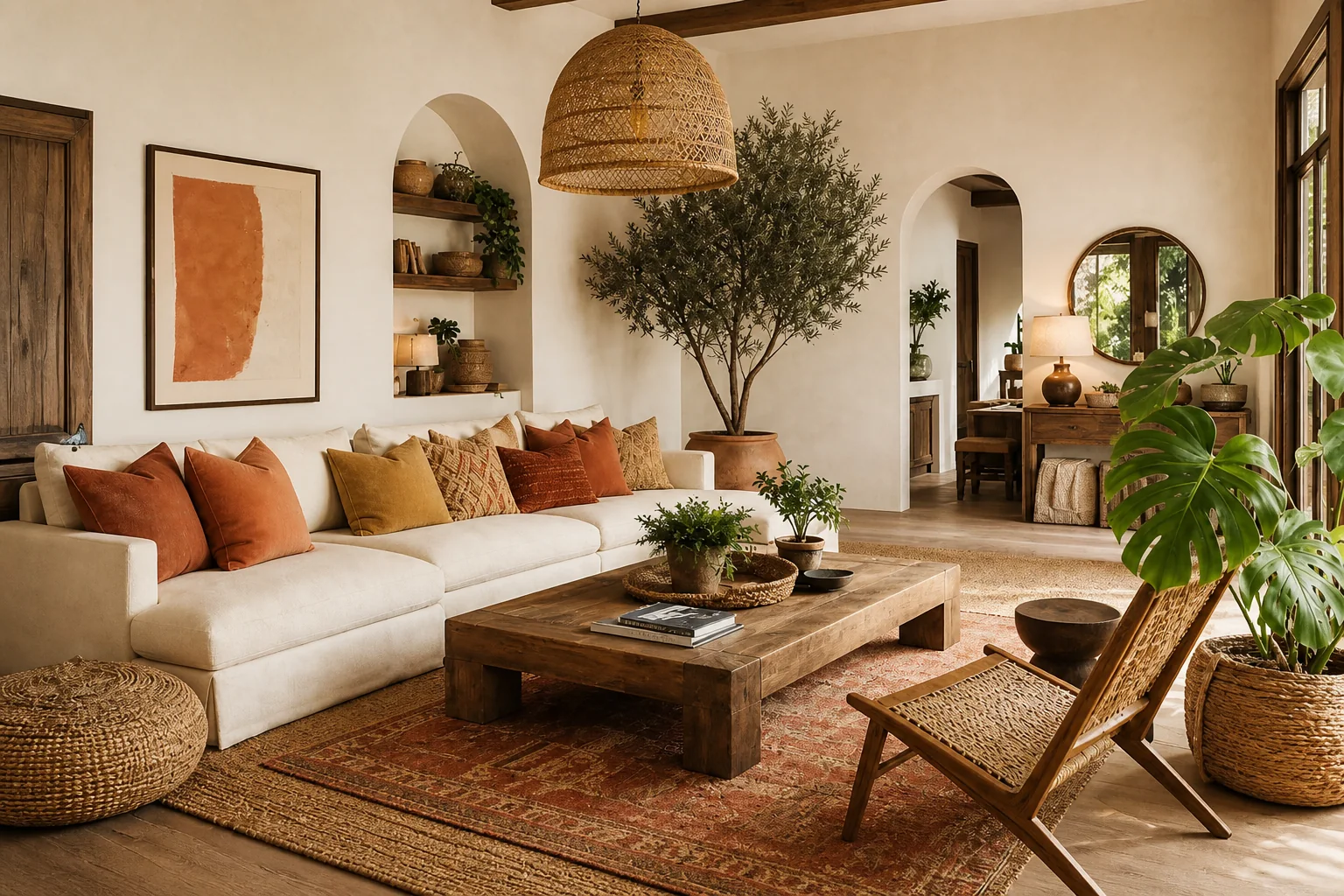
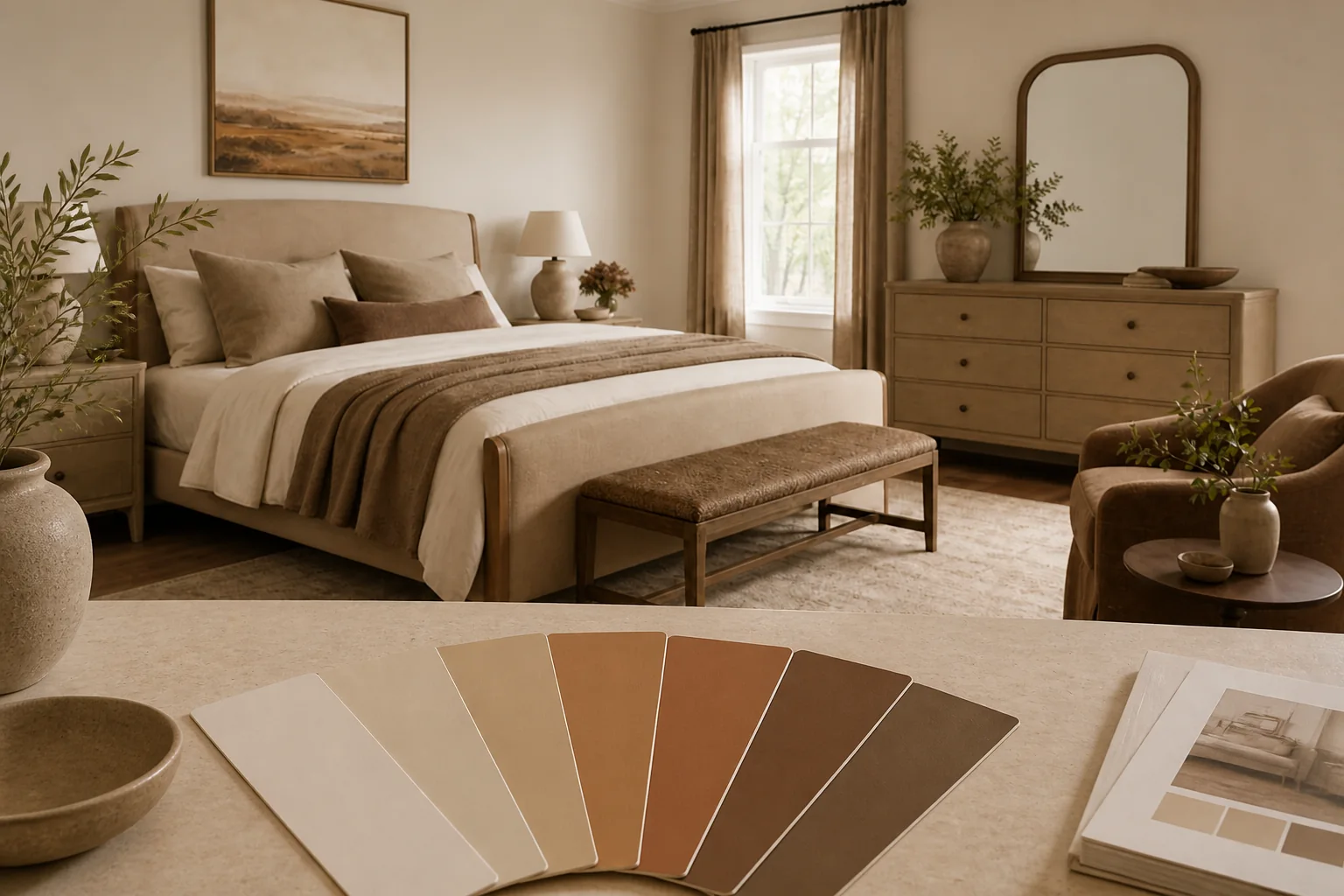
- Six room Style Kits, each with layout, palette and shopping list$114
- The Gallery Wall Studio: 200 prints + 15 measured layouts$29
- The Room Makeover System: 40 solved room layouts + workbook$29
- The Color Palette Handbook: 60 palettes shown in real rooms$19
- The Whole-Home Reset: 40 printable organizing checklists$19
- The Decorator's Cheat Sheets: the 40 measurements that matter$9
- All eleven products, bought separately
$219$97
A single hour with an interior designer costs more than the entire Collection, and this one keeps answering for every room you will ever decorate. Free updates included as the products grow. And if it is not for you, the 14 day money back promise means you simply get a refund.