How to Get the Mid-Century Modern Living Room Look Step by Step
Mid-century modern living room ideas that work in a real room: furniture placement, color, lighting and the few pieces that matter most.
This post contains affiliate links. As an Amazon Associate I earn from qualifying purchases. If you buy through our links, we may earn a commission at no extra cost to you.
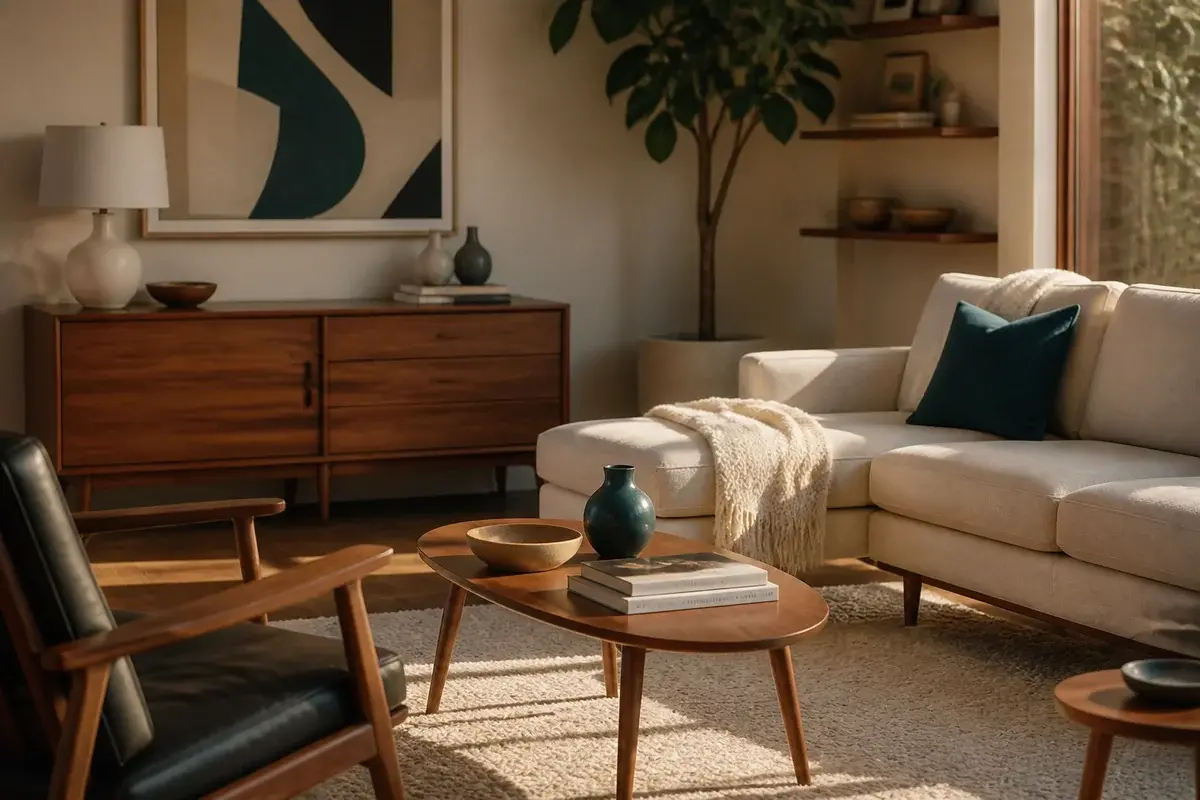
Most living rooms trying for mid-century modern end up feeling like a showroom or a parody of one. You've got the right chair, maybe the right credenza, but the room feels borrowed. Usually the furniture is fine and the room underneath is wrong: the walls, the layout, the sense of proportion. A Noguchi table dropped into that room won't carry it. The whole space has to follow mid-century rules: clean lines, intentional emptiness, and the confidence to leave things out.
Here's how to actually build that look, step by step.
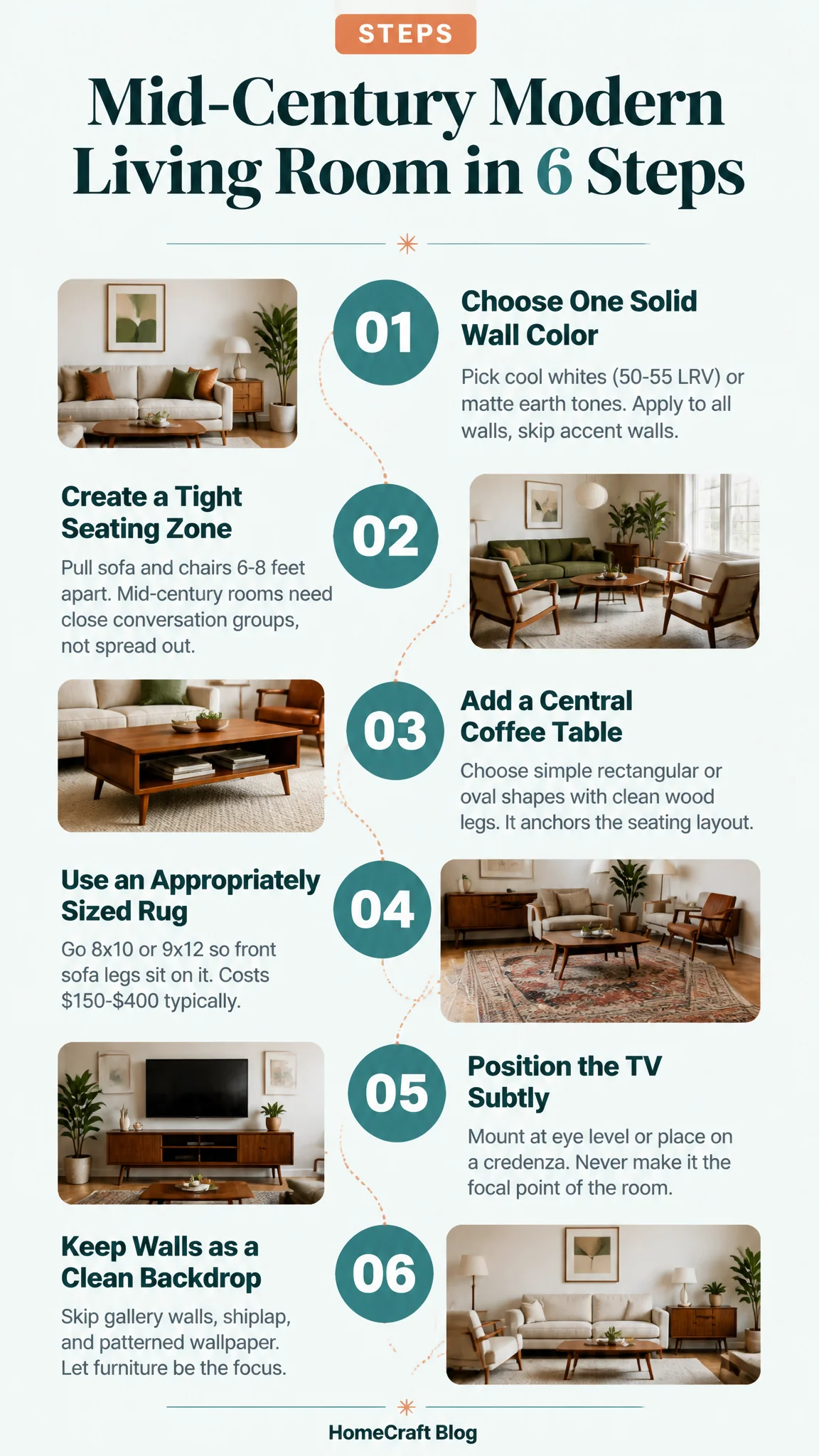
Start with your walls and leave them mostly alone
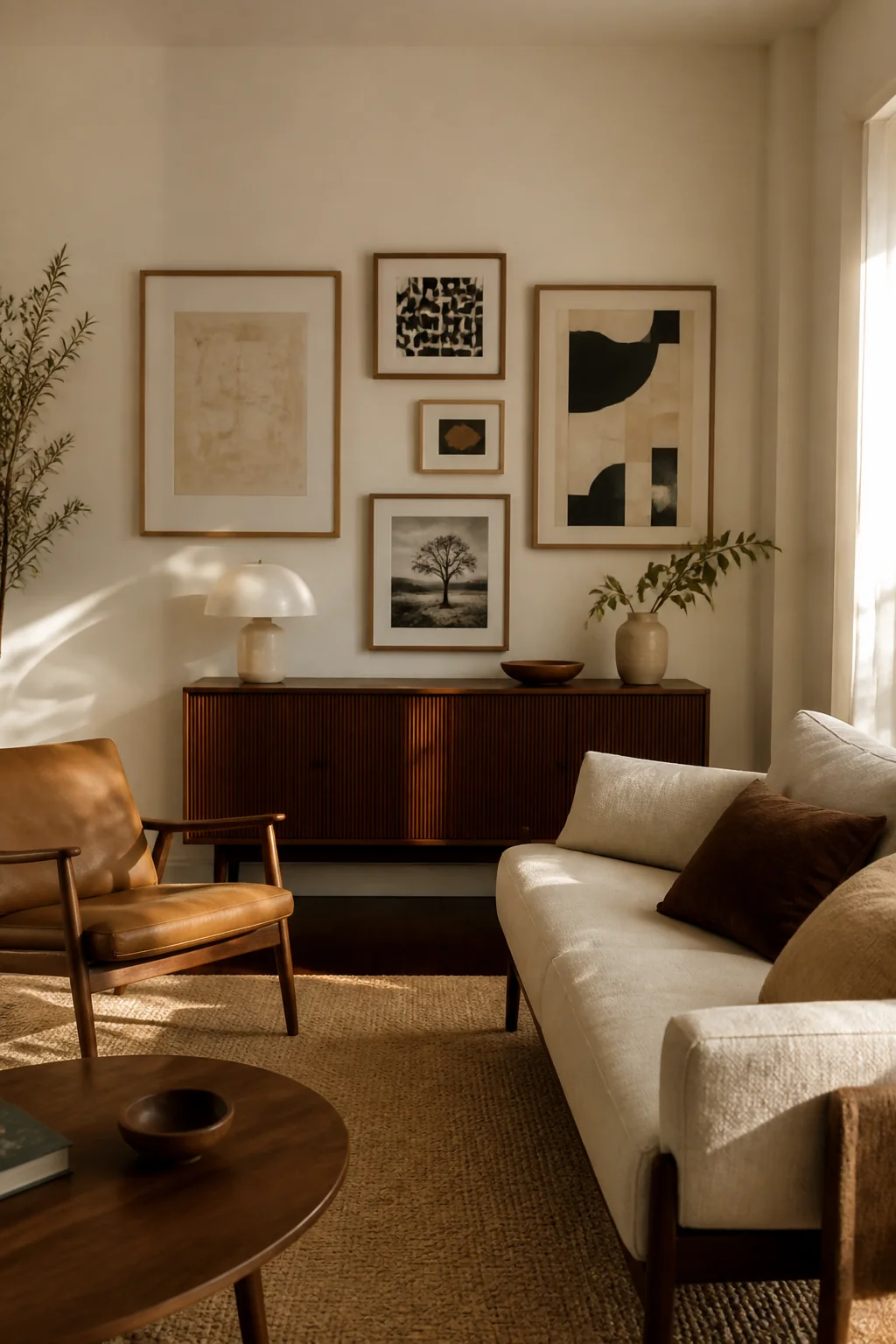
Mid-century rooms leave the walls plain, with no gallery walls or patterned wallpaper. Paint is usually one flat, solid color, white, soft gray, warm beige, or a deeper tone like sage or charcoal, often the same on all four walls.
The instinct that breaks it is treating a bare wall as a problem to solve. Up goes the shiplap, or one wall in navy, or ten frames in a grid. Mid-century design pulls focus down to the furniture and the absence of clutter, and the walls stay a backdrop.
Pick your wall color first. Buy sample pots, paint a two-foot square on two different walls, and look at it at 9am, at 3pm, and under your lamps at night. What reads clean in a north-facing room turns cold and blue in direct afternoon sun. Most mid-century spaces land in one of two camps: an off-white with a light reflectance value above 80, which stays bright without going clinical, or a matte earth tone down in the 20 to 35 range, which lets pale oak and walnut furniture read as the lightest thing in the room. Paint the walls in a flat or matte sheen, since eggshell and satin bounce light off every drywall imperfection and fight the calm you're after. Sample pots run about $8 to $12 each, and two of them cost far less than repainting a room you got wrong.
Furniture placement is the real structure
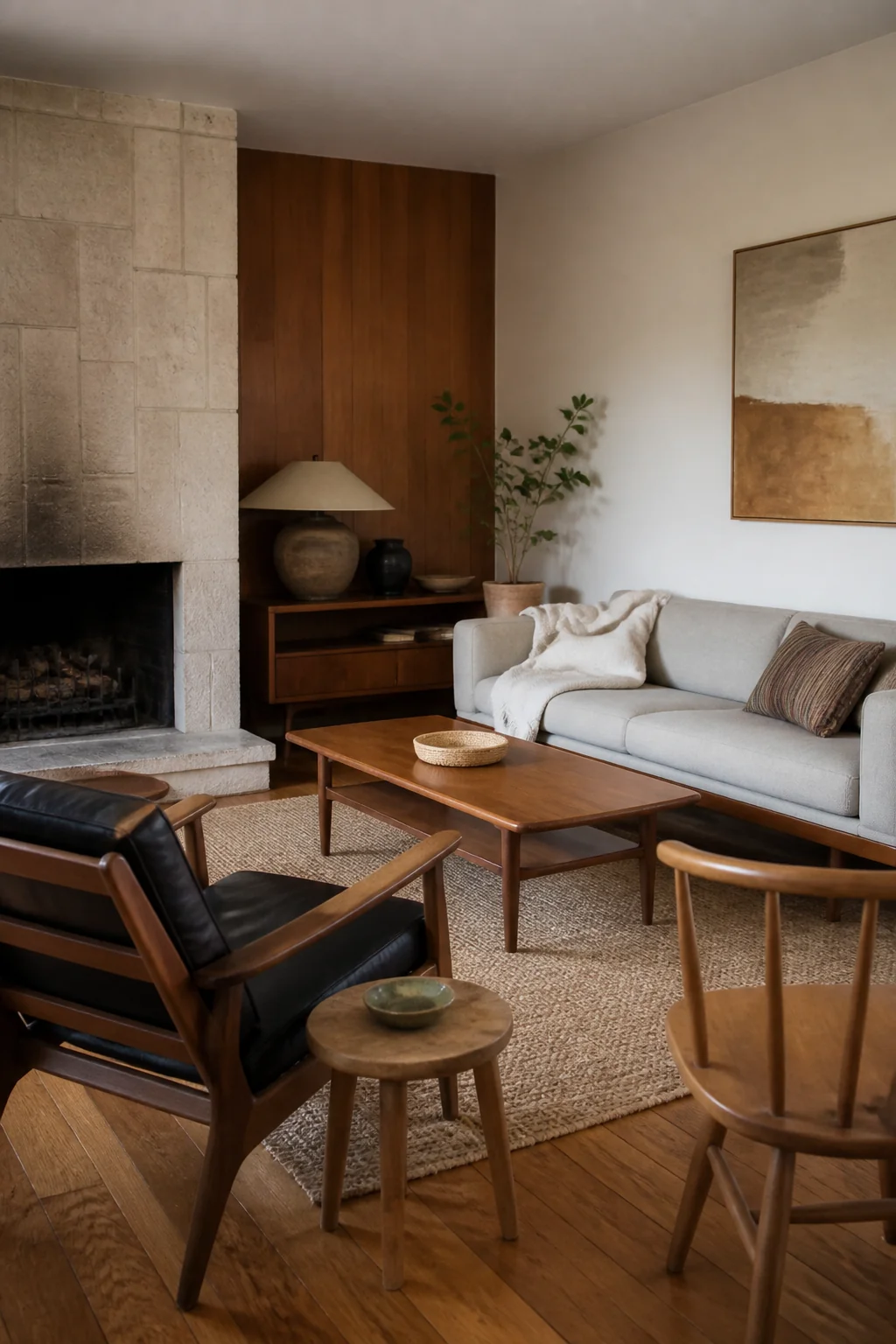
The room layout determines whether this works. Mid-century living rooms don't float furniture in the middle of the space or push everything against the walls. You're creating conversation zones - usually one main seating group, sometimes two if the room is large.
Pull your sofa and chairs closer than feels natural. In mid-century rooms, you're maybe 6 to 8 feet across between opposite seating, not the 12 feet people often think they need. A coffee table sits in the center of that group, usually a simple rectangular or oval shape (think wood legs, clean edges). The TV, if you have one, doesn't become the focal point. It lives on a credenza or mounted to a wall at eye level when seated, not the star of the show.
An area rug anchors the seating group. Size matters here: it should be large enough that the front legs of your sofa and chairs sit on it. For a standard living room, that's usually an 8x10 or 9x12 rug, about $150 to $400 depending on material. Wool holds up better than synthetic fibers because the fibers spring back under furniture legs instead of staying crushed. The rug color should tie back to your overall palette - neutral, earthy, or a soft accent tone.
Choose your core furniture, then stop
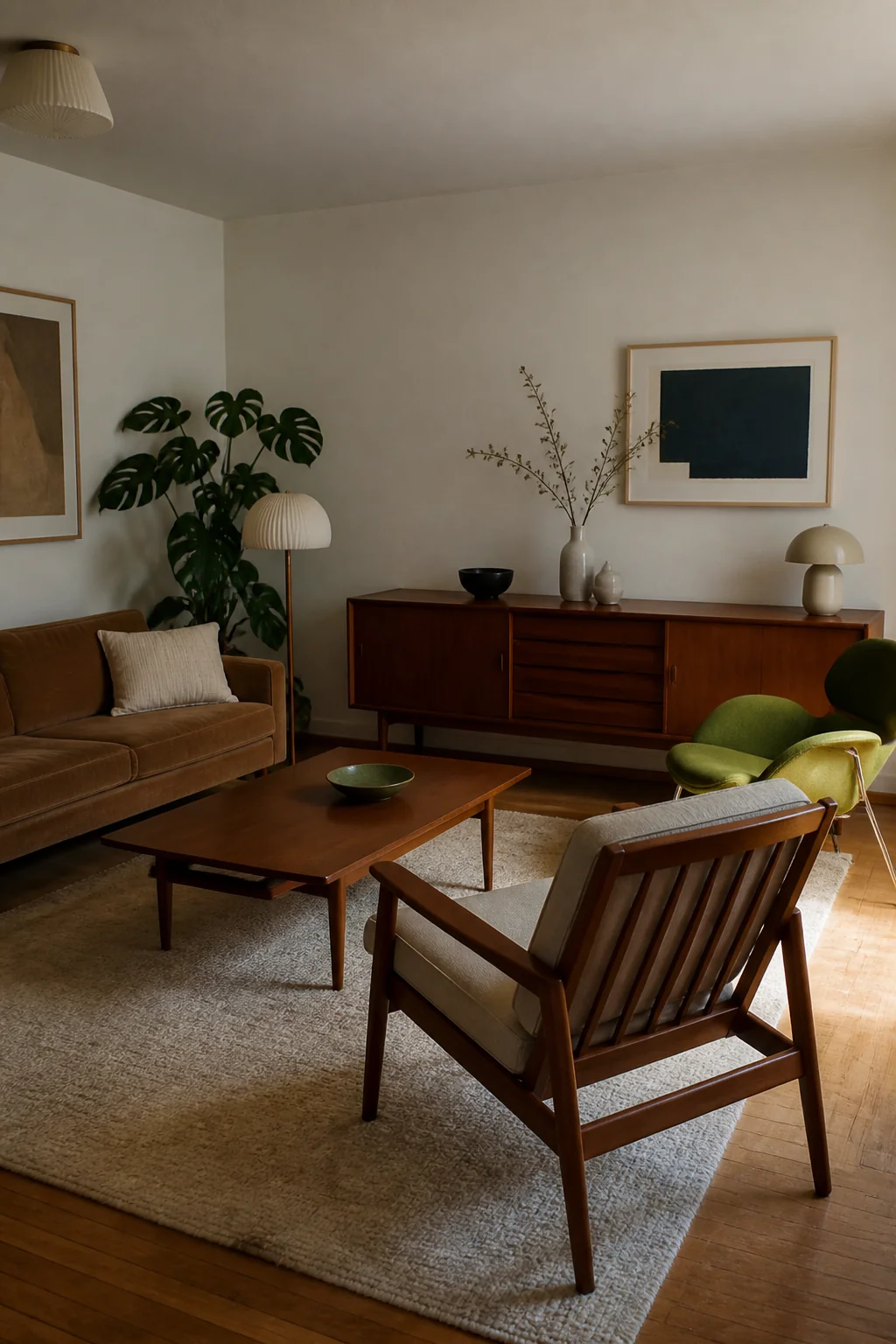
Mid-century isn't cluttered. You don't need six side tables and four accent chairs. Start with a sofa (ideally with clean legs and simple arms), two accent chairs, a coffee table, one credenza or console, and a TV stand if needed. That's your base. One or two side tables for lamps. Done.
Rooms that read as deliberately mid-century aren't full of stuff. They're edited, and every piece earns its footprint. The common instinct is to fill each corner with something functional or decorative, and that instinct is what quietly kills the look. Scale is the other half of it. A sofa in the 72 to 84 inch range suits most rooms; go wider and it swallows the wall it sits against. Keep the coffee table 16 to 18 inches high so it lands level with or just under the sofa seat, and leave 14 to 18 inches between the table edge and the sofa so you can pass through without turning sideways. A walnut or walnut-veneer credenza around 60 inches wide runs roughly $400 to $900 new, and secondhand ones are often better built for the same money.
Legs matter more than you'd think. Tapered wooden legs on your sofa, chairs, and tables are the visual signature of the era. Avoid chunky bases or fully upholstered pieces that sit low to the ground. The space under furniture should be visible. It makes the whole room feel lighter and more intentional.
Color comes through textiles and small pieces
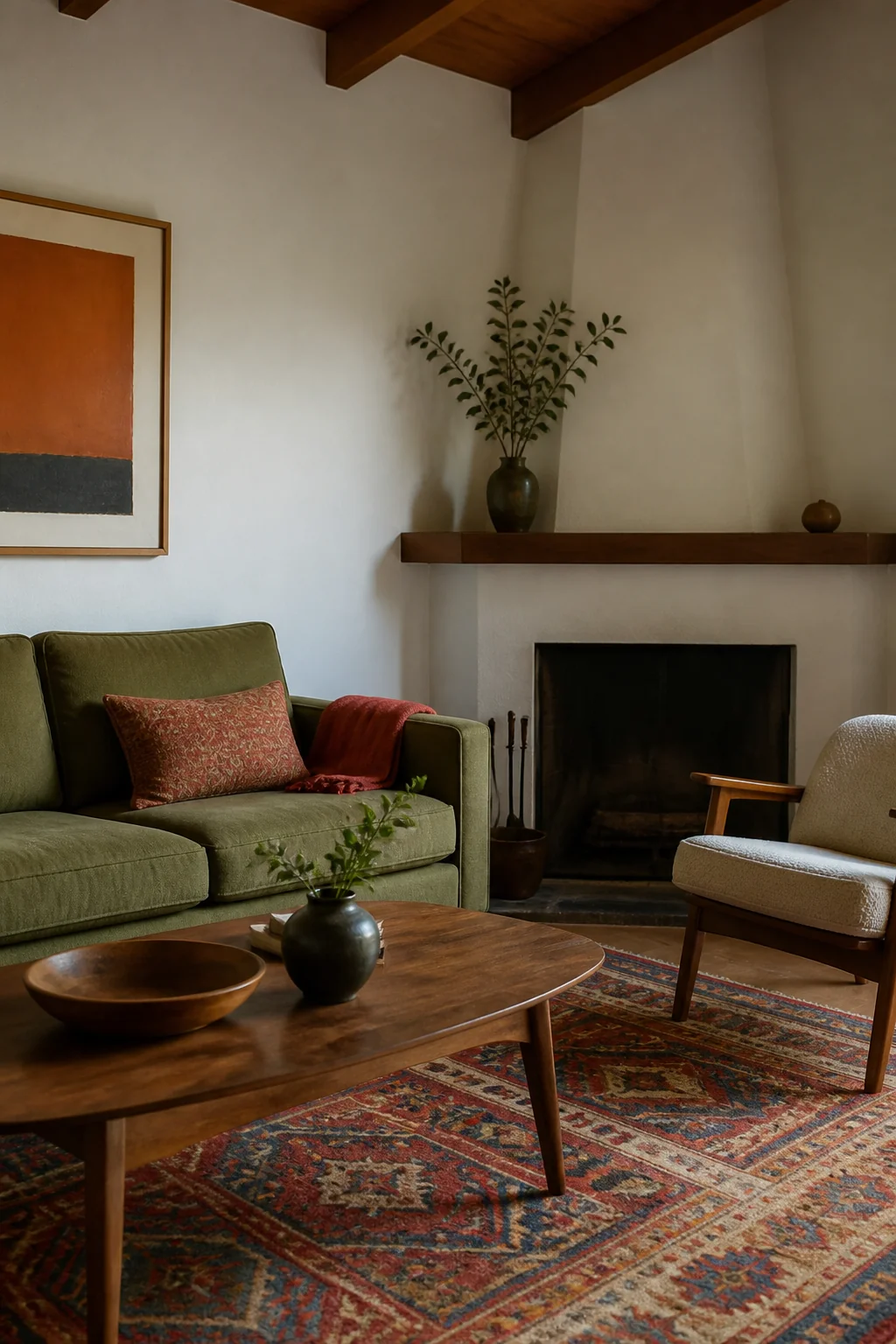
You're not painting the walls bold. You're not upholstering the sofa in hot pink. Color lives in a few strategic spots: a throw pillow in rust or mustard, a rug in muted green, a ceramic vase, a framed print.
This is the place where personality actually lives. Pick two or three accent colors that speak to you - warm terracotta, sage green, burnt orange, charcoal - and weave them through small items. A mid-century room with only white, gray, and wood looks sterile. One with considered pops of color feels alive.
Keep it restrained. Two throw pillows per sofa, one per chair, not eight scattered across both. A small run of framed prints, three at most, with their centers around 57 to 60 inches off the floor so they meet you at standing eye level. Over a credenza that height gives way to the furniture, and you set the gap above the case first instead. A single sculptural lamp rather than a shelf of small objects. One thing to watch: pick your accents from materials that already appear in the room, so the rust in a pillow echoes the warmth in the wood rather than competing with it. Two colors doing that job beat five colors doing nothing in particular.
Lighting is the detail that makes it real
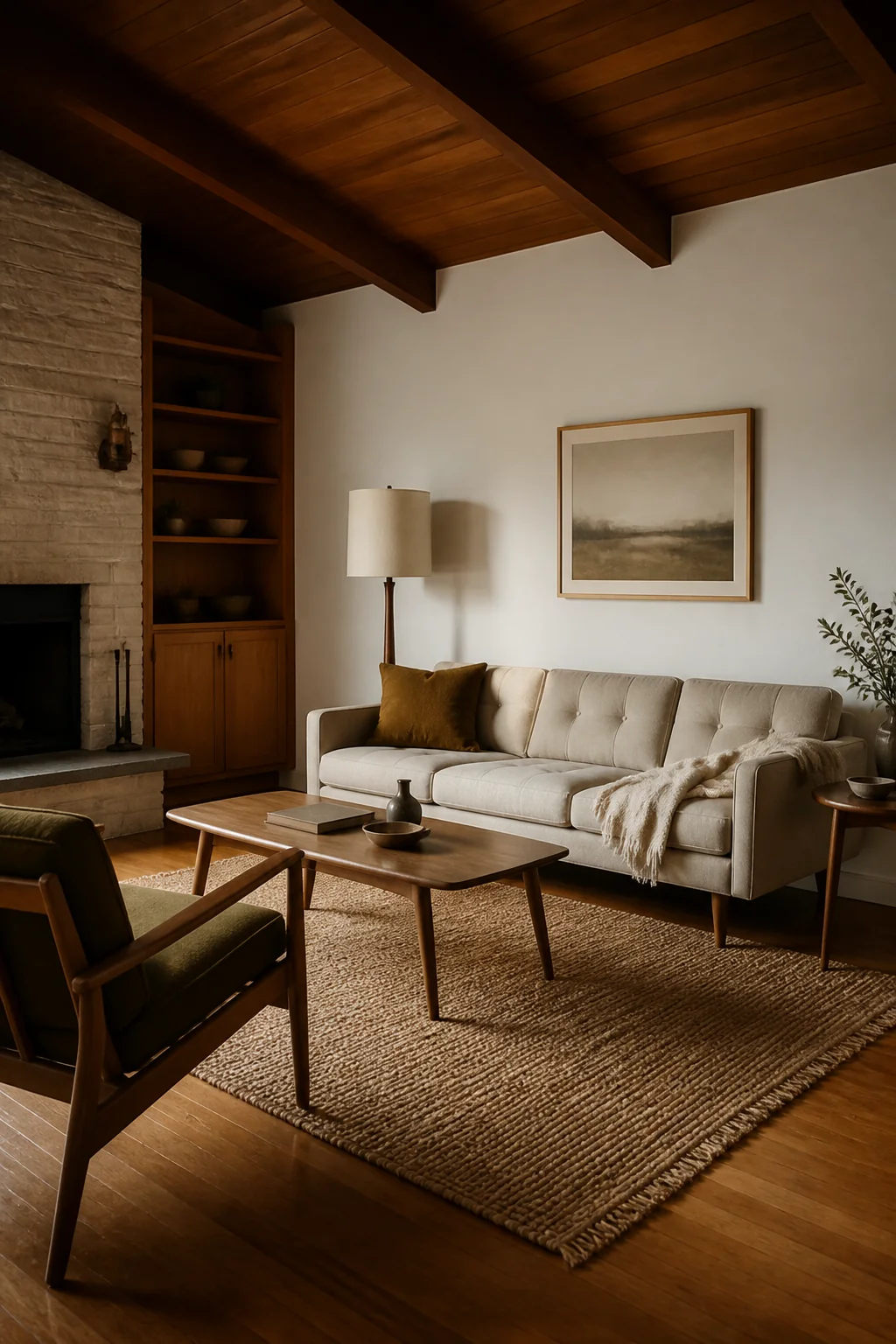
Overhead fixtures are minimal or nonexistent. Mid-century rooms are lit by table lamps and floor lamps - usually with tripod bases, tapered wood legs, or sculptural metal frames. A single arching floor lamp over a reading chair. Paired table lamps on a credenza. That's plenty.
Lamp shades should be simple and cylindrical, usually linen or a neutral shade. Skip pleated or ornate shapes. The bulbs matter too: warm white around 2700K, roughly 800 lumens each, and put them on a dimmer or a smart bulb if you can. Cool white at 4000K makes walnut look gray and flattens the whole room.
Heights are the part people get wrong. A floor lamp wants to be 58 to 64 inches tall, and a table lamp on a 30 inch credenza wants to be 26 to 30 inches so the total lands near standing eye level. The test for both: sit down in your usual spot. If you can see the bulb under the shade, the lamp is too low or the shade is too short, and you'll get glare every evening. Layered light still applies here, the layers are just fewer and better chosen. You're not adding recessed cans or a chandelier.
Accessories stay minimal and meaningful
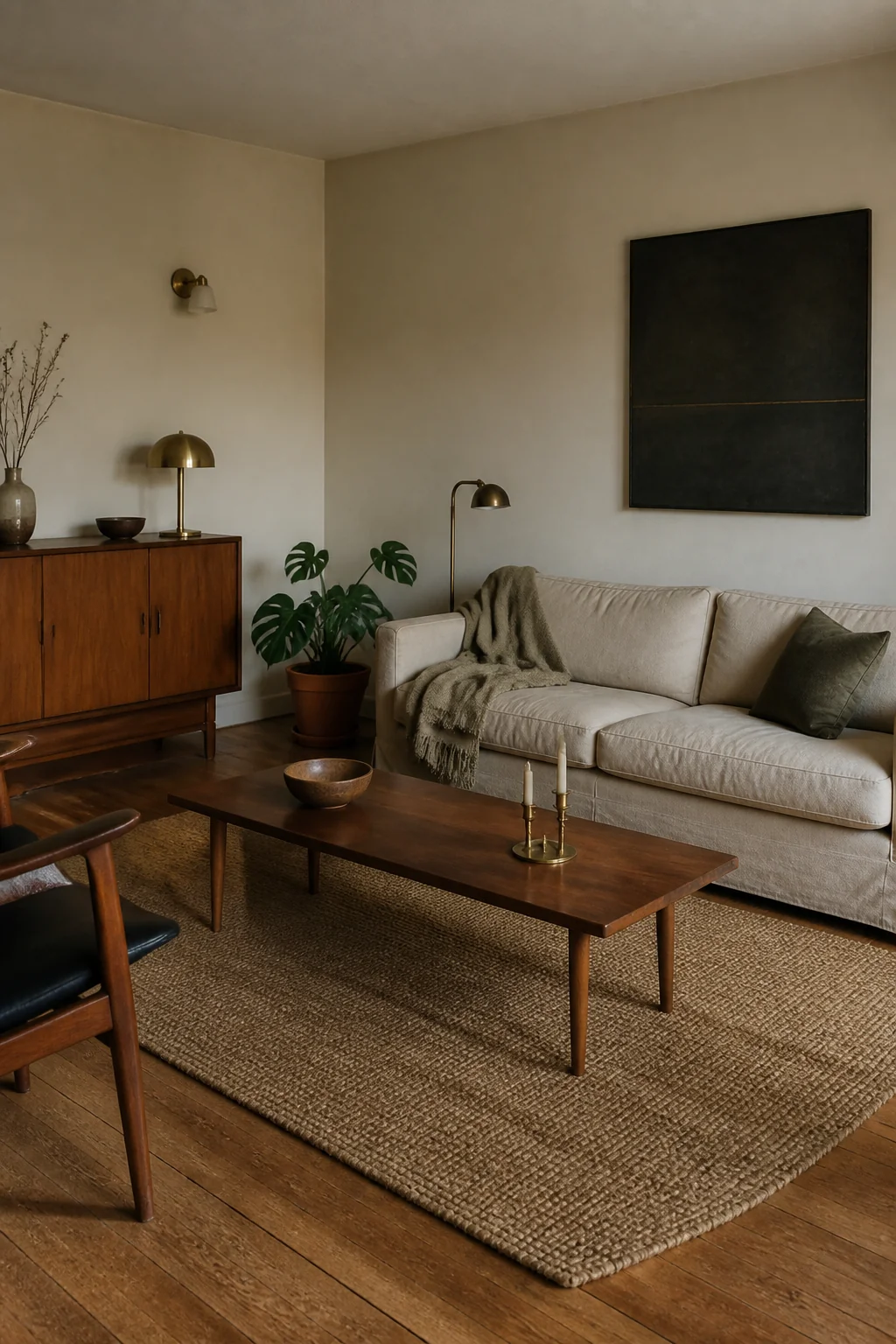
A credenza might hold a few books, a ceramic vessel, a framed photograph. A side table holds a lamp and maybe a small plant. The coffee table is almost bare, perhaps a design book and one small object. That restraint is harder to hold than it sounds when you're used to filling surfaces.
A working rule for surfaces: three objects at most per surface, at three different heights, and give them room to be seen. A 10 to 12 inch ceramic vessel, a stack of two art books, and one small brass or wood piece will hold a 60 inch credenza better than a dozen little things spread across it. Vary the materials as well as the heights, so ceramic next to wood next to metal, because identical finishes blur into one lump from across the room. Books earn their place because they're useful and their spines add a line of color. If you can't say why an object is there, it's clutter, and clutter is the thing this style has the least tolerance for.
Plants are understated. One or two in ceramic planters, not a jungle. Green walls weren't part of the original mid-century aesthetic, and overdoing it tilts the look toward boho.
Textiles matter more than wall color
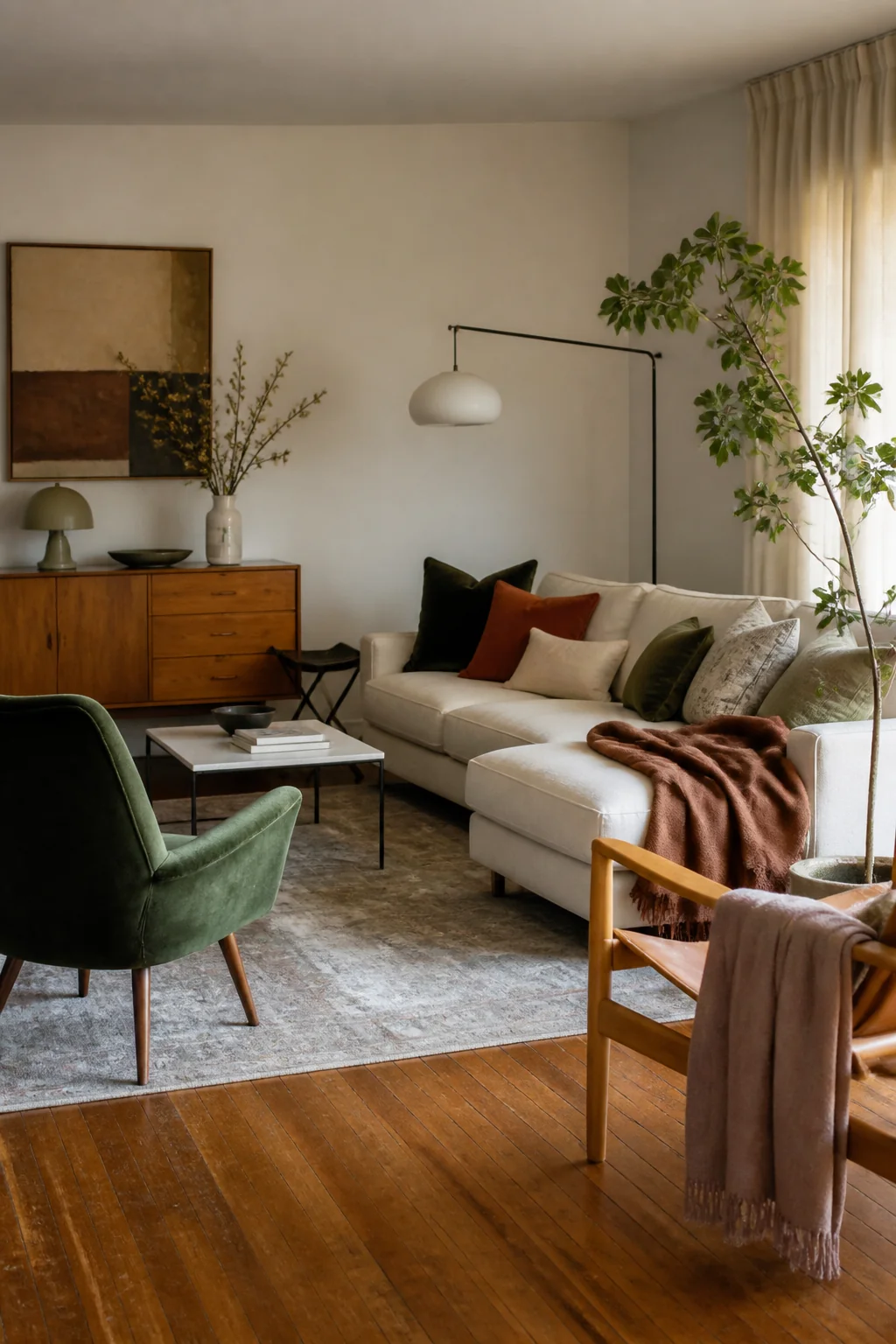
Throw blankets, pillows, and curtains define the space more than you'd expect. Linen is the right call: it hangs with a bit of weight, creases instead of shining, and reads as texture rather than pattern. Cotton canvas behaves similarly for less money. Keep colors neutral or pulled from your accent tones, and skip velvet, chenille, and anything deeply plush. Mid-century textiles feel crisp, not cozy.
Curtains are where most rooms lose the look, and it's usually a hanging problem rather than a fabric problem. Four to six inches above the casing is the default for the rod, with 8 to 10 inches of it running past the frame on each side so the drawn-back panels sit off the glass. Where the ceiling is high and no crown molding is in the way, skip the default and take the rod up near the ceiling instead, closer to the full-height drapery these rooms originally used. Combined panel width should be about double the window width, so a 36 inch window wants roughly 72 inches of fabric across the two panels. Any less and they hang flat like bedsheets. Hem so the panels break about half an inch above the floor. Ready-made linen-blend panels run about $30 to $70 each and a plain metal or wood rod adds $25 to $45.
For pillows, an insert an inch over the cover is the standard buy, so a 20 inch down or down-alternative fill into a 19 inch cover, and the corners go soft instead of square. Firm foam inserts are the exception, since they never give up that last inch, and matching the cover size exactly keeps the seams from straining. The failure mode to avoid: matching everything. When the pillows, throw, and curtains share one fabric and one tone, the room goes flat and the furniture stops standing apart from it.
One last step: trust the emptiness
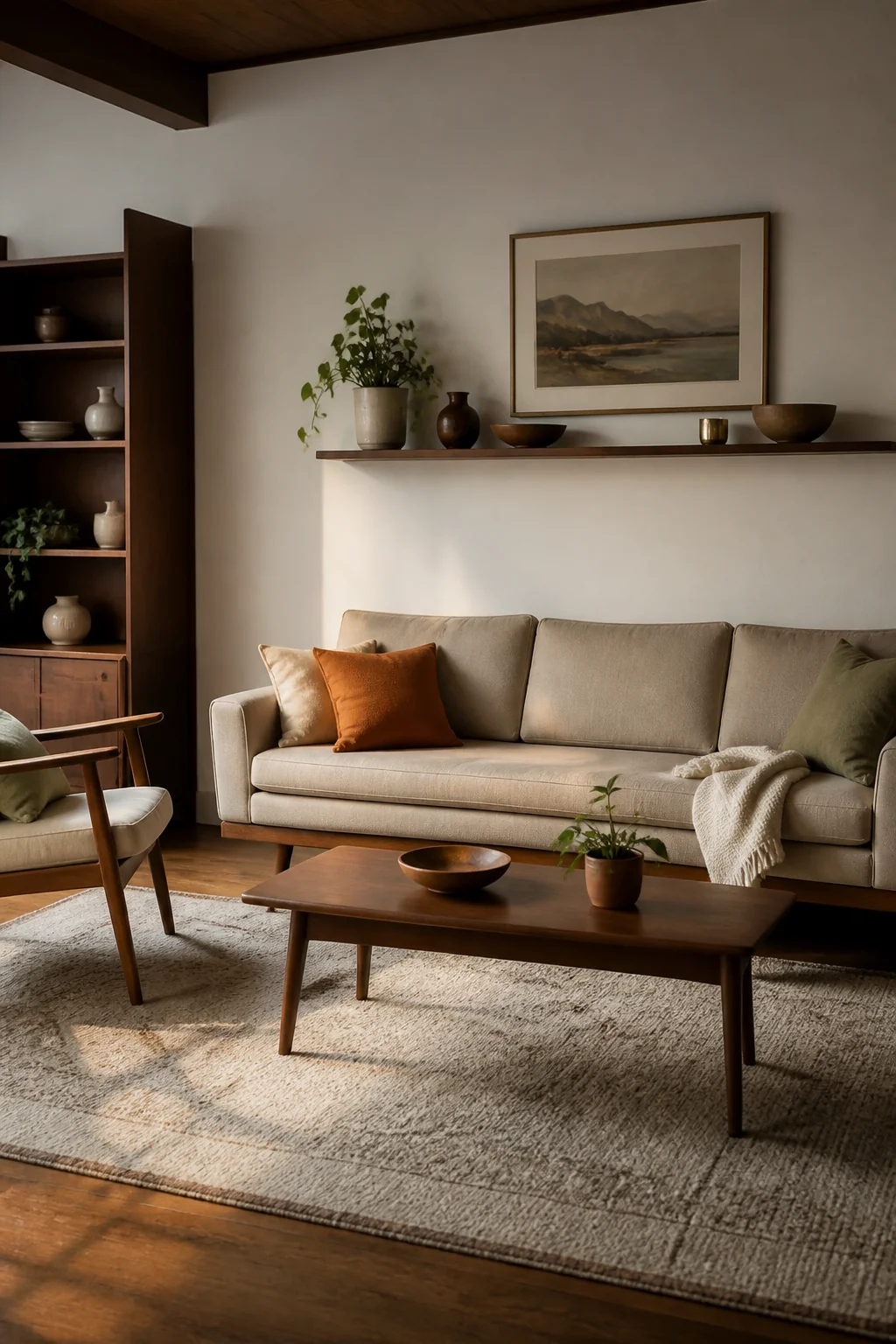
The hardest part of mid-century modern is leaving things out. After you've placed your furniture, added your lighting, and styled your surfaces, the room will probably feel underfull to you. It won't be. That's the style working.
Walk through the room and take out anything you added for the sake of adding it. Books that don't belong on that shelf. The fourth pillow. A throw nobody uses. Art you chose because the wall was bare. Put it all in a box, close it, and leave the room alone for a week. If you haven't gone looking for any of it by then, it wasn't holding the room together.
Take the guide with you
One caution, because the edit fails in a predictable way. When a stripped-back room still feels off, the problem is almost never a missing object. It's scale: a rug too small to catch the front legs, a lamp two feet shorter than it should be, a coffee table pushed a foot too far from the sofa. Adding accessories to fix a proportion problem just buries it under more things. Measure first, then decide whether anything actually needs to come back out of the box.