How to Get That Coastal Bedroom Look Without the Beach House Price Tag
Coastal bedroom decor ideas that fit a real budget: linen bedding, a tight palette, warm lamps and natural fibers that keep a bedroom calm.
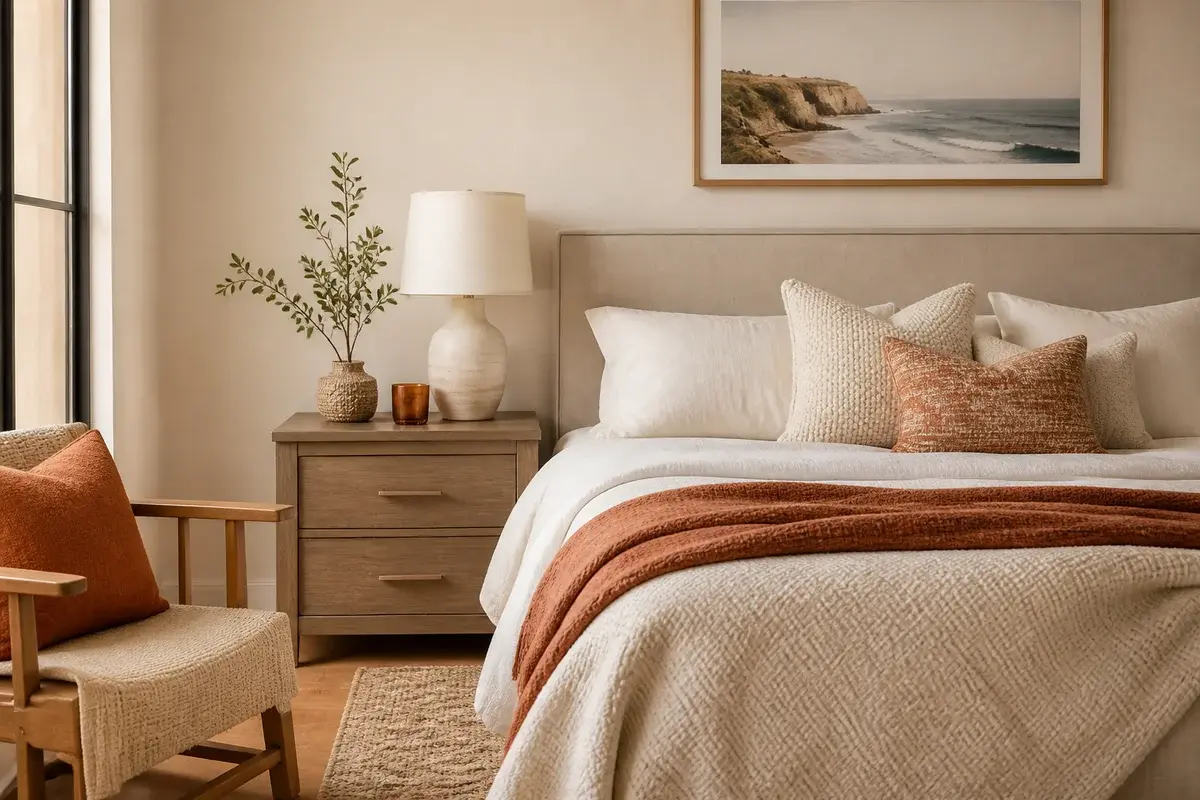
A rental bedroom with builder-beige walls and one small window doesn't sound like a candidate for beach-house calm. It usually is. Coastal style has less to do with where you live than with a short list of choices: light fabrics, a narrow color range, natural fibers, and lamps instead of one hard ceiling light.
None of that needs a landlord's permission, and none of it needs a renovation budget. The pieces that carry the look, bedding and curtains and baskets and a couple of lamps, are things you were going to own anyway. What matters is buying them in the right materials, at the right size, and stopping before the room gets busy.
Here's where the money is worth spending, where it isn't, and the order that keeps you from redoing your own work.
Soft Linens Are Your Secret Weapon
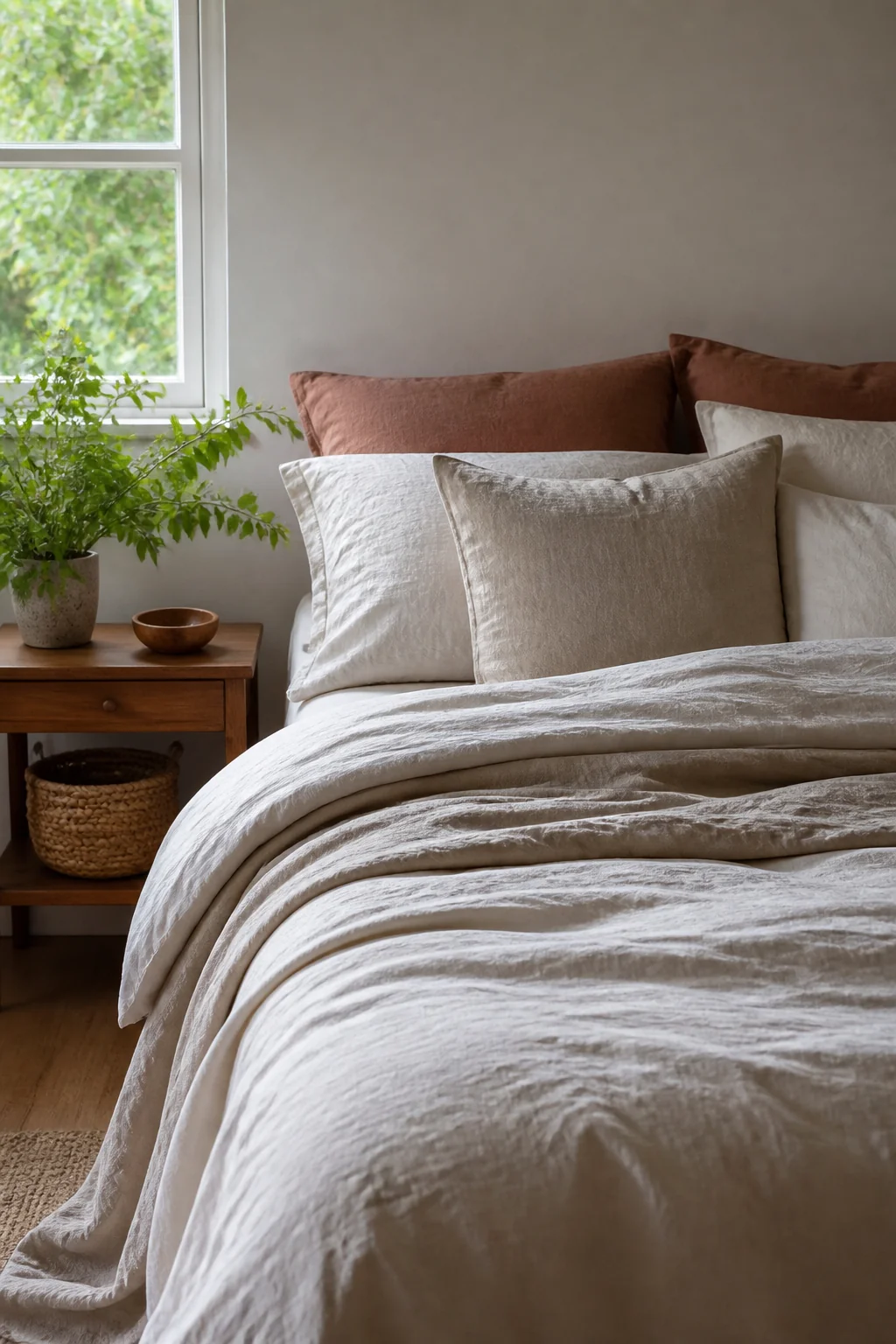
Bedding is the fastest route to coastal, for the plain reason that it covers more square footage than anything else you can buy in one go.
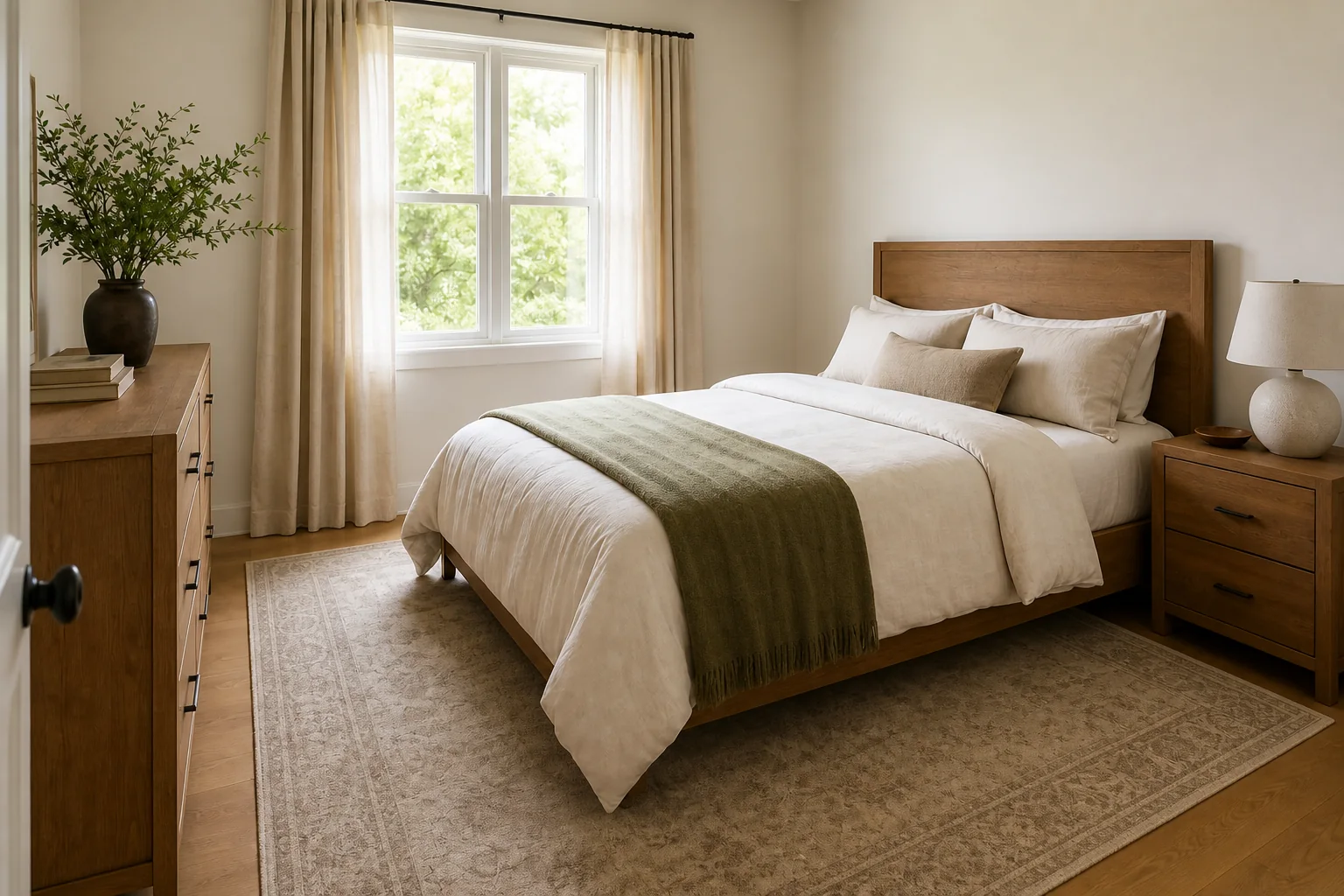
Skip heavy cotton sateen and look for linen or a linen-cotton blend. Linen wrinkles, and the wrinkle is the point: it reads relaxed instead of hotel-crisp. It also breathes, so it stays comfortable in a room that runs warm. A queen duvet cover runs roughly $60 to $120, and plain white or cream pillowcases keep the bed reading as one calm block rather than a patchwork. A linen throw across the foot, another $30 to $40, adds the only texture the bed really needs.
One caution before you buy. Wash cold and tumble low, because linen shrinks noticeably the first time it meets hot water, and a cover that started roomy turns into a wrestling match over a thick insert. Skip fabric softener too; it coats the fibers and stops them loosening.
That loosening is the real payoff. Washed linen softens with every cycle, so a $90 cover usually feels better in its second year than it did new.
Color Palette Is About Restraint
White, cream, soft gray, pale blue, and maybe one sandy beige. That's the entire list, and the shortness of it is the whole technique.
Coastal reads calm because the eye is never asked to jump between competing colors. A simple way to split it: let the two lightest neutrals cover the big surfaces, meaning bedding, curtains and rug, and let a third color appear only in small doses, a lamp base, one cushion, a stack of books.
The classic misfire is treating coastal as a theme rather than a palette. Turquoise, coral, navy and seafoam are each defensible on their own. Put all four in one bedroom and they fight, and the room ends up busy instead of breezy.
If your walls are locked in as builder beige, that's not the problem it feels like. Beige already sits in the sandy family. Pull the room cooler with gray and pale blue textiles rather than fighting the wall color, and let the floor do some of that work: a 5x7 area rug in soft gray with a subtle weave, around $80 to $150, covers enough surface to shift the temperature of the whole room.
Textures Matter More Than You Think
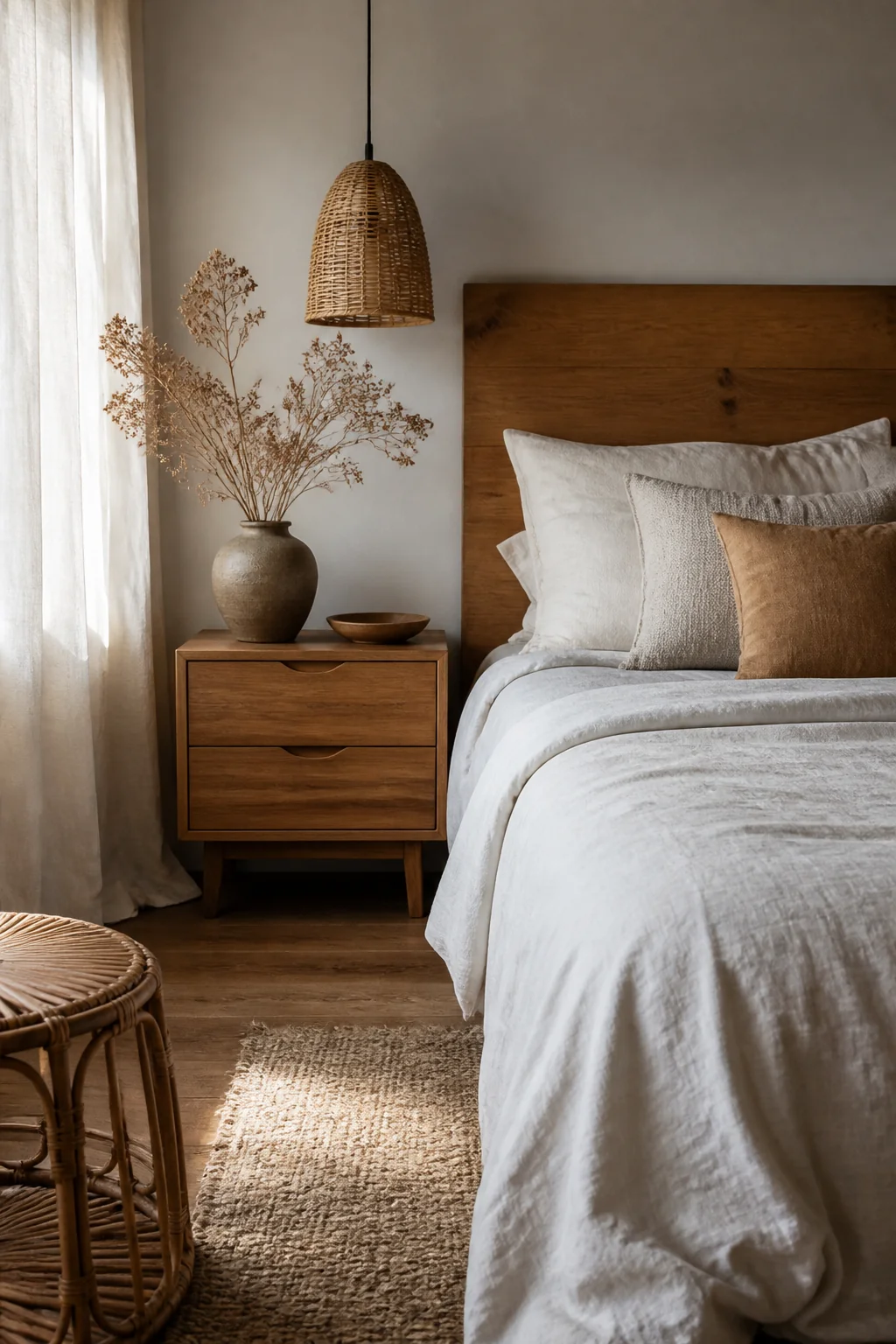
With the color range that narrow, texture is the only thing keeping the room from going flat. Linen, jute, wood and rattan sitting next to each other give the eye something to do without introducing a single new color.
A jute rug under the bed does most of that work. Buy it big enough that 18 to 24 inches of rug shows on each side, so it frames the bed instead of looking like a bath mat that wandered in; an 8x10 covers most queen setups, a 9x12 a king. Jute is genuinely scratchy underfoot, though, so if you're barefoot first thing in the morning, layer a small washable cotton rug on your side of the bed.
Rattan wall baskets run about $20 to $40 each and store spare pillows and blankets while doing double duty as wall decor. Hang them on a hook rated for at least 20 pounds, since a basket with a folded quilt in it gets heavier than the basket suggests.
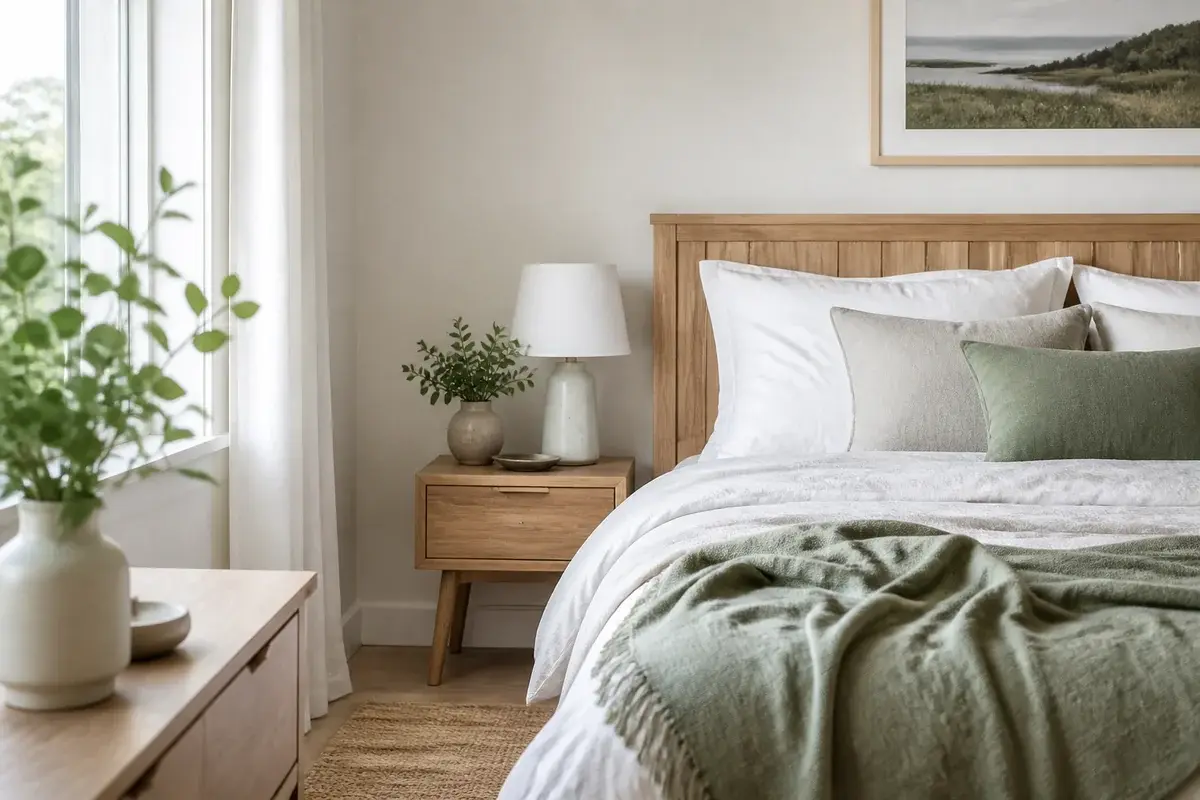
A plain wooden nightstand finishes the mix. Unfinished or lightly waxed wood scatters light rather than bouncing it back, which is what makes it read weathered instead of shiny.
Lighting Can Be Soft and Moody
One bright fixture in the middle of the ceiling flattens a room. Hard shadows, nowhere for the eye to rest, and everything lit from the same unflattering angle. Coastal light is low and layered.
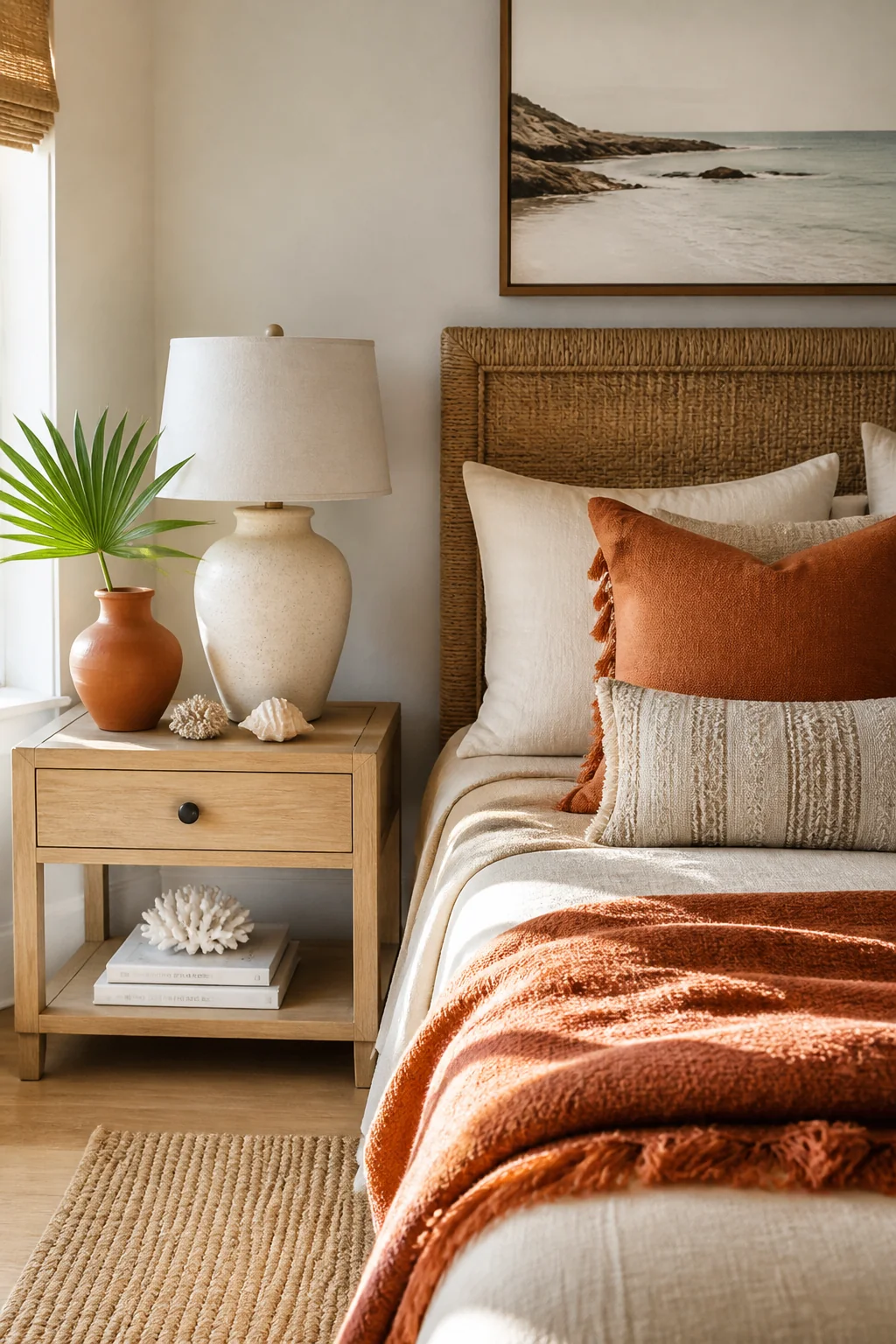
Aim for at least two sources besides the ceiling. Plug-in pendants, roughly $40 to $80 each, hang on either side of the bed and leave the nightstand top clear. Hang them so the bottom of the shade lands about 20 to 24 inches above the mattress: low enough to read by, high enough that you don't headbutt one sitting up. A small table lamp on the nightstand covers the rest.
Bulb color does more here than the fixture does. Stick to 2700K warm white in every lamp in the room and check the box each time, because a mix of 2700K and 4000K bulbs is what makes a room feel subtly wrong without anyone being able to name why. Around 800 lumens per lamp is plenty beside a bed.
Renting changes nothing about this. Adhesive cord clips and a swag hook route a pendant cord along the wall to the nearest outlet with no drilling and no floor cable to trip over.
Window Treatments Don't Have to Be Expensive
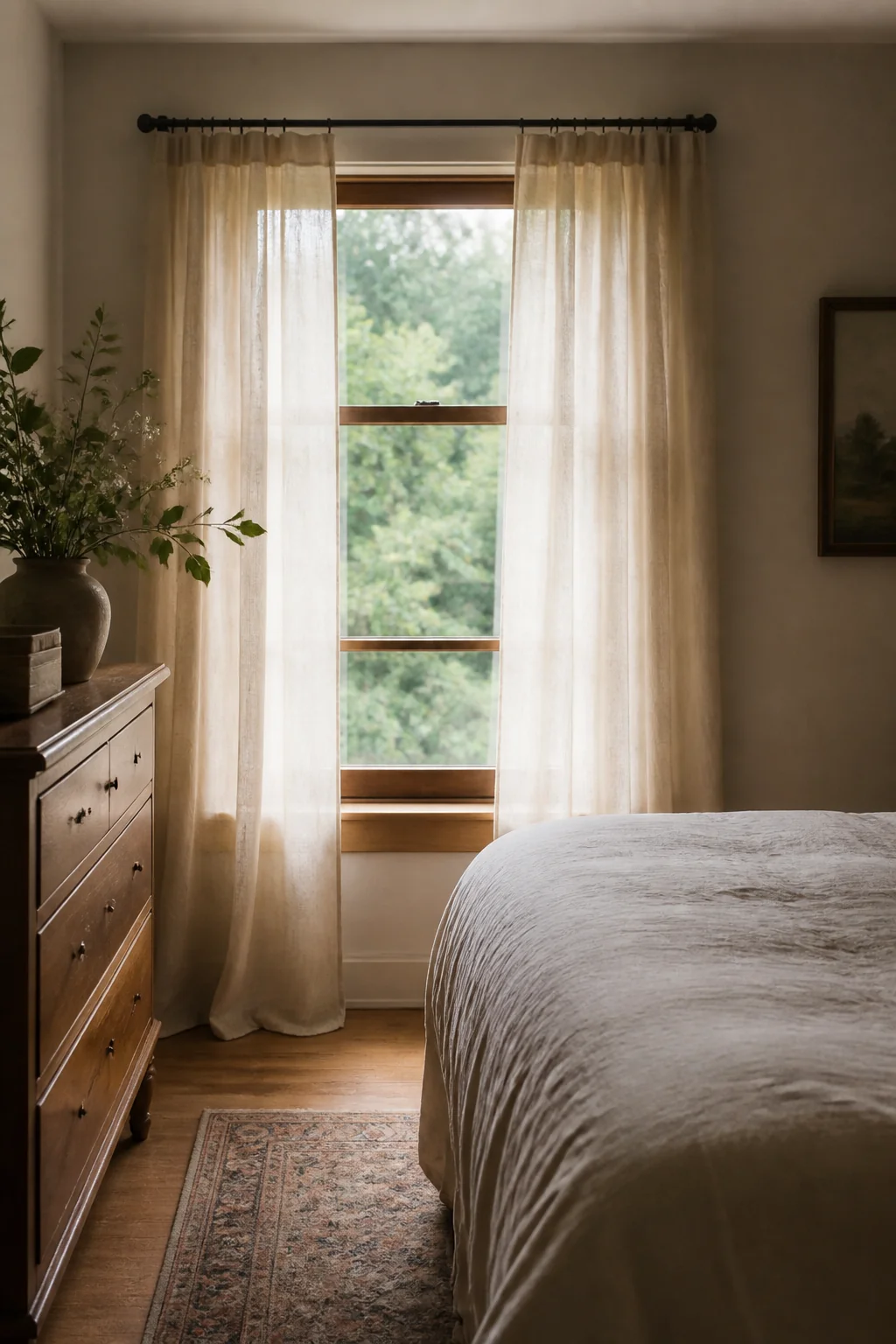
Curtains set the mood faster than paint does. Heavy blackout panels in a dark color kill the look on contact; loose linen or a linen-cotton blend in white or cream is what you want, and basic panels run about $30 to $60 each.
Hang them high and wide, which costs nothing and does more than the fabric choice. Every inch of rod sitting inside the frame is an inch of glass a curtain will cover once it's open, and daylight is the one thing this look can't fake, so go 4 to 6 inches above the frame, higher where there's wall to spare between frame and ceiling, and 8 to 12 inches past it on each side. The fabric then gathers on plaster, the window keeps everything it lets in, and the wall reads taller into the bargain. A wood or metal rod runs $25 to $40.
Length is where most people trip. Measure from the rod to the floor and buy panels that just kiss it, within half an inch. Panels that stop at the sill look cheap no matter what they cost, and hems are easy to shorten but impossible to lengthen.
If sheer linen leaves you feeling exposed after dark, add a cream roller shade behind the panels. Daytime glow stays, privacy arrives at night.
Wall Decor Keeps It Simple and Natural
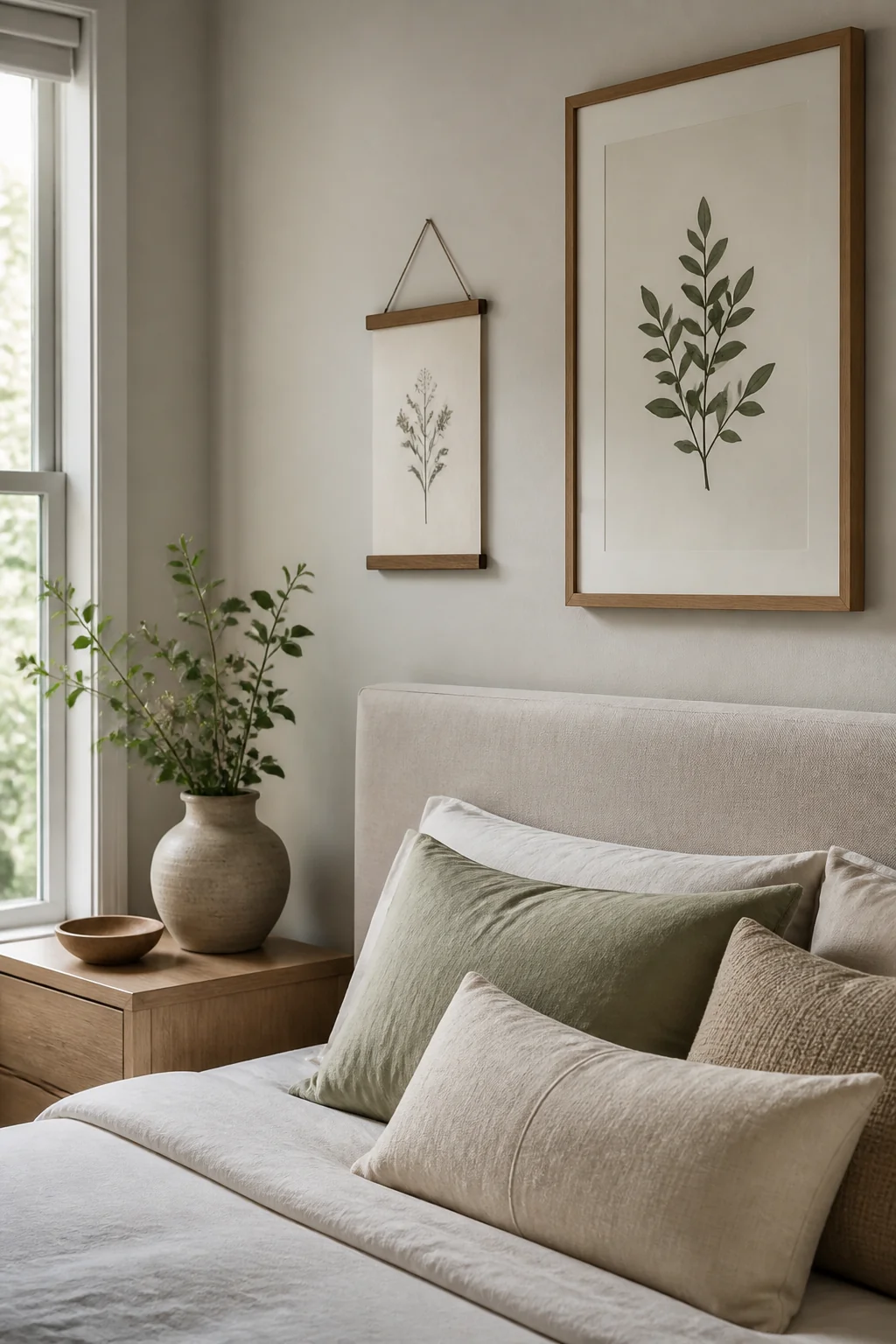
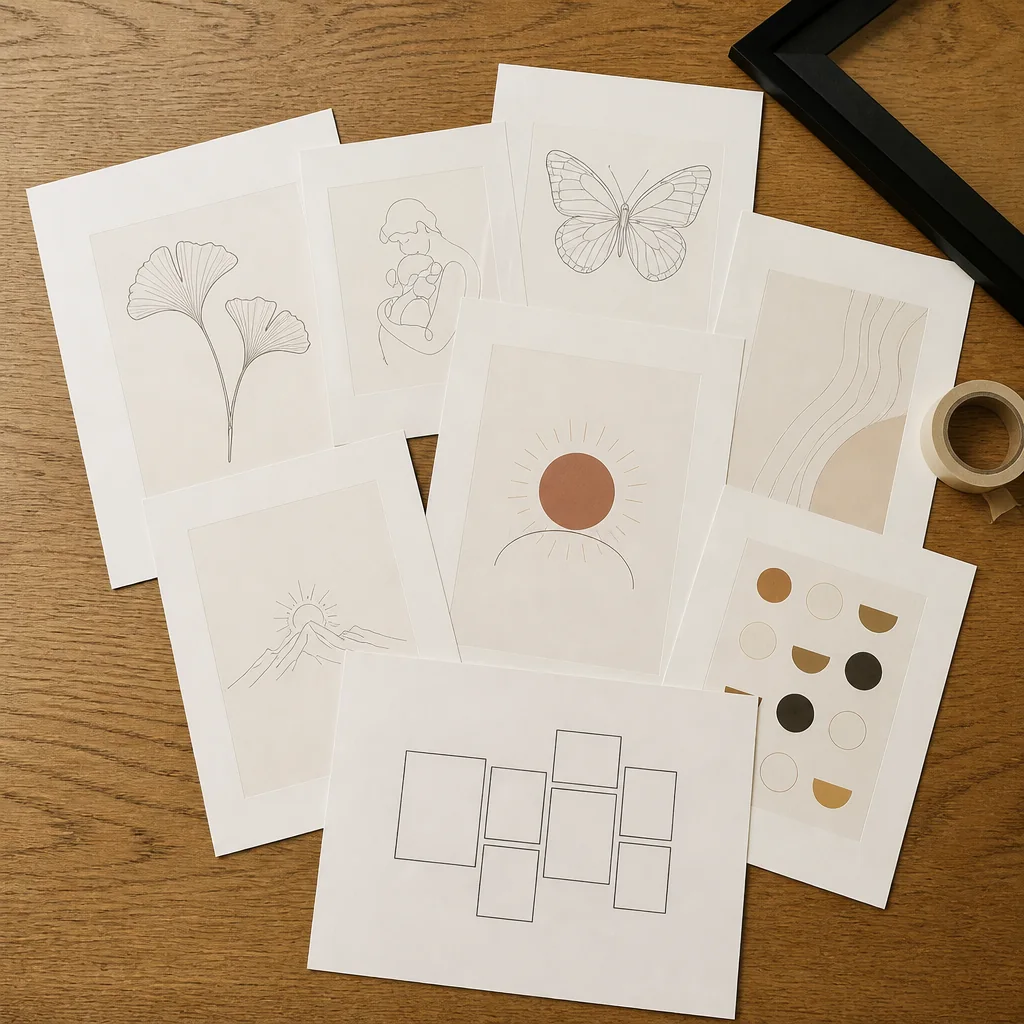
Two to four pieces, not ten. Driftwood, a loose line drawing, a small woven hanging, a botanical print.
Build the wall around one anchor. A 24x36 inch piece above the headboard sets the scale, then one or two smaller frames sit beside or below it. Prints run $15 to $40, and a craft-store frame with a plain white mat costs about the same again, so a finished wall usually lands somewhere between $60 and $120.
Hanging height is the detail that gets skipped. A frame held up against a wall always looks right a little too high, because the arms doing the holding are already lifted, so trust a tape measure over the moment: the center of the anchor piece belongs around 57 to 60 inches off the floor. Over a bed, go by the headboard instead: leave 8 to 10 inches between the top of the headboard and the bottom of the frame, or the art floats off on its own and stops looking connected to anything.
One practical note on anything glass-fronted over a bed. Use two hooks and a wire rather than a single nail, because a frame hanging from one point pivots crooked every time the wall gets knocked. Canvas or an unframed wood piece removes the worry entirely, which is part of why driftwood suits this spot so well.
Add Greenery Without the Guilt
Greenery belongs here in very small doses. A single pothos or one snake plant is plenty, because a jungle reads tropical, which is a different look entirely.
Pothos and snake plants are the safe picks at $10 to $20 in a 6 inch grow pot, and both forgive a forgotten week. Pothos wants bright indirect light and announces thirst by drooping, then recovers within a few hours of a drink. A snake plant tolerates a dim corner and prefers being left alone, roughly every two to three weeks in summer and less than that in winter.
The pot does most of the styling. Unglazed terracotta, natural ceramic or concrete in a chalky or sandy tone, about 8 inches across to hold a 6 inch nursery pot, $15 to $25.
Here's the failure that kills more houseplants than neglect: decorative pots usually have no drainage hole. Leave the plant in its plastic nursery pot, drop that inside the pretty one, and lift it out to water at the sink until it stops dripping. Water pooling in a sealed pot rots the roots in a couple of weeks, and by the time leaves start yellowing the damage is done.
Keep either plant clear of an AC vent, too. Constant cold airflow browns the leaf edges.
The Nightstand Does More Work Than You Think
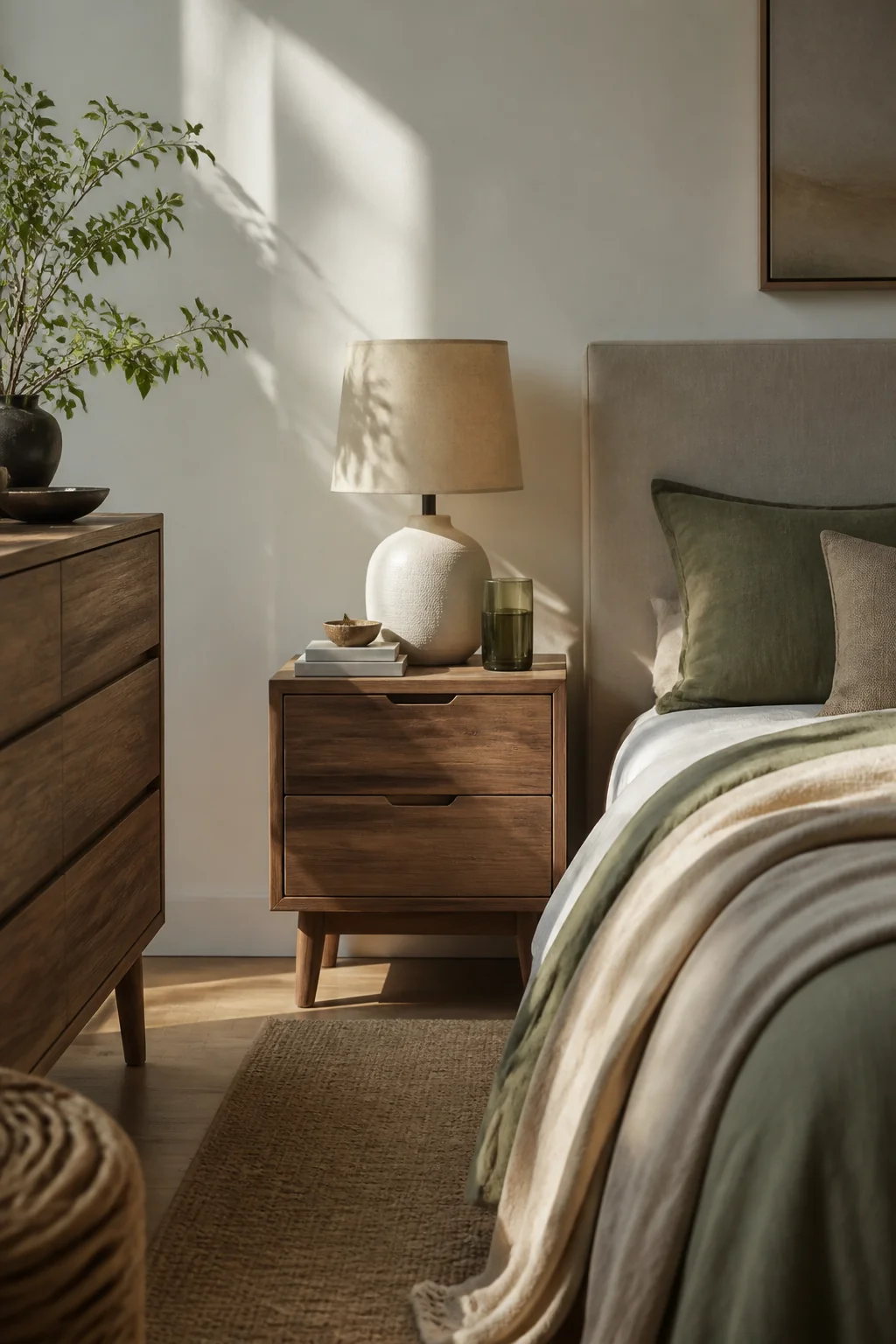
A nightstand carries the lamp, the book and the glass of water, and it quietly sets the wood tone for the whole room. A plain wooden one, thrifted, flat-pack or a small dresser pressed into service, costs $40 to $100.
Check the height before you fall for the finish. The top should land within a couple of inches of the top of your mattress, which for most beds means a piece 24 to 28 inches tall. Too low and you're groping downward for the lamp switch in the dark; too tall and it looms over the pillow. Leave 2 to 3 inches between the nightstand and the bed frame so bedding doesn't snag on the corner every time you make the bed.
A thrifted piece in a dark or orange-toned stain is worth rescuing. Sand it back with 120 grit, follow with 220, then finish with clear paste wax or a matte water-based polyurethane. Avoid glossy oil-based finishes, which yellow as they age and reflect too hard for this palette.
Then keep the top nearly bare: lamp, small dish, maybe the plant. White or cream drawer pulls, $5 to $10 a set, are the cheapest way to lift a plain box.
What to Do First, and What Can Wait
Bedding comes first, every time. It's the largest soft surface in the room, it's reversible, and it needs nobody's permission. A white or cream linen duvet cover with plain pillowcases moves the room further than any other single purchase at that price.
Curtains second, because hanging them high and wide changes the proportions of the wall, and you want to know those proportions before deciding where the art goes. Lighting third: the pendants or lamps, plus a matched set of 2700K bulbs, which is the cheapest line item here and one of the most noticeable.
Save this for your next project
Everything after that, the rug, the baskets, the plants, the nightstand, can arrive whenever the right one turns up at the right price. We'd argue that's the part worth being slow about. A thrifted wooden nightstand you waited two months for will do more for this room than a matching bedroom set bought in an afternoon, because the coastal look has always depended on pieces that seem to have collected themselves over time rather than arrived together in one delivery.
Ideas fade by Friday. A plan finishes the room.
You just read a full guide to your bedroom. Saving ideas will not change it; a plan will. The Home Decor Collection is every planning tool we make, for every room in the house, in one download, so the after photos below stop being other people's rooms.
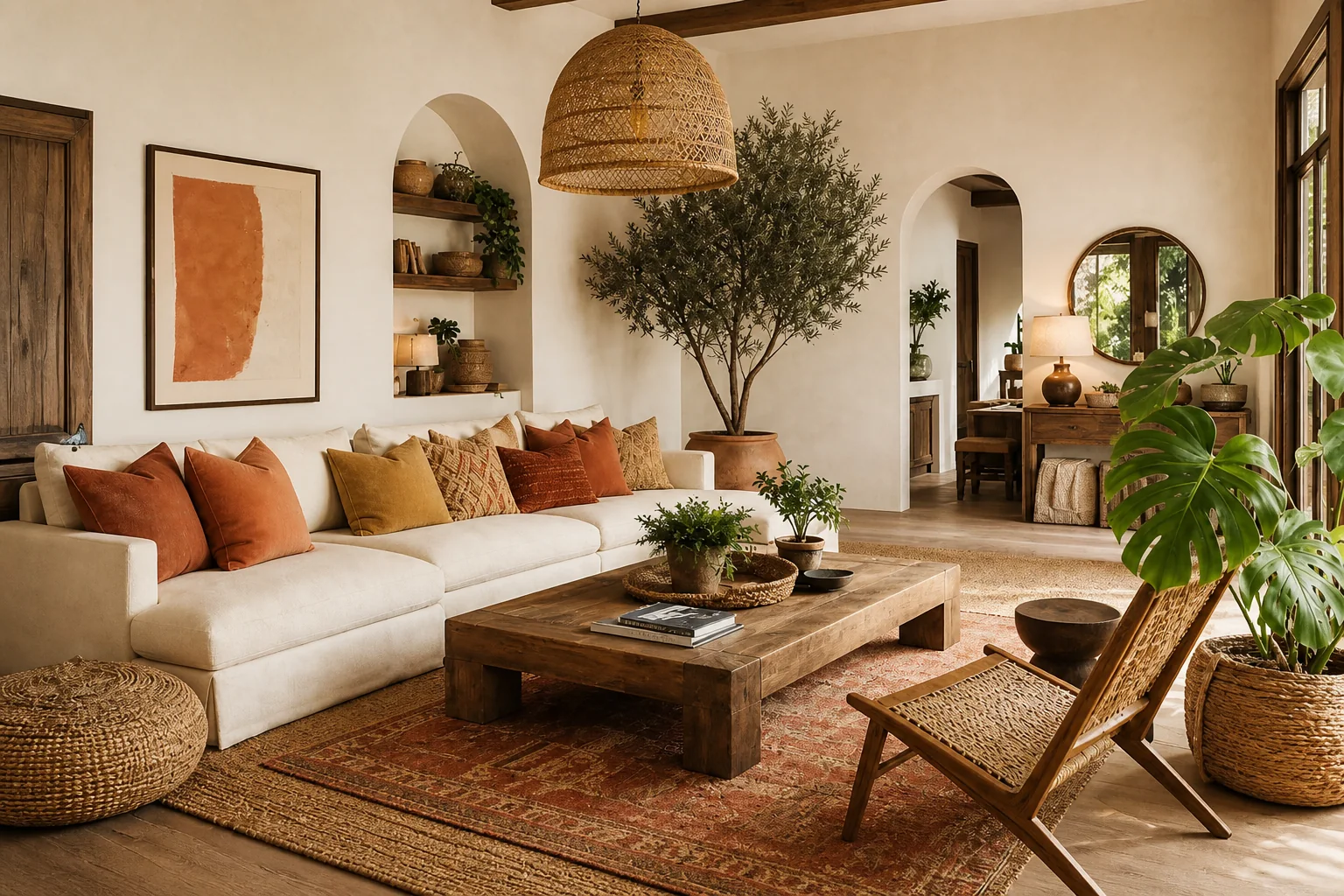
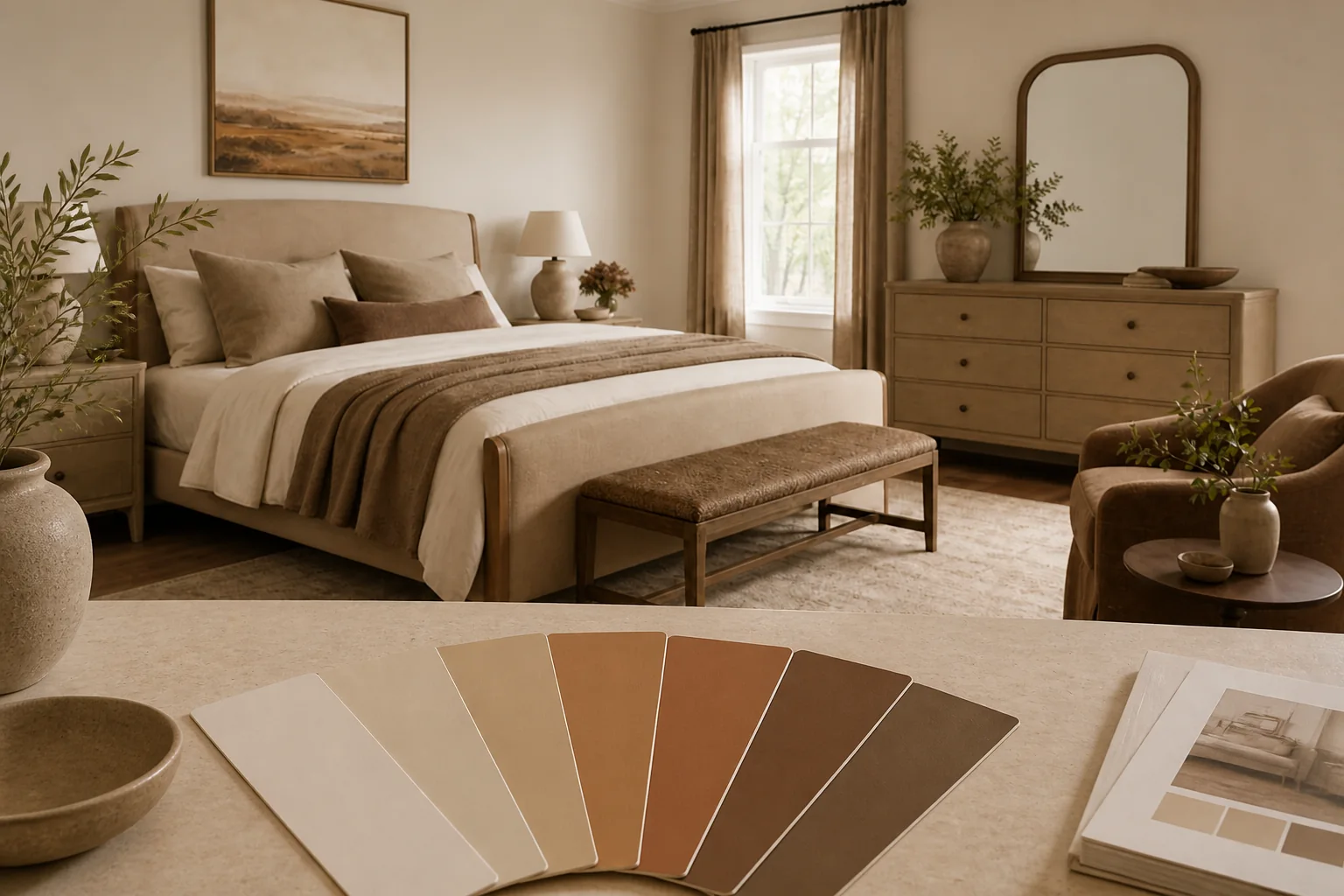
- Six room Style Kits, each with layout, palette and shopping list$114
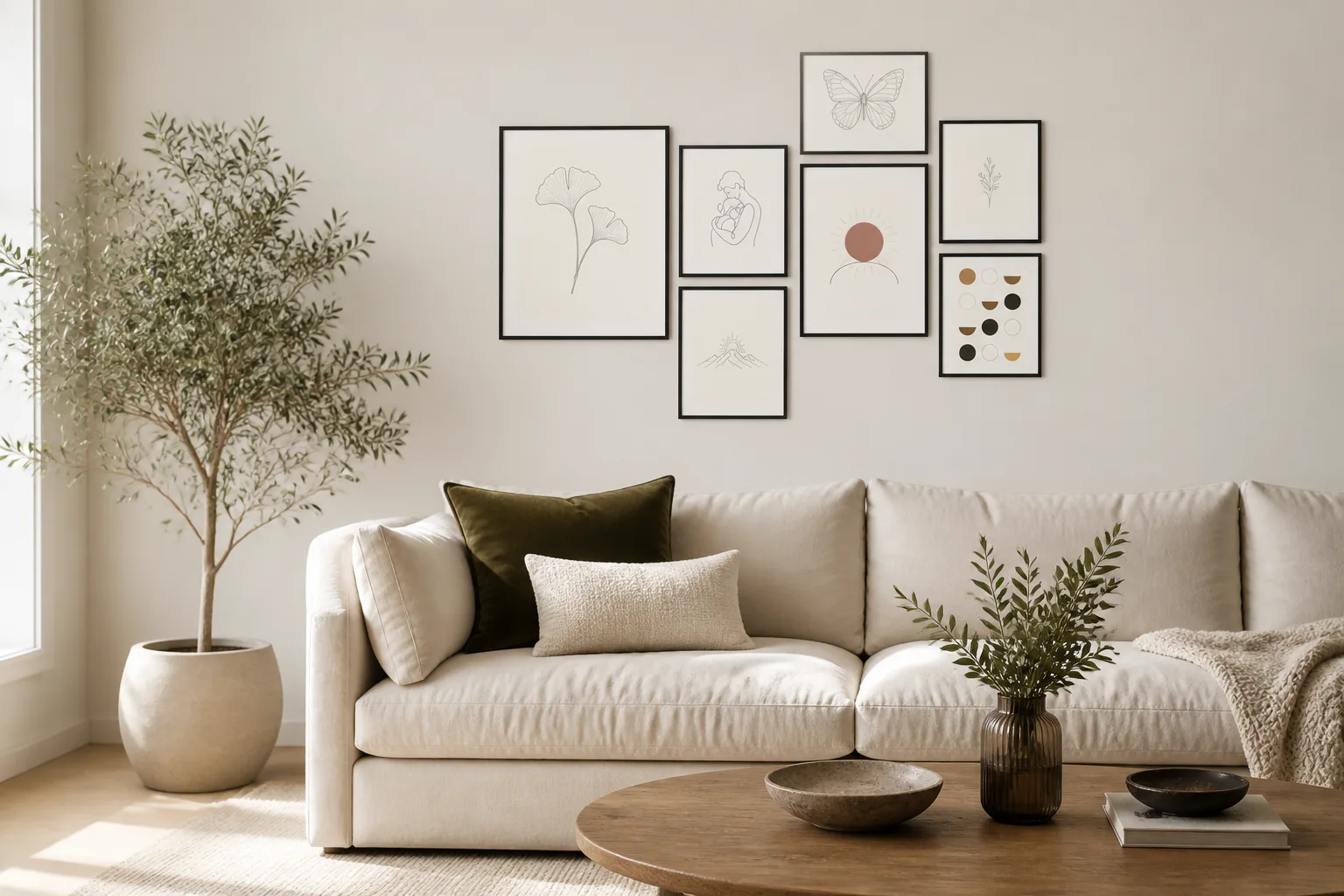
- The Gallery Wall Studio: 200 prints + 15 measured layouts$29
- The Room Makeover System: 40 solved room layouts + workbook$29
- The Color Palette Handbook: 60 palettes shown in real rooms$19
- The Whole-Home Reset: 40 printable organizing checklists$19
- The Decorator's Cheat Sheets: the 40 measurements that matter$9
- All eleven products, bought separately
$219$97
A single hour with an interior designer costs more than the entire Collection, and this one keeps answering for every room you will ever decorate. Free updates included as the products grow. And if it is not for you, the 14 day money back promise means you simply get a refund.