21 Timeless Art Deco Living Room Design Ideas With Sizes and Costs
Discover 21 art deco living room design ideas that combine geometric patterns, bold colors, and luxe finishes for authentic 1920s glamour.
This post contains affiliate links. As an Amazon Associate I earn from qualifying purchases. If you buy through our links, we may earn a commission at no extra cost to you.
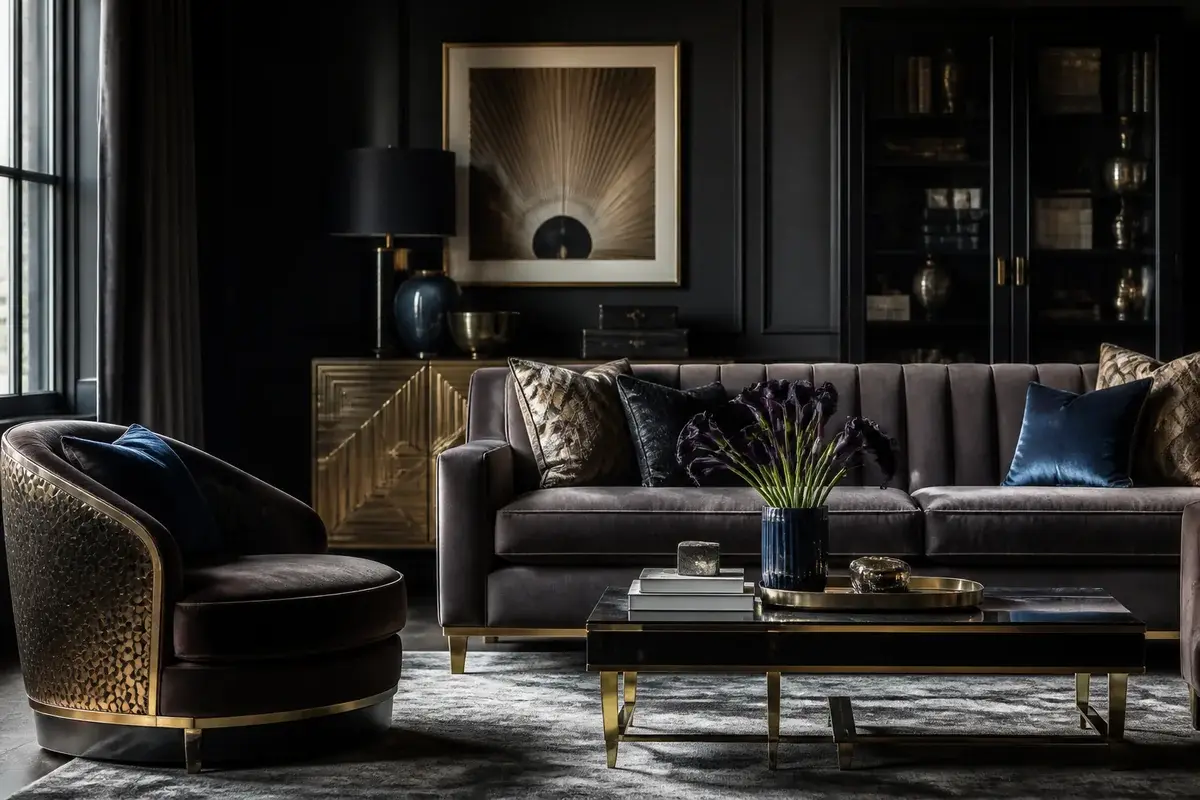
Art deco living rooms depend on precision. Most people add a gold lamp and some zigzag patterns and stop there, but the style comes from how the pieces combine: exact angles, intense color, and materials that catch the light. Get those right and the room looks rich and deliberate. Miss them and it reads as scattered retro.
1. Anchor with a geometric area rug in jewel tones
A rug in emerald, sapphire, or deep teal with sharp geometric lines grounds the whole room. Size it to the seating, not to the floor plan: the rug should run at least 6 inches past each end of the sofa, with the front two legs sitting on it and the coffee table fully centered. In a standard 12x14 room that usually means an 8x10 rather than a 5x8, which tends to float like a bath mat once real furniture lands on it. Leave 12 to 18 inches of bare floor between the rug edge and the walls so the border looks deliberate.
Pile height matters more here than in most rooms. A low pile around a quarter inch keeps chevrons, stepped fans, and sunburst motifs crisp, while a shaggy pile blurs every angle the pattern is doing. Machine-woven polypropylene runs about $150 to $300 at 5x8; hand-tufted wool starts near $450 and holds its edges far longer under a coffee table.
2. Choose a statement sofa in deep velvet
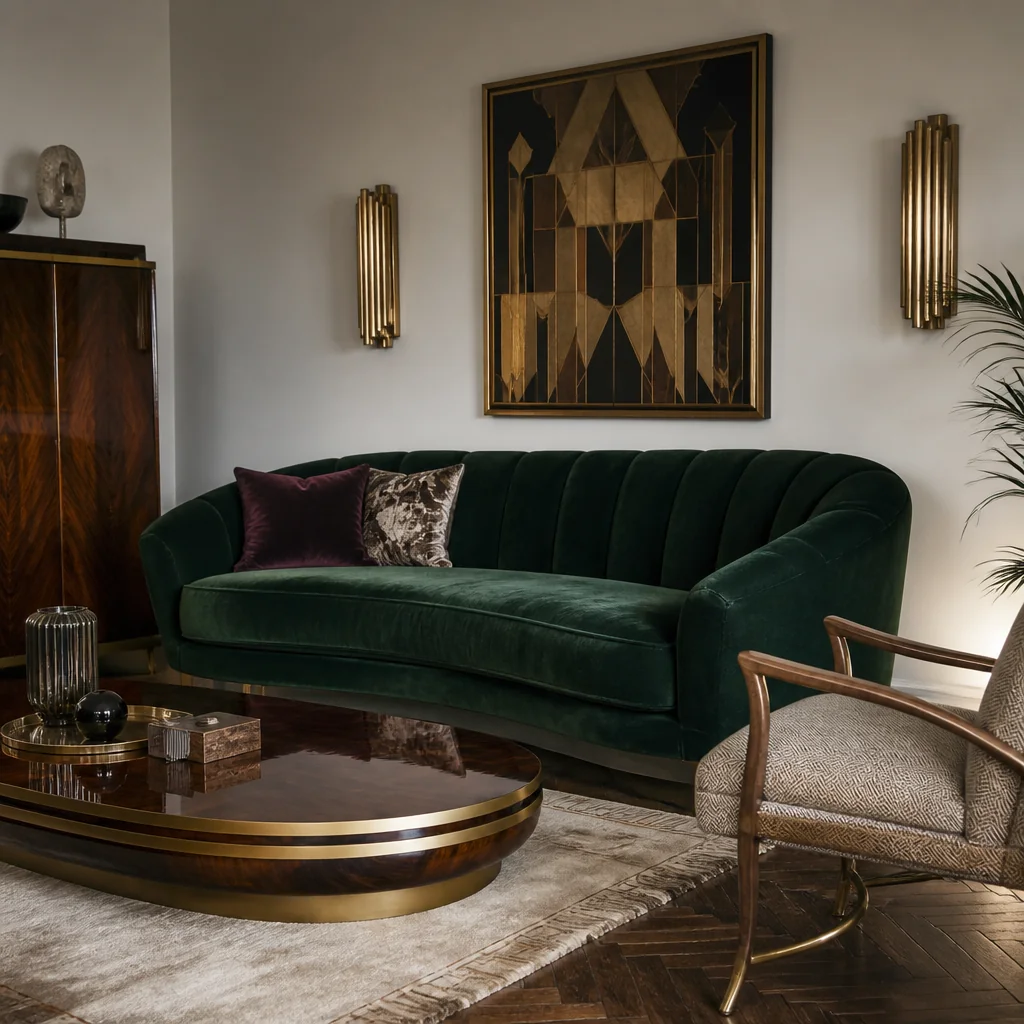
Charcoal, navy, or black velvet reads more authentically than lighter fabrics. A sofa about 84 inches wide gives you real presence, and a seat depth of 22 to 24 inches keeps it loungey without swallowing a mid-size room. Legs are where the style lives: brass or chrome, 5 to 7 inches tall, so the frame appears to hover instead of sitting on the floor like a block. Wood legs pull the whole piece toward mid-century.
Fabric choice decides how it ages. Cotton velvet has the richest depth but watermarks and crushes where people sit; polyester performance velvet resists both and wipes clean, which is the safer call with kids or a dog. Expect $900 to $2,000 for a well-built frame on kiln-dried hardwood. Before you order, measure your narrowest doorway. Most are 30 to 32 inches, and an 84-inch sofa has to come through on its side, so check that the diagonal clears too.
3. Hang floor-to-ceiling curtains in a solid jewel tone
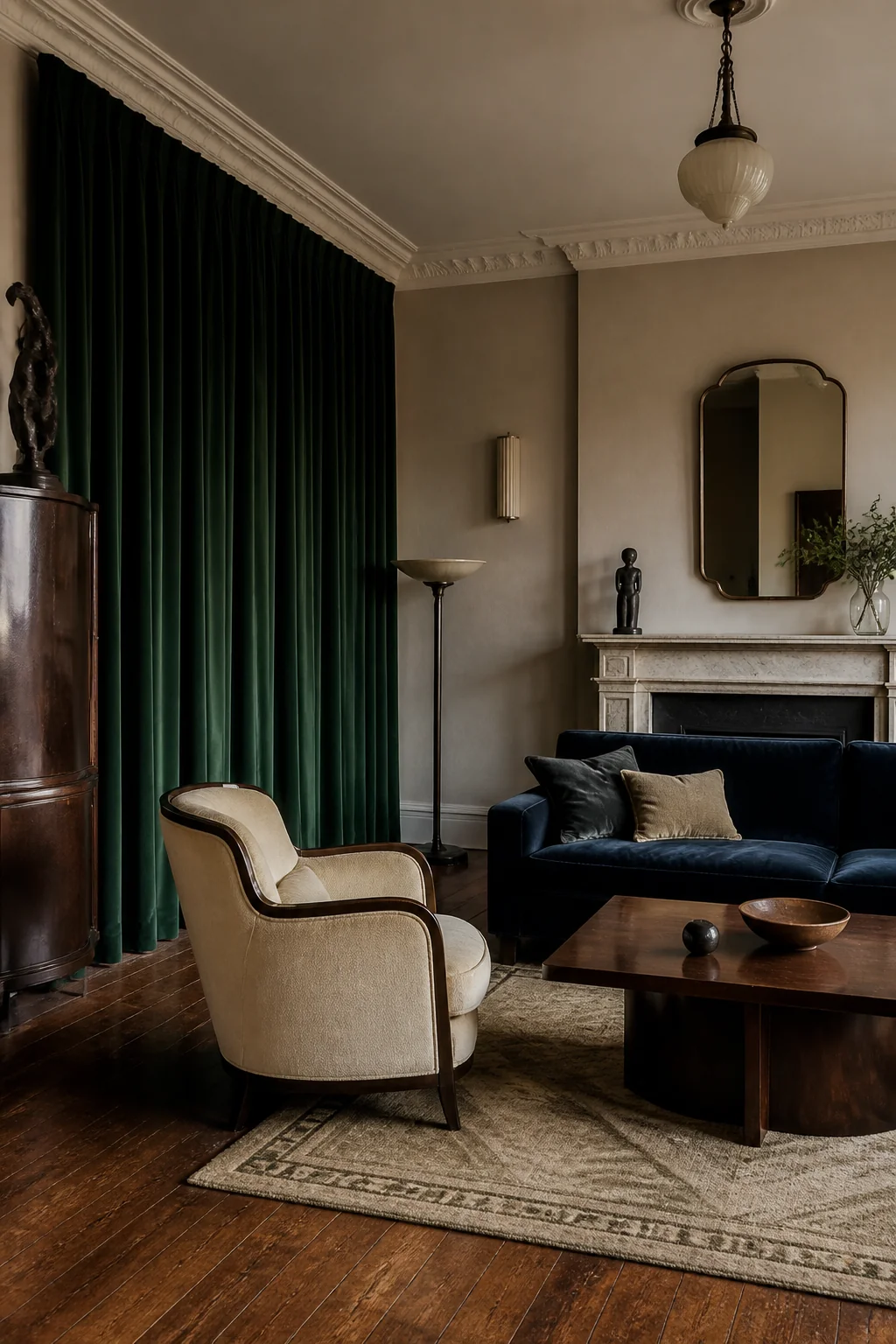
Fix the rod within 2 to 4 inches of the ceiling line, or tuck it just under the crown molding, even when the windows themselves start a foot lower. Then run it 8 to 12 inches past the frame on each side so the drawn-back panels rest on wall rather than glass. Curtains pinned tight to the casing are the reason a deco room with the right sofa and the right paint still reads flat: the eye stops at the top of the window instead of running up the whole wall.
Buy total panel width at roughly two to two and a half times the window width, or the fabric hangs thin and flat instead of falling in deep folds. Measure from the rod to the floor and subtract half an inch if you want the hem to hover, or add 2 to 3 inches for a soft puddle. Nine-foot ceilings need 108-inch panels; the standard 84-inch pair sold everywhere will strand you six inches short. Velvet panels run about $40 to $90 each in emerald, navy, or burgundy.
4. Layer brass and chrome accents throughout
Don't mix them randomly. Let one metal carry roughly two thirds of the room, usually brass on all lighting and cabinet hardware, then bring chrome into two or three deliberate places: table legs, a mirror frame, a drinks tray. That ratio is what separates layered from accidental.
Finish matters as much as the metal itself. Unlacquered brass darkens over a year or two into a soft honey patina, lacquered brass stays bright and even, and polished chrome throws a cooler, harder reflection that suits glass and marble. Gold-tone plating is the usual trap, since it can read slightly green beside real brass under a 2700K bulb. Hold samples side by side under the lamp that will light them nightly before you commit to a set of eight pulls at $12 apiece. Oil-rubbed bronze and antique pewter, meanwhile, pull the room toward traditional or farmhouse and fight the crisp geometry you're building.
5. Add a sunburst mirror above the sofa
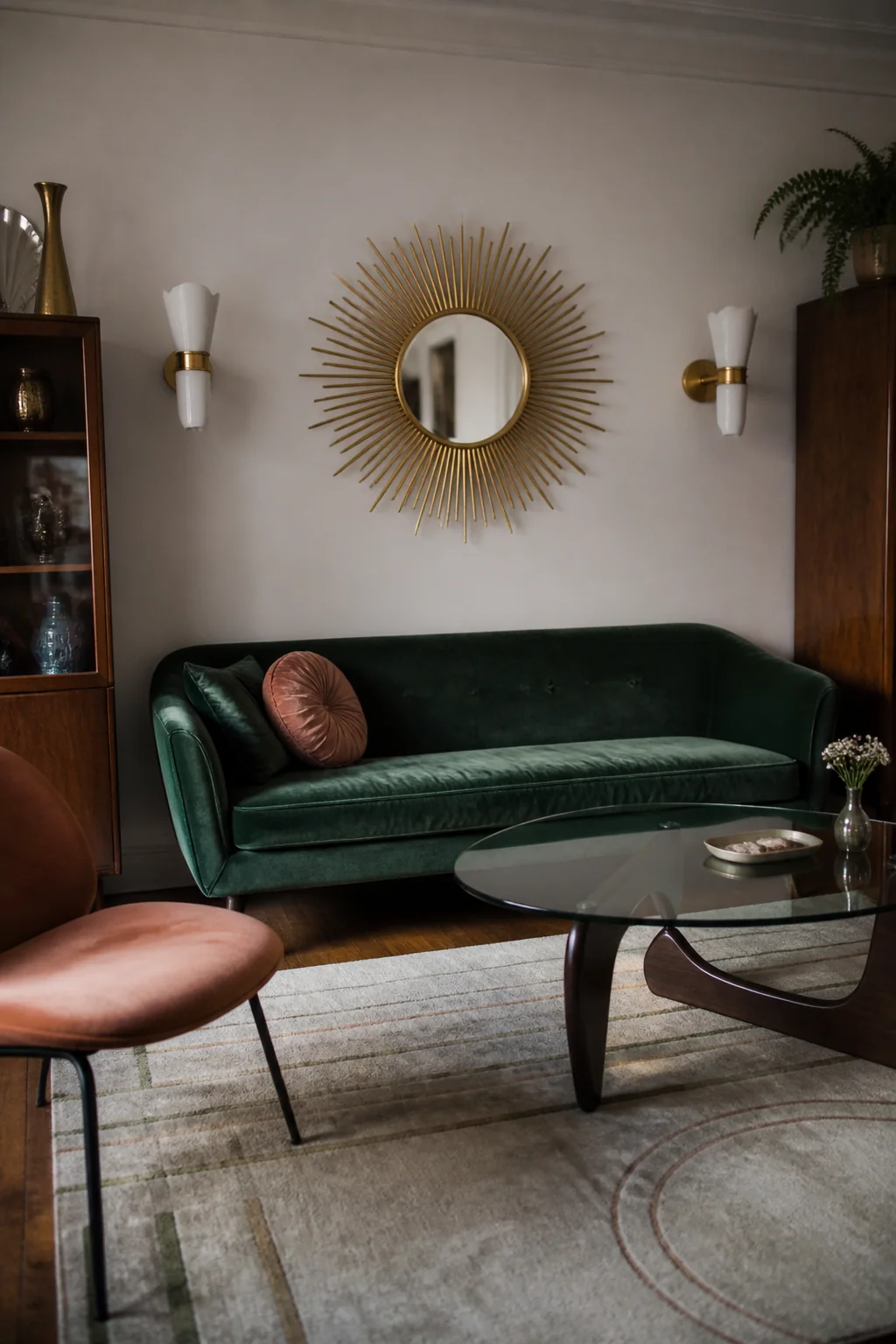
This is the signature art deco move. A mirror with radiating brass rays creates immediate focal point drama, but scale it to the sofa rather than the wall: around two thirds of the sofa's width, so roughly a 56-inch starburst over an 84-inch sofa and a 30-inch one over a loveseat. Hang the bottom edge 6 to 10 inches above the sofa back, which usually puts the center 56 to 60 inches off the floor.
Look at what it will reflect before you drill. A sunburst aimed at a blank hallway wall or a ceiling fan gives you a rotating blade in the frame all evening; pointed at a window or a lamp, it pushes light back into the seating area. Weight decides the hardware. Resin and MDF versions with gold leaf run $80 to $250 and weigh 10 to 20 pounds; solid brass rays start around $400 and need a stud or a toggle bolt rated well above the mirror's weight.
6. Install sconces flanking a central focal point
Sconces do the job a single ceiling fixture can't: they put light at eye level and add two more vertical lines to the wall. Place them on either side of your sunburst mirror or above a console table, 60 to 66 inches from the floor to the center of the fixture, and 24 to 36 inches out from the mirror's center so the pair frames it instead of crowding it.
Hardwiring is cleaner but means a junction box and an electrician, typically $100 to $200 per side. Plug-in sconces with a fabric-covered cord dropping to an outlet cost $60 to $200 each and skip the wiring entirely. Put both on one dimmer. Choose frosted or opal glass shades with 2700K bulbs around 450 lumens, because a bare filament bulb reflected in a mirror across the room becomes glare you'll notice from the sofa every night. Measure twice for symmetry; a sconce an inch off center reads as a mistake, not a quirk.
7. Use black accent walls strategically
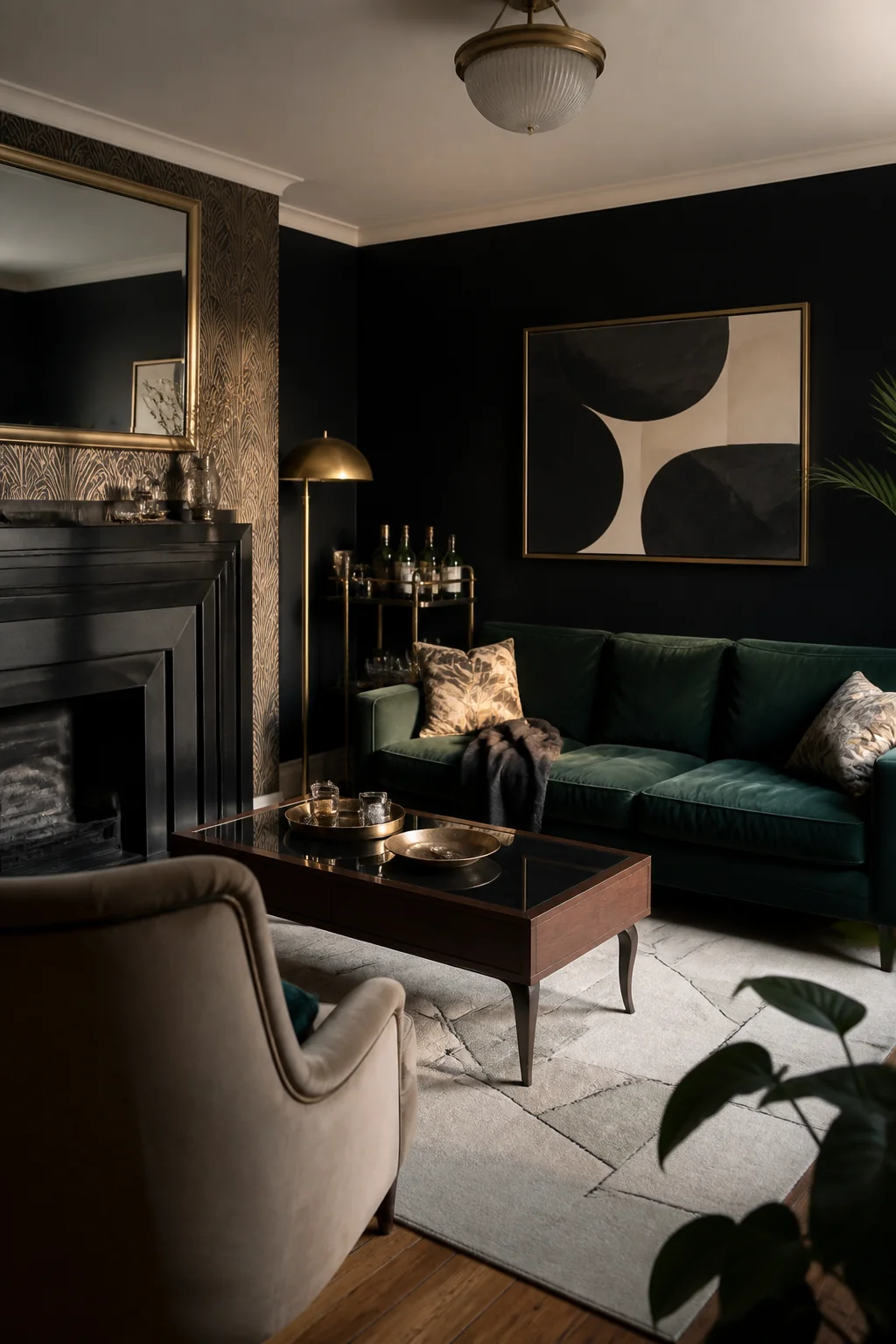
Paint one wall, ideally behind your sofa or opposite the main seating, in matte black or very dark charcoal. Sheen is the decision that makes or breaks it. Matte absorbs light and hides drywall seams, tape lines, and roller marks; anything with gloss shows every imperfection the wall has, and a dark color amplifies them. Use a gray-tinted primer first, then two finish coats, or the black will look patchy and slightly blue in raking window light.
Buy one gallon and stop there, because a 12-foot wall at 9 feet tall is only about 108 square feet against the 350 to 400 square feet a can will reach, so $50 to $80 does the whole job. Test a 2x2 foot patch and live with it for two days. In a room with one small north-facing window, a black wall flattens the space rather than framing it. Painting the trim and any built-ins the same color keeps the wall reading as one deep plane, which is what makes brass and jewel tones stand out against it.
8. Incorporate a marble or glass coffee table
A glass top on a brass base runs about $400 to $600. Marble with brass legs costs more but feels museum-quality. Height is the detail most people skip: aim for 16 to 18 inches, roughly one to two inches below the sofa's seat height, with a length about two thirds of the sofa. Leave 14 to 18 inches between the table edge and the sofa so legs pass through without a shin bruise.
Both materials carry a maintenance cost. Marble is porous and etches dull where lemon, wine, or coffee sits, so it wants a penetrating sealer once a year and coasters permanently. Tempered glass at three eighths to half an inch thick is sturdy but records every fingerprint, and that shows most in a dark room lit from the side. Round or square geometry both work; skip organic, river-edge shapes, which belong to a different era. A 42-inch marble top can pass 100 pounds, so plan on two people and a clear path.
9. Layer patterned throw pillows in contrasting scales
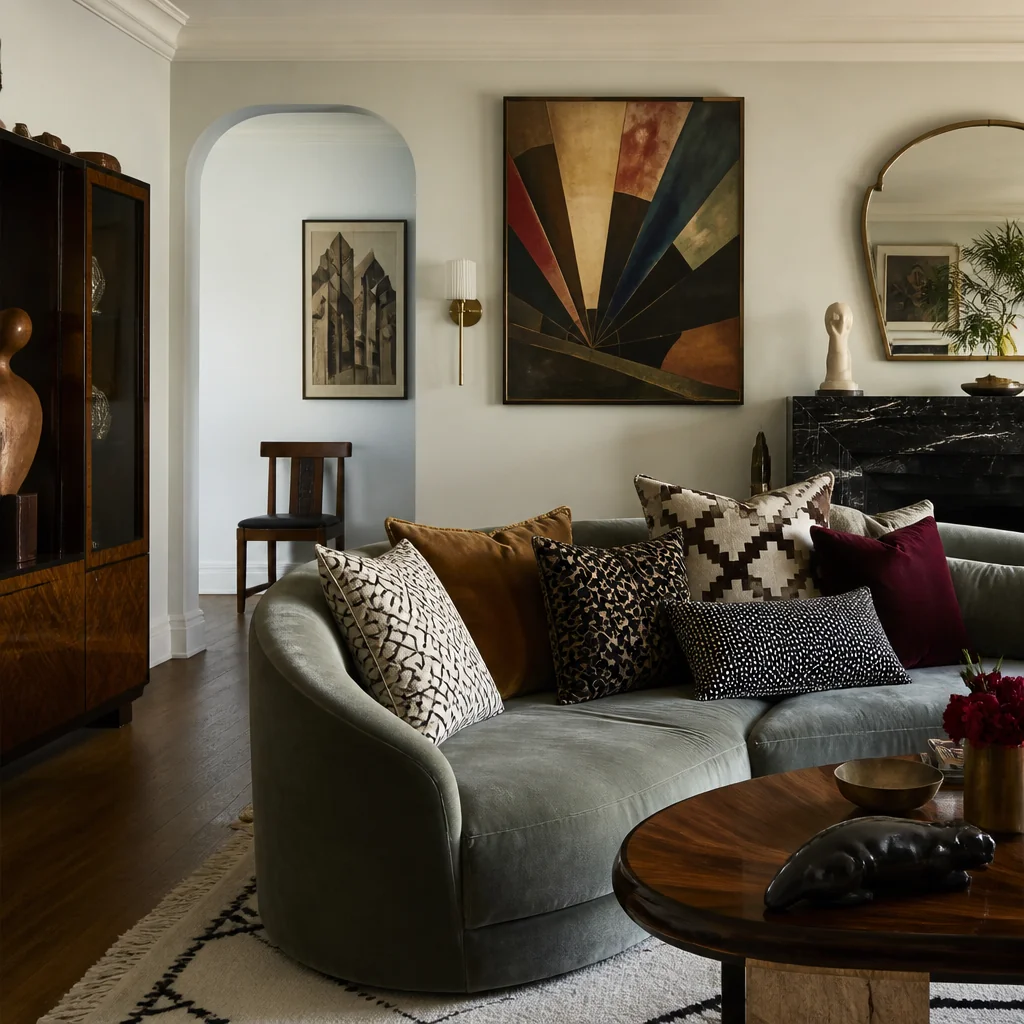
Mix small geometric patterns with solid jewel tones. A 16x16 pillow with an art deco print next to a solid emerald 18x18 creates visual interest without clashing. Stick to two colors maximum (say, navy and gold) so it reads as intentional.
On an 84-inch sofa, five is the number that works: a pair of 20x20 in the corners, a pair of 18x18 in front of those, and one 16x16 lumbar in the middle. Order the fill a size up from the cover, dropping a 20-inch insert into an 18-inch cover, or the corners deflate and go slack inside a week. Feather-down inserts cost $12 to $20 each and hold their shape when you chop the top; polyester runs $8 to $12, stays puffier out of the bag, and flattens under actual use. Covers with a hidden zipper at $20 to $45 let you change the pattern without rebuying the fill.
10. Hang abstract geometric artwork in a grid
Three pieces arranged in a tight vertical grid over a console table or side wall looks more curated than one oversized piece. Black frames with artwork in shades of gold, navy, and cream keep the focus sharp. Use identical frames, typically 16x20 with a 2 to 3 inch mat, and hold the gap between them to 2 or 3 inches so the trio reads as a single tall block rather than three separate decisions.
Pin the middle of the trio at roughly 57 inches up and the block meets the eye square on. If it hangs above a console, keep the bottom edge 8 to 10 inches above the surface so lamps and objects don't crowd the lowest frame. Cut paper templates the size of each frame and tape them to the wall before you touch a drill. Sliding paper around for five minutes costs nothing; patching four wrong holes in a matte black wall costs you an afternoon and a repaint. Simple metal or wood frames run $25 to $60 apiece at that size.
11. Add a brass floor lamp with a geometric shade
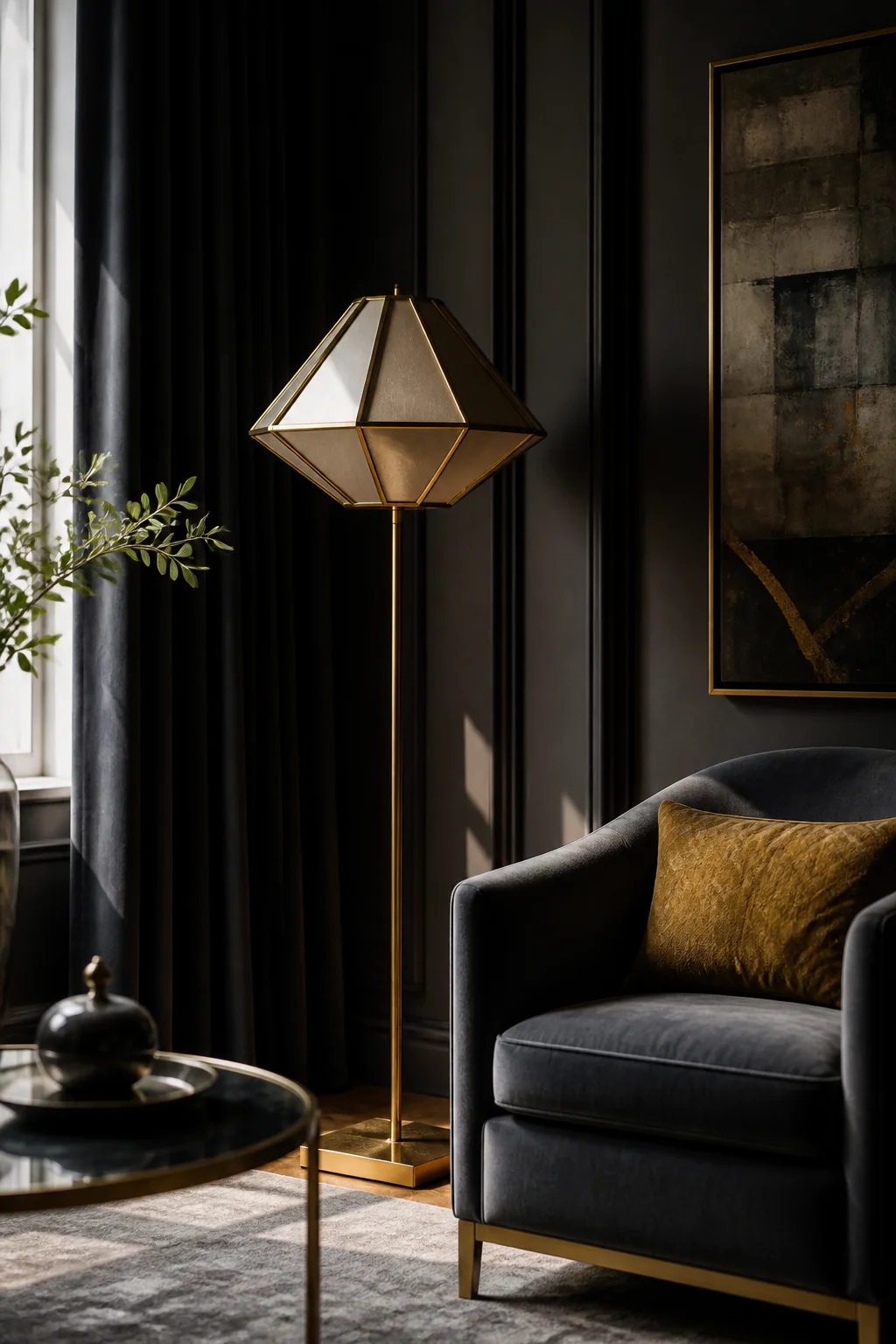
A tripod arc lamp or a tall cylinder shade lamp in a warm brass finish costs $150 to $350. Position it beside a reading chair so the bottom of the shade sits 58 to 64 inches up, above your eye line when seated and below it when you stand. An arc lamp should reach 20 to 30 inches over the seat, and that overhang is exactly why the base matters: anything under about 25 pounds of marble or cast metal will tip when a chair back knocks it.
Fill it with an 800 to 1,000 lumen bulb at 2700K. Cooler daylight bulbs turn brass gray and drain the warmth out of every jewel tone in the room. Run the cord along the baseboard behind the chair rather than across the rug, partly because it's a trip hazard, and partly because a cord crossing a geometric pattern is the first thing your eye catches in the finished room.
12. Place a side table in glass, brass, or lacquered wood
An end table about 24 inches tall and 18 inches wide with clean lines keeps the style consistent. The measurement that matters most is arm height: the tabletop should land within 2 inches of the sofa arm, above or below, so setting a glass down doesn't take a reach. Leave a 2 to 3 inch gap between the table and the sofa so cushions can be fluffed without shoving furniture around.
Each material behaves differently over time. Glass and brass keep a corner visually open in a small room. Mirrored surfaces look right for the period but show water rings, so coasters are not optional. High-gloss lacquer chips at the edges where a vacuum knocks it. Expect $80 to $250 for something well made, and check that the top is at least 14 inches across, since anything narrower won't hold a lamp base and a mug at once. Avoid ornate carved wood; sleek and polished is the art deco way.
13. Bring in black lacquered storage or a bar cabinet
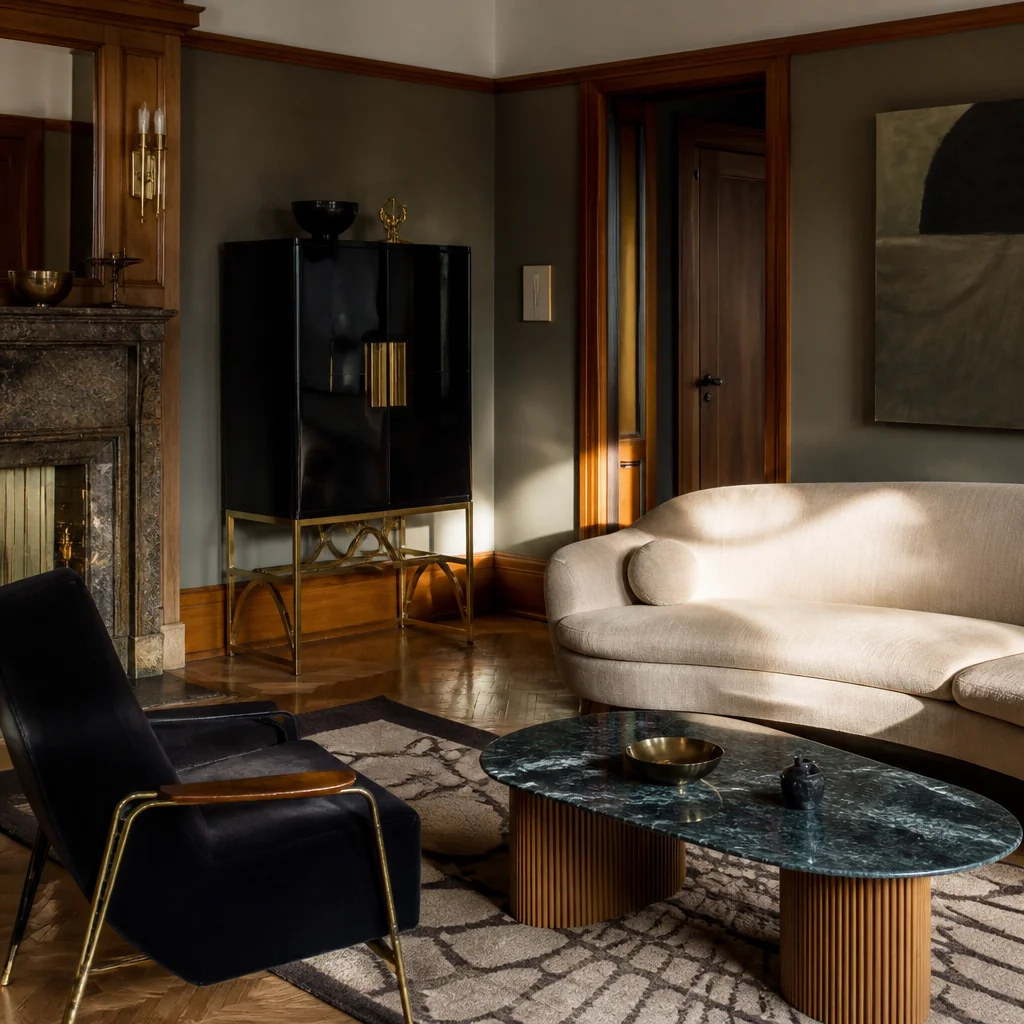
A small bar cabinet with a black or dark wood finish and brass hardware reads instantly glamorous, and it gives the room a piece of furniture with real weight instead of another open shelf. Look for something 32 to 36 inches wide, 16 to 18 inches deep, and 30 to 36 inches tall. Check the interior height before you buy: a standard 750ml bottle needs about 13 inches of clearance, and plenty of cabinets in this style give you 11.
Prices run $300 to $900, and the gap usually comes down to whether the finish is real lacquer over MDF or a printed foil wrap that peels at the corners within a few years. High-gloss black shows dust and fingerprints the way a phone screen does, so keep a microfiber cloth inside. Watch the depth against your walkway: you want 30 to 36 inches of clear path in front, and an 18-inch cabinet eats that fast in a narrow room. Stock it or keep it closed; the visual impact is what matters.
14. Use metallics on picture frame edges
Brass frames for artwork, photos, or a large mirror intensify the luxe feeling, and a metal profile of 1 to 2 inches carries enough visual weight to hold its own against a dark wall. Don't go subtle here. Solid or brass-plated aluminum frames run $30 to $80 at 16x20; the thin gold-finish plastic ones sold in multipacks read cheap under warm light, where the seams and mold lines catch the eye at close range.
Keep one finish per grouping. A run of four brass frames with a single antique gold in the middle looks like an oversight, not a mix. If the art hangs on the wall opposite a window, anti-reflective glazing adds $30 to $60 per frame and is the difference between seeing the artwork and seeing yourself. For a heavy framed mirror, check the frame depth: past about 2 inches it needs a French cleat rather than the sawtooth hanger that came in the box.
15. Add a jewel-tone ottoman as a functional accent
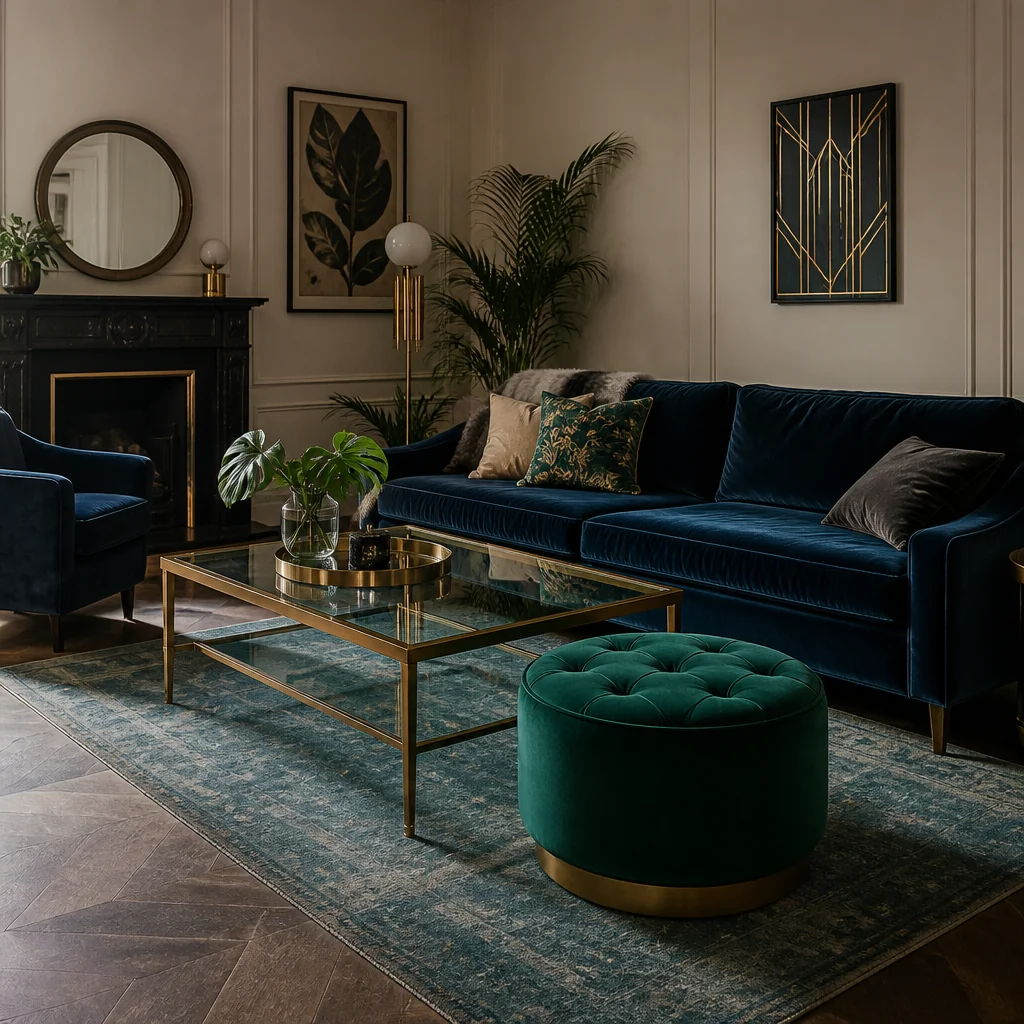
Upholster it in the same velvet as your sofa or in a contrasting jewel tone like sapphire if your sofa is charcoal. About 24x24 inches works for most living rooms, and the height should sit within an inch of the sofa seat, generally 17 to 19 inches, so it works as a footrest without pushing your knees up. Keep 14 to 18 inches between the ottoman and the sofa front: enough for feet to pass, close enough to reach without shuffling forward.
If it doubles as seating, choose a performance velvet rated near 50,000 double rubs. Decorative velvets around 15,000 pill along the top edge inside a year, and on a jewel tone that wear shows as a pale patch. A lift-top version swallows blankets and remotes and runs $120 to $350. Set an 18-inch brass or lacquer tray on top and the same piece becomes a coffee table, which is how it earns its footprint in a room too tight for both.
16. Install a geometric wall panel or wallpaper accent
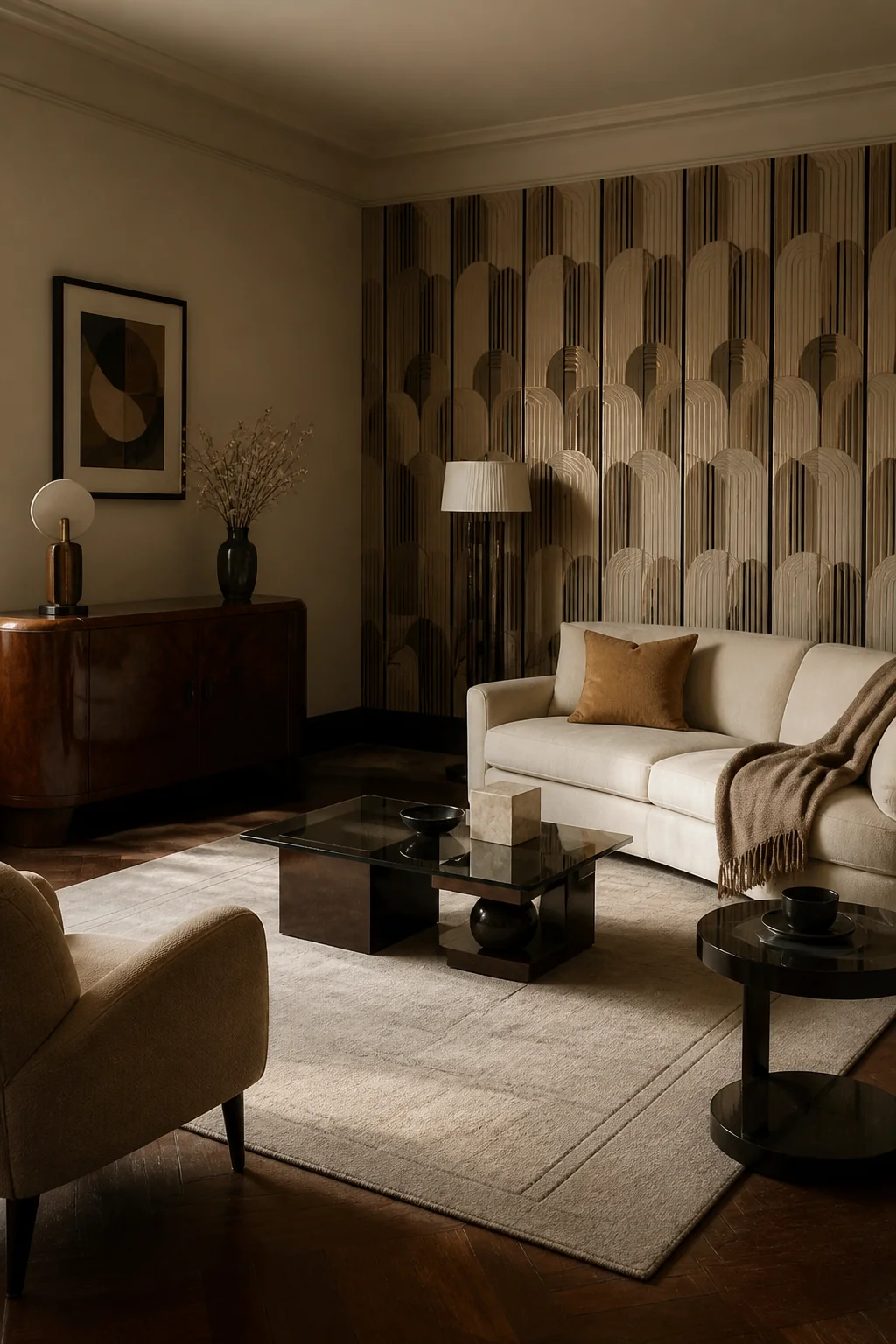
A single wall of art deco geometric wallpaper in black and gold or navy and gold creates sophisticated visual texture. Apply it to one feature wall behind a console or sofa. Expect to spend $30 to $60 per roll for quality paper, and do the arithmetic before ordering. A standard European roll is about 20.5 inches wide by 33 feet long, roughly 56 square feet, but a large pattern repeat eats extra length at every seam where the motif has to line up, so a 12x9 foot wall takes three rolls rather than two.
Peel-and-stick is forgiving and removable, which matters in a rental, though it lifts at the seams in a humid room. Traditional paste-the-wall paper sits flatter and lasts far longer. Either one needs a smooth surface underneath. Orange peel or knockdown texture telegraphs straight through a bold geometric print, so a skim coat or lining paper first is the step that separates a crisp wall from a bumpy one.
17. Layer sheer and solid curtains for depth
Under your jewel-tone drapes, hang a sheer gold or champagne-colored curtain liner. When light filters through, it creates a warm, luminous effect that photographs beautifully and feels authentically glamorous. You need a double rod for this. The outer bracket should project 5 to 6 inches from the wall so the heavy panels clear the sheers behind them, with the inner rod sitting at 2 to 3 inches.
Sheers want more fullness than drapes, closer to two and a half times the window width, and they cost far less at $15 to $30 per panel, so buying extra width is cheap insurance against a thin, stretched look. Pick the color against your brass rather than against the wall. A bright white sheer beside warm brass and emerald velvet reads cold and faintly blue; champagne, ivory, or pale gold keeps everything at one temperature. The practical payoff is daytime privacy with the drapes wide open.
18. Use brass or chrome hardware on all cabinets
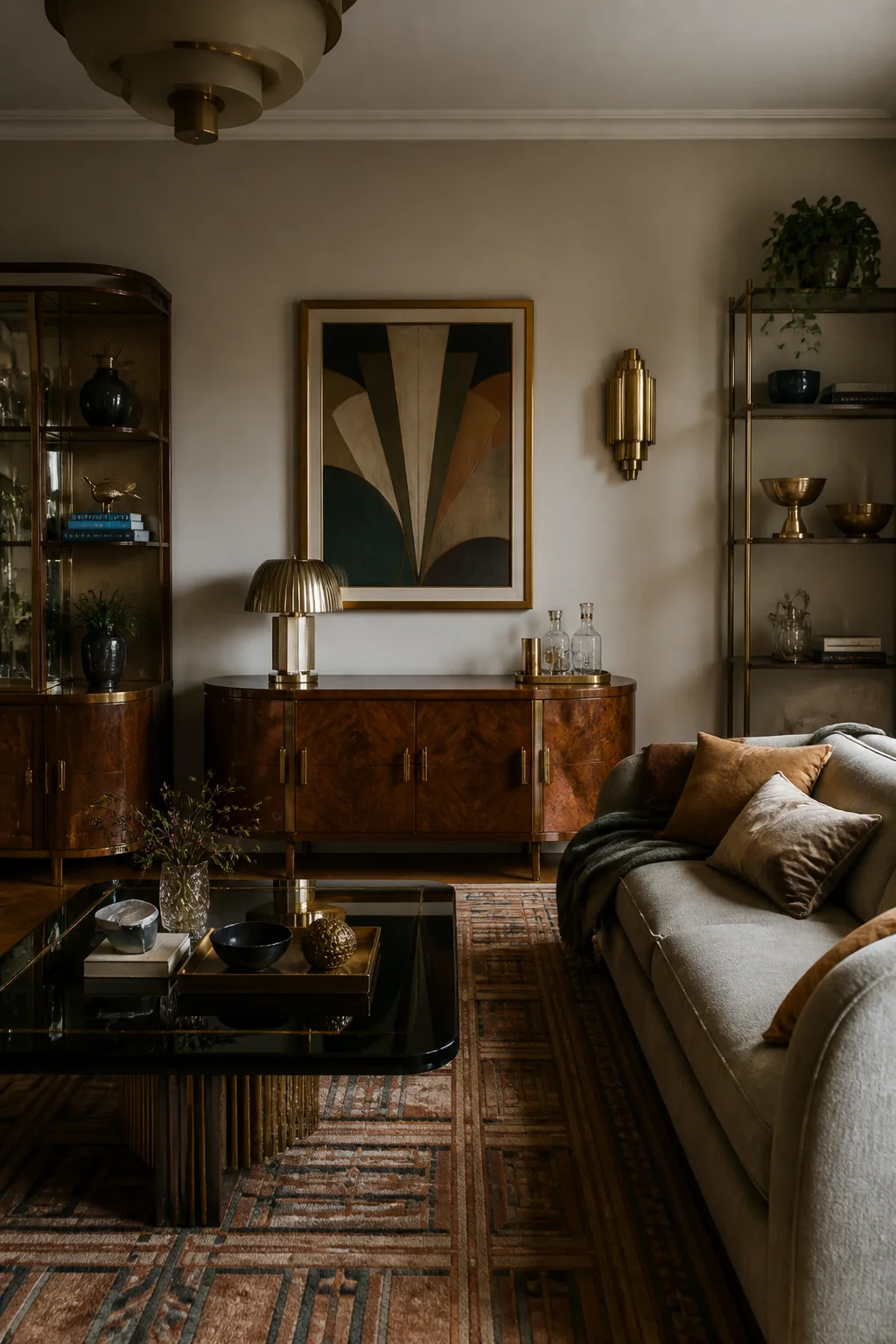
If you have built-in shelving or a media console, swap out existing knobs and handles for art deco-inspired brass or polished chrome. This small detail ties the whole room together, but measure before you order anything. Pulls are sized by center-to-center hole spacing, and 3 inches (76mm), 96mm, and 128mm cover most cabinets. A pull that's 10mm off will not line up with the holes you already have. Knobs are single-hole and interchangeable, which makes them the easier swap.
Check screw length too, since a thicker door or an added backplate needs 1 inch or longer machine screws, usually sold separately. Budget $6 to $18 per piece, so a console with eight pulls costs $50 to $140 and takes about twenty minutes with a Phillips screwdriver. If the spacing doesn't match, a rectangular brass backplate hides the old holes and adds another geometric shape to the door front, which looks like a design decision rather than a repair.
19. Add a potted plant in a geometric ceramic planter
A tall floor plant in a black or gold ceramic pot with sharp lines brings organic texture while staying true to the geometric aesthetic. A fiddle leaf fig or snake plant works well at about 3 to 4 feet tall. Match the planter to the nursery pot rather than to the plant: a 10-inch grower pot drops neatly into a 12 to 14 inch cachepot and lifts straight out at watering time, which beats repotting into a ceramic with no drainage hole and slowly drowning the roots.
Light decides which plant you buy. A fiddle leaf fig wants bright indirect light within 3 to 5 feet of a window and will drop leaves in the dim corner beside a black accent wall. A snake plant holds that same corner for years and forgives three weeks without water. Expect $35 to $80 for the plant and $40 to $120 for a ceramic planter with clean facets or a stepped profile.
20. Create a styled bookshelf with vertical and horizontal stacking
Mix books stood upright with stacks laid flat. Intersperse small brass objects: a clock, a geometric sculpture, a lidded box. The variation reads more intentional than a uniform arrangement, but the sequence matters. Take everything off the shelves first, sort the books by spine color, then rebuild one shelf at a time.
Fill roughly two thirds of each shelf and leave the last third empty. That negative space is what makes the objects look chosen instead of stored. A stack of three or four flat books becomes a pedestal, so put a brass piece on top of it to lift the eye off the shelf line. Alternate which side the upright run sits on from shelf to shelf so the eye zigzags rather than scanning a flat wall of spines. Pull the dust jackets off anything with loud publisher graphics; cloth boards in cream, navy, and black hold the palette. On a 30-inch shelf, two vertical groupings and one stack fill it without crowding.
21. Hang pendant lights with angular or cylindrical shades
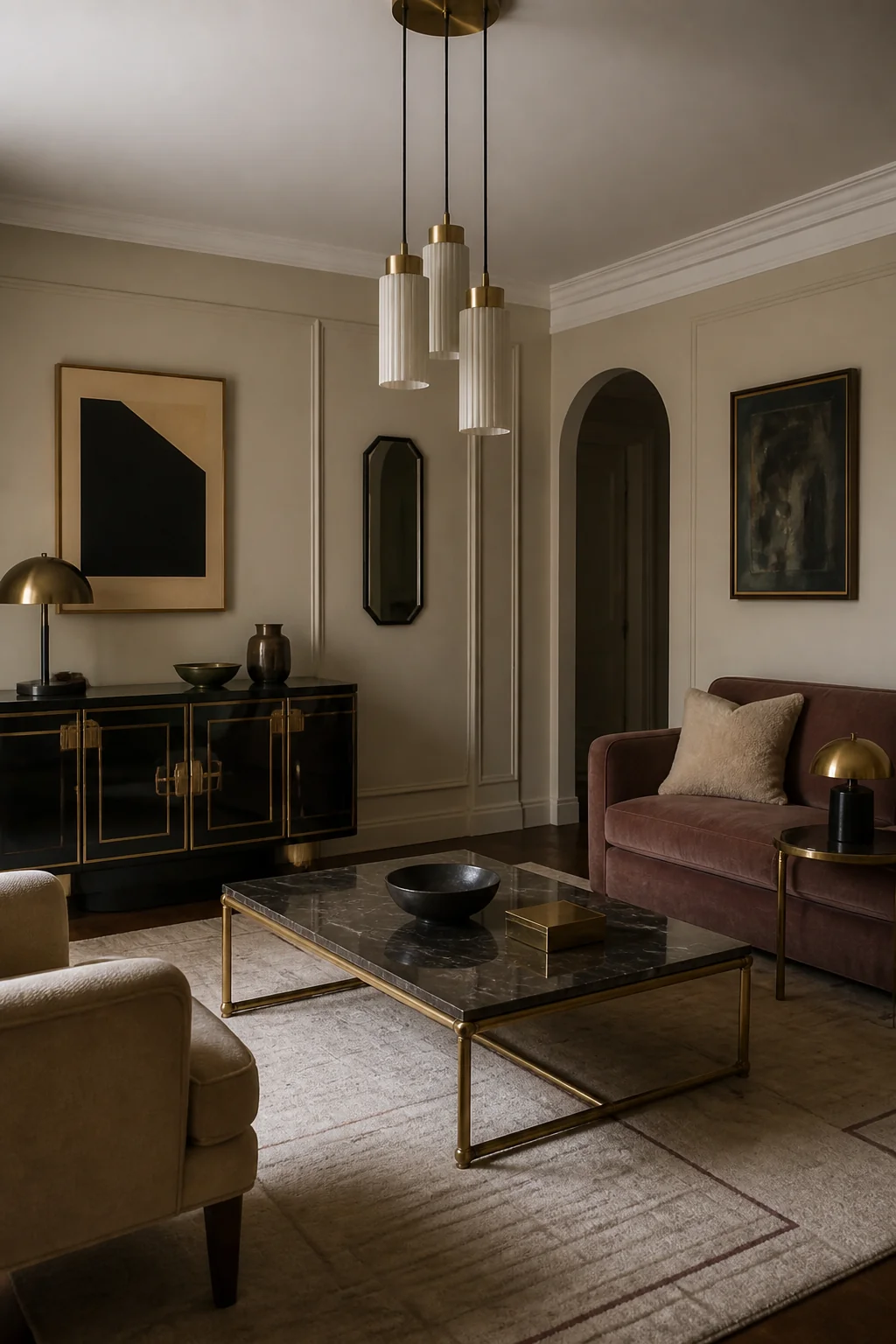
A pair of pendant fixtures with geometric shades hung at 30 to 36 inches above a console table or bar area adds architectural interest overhead. Brass bodies keep them consistent with other metallics in the room. Space the two 24 to 30 inches apart, centered on the surface below, and leave at least 6 inches between the outer edge of each shade and the end of the console so the pair doesn't look shoved to one side.
Pendants need a ceiling junction box rated for the fixture weight. Adding one where none exists means an electrician, typically $100 to $200 per light on top of the fixture at $80 to $300. Buy adjustable rod or cord versions rather than fixed-length, because a 9-foot ceiling and an 8-foot ceiling call for different drops and you rarely know which you want until the fixture is up. Wire them to a dimmer and use 2700K bulbs so the brass stays warm after dark.
Save the full guide
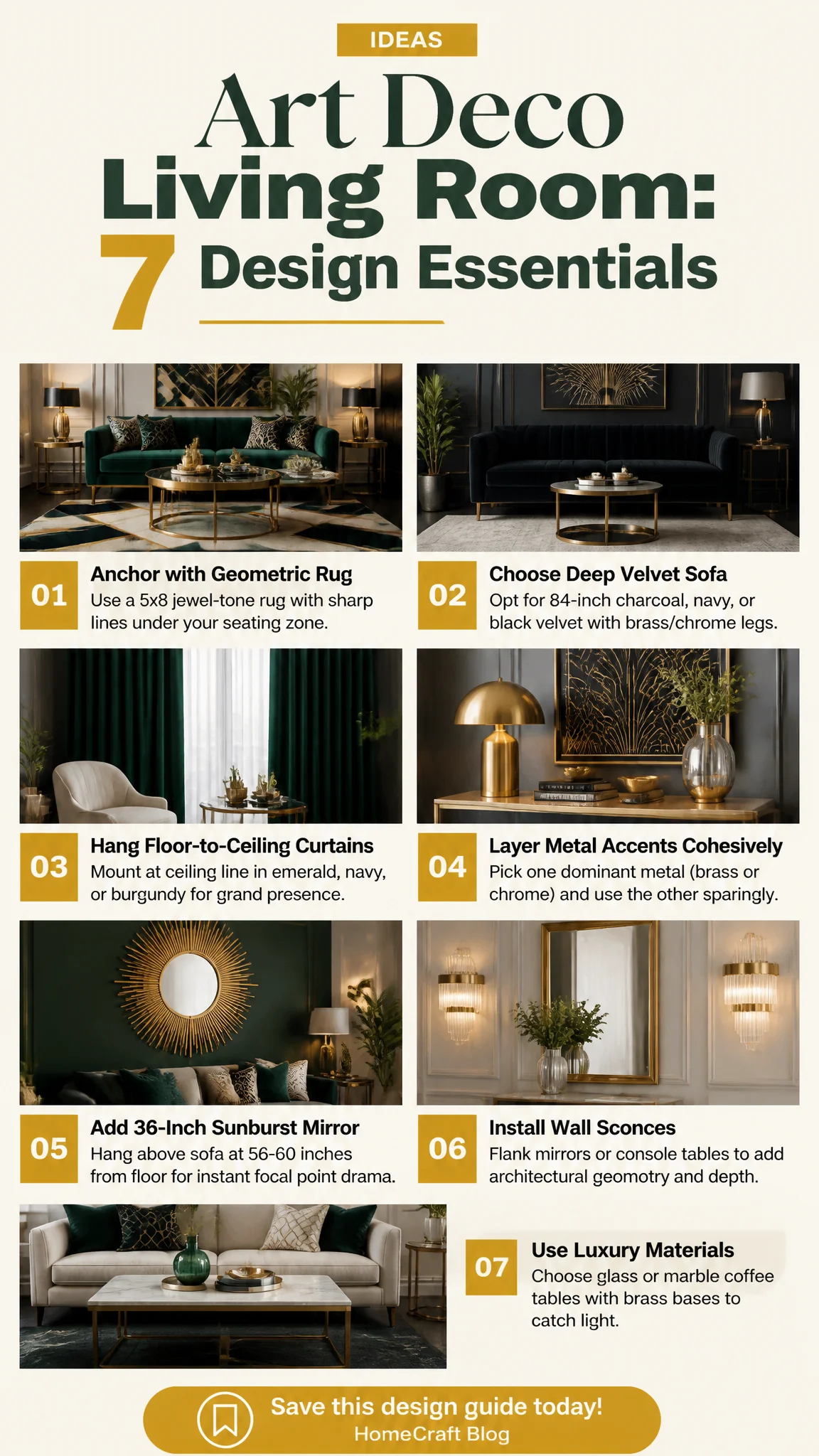
Scale is what separates a room that looks art deco from one that looks like it's referencing art deco. The style falls apart when the pieces are timid: a 5x8 rug swimming under an 84-inch sofa, a 24-inch mirror stranded on a nine-foot wall, curtains stopping short at the window frame. Sharp geometry needs enough size to be read from across the room. Get the proportions right and the brass, the velvet, and the black lacquer all do more work with fewer pieces.