16 Calming Olive Green Bathroom Decor Ideas That Won't Darken a Small Room
Olive green bathroom decor ideas with real paint names, tile and grout pairings, fixture finishes and prices, plus how olive shifts under warm and neutral bulbs.
This post contains affiliate links. As an Amazon Associate I earn from qualifying purchases. If you buy through our links, we may earn a commission at no extra cost to you.
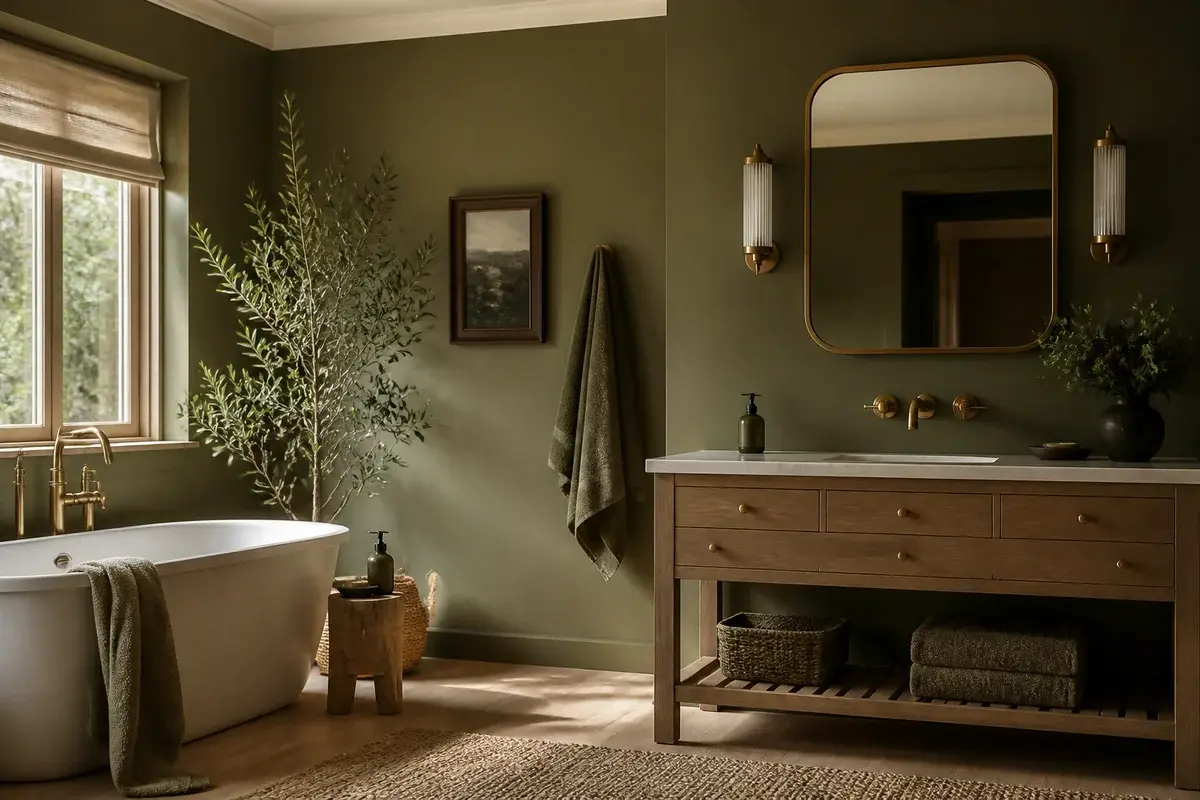
Olive green feels restful in a bathroom because it pulls from nature without shouting, but most bathrooms are small, and one shade too deep makes the space feel cramped or muddy. You need a plan that works whether you're renting, own the place, or just want to test the color before committing. These 16 ideas give you concrete ways to bring olive green in, layer it properly, and keep the room feeling open and calm instead of cave-like.
1. Paint the walls a soft, muted olive instead of a deep forest green
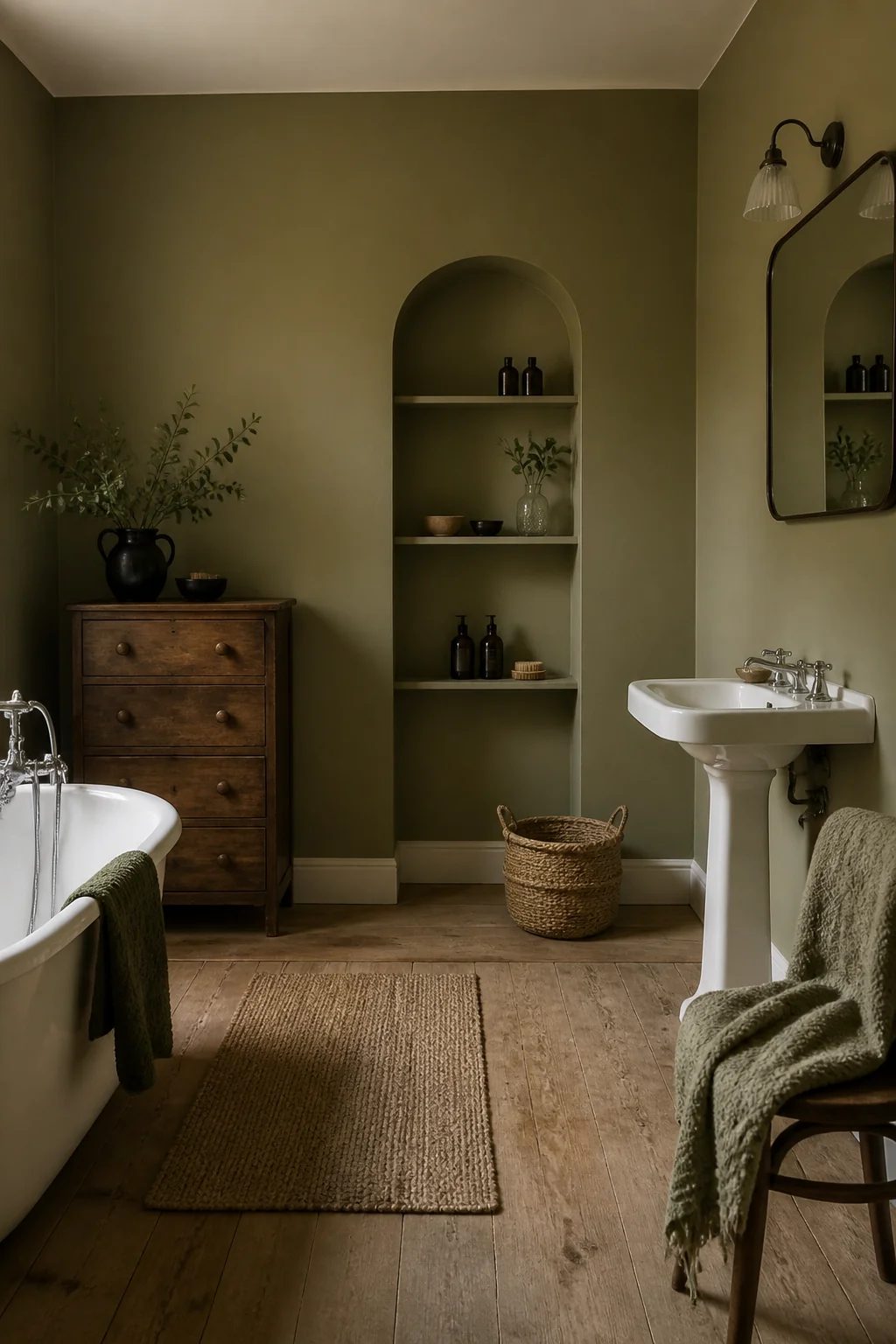
Deep forest green swallows light in a room that rarely has much to spare. A muted, gray-leaning olive keeps the color without the weight: Sherwin-Williams Dried Thyme SW 6186, Benjamin Moore October Mist 1495 and Farrow and Ball Lichen No. 19 all sit in that softer band. Undertone is the thing to check before you commit. An olive with a yellow undertone warms up under 2700K bulbs and can drift toward tan, while the same chip under 4000K reads cooler and grayer, much closer to what you saw in the store. Tape your samples beside the mirror and look at them at night with the vanity light on, not at noon by the window. Finish matters just as much in a wet room. Eggshell scuffs and holds moisture along the splash line, so satin or a bathroom-specific paint like Benjamin Moore Aura Bath and Spa copes with steam far better. Premium paint runs $50 to $75 a gallon, and two coats is standard.
2. Add olive green subway tile to the shower wall only
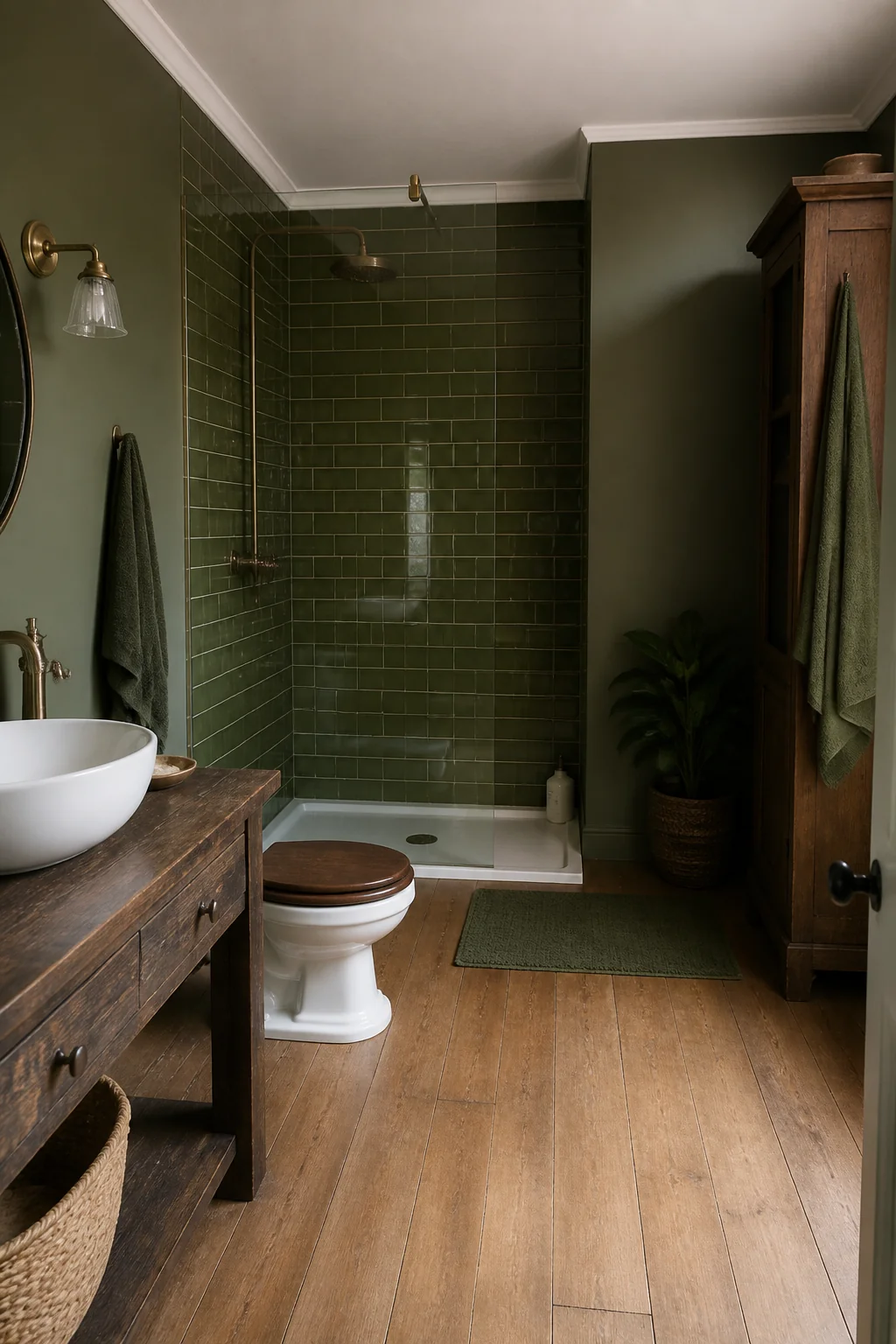
Tile is the one decision here you can't undo with a roller, so keeping it to a single wall behind the tub or shower limits both the cost and the regret. A standard tub back wall, roughly 5 feet wide and tiled to 7 feet high, works out near 35 square feet. Glossy olive 3x6 field tile runs $8 to $15 per square foot; a handmade zellige-style olive with real variation in the glaze climbs past $20. Labor typically adds $10 to $15 per square foot, which is where a $400 to $600 total for a small feature wall comes from. Grout color decides how the finished wall reads. Bright white grout draws a sharp grid around every tile and stains fastest in a wet corner, while a light greige or soft gray keeps the olive continuous and hides soap film between cleans. Use unsanded grout for joints under 1/8 inch so the lines stay crisp.
3. Hang a large olive green shower curtain with a white or cream interior
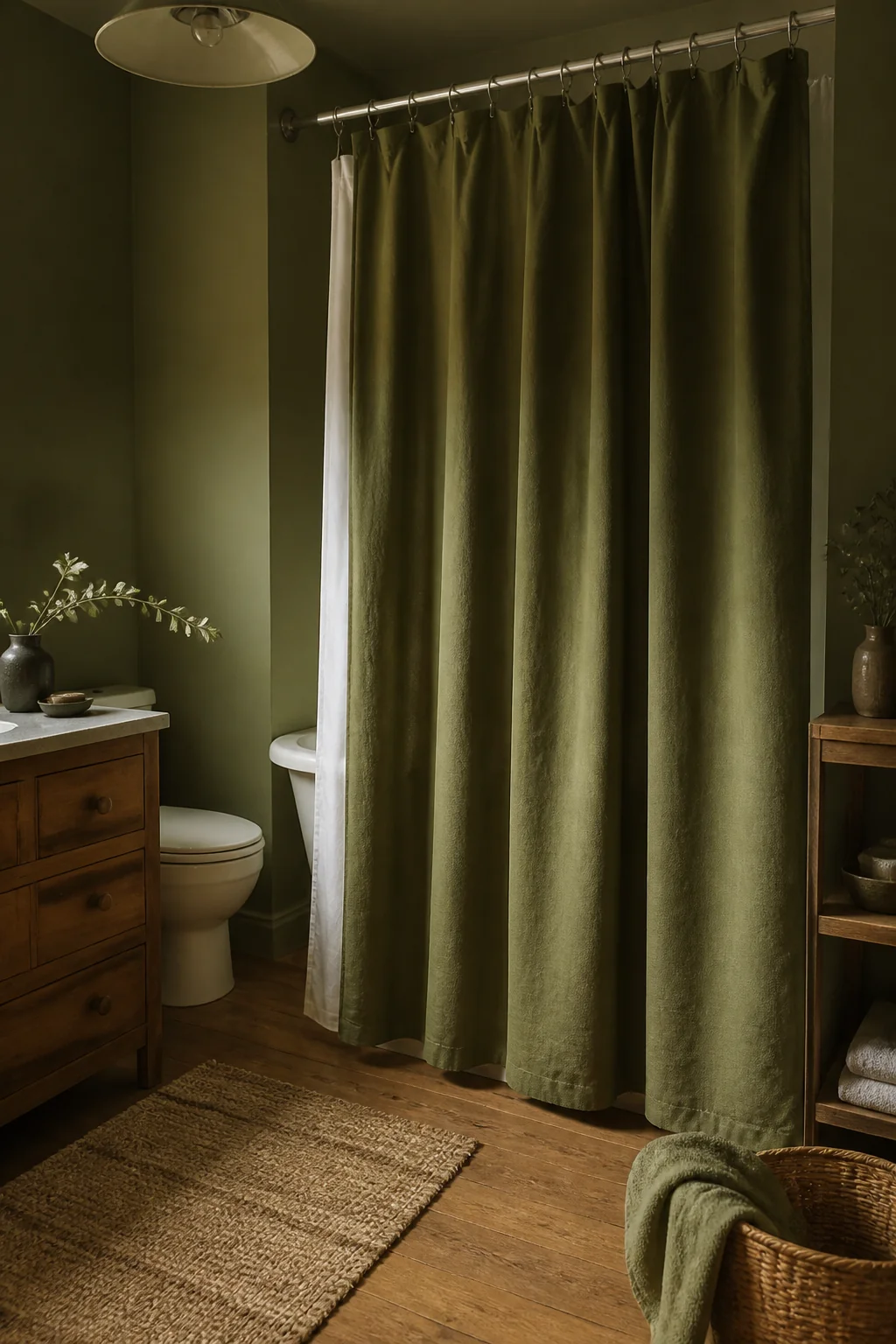
Nothing here is permanent, which is why this is usually the first move in a rental. A 72x72 olive curtain runs $50 to $80, and the lining decides whether the room stays bright. A white or cream liner bounces light back at you; a charcoal or matching olive liner absorbs it, and the tub alcove turns into a dark box at the end of the room. Set the rod at 75 to 77 inches off the floor so the hem clears the tub lip by an inch or two and never sits in standing water. Cotton and cotton blends hang better than PEVA but need a warm wash every six to eight weeks, then go back on the rod damp so the creases fall out. If the bathroom has no window, we'd go one shade lighter than the swatch you like, because olive reads noticeably deeper once it's gathered into folds.
4. Layer olive green and white striped towels on a chrome rack
Rolled towels stacked vertically give a narrow wall something to do without the bulk a cabinet would add. Set the bar at about 48 inches off the floor and leave 4 inches of clear wall underneath, so a hanging towel doesn't drag across the counter or the toilet tank. Chrome is the finish most bathrooms already came with, and it holds up fine against olive when the green leans gray. Against a yellow-leaning olive, chrome's cool blue cast can look slightly sour, and the white in the stripe is what pulls the two back together. Stripe direction does real work in a small room: horizontal stripes stretch a narrow wall sideways, vertical ones push the eye upward. Cotton towels at $15 to $25 each are the sensible tier, and anything under 500 GSM goes thin and papery after a year of hot washes.
5. Place olive green terra cotta pots on floating shelves
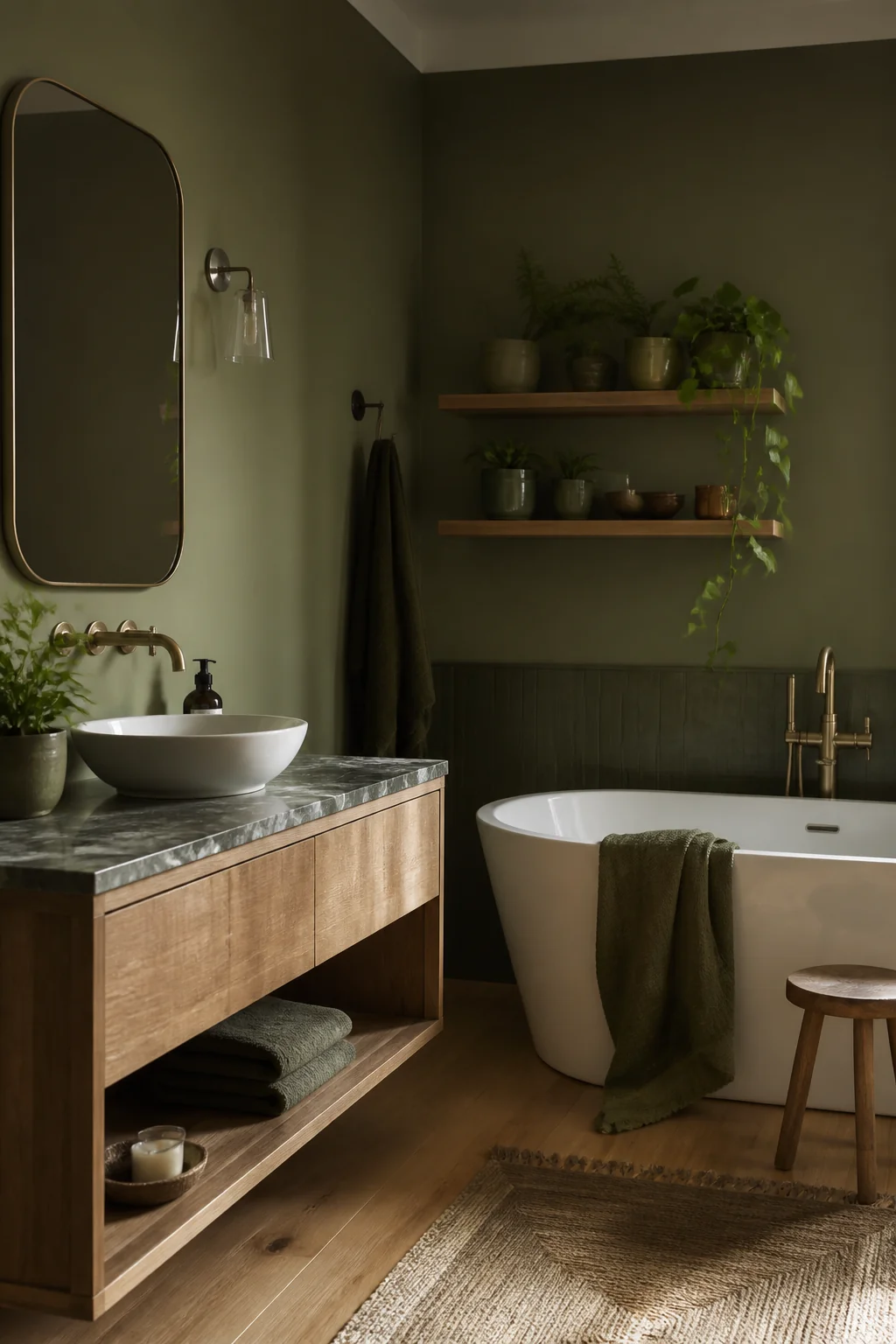
Floating shelves over the toilet are the cheapest square footage in the room. Two 24-inch shelves work well, with the lower one about 24 inches above the tank lid so you can still lift the lid and there's headroom for a tall bottle. Olive glazed terra cotta or ceramic pots at $8 to $20 each echo the wall color, and the plant does the rest. Pothos, snake plant and heartleaf philodendron all tolerate low light and the humidity swings of a room that fogs its own mirror twice a day. All three are on the ASPCA's list of plants toxic to cats and dogs (pothos, snake plant, philodendron), so if a cat can reach the shelf, a spider plant is the safer pick. Unglazed terra cotta breathes and dries fast, which suits a succulent and frustrates anything thirsty. Skip drainage holes over a shelf unless you enjoy water rings on the paint: use a cachepot with the plastic nursery pot dropped inside, then lift the whole thing out and water it at the sink.
6. Use an olive green bath mat with a non-slip backing
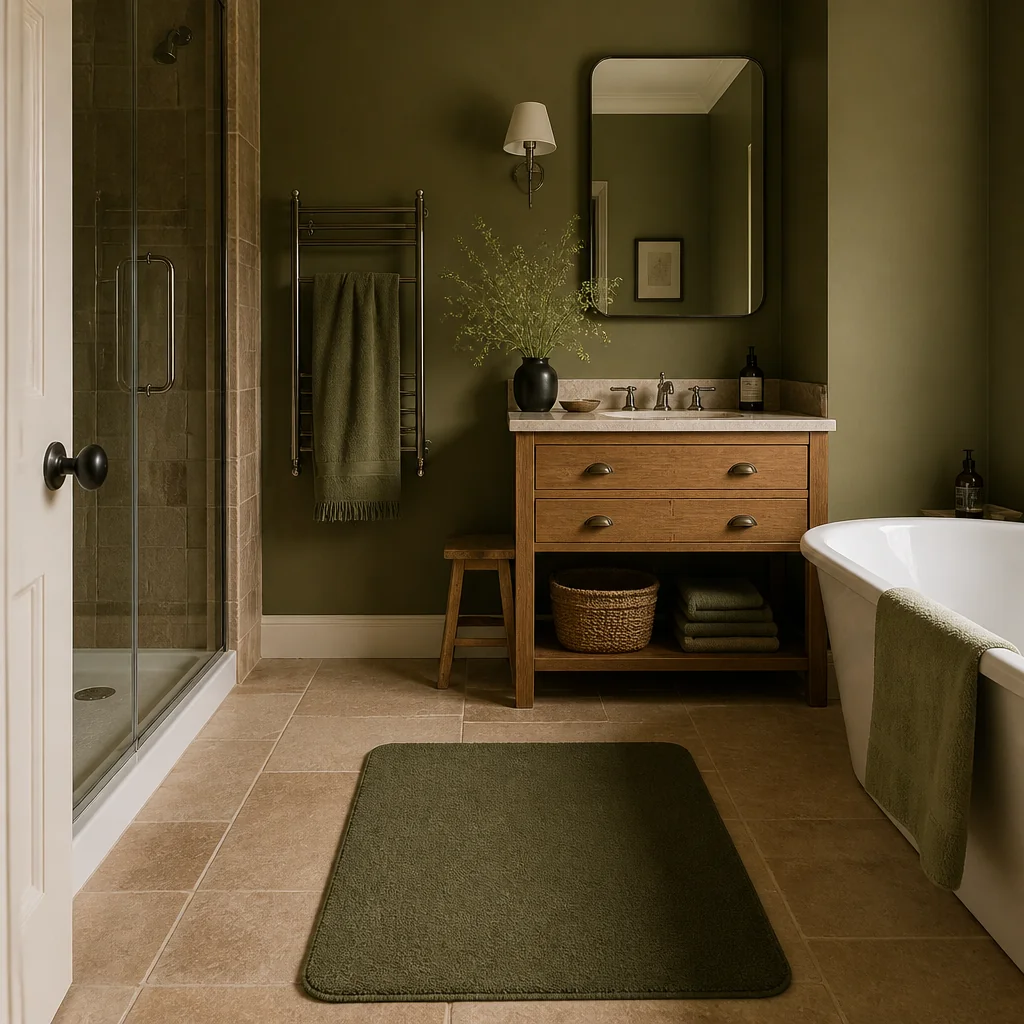
A 24x36 mat in front of the sink or tub puts color on the floor without stealing usable space. The backing is the part that matters: latex or TPR grips glazed porcelain, while a plain woven rug slides on wet tile and is genuinely risky on the step out of a shower. Cotton chenille and tufted cotton at $40 to $60 dry fastest. Memory foam feels luxurious for about four months, then stays damp underneath, which is how a mildew ring ends up printed on your tile. Wash it cold every two or three weeks and skip fabric softener, which coats the fibers and kills absorbency. Tumble dry on low, since heat cracks rubber backing. Olive earns its place on a bathroom floor for a mundane reason too: it hides the dust and hair that show up the moment a white mat dries.
7. Swap your shower liner for a subtle olive-tinted frosted version
Clear and stark white liners both read a little clinical. A frosted liner with an olive tint costs $20 to $35 and softens the shower opening while still passing light into the alcove. The failure mode is choosing one so dark or so heavily printed that the tiled wall behind it disappears, at which point the tub reads as a closed box and the room loses a good foot of visual depth. Check the gauge as well as the color. Liners run roughly 4 to 10 mil, and the thin ones cling to your legs and tear out at the grommets within a season; 8 mil PEVA is the practical middle. Hang it inside the tub with the hem an inch above the base, and shake it flat after every shower so water can't pool in the folds and start mildew along the bottom seam.
8. Frame a botanical print with an olive green mat and natural wood frame
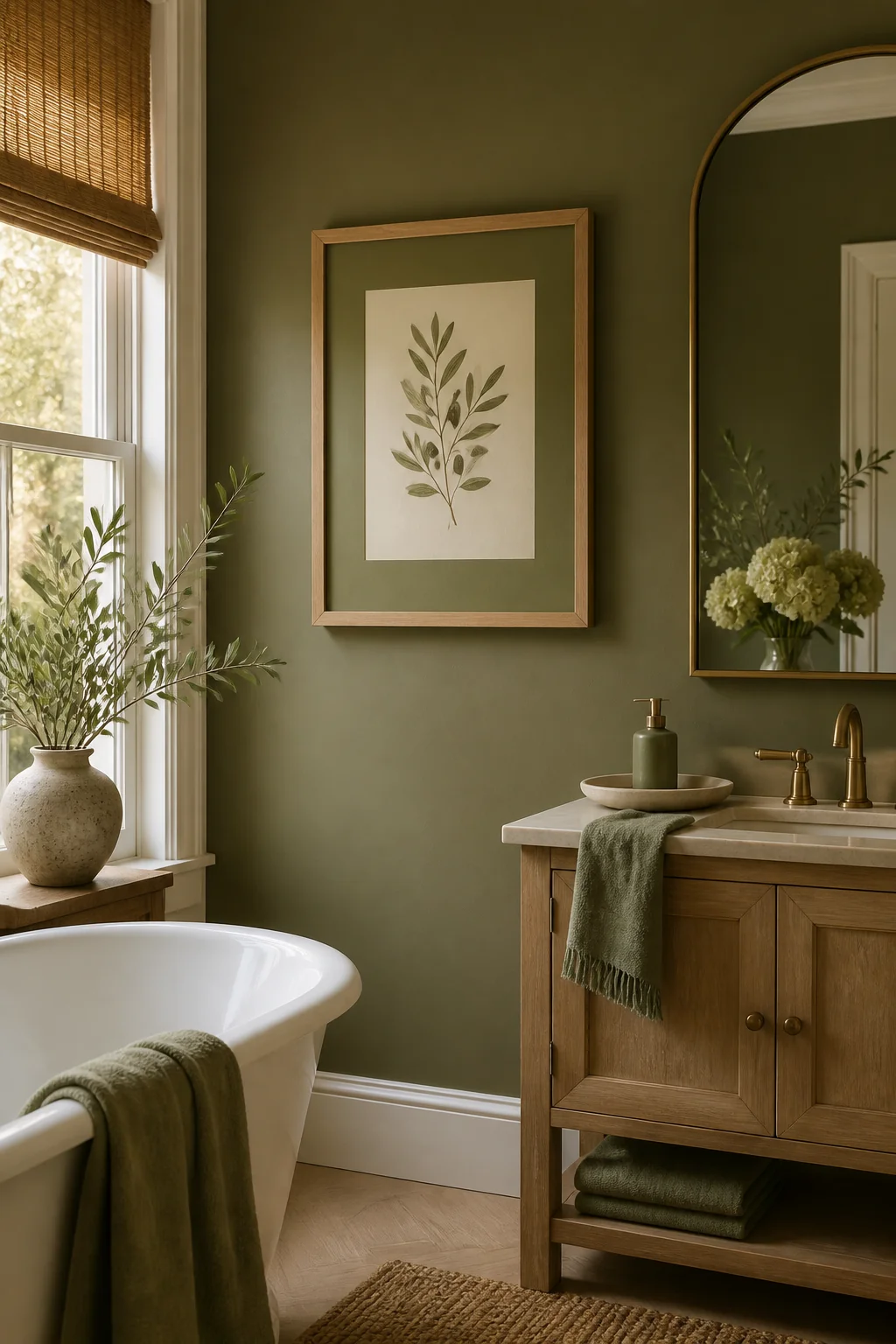
Paper has one real enemy in a bathroom, and it's steam. Frame a 16x20 botanical print of leaves or herbs with a 2-inch olive mat, and ask for foam core backing or a cotton rag print so the sheet doesn't ripple and lift off the mat by the second summer. Sealing the back edge of the frame with tape slows the moisture down further. Natural oak or ash frames at $30 to $50 carry the warm side of olive better than black does, and the wood grain gives the wall a second texture. Hang it on the wall the mirror faces so the print shows up twice in the room. If drilling is out of the question, adhesive picture strips rated for at least double the frame's weight will hold it, though the bond gives out sooner in a steamy room than the packaging suggests, so press them back down every few months.
9. Paint the vanity cabinet a soft olive with white or marble countertop
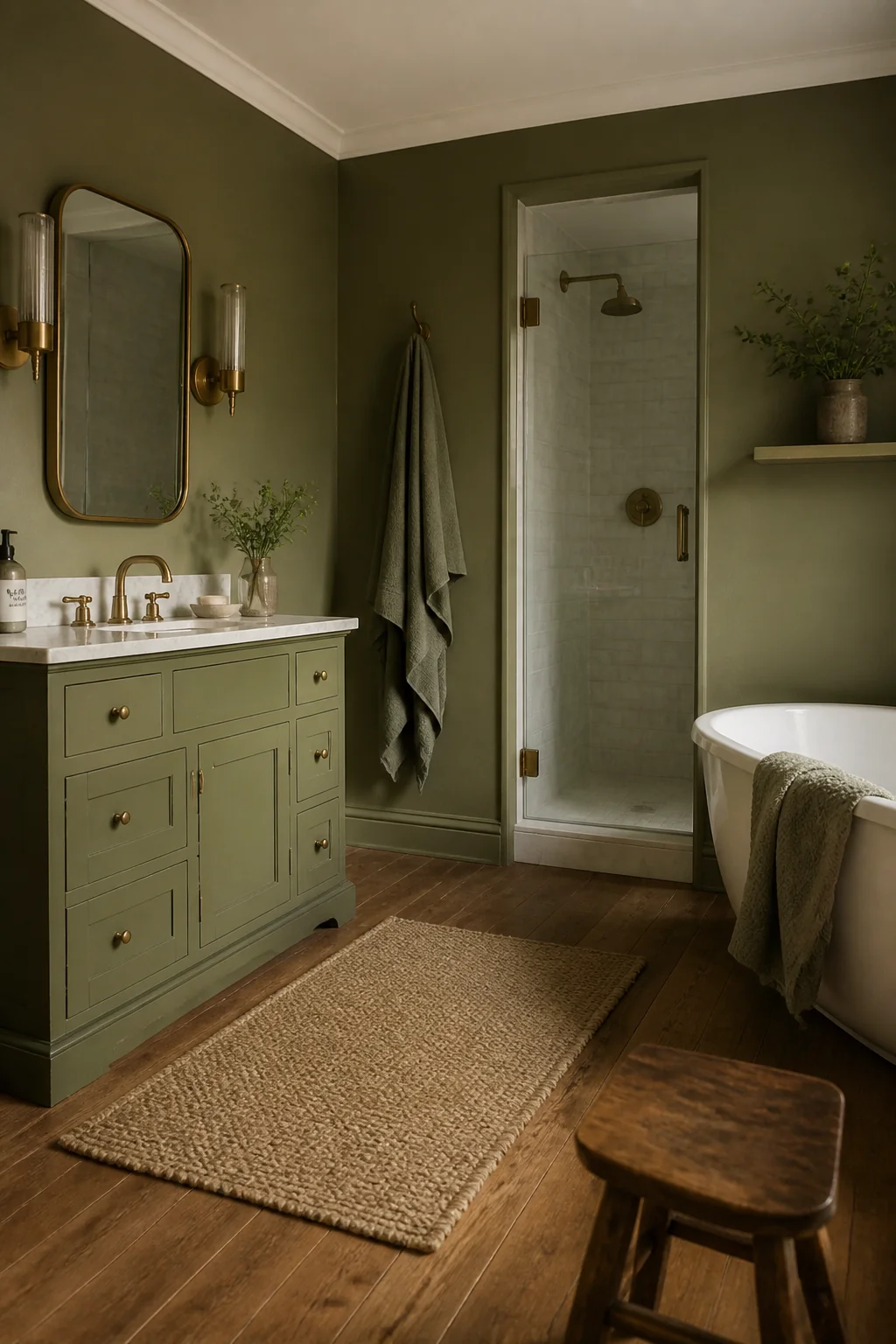
Painting the cabinet is the cheapest way to get olive onto something that isn't a wall. Take the doors off, degrease with a TSP substitute, scuff sand with 220 grit, and lay down a bonding primer before any color goes on, because bathroom cabinets carry years of hairspray and hand cream. Two thin coats of a cabinet-grade enamel like Benjamin Moore Advance or Sherwin-Williams Emerald Urethane, at $30 to $45 a quart, cure into a surface that survives wet hands. Give it a full week before you rehang the doors and longer before you load the drawers, since those enamels reach hardness slowly. A white or light marble top stops the vanity from becoming one solid block of green, and the veining picks up whatever gray hides inside the olive. Skip the chalk paint and wax route here, because wax softens in steam and marks under a dripping soap dish.
10. Add olive green glass jars for cotton balls and Q-tips on the counter
Apothecary jars in olive-tinted glass turn cotton balls and swabs into something you don't mind looking at. A set of three runs $15 to $25. Buy them in stepped heights, roughly 4, 6 and 8 inches, so the group reads as a shape rather than a flat line, and cluster them at one end of the counter instead of spacing them out along it. Ground glass stoppers seal better than loose-fitting lids, which matters for cotton pads that go limp in humidity. There's an honest limit to this one: jars only look calm when the contents are uniform, so cotton balls, swabs and bath salts work, while a jumble of hair ties and sample sachets just puts your clutter behind glass. Tinted glass also hides how low the supply is running, which is either a feature or the reason you keep forgetting to restock.
11. Install olive green hexagon floor tiles in a 12x12 space
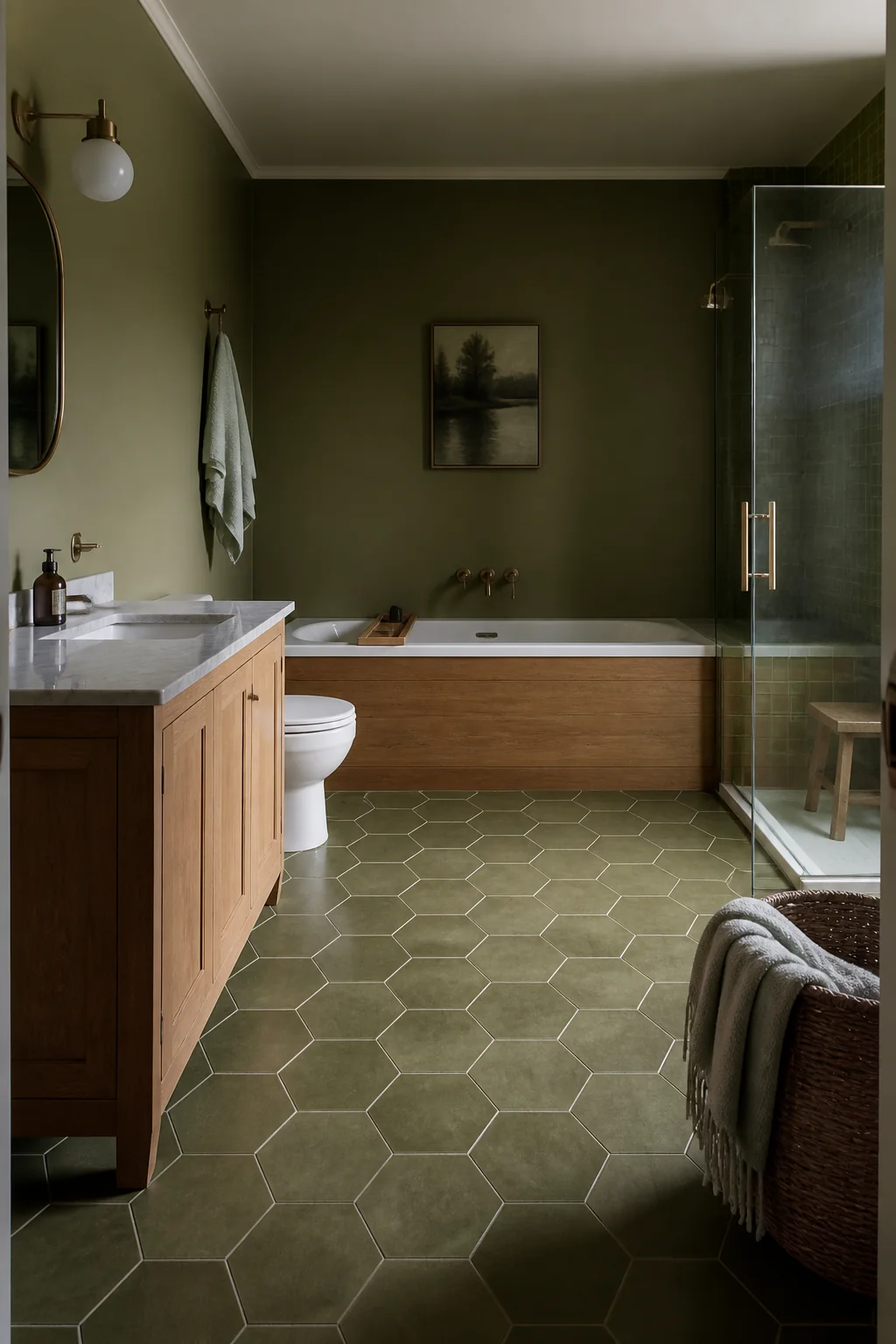
Hexagon tile keeps the eye moving across a floor, which helps in a room too small for a pattern with any scale to it. Olive porcelain hex usually arrives as 2-inch mosaics on 12x12 mesh sheets at $6 to $15 per square foot, so a 5x7 bathroom floor lands around $200 to $500 in tile before thinset, grout and labor. Ask for a matte or honed surface with a wet DCOF of 0.42 or higher, the industry benchmark for level indoor floors that get walked on wet; glossy hex underfoot is one wet heel away from trouble. Grout does the styling here. White or cream grout outlines every hexagon and turns the floor graphic and busy, while a grout matched close to the olive lets the floor sit quietly under everything else. Epoxy grout costs more and is fussier to work with, but it won't absorb the water that darkens cement grout along the tub line.
12. Drape an olive green linen hand towel over a brass towel bar
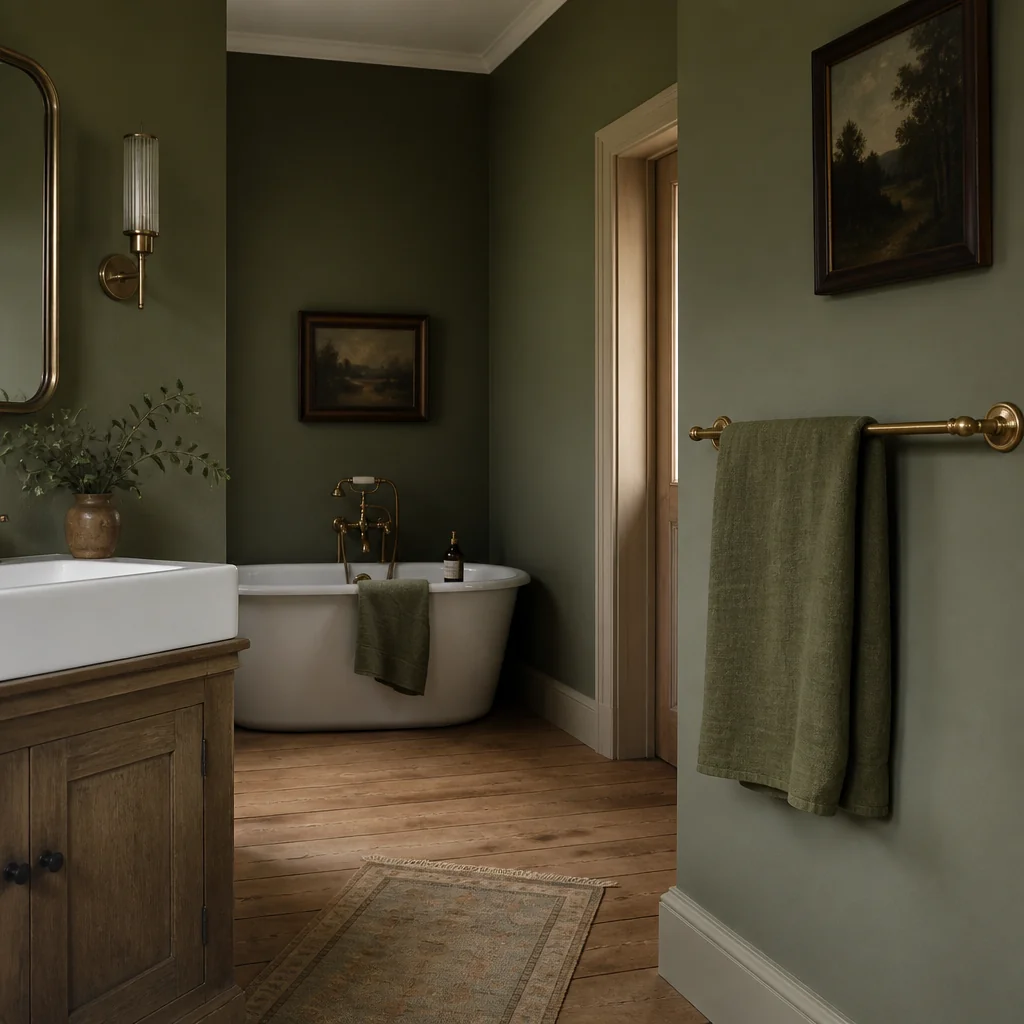
One linen towel over a brass bar near the sink does more for the room than a matched set of six. Linen at $20 to $35 a towel starts stiff and softens with every wash, and it dries far faster than terry, which is the practical argument for it in a room with weak ventilation. The metal deserves a decision of its own. Unlacquered brass is a living finish, so in a humid bathroom it patinas unevenly, shifting from bright yellow toward a deeper bronze inside a year. Some people want exactly that and some find it maddening, so buy lacquered brass or a satin brass PVD finish if you want the shine to hold. Warm metal sits closer to olive on the color wheel than chrome does, which is why the pairing looks settled rather than contrasting. Drape it rather than folding it, and let the ends hang uneven.
13. Layer a small olive green rug under the vanity for warmth
A 2x3 rug under the sink is the difference between stepping onto cold tile and stepping onto something soft. Wool at $60 to $120 handles a bathroom better than most people expect, because the fibers hold water without feeling wet and release it as the room dries out. Jute and sisal at $40 to $80 look right beside olive but stiffen up and can mildew if they sit in a splash zone. Put a thin non-slip pad underneath, since the hazard with a rug on tile isn't the rug, it's the slide. Keep it out of the drip line from the shower door, and hang it over the tub rail once a week so it dries all the way through. It also soaks up the echo, which is why a tiled bathroom stops sounding like a stairwell as soon as there's a rug and a towel in it.
14. Install medicine cabinet hardware in matte olive or sage-toned knobs
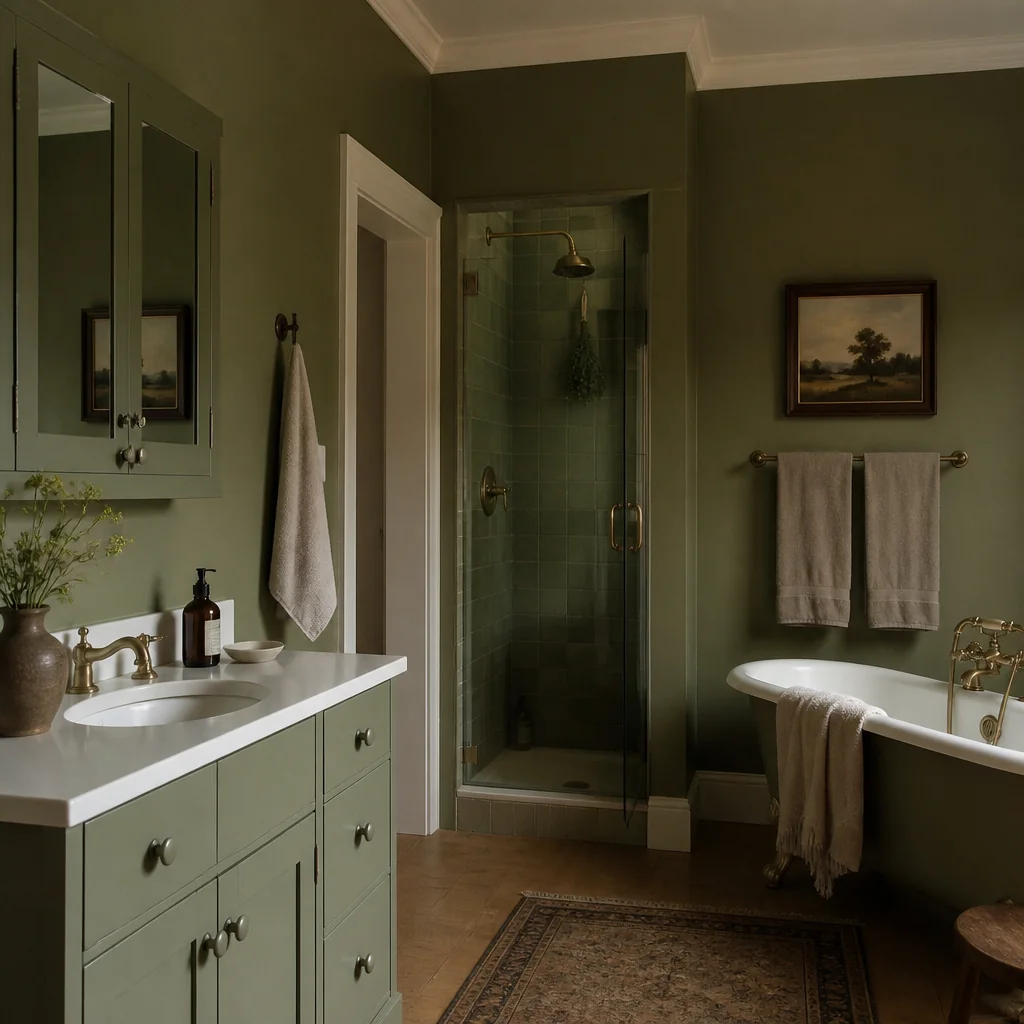
Swapping knobs is a twenty minute job with a screwdriver and a tape measure. Matte olive and sage-toned knobs cost $8 to $15 each, and a typical vanity plus medicine cabinet needs two to six. Measure center to center on the existing holes before you order anything, because 3-inch and 96mm pulls look identical in a product photo and only one of them will land on your pre-drilled door. If olive hardware feels too matched to the cabinet, matte black is the other honest option against green, though it shows limescale and toothpaste spatter more plainly than a brushed finish, so it earns a wipe every few days. Stock cabinet screws assume a door around 3/4 inch thick; a thicker shaker door needs longer screws, sold in a bag for a couple of dollars. Keep every knob in the room to one finish and the small mismatches stop registering.
15. Hang a linen curtain rod with olive green linen panels for privacy
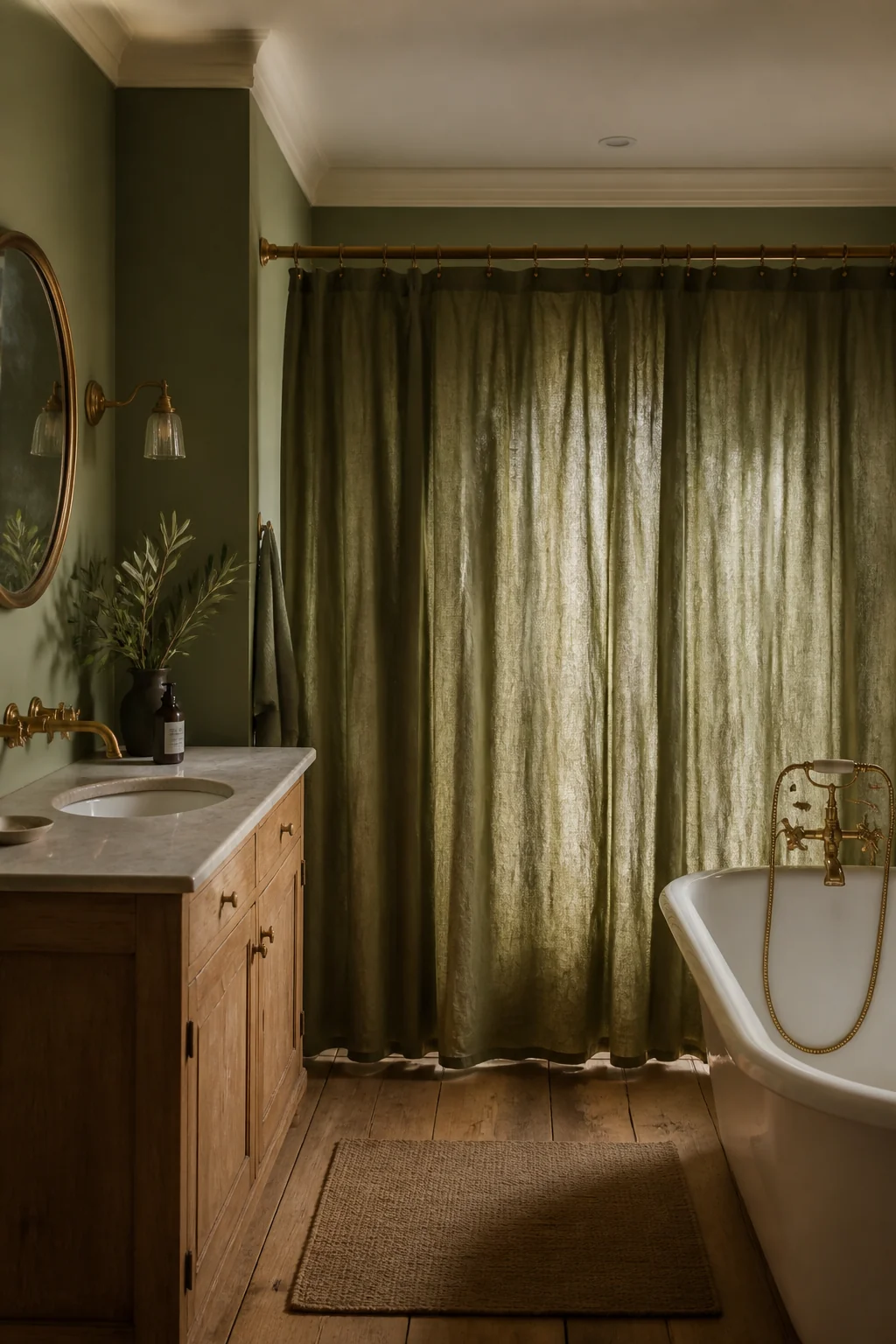
Linen handles a bathroom window better than a blind does, since it diffuses light instead of blocking it and there are no slats to collect dust and hairspray. A pair of olive linen panels costs $60 to $100. Reach for 63-inch panels when the window sits above a vanity and 84-inch when it runs closer to the floor. Give the rod real height above the casing, a hand's width at minimum, and let it extend past the frame on both sides so the open panels rest against wall rather than glass. That's what stops a small window from looking boxed in. For actual privacy, a linen-cotton blend with a tighter weave beats pure loose-weave linen, which goes translucent the moment there's a light on behind it at night. Matte black or brass rods both suit olive, with black drawing a firmer outline around the window.
16. Place a small olive green vessel sink or pedestal sink
This is the one idea on the list with a plumber attached. Olive or sage ceramic pedestal sinks run $300 to $800, while a vessel bowl sits on top of a counter or slim console instead, which means a shorter cabinet and a taller faucet to clear the rim. Budget another $200 to $600 for installation if the drain and supply lines don't already sit where the new sink wants them, and considerably more if a drain has to move inside a wall. Two clearances decide whether the swap works at all. Leave about 21 inches of open floor in front of the sink, the minimum the residential code's fixture-clearance figure shows. And keep roughly 15 inches from the sink's center to the nearest side wall; that is the plumbing code's spacing for lavatories, and while the house code itself sets no side-wall minimum for a sink, anything tighter leaves no room for your elbows. A vessel also raises the working height, so check that the rim lands near 34 to 36 inches or you'll be leaning over it every morning. Pedestals hand back floor space and take away storage, which is the usual trade in a small bathroom. Our coastal bathroom decor ideas for small spaces work inside the same limits in a lighter palette.
Pin this for later
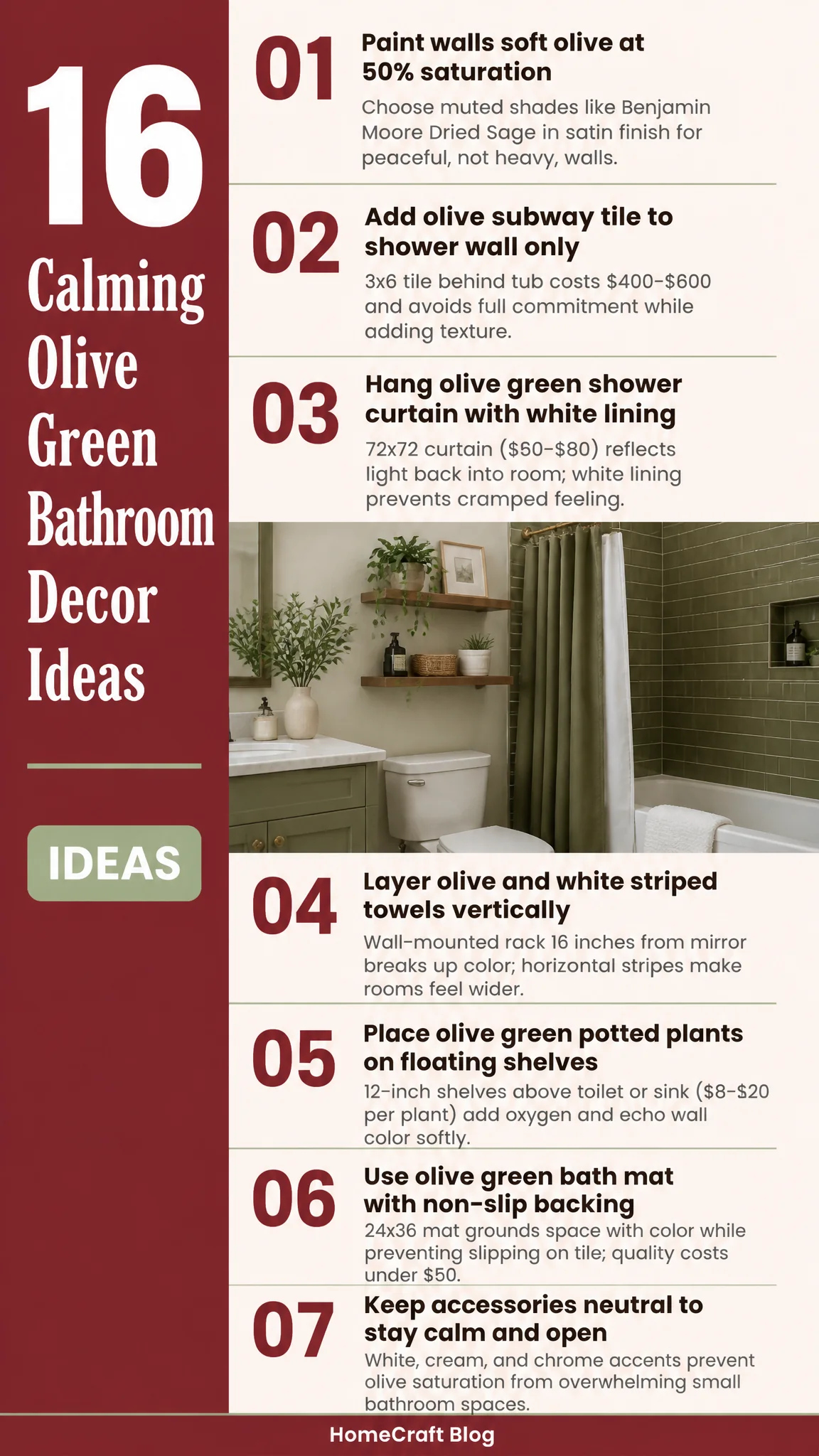
If the bathroom has no window and one overhead fixture, the shade you land on matters more than how many olive things you carry in. A gray-leaning olive under a warm bulb can go flat and colorless, and a yellow-leaning one can turn khaki by evening. Settle the paint and the bulb first, then let the towels, the pots and the hardware follow the color you already proved works in that light. The tile and the sink will wait a year without anything lost.