32 Bright End of Summer Backyard Party Ideas for Every Crowd
End of summer backyard party ideas that work for any crowd size. 32 practical themes, setups, and tips to throw your best gathering yet.
This post contains affiliate links. As an Amazon Associate I earn from qualifying purchases. If you buy through our links, we may earn a commission at no extra cost to you.
Late summer is when most people want to throw a backyard party: the weather's still warm, the daylight stretches past 8 p.m., and there's pressure to squeeze in one more gathering before fall. A lot of setups fall flat in the same predictable ways. Tables end up in the wrong spot, the light runs out around 8:30 with no plan for it, guests bunch up in one corner near the drinks, and the food goes cold or gets picked over in fifteen minutes.
None of that takes much money to solve. It takes a layout that moves people around, light that reaches the chairs instead of just the fence, food you can eat one-handed with a drink in the other, and something to do once the sun is down. The thirty-two ideas below are grouped loosely by the order you'd tackle them, and each one carries the number you need to buy it or build it: a clearance, a height, a rough price, or a time on the clock.
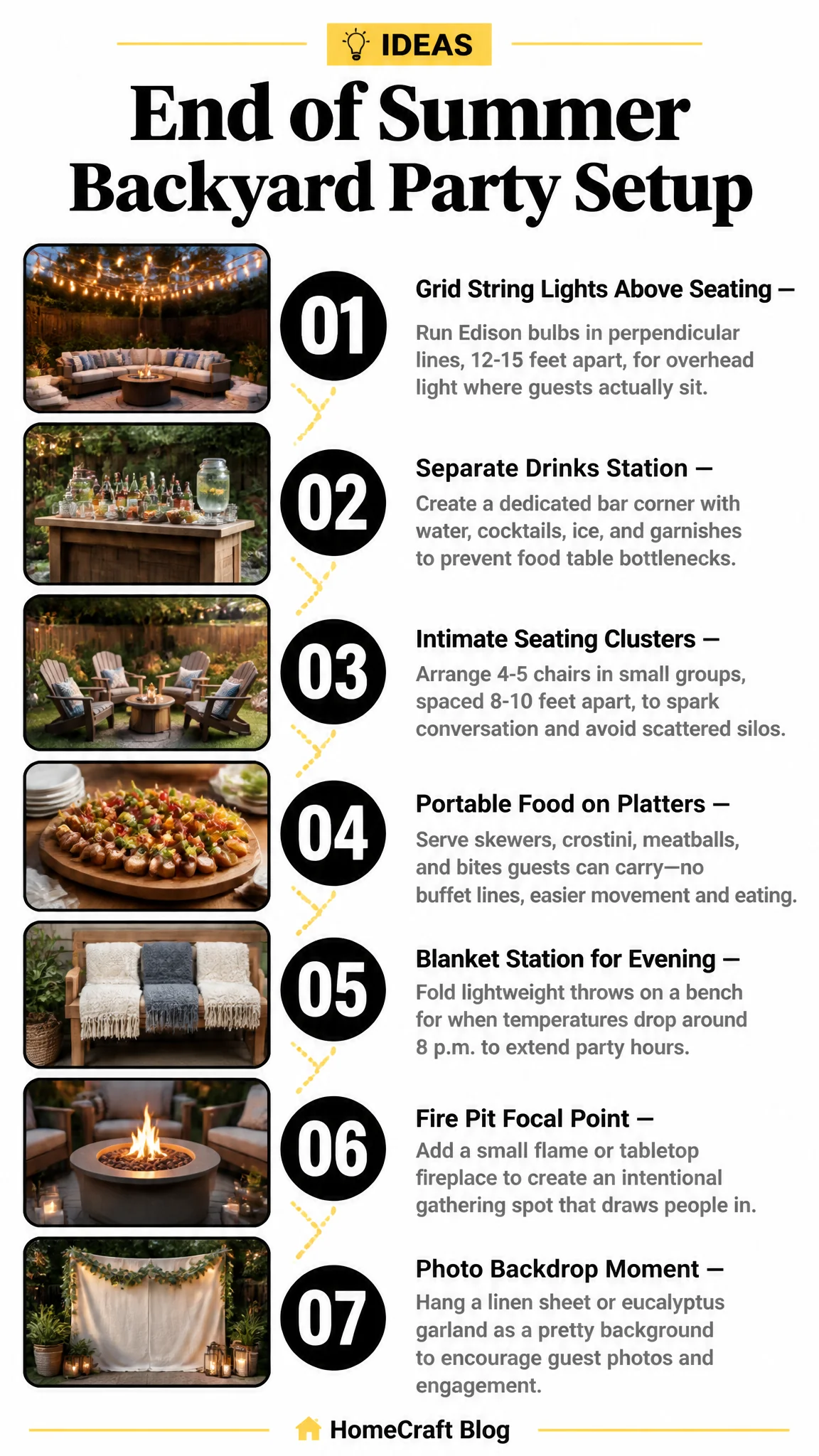
1. String cafe lights in a grid above the seating area
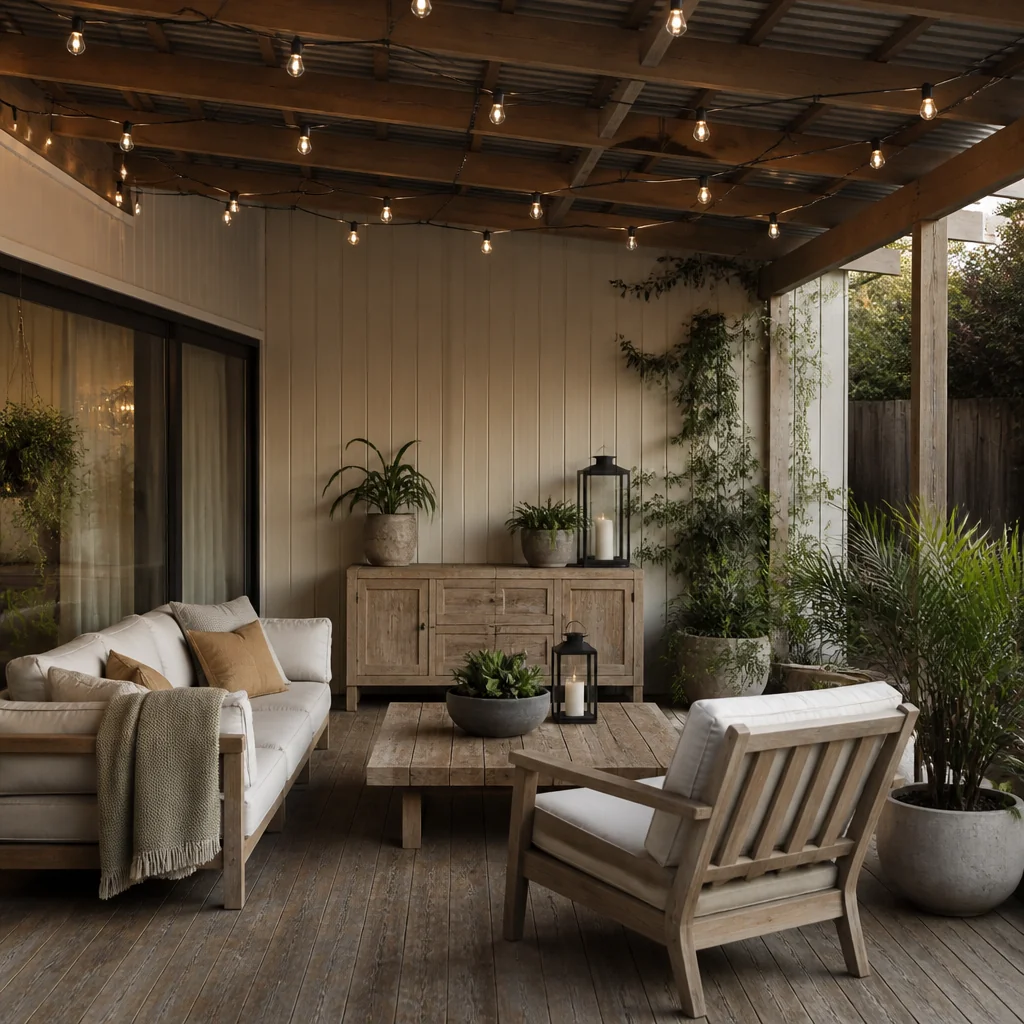
Run two sets of Edison bulb strings in perpendicular lines above your main gathering zone rather than only around the perimeter. Perimeter lights are decoration. A grid overhead is light you can eat and read faces by. Hang the strands 8 to 10 feet off the ground: high enough that a tall guest clears them, low enough that the yard reads as a room with a ceiling.
The part most people skip is the support wire. String light cord stretches, so a 48-foot strand hung on its own will sag another 6 inches within a week and look tired by the party. Run 1/8-inch stainless guy wire between your anchor points first, tension it with a turnbuckle, then zip-tie the strand to the wire every 3 feet. Anchor into fascia board, a 4x4 post, or a tree trunk with lag-eye screws, never into stucco or a gutter.
Budget roughly $35 to $70 for a 48-foot commercial-grade strand with S14 bulbs. Choose LED bulbs in the 2200K to 2700K range; anything cooler turns skin tones gray. Everything plugs into a GFCI outlet, and outdoor-rated extension cord only.
2. Set up a drinks station separate from the food table
Let guests pour their own water, cocktails, or mocktails from a dedicated bar corner. Put it 10 to 15 feet from the food, ideally on the far side of the seating so people have to walk past each other to get from one to the other. That single decision does more for mingling than any icebreaker.
A 6-foot folding table works, or a bar cart at $80 to $150 if you want it to look furnished. Ice is where hosts underbuy: plan about 1.5 pounds per guest, and closer to 2 if the afternoon is above 85 degrees, because half of it goes to chilling bottles rather than into glasses. A 15 to 17 gallon galvanized tub, around $25 to $40, holds a case and a half plus ice.
Set water at the near end so it's the first thing anyone reaches. Add small tent cards for each option and put the recycling bin within 3 feet of the table, or empties will collect on every flat surface in the yard.
3. Arrange seating in small clusters of 4-5 chairs instead of long rows
A long row against the fence gives every guest exactly two people to talk to. Small groupings give them four. Set each cluster 8 to 10 feet from the next so they feel separate without the party splintering into silos.
Inside a cluster, keep facing chairs 4 to 8 feet apart. Closer than 4 feet and people are in each other's laps; past 8 feet they have to raise their voices, which is exhausting outdoors where there are no walls to carry sound. Put a side table or low stool within arm's reach, roughly 16 to 18 inches out from the chair front, so drinks have a home other than the grass.
Arrange each cluster as a loose C or horseshoe that opens toward the food and the fire, not a closed circle. A closed circle is genuinely hard to join: a newcomer has to break the ring. Leave 30 to 36 inches of walking space between groupings. For twenty guests, twelve to fourteen chairs is usually right, since a good chunk of the crowd will stand.
4. Serve food on platters guests can carry, not a single buffet line
Skewers, crostini, empanadas, meatballs, and cheese bites beat a long table where people line up. The test is simple: can it be eaten in one or two bites, with one hand, while the other hand holds a drink? If it needs a knife or it drips, it belongs at a sit-down dinner instead.
Use several 12 to 14 inch platters rather than one big spread, and place them at three or four spots around the yard. Guests circulate to the food instead of forming a line at it, and a smaller platter still looks generous when it's half gone. Plan 6 to 8 pieces per person for a two to three hour party where you're not serving dinner, and 10 to 12 if the appetizers are the meal.
Cocktail napkins do the work of plates for most of this. One caution: anything on a bamboo pick needs a small discard cup beside the platter, or you'll be pulling skewers out of the flowerbeds all the next morning.
5. Add a blanket station for when the sun goes down
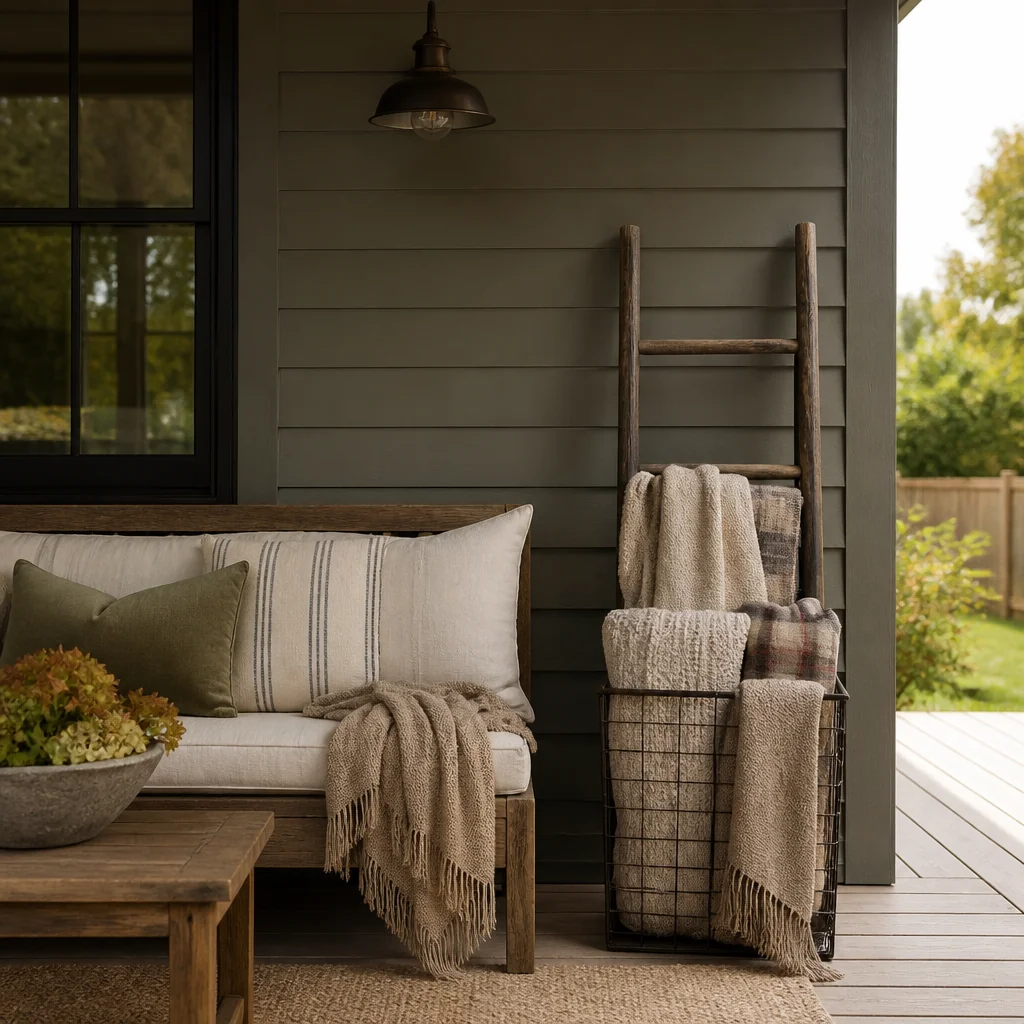
Fold six to eight lightweight cotton throws or linen blankets on a low bench where guests can help themselves. In late August the air can shed ten to fifteen degrees within an hour of sunset, and cold is the single most common reason a good party empties out at 8:45 instead of 10.
Look for waffle-weave cotton around 50 by 60 inches, roughly $15 to $25 each. That size covers a seated adult's lap and shoulders without dragging on the ground. We'd skip wool here: it's too warm for a 70-degree evening and it sheds onto dark clothes.
Storage matters more than it sounds. Grass is soaked with dew by 9 p.m., so anything that ends up on the lawn comes back in damp and smelling like a basement. A lidded deck box or a bench with a slatted top keeps them dry and gives you somewhere to dump them at the end of the night. Put the stack next to the seating, not by the back door, so nobody has to ask.
6. Light a fire pit or tabletop fireplace if you have the space
Even in summer, a small flame pulls people into one spot. It isn't about warmth in August. It's that a flat lawn has no center, and fire gives the yard one.
Clearance first: keep a fire pit at least 10 feet from the house, fences, and any overhanging branches, and check your local rules, since many towns specify 15 or 25 feet and late summer is prime burn-ban season. Set it on gravel, pavers, or stone. A steel bowl on a wood deck will scorch through the boards even with a heat shield. Pull seating back about 3 feet from the rim and keep a bucket of water or an extinguisher within reach.
A basic steel bowl runs $80 to $150, a propane fire table $300 to $700, and a tabletop propane or bioethanol burner $60 to $120. The tabletop version is the one to pick for a small patio or a condo: no smoke, no sparks, and nothing to put out. Wood fires are cheaper but the wind decides who gets smoked, and that person leaves early.
7. Create a "sunset photo moment" with a simple backdrop
Hang a plain linen sheet or a eucalyptus garland as a background for photos. People take pictures at parties whether you plan for it or not. Give them one good spot and you stop getting twenty shots of the recycling bin.
Size it about 5 to 7 feet wide and 7 feet tall, hung on a fence or between two poles, so two or three people fit in frame. Steam or iron the sheet first: fold creases catch the light and read as laundry in every photo.
The placement rule is the one that actually decides whether the pictures work. Put the backdrop on the east side of the yard so the low sun is behind the camera and lands on faces. Hang it on the west fence and every guest comes out as a silhouette. The best window is the 30 to 45 minutes before sunset, so mention it once around 7. A fresh eucalyptus or smilax garland runs $25 to $45; after dark, two battery uplights at the base keep the spot usable.
8. Use outdoor rugs to define seating zones
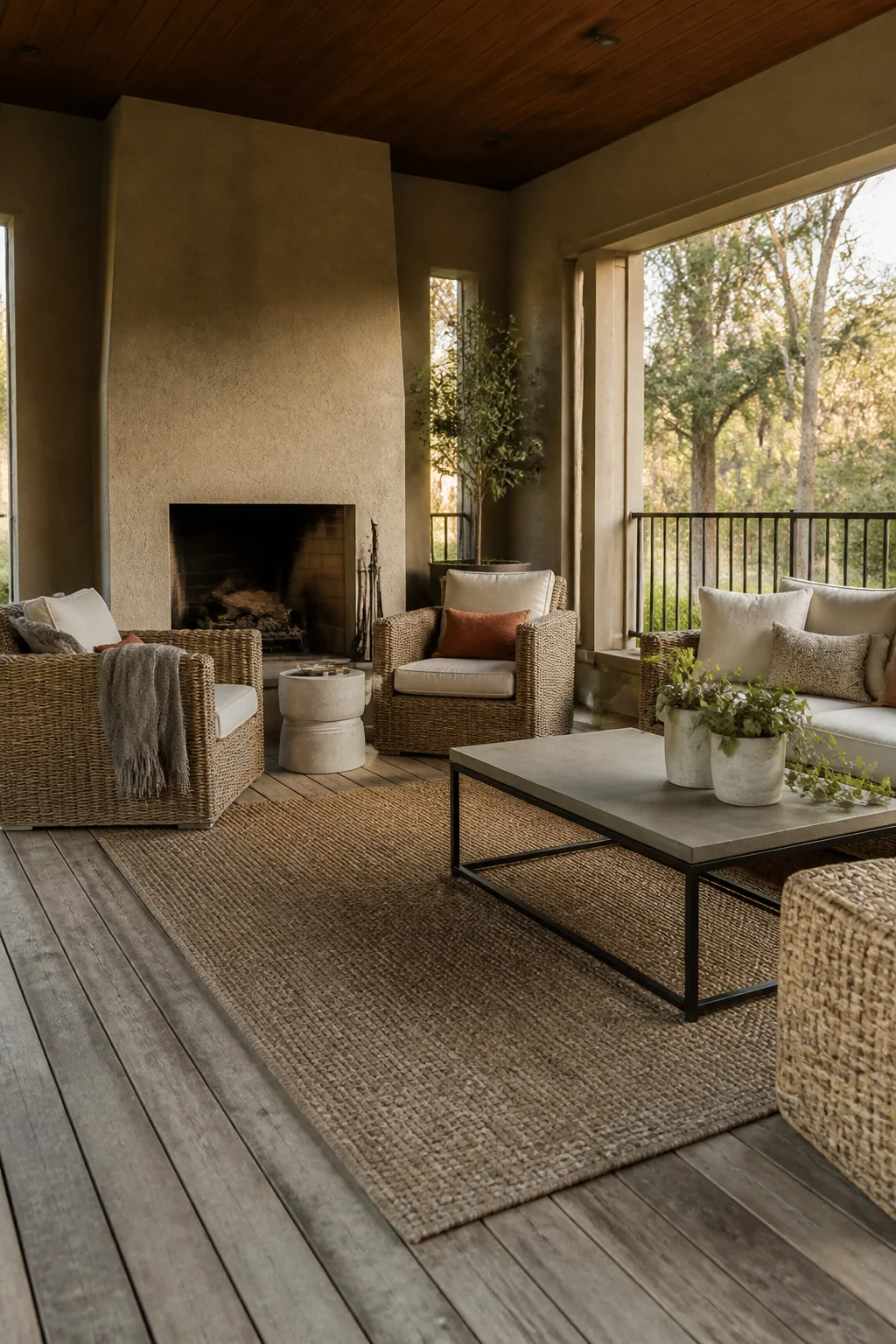
A rug tells people where the room is. Drop one under a pair of chairs and a side table and that corner stops looking like furniture someone left out.
Size it to the grouping. A 5x7 handles two chairs and a small table; a 4 or 5 chair cluster wants an 8x10 so the front legs of every chair land on the rug and you still have about 18 inches of border showing. Budget $60 to $120 for a 5x7.
Material is the whole decision. Flat-woven polypropylene dries in an hour, resists UV fading, and hoses clean. Natural jute or sisal looks better in photos and grows mildew after one overnight rain, so keep those on a covered porch. On grass, lift the rug within three or four days: it traps moisture and you'll find a yellow rectangle underneath. On pavers or a deck, sweep the grit out from under it, and use rug tape or corner weights so a curled edge doesn't catch someone's toe after dark.
9. Hire or borrow a small Bluetooth speaker system instead of relying on a phone speaker
One phone speaker disappears outdoors. Indoors, walls and ceilings bounce sound back at you; a yard has nothing to reflect off, so the sound just leaves.
Two modest speakers beat one loud one. Set a pair at opposite ends of the seating area, stereo-paired, at roughly ear height for a seated guest, which means about 4 feet up on a table or a stand. A speaker on the grass loses most of its low end into the lawn. Expect $120 to $300 for a pair worth keeping; look for an IPX4 or better rating, since dew alone will soak a speaker left out past 10, and 10 to 12 hours of battery so you're not hunting an outlet mid-party.
Set the volume so you can hold a normal conversation standing 3 feet from a speaker. Louder than that and guests start shouting, which reads as a good time for about twenty minutes and then wears everyone out.
10. Serve a signature cocktail in a large batch dispenser
Mix one good drink ahead of time and let people serve themselves. You stop playing bartender, and nobody has to ask for anything.
A 2 to 3 gallon dispenser with a spigot costs $30 to $60. Three gallons is roughly 48 cups, which covers about 20 guests if you plan two drinks in the first hour and one an hour after that. Raise the dispenser on a crate or an overturned tub so the spigot clears a tall glass, and check the tap for drips before you fill it.
Two things keep a batch from tasting tired. Freeze water in a loaf pan and drop that block in instead of cubes, because one large piece melts far more slowly and your last glass tastes like your first. And hold back the bubbles: stir in sparkling wine, soda, or tonic right before guests arrive, never hours ahead. Fresh citrus juice is best squeezed the same afternoon; by the next day it turns dull and slightly bitter.
11. Set appetizers out in waves instead of all at once
Put out cheese, olives, nuts, and bread as people arrive. Twenty to thirty minutes in, once most of the guest list has landed, send out the hot things. Hold dessert until about the ninety-minute mark. Three small events beat one big one, and the person who shows up at 6:40 doesn't walk into a picked-over table.
Refill in halves. Keep the backup platters in the fridge and top up a small dish rather than setting out everything at once, which looks abundant for ten minutes and sad for the next two hours.
There's a hard limit underneath this, not just an aesthetic one. Food shouldn't sit out more than two hours, and that shrinks to one hour once the air is above 90 degrees, which late August delivers regularly. Anything with mayonnaise, dairy, or cooked meat goes back in the fridge at the two-hour mark whether it's finished or not. Nesting a platter in a shallow tray of ice buys you extra time on the shrimp and the dips.
12. Use battery-powered lanterns on tables, not overhead lights alone
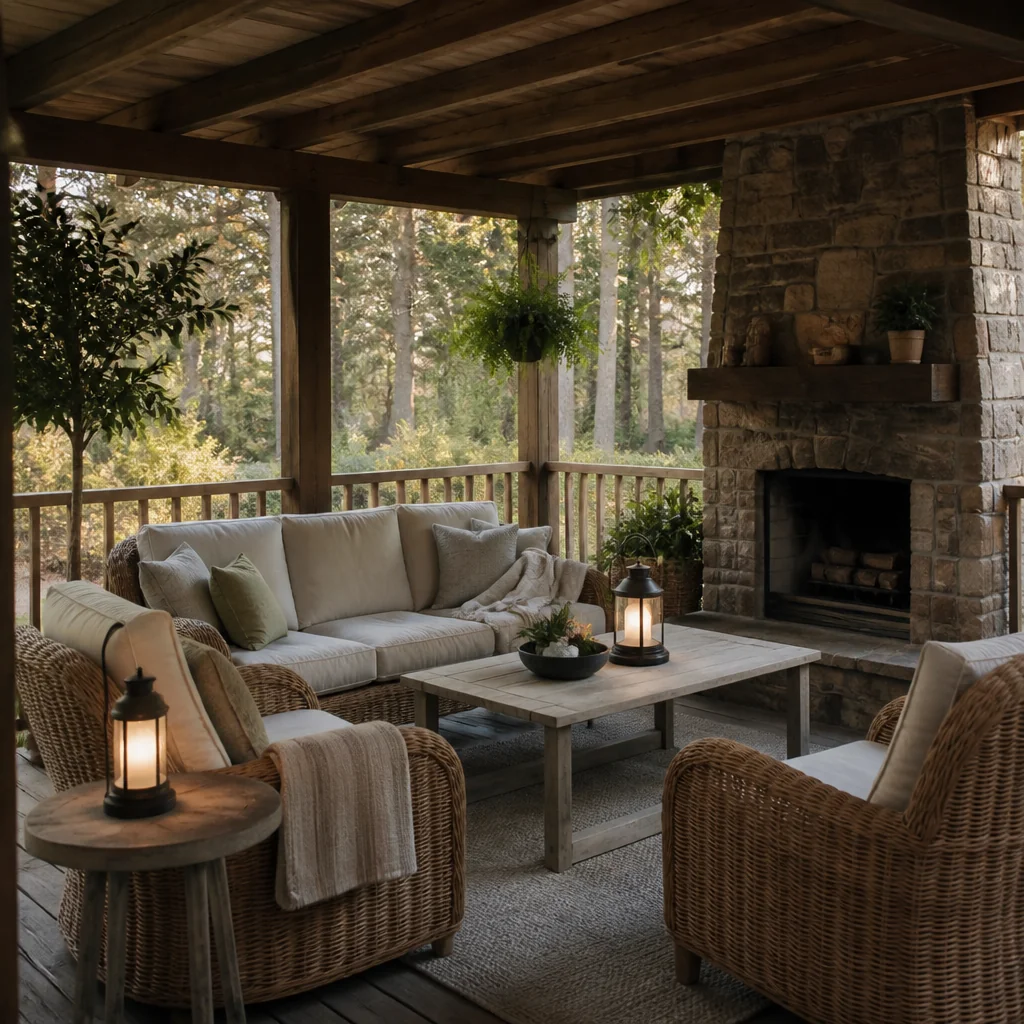
Overhead strings light the whole zone evenly, which is useful and a little flat. Small LED lanterns about 6 to 8 inches tall add the low pools of light that make a corner feel occupied. Put one on each table, plus a couple on the steps and along any path where someone could turn an ankle.
They run $12 to $25 each. Look for 2200K to 2700K warm white; a 4000K lantern reads like a work light and will fight your string bulbs. Flickering flame-effect models look better than a steady glow because the movement mimics a candle. Check the power source before you buy: AA-powered lanterns get 8 to 20 hours and need a fresh pack on hand, while USB-rechargeable ones need charging the day before.
Keep the lantern below chin height for anyone seated. A bright bare LED sitting at eye level on a high table glares straight into faces and wrecks every photo taken across it. Frosted or seeded glass diffuses it.
13. Create a kids' corner with lawn games if families are attending
Giant Jenga, cornhole, ladder toss, or badminton. Teenagers play these too, once one adult starts and nobody's watching them decide.
Give the games their own flat patch, roughly 15 by 20 feet, well off the walking line between the food and the seating. Beanbags that land in the cheese board are a solved problem: solve it with geography. Regulation cornhole sets the boards 27 feet apart, but 15 to 20 feet is friendlier for mixed ages. Ladder toss wants about 15 feet of throwing room, and giant Jenga needs a flat board or a paver underneath, since a lawn tilts the tower and it falls on the first pull.
Costs run about $60 to $150 for a cornhole set, $40 to $80 for giant Jenga, and $30 to $50 for ladder toss. Point one battery uplight or a lantern at the game zone, or it goes dead the moment the sun drops. Keep a bin nearby for the pieces.
14. Serve drinks in glassware, not plastic cups, if your crowd is relaxed
Glass has weight and it doesn't crumple, so a backyard set with real glasses reads as an event rather than a hangout. Stemless wine glasses at $2 to $4 each are the practical pick: they stack, they don't tip on an uneven table, and they handle water, wine, and a cocktail equally.
Count 2 to 3 glasses per guest, not one. People set a glass down, wander off, and start fresh. The fix that saves the most washing is a paint pen or a set of charms by the drinks station so everyone marks their own. Even so, twenty guests will generate 40 to 60 glasses, roughly two dishwasher loads, so keep a bus tub under the drinks table and load as you go.
Here's the real trade-off: glass near a pool deck or a fire pit is a hazard, and barefoot guests plus a broken stem is an emergency-room evening. In those yards, switch to Tritan or acrylic tumblers at $3 to $6 that look close and don't shatter.
15. Hang fabric panels on one side to create windbreak and visual enclosure
Near a coast, on a ridge, or anywhere with an open field behind the fence, wind is what ends the evening. It blows out candles, lifts napkins, and makes 68 degrees feel like 58. A panel on the windward side fixes all three and gives the yard a wall it didn't have.
Watch which way the smoke or a ribbon drifts around 6 p.m. and put the panel there. Use permeable shade cloth rather than solid canvas. Shade cloth slows the air; a solid panel behaves like a sail and can pull a fence panel loose in a gust. If you only have solid fabric, leave a gap at the top or bottom to bleed pressure.
A 10x10 shade sail runs $40 to $90. Look for grommets every 12 to 18 inches and hang it from a fence or two 8-foot posts with bungees rather than rigid ties, so it gives instead of tearing. Pull it taut: a slack panel flogs and slaps all night, and the noise is worse than the wind.
16. Set up a dessert cart or rolling station with sweets
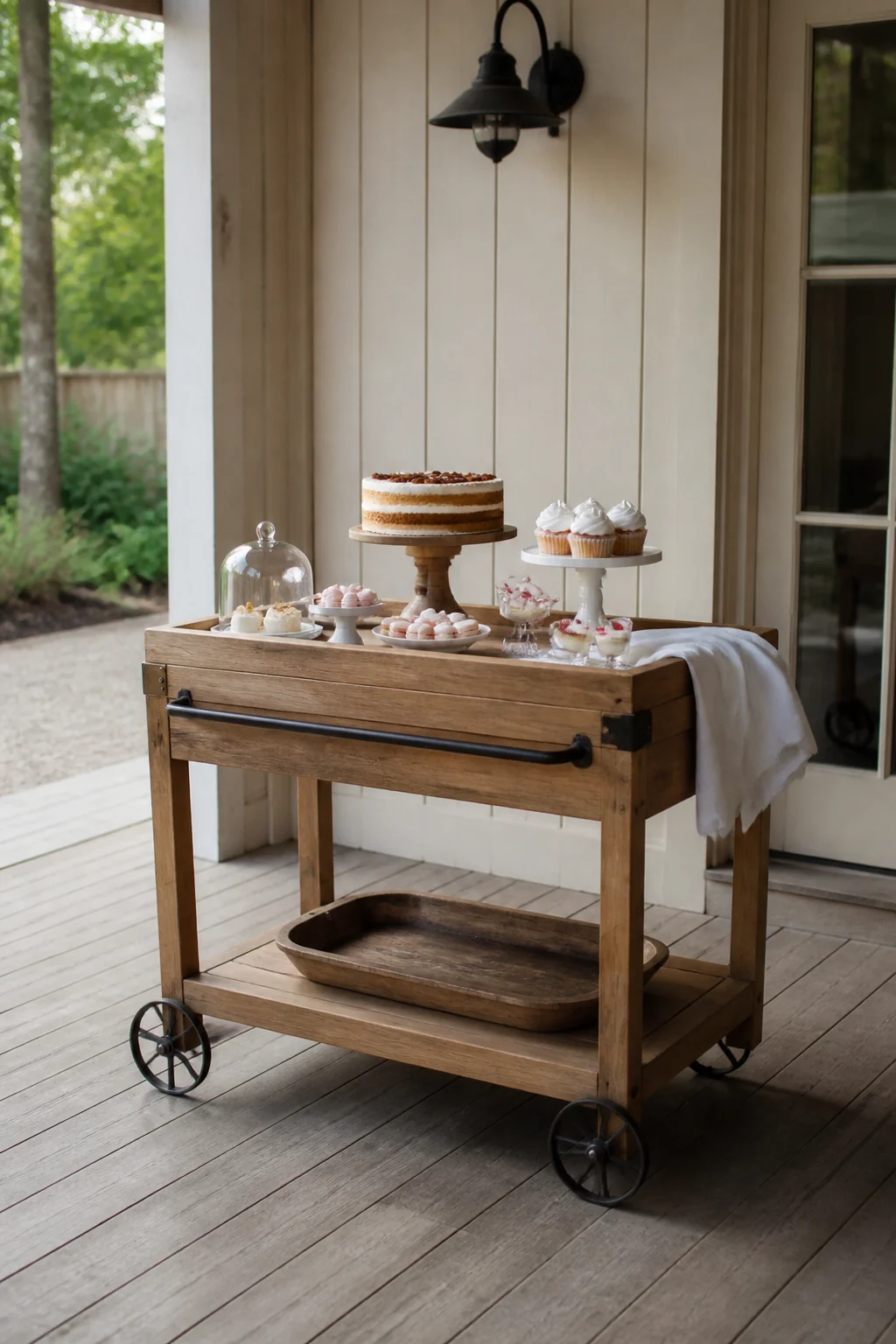
A two or three shelf bar cart, 30 to 34 inches tall and $80 to $150, holds cupcakes, cookies, chocolate, and fruit and gives the evening a second act. Wheel it out around 8, not at the start. Something new arriving is what resets a party that's gone quiet.
Keep it indoors until then. Buttercream slumps and chocolate blooms at 80 degrees, and an hour on a patio does real damage to both. Plan about two pieces per guest and put a lantern on the top shelf so the cart reads at dusk.
Check the wheels before you buy. The small hard casters on inexpensive carts sink into grass and stop dead; large casters or rubber wheels roll. If your party is on a lawn, park it on the patio or a paver instead of pushing it around. And keep it out of the traffic lane between the food and the seating, because a stationary cart in a walkway turns into a bottleneck by the third pass.
17. Plant potted flowers or greenery around the perimeter before guests arrive
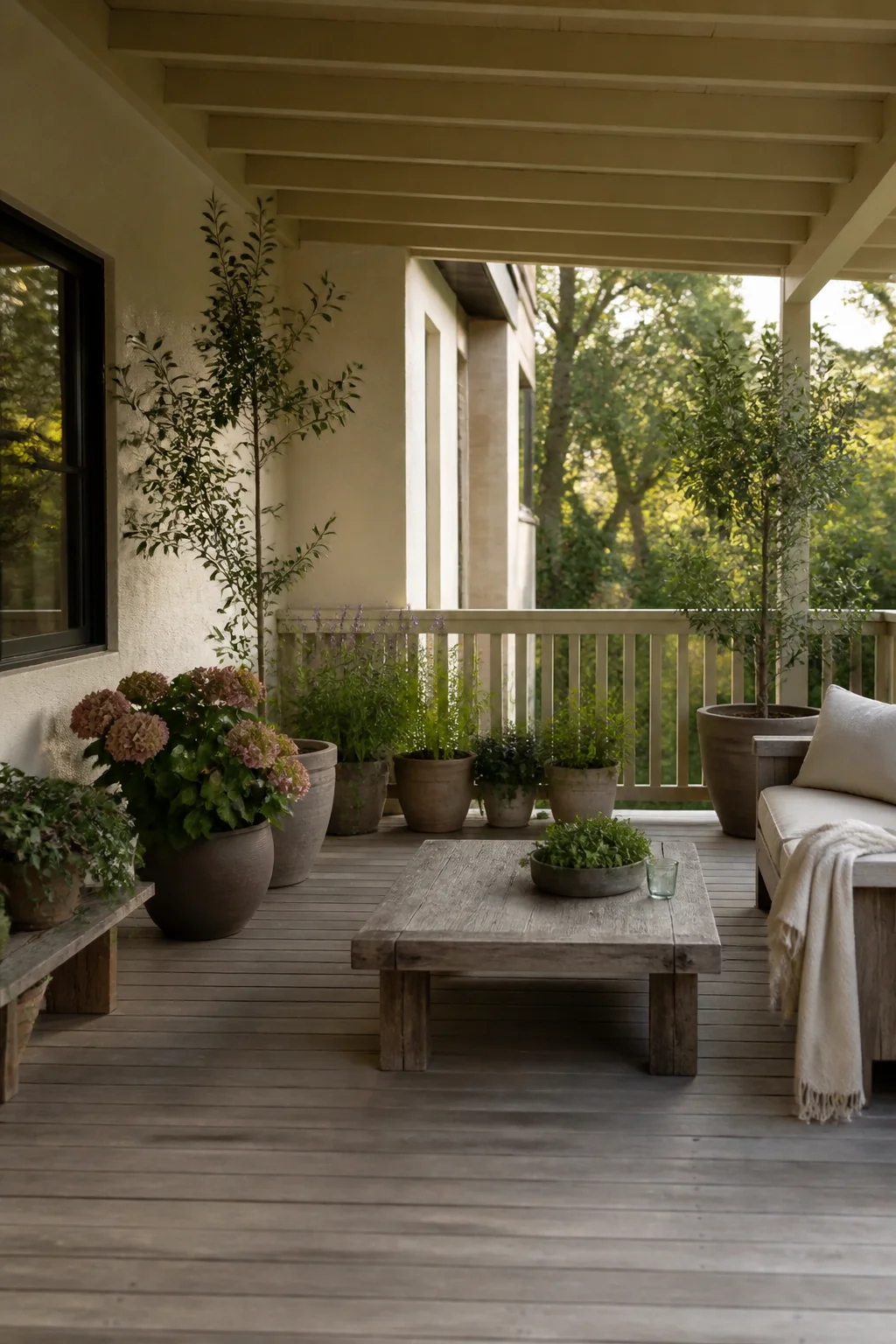
Three large pots read better than ten small ones. Go for 14 to 16 inch diameter containers, grouped in odd numbers at two or three corners, and the yard's hard edges soften immediately. Budget $40 to $80 depending on pot size.
Fill each one with three things: something tall for height, like an ornamental grass or canna; something mounding in the middle, like lantana or coleus; and something trailing over the rim, like sweet potato vine. That combination is what makes a $12 pot look designed rather than dropped.
Late August is the cheapest week of the year for this. Nurseries clear four-inch annuals at $2 to $4 and one-gallon perennials at $8 to $15 to make room for mums, and you can buy what's already blooming instead of hoping.
Do it two or three days ahead, not the afternoon of. Transplants wilt for a day before they perk up, and a big pot in late-summer heat can dry out in a single afternoon, so water deeply the morning of the party.
18. Offer a signature mocktail alongside alcoholic drinks
Plenty of your guests aren't drinking, and handing them a plastic cup of soda tells them exactly where they rank. Build the mocktail the way you'd build a cocktail: something tart, something sweet, something with a little bitterness or aroma, and bubbles.
Sparkling elderflower with fresh mint and lime is the reliable one. A bottle of elderflower cordial runs $10 to $14 and makes around a dozen drinks. Strong-brewed black tea, verjus, or non-alcoholic bitters supply the bitter edge that keeps it from tasting like juice, which is what most alcohol-free drinks get wrong.
Make the same volume you'd make of the alcoholic version, serve it in the same glassware, and garnish it the same way. Write its name on the tent card rather than labeling it for non-drinkers; people then take it because it sounds good, not because they have to explain themselves.
One timing note: add the sparkling component right before guests arrive. Mixed at 3 p.m., it's flat by 7.
19. Start the party around 5 or 6 p.m. rather than 7 p.m.
Golden hour is free, and it flatters a backyard more than anything you can buy. In late August, sunset across much of the country lands somewhere between 7:45 and 8:15, so a 5:30 start hands you two full hours of warm daylight to get people fed, settled, and talking before your lighting has to carry the evening.
Build in the drift. Guests arrive 15 to 30 minutes after the time on the invite, so a 5:30 invitation means a real start closer to 6. If you put food out at 5:30 sharp, the early arrivals eat it alone.
An early start also widens who can come: people with small kids, people working early, anyone driving more than half an hour. And it changes the shape of the night, because leaving at 8:30 feels normal rather than like an escape. Put an end time on the invite so nobody has to guess.
20. Serve warm bread or fresh focaccia alongside appetizers
A table of cold appetizers is fine. Add one warm thing and it becomes food. Bread is the cheapest way to do that: a sheet-pan focaccia costs about $15 in flour, olive oil, yeast, salt, and rosemary, or you can pick up a bakery loaf for $6 to $9 and skip the work entirely.
Warm it at 350 degrees for 8 to 10 minutes right before it goes out. The smell reaches the yard before the basket does, and that does more for the mood than any garnish.
Cut it into 2-inch squares so nobody needs a knife, and line the basket with a cloth napkin folded over the top. The cloth traps steam and keeps the bread warm for 20 to 30 minutes instead of five. Slice only half up front and leave the rest whole, because exposed crumb dries out fast in dry evening air. Set a shallow dish of good olive oil and flaky salt beside it, and time it to land with the hot appetizers.
21. Use outdoor cushions on basic lawn chairs to make them look intentional
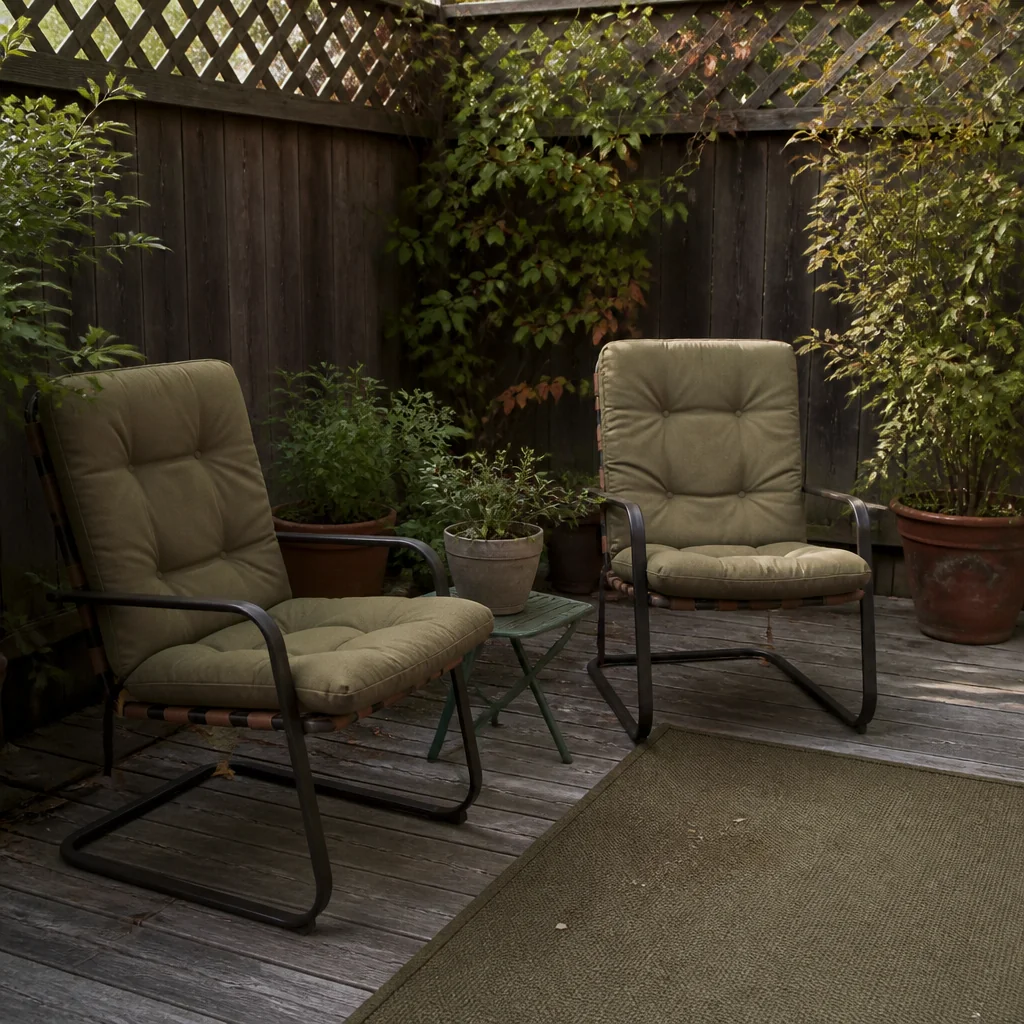
A 16x16 or 18x18 inch outdoor seat cushion runs $20 to $40 and turns a stacking plastic chair into something that looks chosen. It also buys you an extra hour of sitting, because molded plastic gets uncomfortable fast.
Buy the ones with tie-back straps. Cushions without ties slide off the seat every time someone stands, and by 8 p.m. they're all on the grass.
Fabric decides how long they last. Solution-dyed acrylic, the Sunbrella family, holds its color through a full season of direct sun and shrugs off mildew; printed polyester costs less and fades noticeably by the second summer. Ask about the foam too: quick-dry open-cell foam sheds a rain shower in a few hours, while standard foam holds water for days and starts to smell.
Keep to one or two colors across the yard so mismatched chairs read as a set. Skip cream and white, which show every grass stain; a mid-tone or a small pattern hides real life.
22. Set up a small table for coats and bags instead of letting them pile on chairs
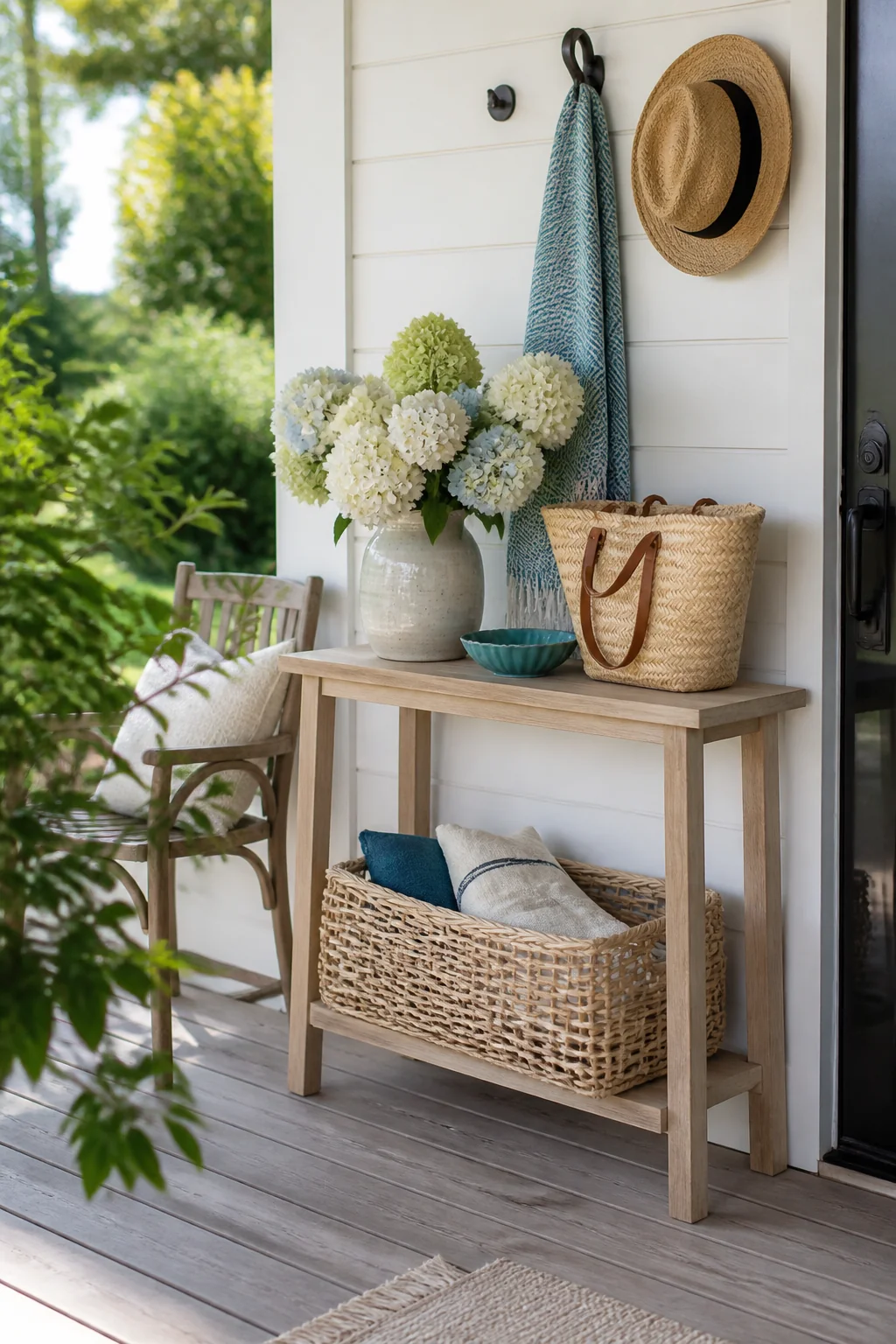
Without a landing spot, every bag and jacket claims a chair, and by 7 p.m. a third of your seating is holding someone's tote.
A 4-foot folding table at $35 to $50 near the entrance to the yard solves it. Twenty guests need roughly 6 feet of surface, so add a second table or a freestanding coat rack at $25 to $40 if the group is bigger. Put out two baskets, one for phone chargers and one for sunglasses and keys, and everything stops migrating.
Site it just off the path, not in it, or people stop to dig through bags while others are trying to get past with plates. On grass, a folding table's narrow legs sink and the whole thing wobbles, so set it on the deck, the patio, or a couple of pavers.
Add a small lantern to it. At 10 p.m. people are looking for a black bag on a dark table, and that's how phones get left behind.
23. Play a curated playlist instead of just shuffling
Build three to four hours of music, roughly 60 to 70 songs, so nothing repeats. An hour-long playlist loops twice before dessert and people notice on the second pass even if they can't say why.
Shape it like the evening. Mellow and mostly instrumental while guests arrive and are still finding people to talk to, then lift the energy after 8 once the light drops. Volume should let you talk at a normal voice from 3 feet away.
Two settings do the real work. Turn off autoplay or radio mode, because that's what serves up a hard rock track at 9:15 when the algorithm runs out of your list. And download the playlist for offline play: yard Wi-Fi is usually weak at the fence line, and a buffering silence lands harder than no music at all.
Run it from a spare phone or tablet on Do Not Disturb. A call on the host's phone cuts the music every time.
24. Offer bug spray or citronella candles without making it awkward
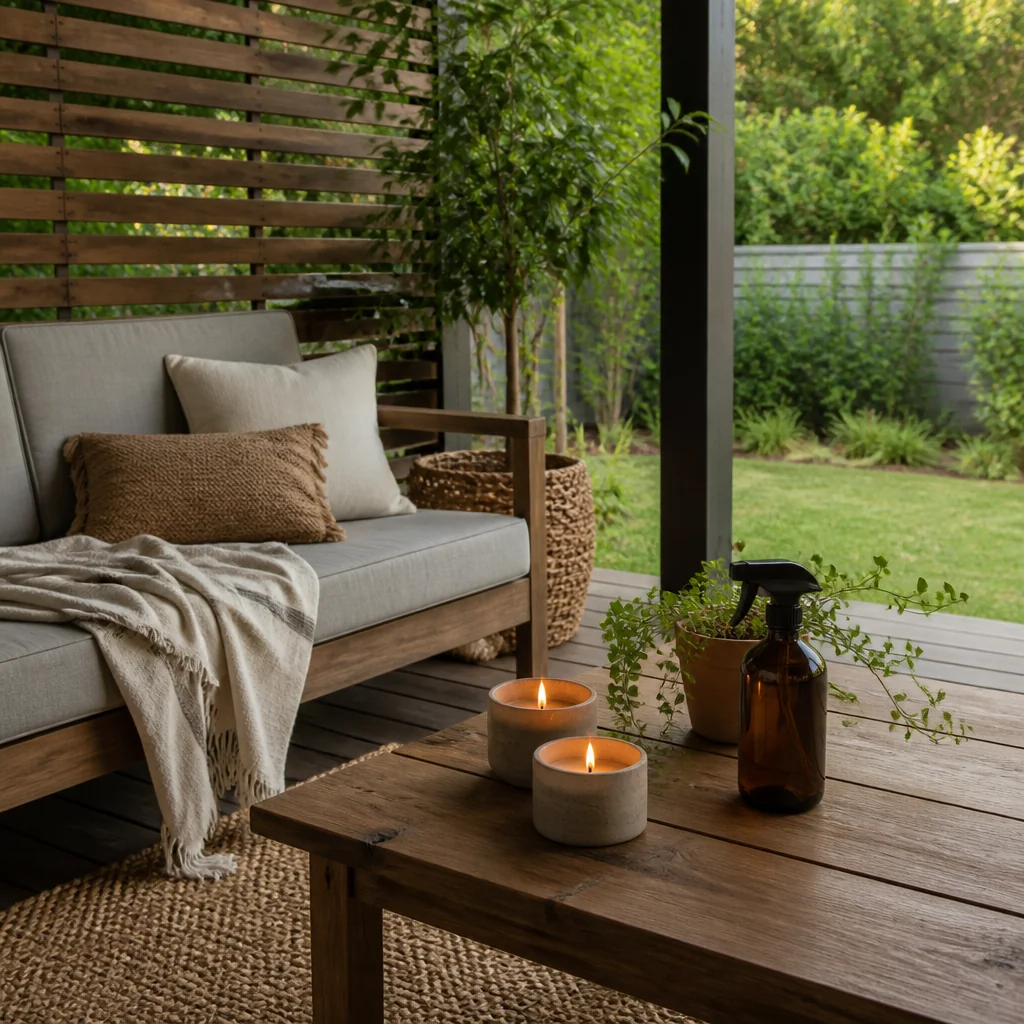
Put the defenses out quietly and don't announce them. Mosquitoes empty a yard faster than rain, and peak biting runs from dusk to about an hour after dark, which is exactly your party.
Citronella and lavender candles at $10 to $15 each work over a small radius, so cluster three around each seating group rather than setting one lonely candle at the corner of the patio. A Thermacell-style device at $25 to $40 covers roughly a 15-foot zone and does more than candles in still air.
The most effective trick costs nothing extra: point an oscillating or box fan across the seating area. Mosquitoes are weak fliers and can't hold position in moving air, and the breeze is welcome anyway on a warm evening.
Two days ahead, walk the yard and tip out standing water. The saucer under a planter, a wheelbarrow, a clogged gutter, a dog bowl. Larvae need still water, and most of the mosquitoes at your party will have hatched in your own yard. Set a basket of picaridin or DEET wipes on the drinks table.
25. Create a "last call" moment around 9 or 10 p.m. with a final round of food
Bring out warm cookies, coffee, or one last tray. It hands guests permission to leave without anyone having to say the word, and it gives the night a proper ending instead of a slow leak.
Time it backwards from your stated end time and put it out about 30 minutes before. Start the coffee at 8:30 so it's poured by 9, brew decaf so nobody is awake at 1 a.m., and keep it in an insulated carafe rather than a warming plate that scorches it.
Adjust the room while you're at it. Turn the music down two notches and switch off the uplights at the far end of the yard. People read light and volume long before they read words, and they'll start gathering their things on their own.
The food is what keeps it gentle. A bare announcement clears a yard in five minutes and feels like a shove. Have a few to-go containers ready for the leftovers.
26. Hang paper lanterns or fabric banners if you want color without committing to decor
Paper lanterns run $5 to $15 each in the 12 to 16 inch sizes, and a 10-foot cotton bunting is $12 to $20. Neither weighs anything, so you can hang them from a fence, a branch, or the same guy wire carrying your string lights.
Cluster three to five at different heights in one or two spots instead of spacing them evenly along a line. An even row reads as a store display; a cluster reads as a decision. Hang them at 7 to 8 feet so tall guests clear them, and use clear fishing line so the hardware disappears.
Drop a battery LED puck inside each lantern and they keep working after dark rather than turning into pale shapes.
The failure mode is weather. Paper lanterns are pulp after one shower and they sag in heavy dew, so bring them in overnight or buy nylon versions if rain is anywhere in the forecast. Stored flat in a box, both collapse down and last for years of parties.
27. Set up one high-top table or bar-height seating for guests who want to stand while eating
Some guests will stand all night, and standing next to a low chair with nowhere to set a drink is the worst spot at any party. One tall table fixes it.
Get the heights right or the stools won't match. A cocktail high-top is typically 42 inches tall with a 30-inch round top and works for three or four people standing; pair it with 29 to 30 inch seat-height bar stools. A 36-inch counter-height table takes 24 to 26 inch stools instead. Mixing the two leaves people perched with their knees under their chin.
A folding cocktail table runs $60 to $120 to buy, or $12 to $18 to rent for the evening. One per 8 to 10 guests is plenty.
Put it near the drinks station, since standing people gather where the drinks are anyway. On grass, set it on a paver or use a model with wide feet, and weight the base: lightweight folding tables tip the moment someone leans an elbow on the edge.
28. Use battery-operated uplighting behind plants or on fence lines
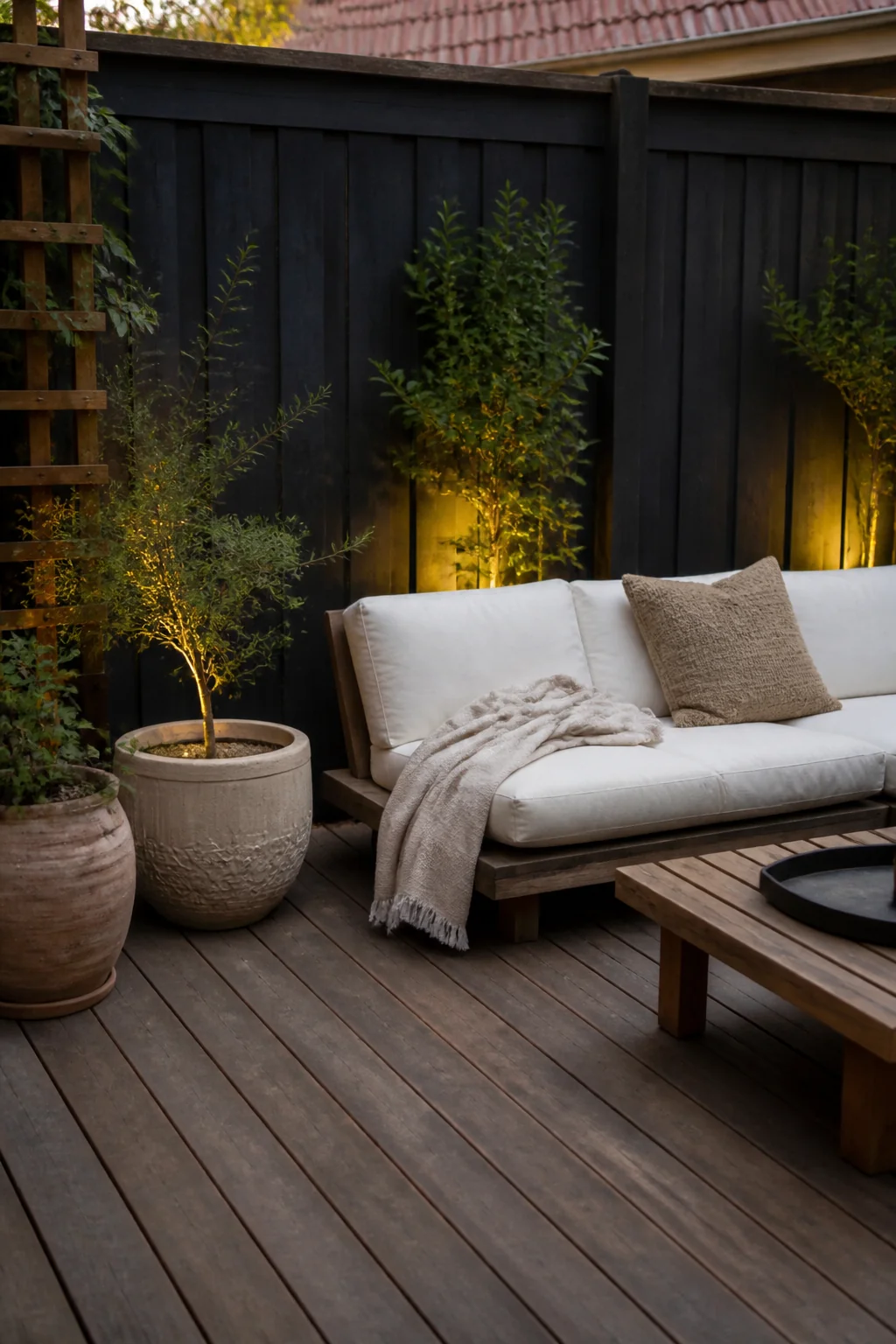
Wireless uplights at $20 to $40 each give a yard depth after dark without a single wire or an electrician. Three to five units cover a typical fence line.
Placement is the whole technique. Set each one 12 to 18 inches out from the base of a tree trunk, a shrub, or a fence panel and angle it up, then let the bounce do the work. Aimed across an open lawn, an uplight hits guests straight in the eyes and blows out every photo taken in that direction.
Color choice splits by target. Warm amber, around 2700K to 3000K, flatters skin, brick, and stone. Blue and green look great on foliage and terrible on people, so save them for the back fence and the hedge.
Practical notes: runtime is usually 6 to 8 hours, so charge everything the day before, and look for an IP65 rating because dew alone will kill a non-rated unit. Cheap solar spike lights are far dimmer and fade within an hour or two of sunset.
29. Offer wet wipes or a hand-washing station near food
When the food is hand-held and there are lawn games, a dog, and a fire pit in the mix, hands get grubby. Sending guests through the house to the bathroom every time is worse for you than it is for them.
The cheap version is a pump dispenser and a stack of biodegradable wipes for about $10. The better version is a 5-gallon beverage cooler with a spigot set on a small table, a bucket underneath to catch the runoff, pump soap beside it, and a pile of small towels, all for $25 to $35.
Put it near the food table rather than by the back door, and set it 3 to 5 feet off the walking path so the line doesn't block traffic. Add a small bin right next to it or used wipes end up on the ground and in the flowerbeds.
Worth knowing: alcohol sanitizer doesn't cut grease. After ribs or buttery corn, only soap and water work.
30. Schedule the party for 2-3 hours max, not 5-6 hours
Put both times on the invite: 5:30 to 8:30, not just 5:30. A window tells people how to plan their evening, and it tells you when you're done hosting.
Three hours is really closer to two and a half once you subtract the arrival drift. Here's a workable arc: 30 minutes of arrivals and first drinks, an hour of food coming out in waves, an hour of games or sitting once the light goes, then the last-call tray about 30 minutes before the end.
The trade-off is worth naming on the invite. A three-hour window means appetizers, not dinner, so say "drinks and snacks" and nobody turns up starving at 6 expecting a meal.
The failure mode of an open-ended party is predictable. You run out of food, ice, and energy at hour four, and the last three guests are the ones least likely to notice. A stated end time spares you that conversation entirely.
31. Create a "comment wall" with craft paper and markers if you like interaction
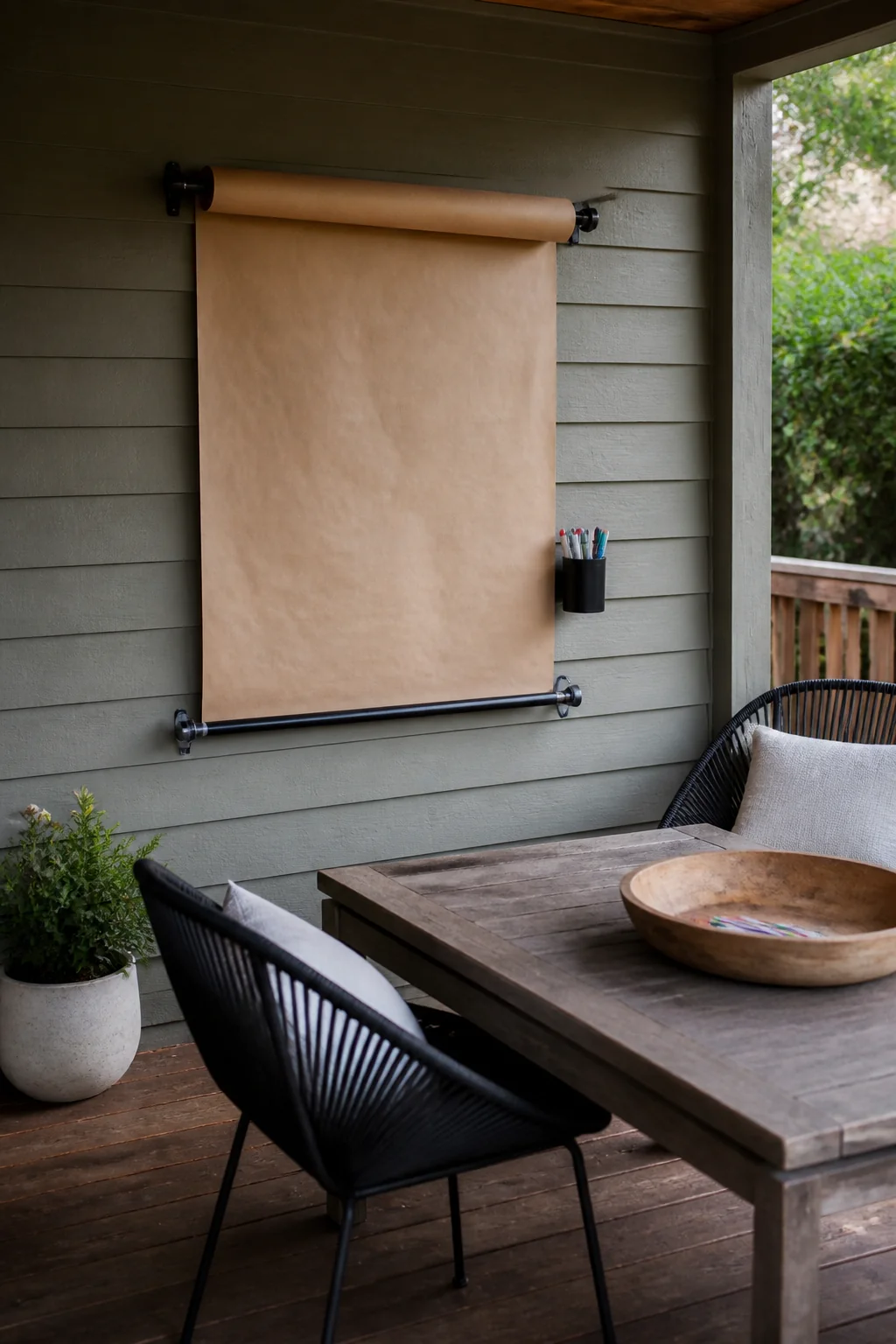
Hang butcher paper on a fence and let guests write down what they loved about the summer. A roll of 36-inch kraft paper is $15 to $20 and covers a long stretch, so one roll outlasts several parties.
Clip or staple it at 40 to 50 inches off the ground, which is comfortable writing height for a standing adult. Tape a second layer of paper behind it: markers bleed through, and a permanent smudge on a painted fence is a bad souvenir.
Write the prompt at the top yourself before anyone arrives. A blank wall gets nothing for the first hour, while "best thing about this summer" or "where we should go next year" gets filled in. Put out chunky markers rather than fine tips, which skip and dry out on rough kraft paper.
One caveat: this needs a crowd. At a party of eight, a comment wall just makes people self-conscious. Around fifteen or more it works, because there's a queue and something to read. Photograph it before you take it down.
32. Have a rain backup plan before guests arrive, not the day-of
Decide the plan by the clock, not by the mood. Check the hourly forecast at noon the day before and again at noon on the day, and make the call by 2 p.m. so you have time to text people and move things.
You have three options, and they cost very different amounts. A 10x10 pop-up canopy at $80 to $150 shelters six to eight standing guests, which covers the food and the drinks but not the crowd. A 20x20 rental tent runs $250 to $450 and needs booking several days out, because late August is the busiest weekend stretch of the season. Or move the food indoors and let people flow in and out through one door.
Two things people get wrong: a pop-up on a patio must be weighted, roughly 25 to 40 pounds per leg, since stakes won't go into pavers and a gust will roll it. And never pitch a canopy under a tree, which dumps a bucket of collected water on the first person who brushes a guy line.
Wet grass is the quieter problem. Even a shower that stops at 3 p.m. leaves a lawn that soaks shoes and sinks chair legs, so know in advance which part of your yard is hard surface.
Keep this guide handy
Of everything on this list, lighting and ice are the two most people underbuy, and both are hard to fix once the party has started. Nobody has ever complained that the yard was too well lit or the drinks too cold.