The Kitchen Decor Mistake Everyone Makes (And How to Fix It)
The most common kitchen decor mistake is decorating from staged photos instead of from how you cook. Here's the fix, and what light, paint and hardware really cost.
This post contains affiliate links. As an Amazon Associate I earn from qualifying purchases. If you buy through our links, we may earn a commission at no extra cost to you.
Most kitchens disappoint because they get decorated last, not because they're ugly. The living room gets the rug, the entryway gets the mirror, and by the time anyone turns to the kitchen the budget is thin and the room ends up perfectly functional and completely silent.
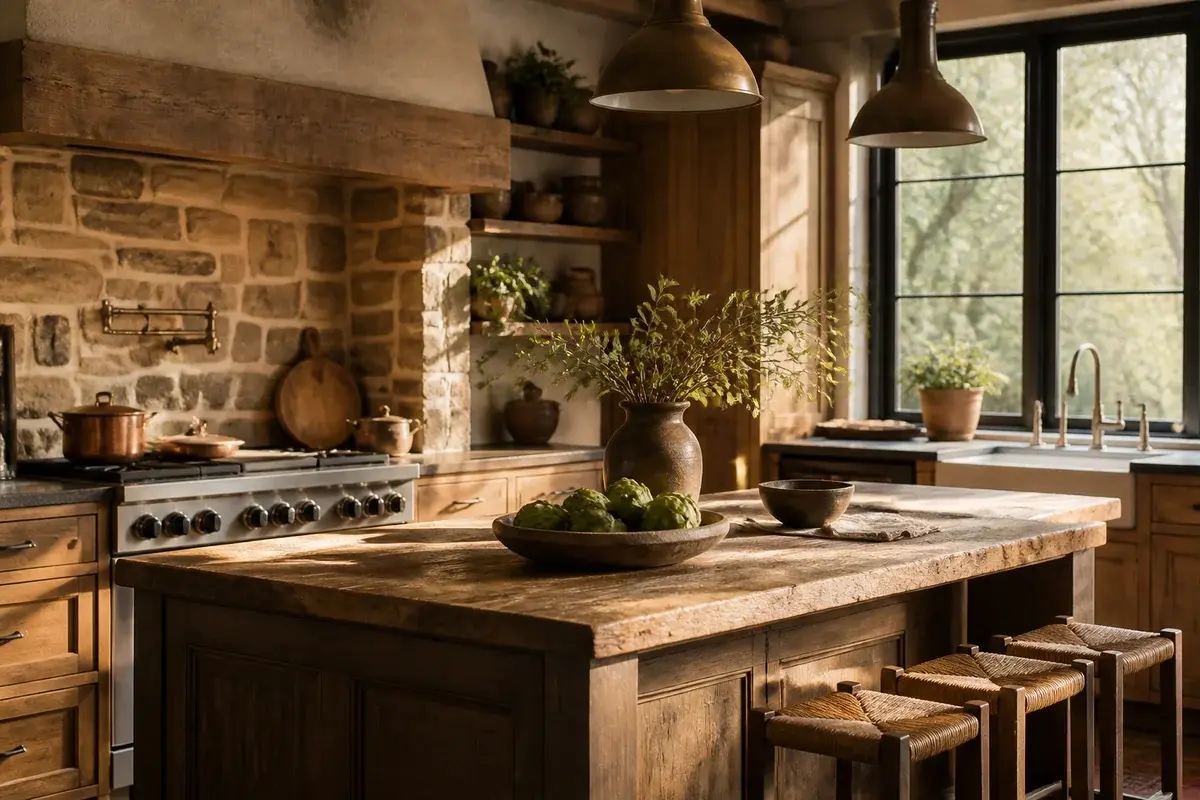
There's a more specific reason it happens, though. Most kitchen decor ideas get chosen from photographs, and a photograph shows a kitchen at its tidiest, in the best light of the day, with the drying rack pushed out of frame. Decorate from that and you're styling a version of your kitchen that exists for about four minutes a week.
Here's what to do instead: seven shifts, starting with the one that costs nothing at all.
Stop Decorating Around Your Appliances
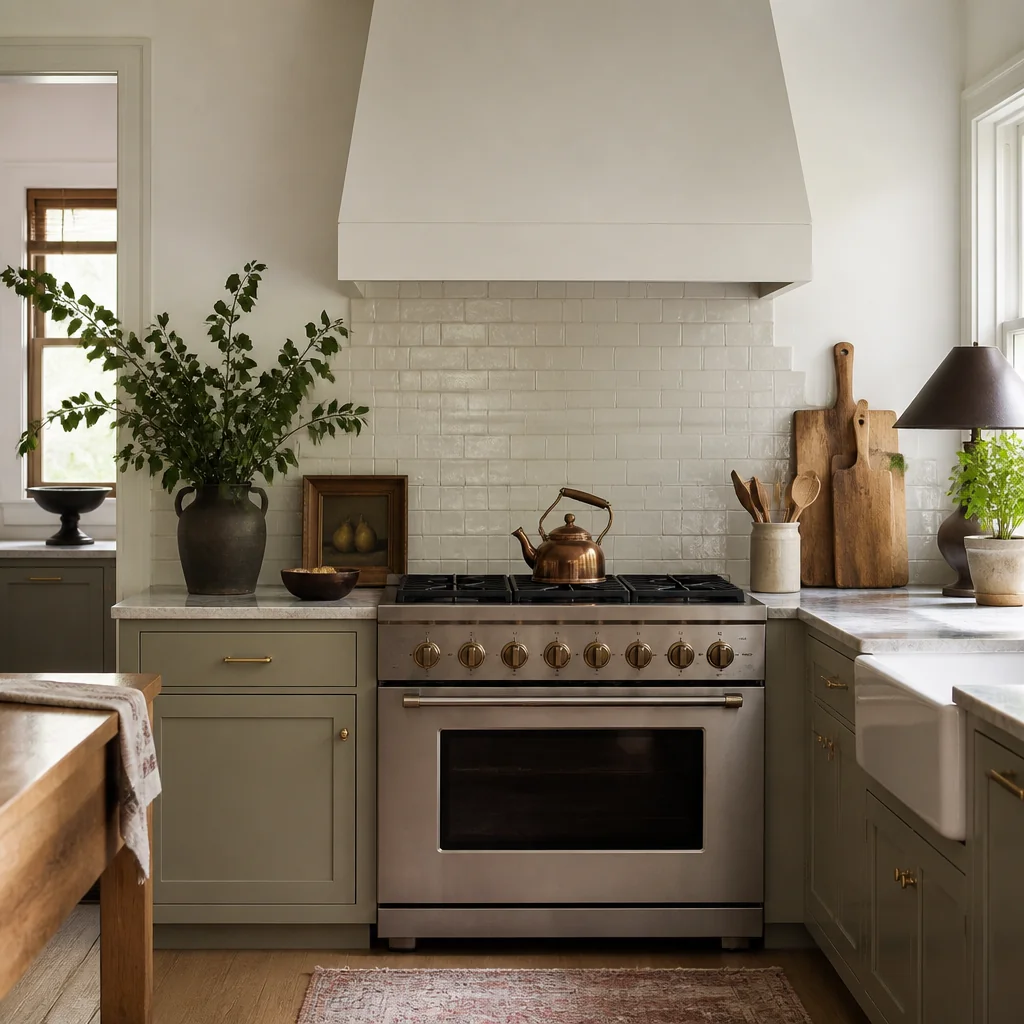
Your kitchen is a working room. You make breakfast in it at 6 AM with bedhead, you spill coffee, you park the drying rack in the same spot every night. It isn't a showroom, and the appliances in it aren't a color scheme.
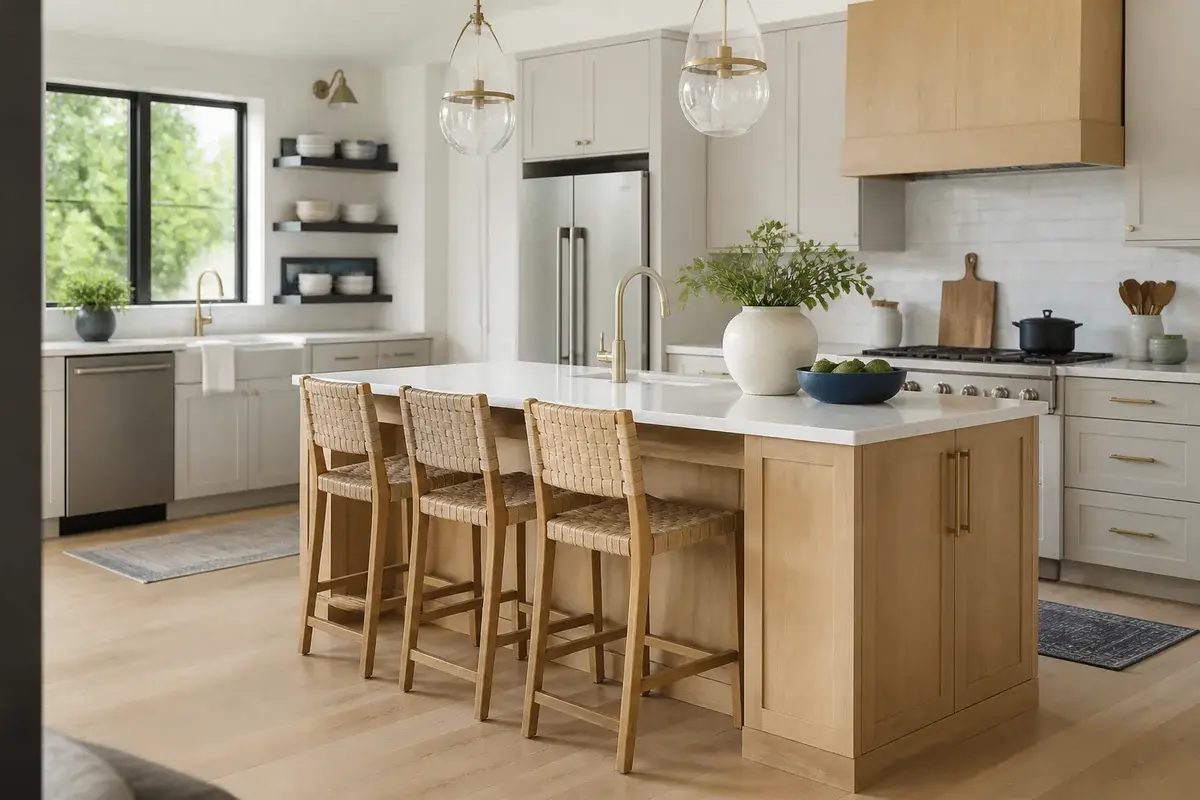
Stainless steel gets treated like one anyway. It's the most expensive thing in the room, so it becomes the reference point and every other decision bends toward it: cool grays, greige cabinets, a backsplash that won't argue. Stainless is a neutral, though. It sits beside sage, clay, deep blue and warm cream without complaint, and so do the range hood and the dishwasher panel.
The better starting question is what you want to be looking at while you stand at the stove. Answer that, then buy paint. Pick two or three candidates and get peel-and-stick samples, roughly $6 each, rather than brushing test patches straight onto the wall. Put them where you'll actually face them, then look at 7 AM and again under lamplight, because kitchen color shifts more than any other room's between daylight and overheads.
One accent wall takes a quart, about $18 to $25. Choose satin over flat: kitchen walls get splashed, and satin wipes clean where flat holds grease. If you'd rather put color somewhere with more presence, the island is the traditional place for it, since it reads as furniture rather than architecture.
Your Kitchen Doesn't Need to Match Everything Else
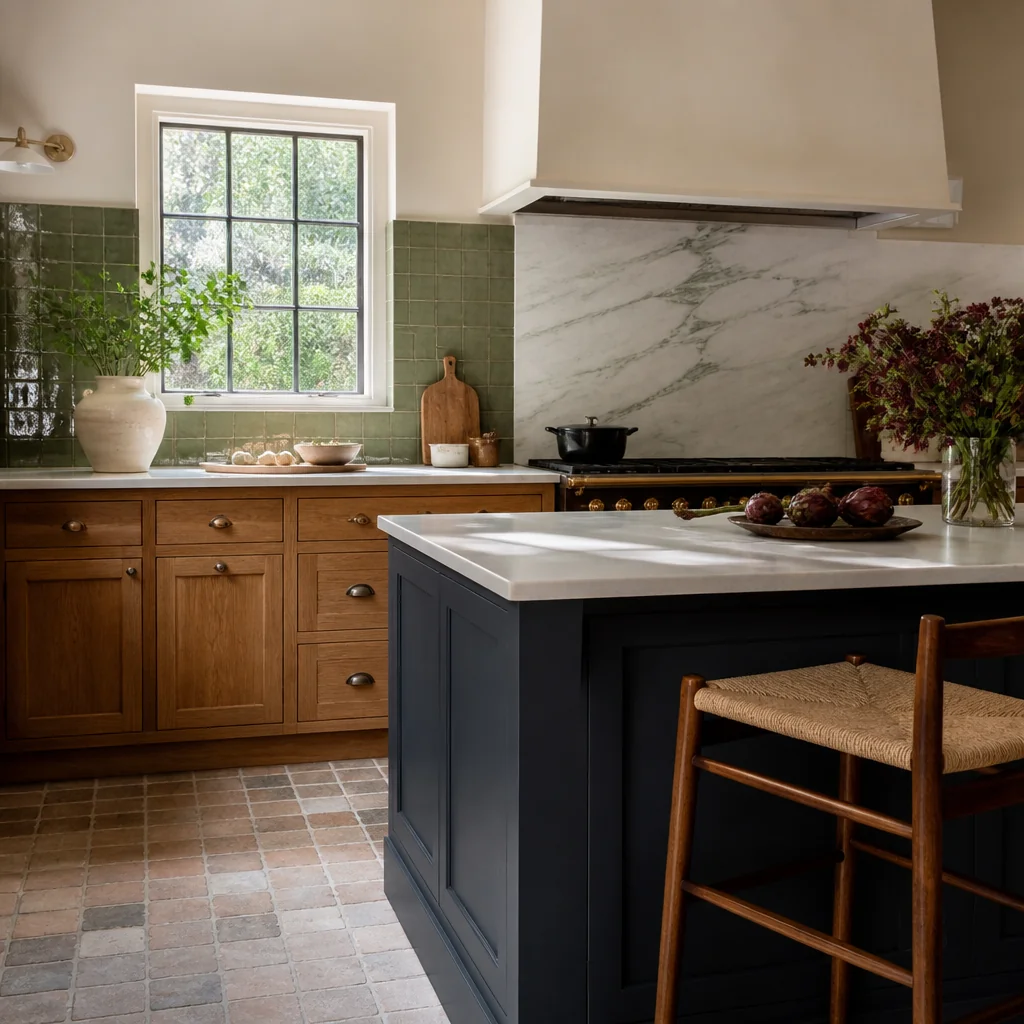
Whole weekends disappear into making a kitchen match the living room palette, usually for the sake of a wall you can't see from the sofa anyway.
The rule that matters isn't about rooms, it's about sightlines. Stand in the doorway and note what you can take in at a single glance. If the kitchen sits around a corner or behind a wall, it can run a completely different color story from the dining room beside it: cream and sage on one side, warm gray and terracotta on the other, no apology required. If it's a true open-plan great room where both are in view at once, they need one honest thread instead. The flooring that already runs through both is usually that thread. So is a repeated metal, or a single neutral on the largest surfaces.
Cabinets are normally that neutral. Leave them cream or white and you've bought yourself freedom everywhere else: walls, textiles, the tile you fell for.
Where this goes sideways is half-commitment. Two palettes that are almost the same read as a mistake. Two that are clearly different read as a decision. If you're going to diverge, diverge properly.
Lighting Is Your Real Problem (Not Styling)
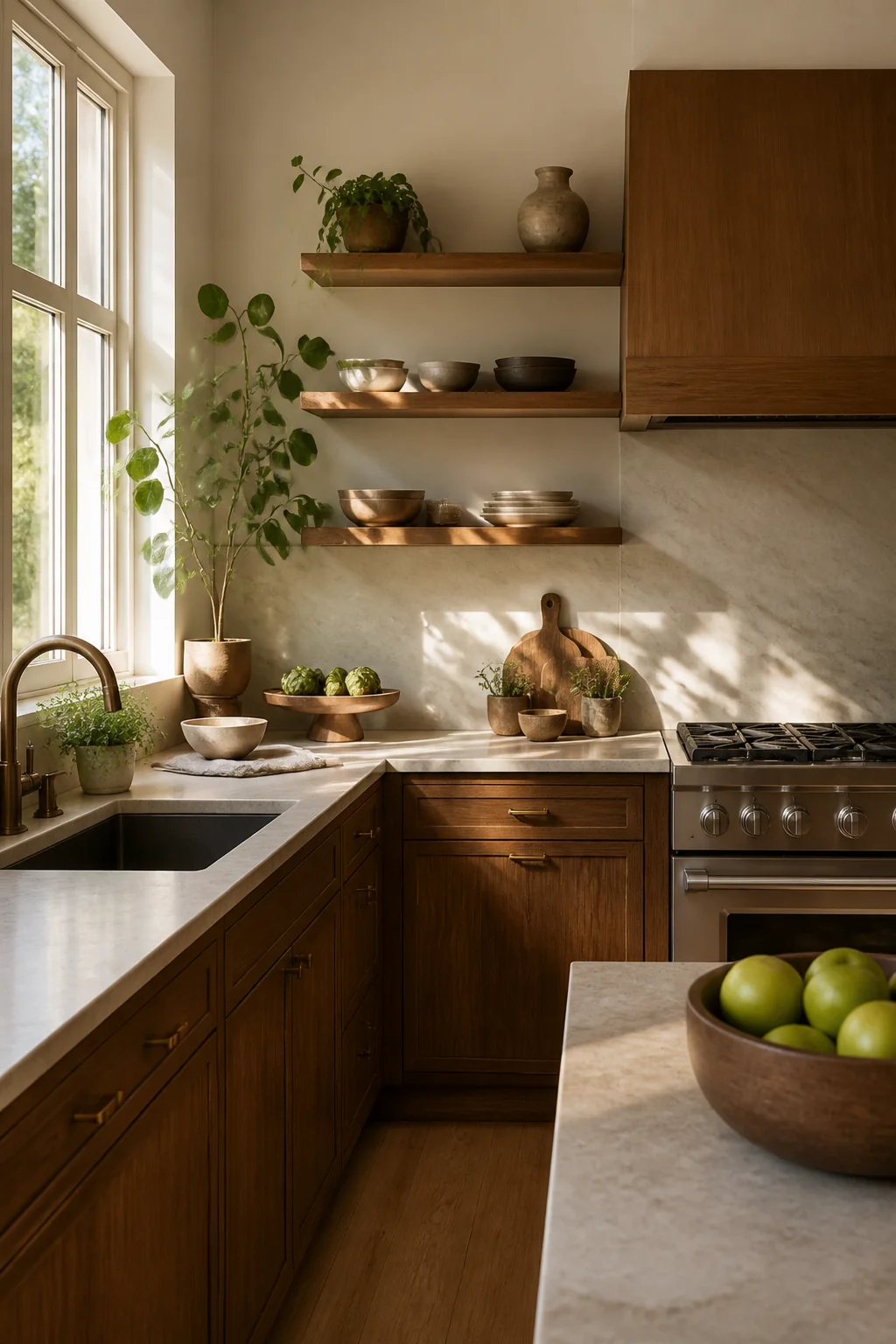
Before buying one more ceramic canister, count the light sources in the room. If the answer is one fixture in the middle of the ceiling, that's the problem, and no amount of styling will cover for it.
A center-of-room light puts your own body between the bulb and the counter. You chop in your own shadow, the backsplash goes flat, and everything you've set out sits in gloom. Nothing you buy survives that.
The fix is the highest-return $40 in the kitchen. A plug-in LED under-cabinet strip costs $25 to $50 for a run long enough to cover one wall, and two specs decide whether it looks good. Pick 2700K to 3000K warm white, which flatters wood, cream and skin instead of turning the room clinical, and look for CRI 90 or higher so tomatoes and cutting boards read as their real color. Cool 4000K light is why pale, coastal kitchens can go faintly blue after dark.
Mount the strip toward the front edge of the cabinet bottom, tucked behind the face frame lip. Set too far back, it lights the wall instead of the counter. Left exposed above glossy tile, it shows a row of reflected dots, which a diffusing aluminum channel solves for a few dollars more. Keep the overhead for tasks, add a $20 dimmer, and you have two moods instead of one.
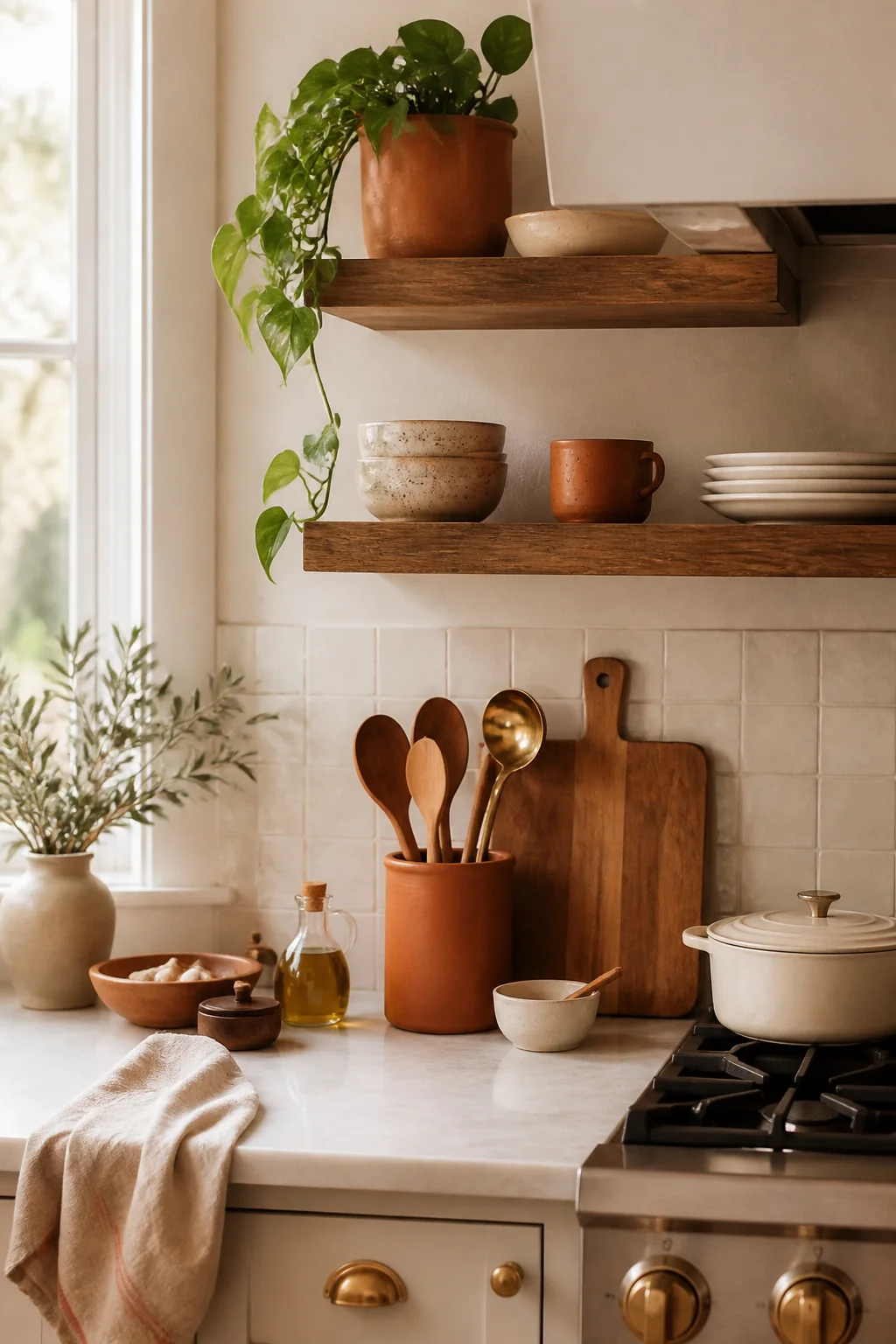
The Open Shelving Trap
Open shelving photographs beautifully and lives badly, and the reason is physical rather than aesthetic.
Cooking puts a fine film of airborne grease into the room. It settles on whatever is nearby and it holds dust, so anything sitting open within a few feet of the range needs wiping far more often than you'd expect, and not just the shelf: the rims and undersides of everything on it. Plates you use daily stay fine, because they cycle through the sink every night. Serving platters and the good bowls you keep for company are the ones that turn tacky.
That's the gap between the photo and the Tuesday. Someone styled that shelf for the shot, and half of what's on it never went back up.
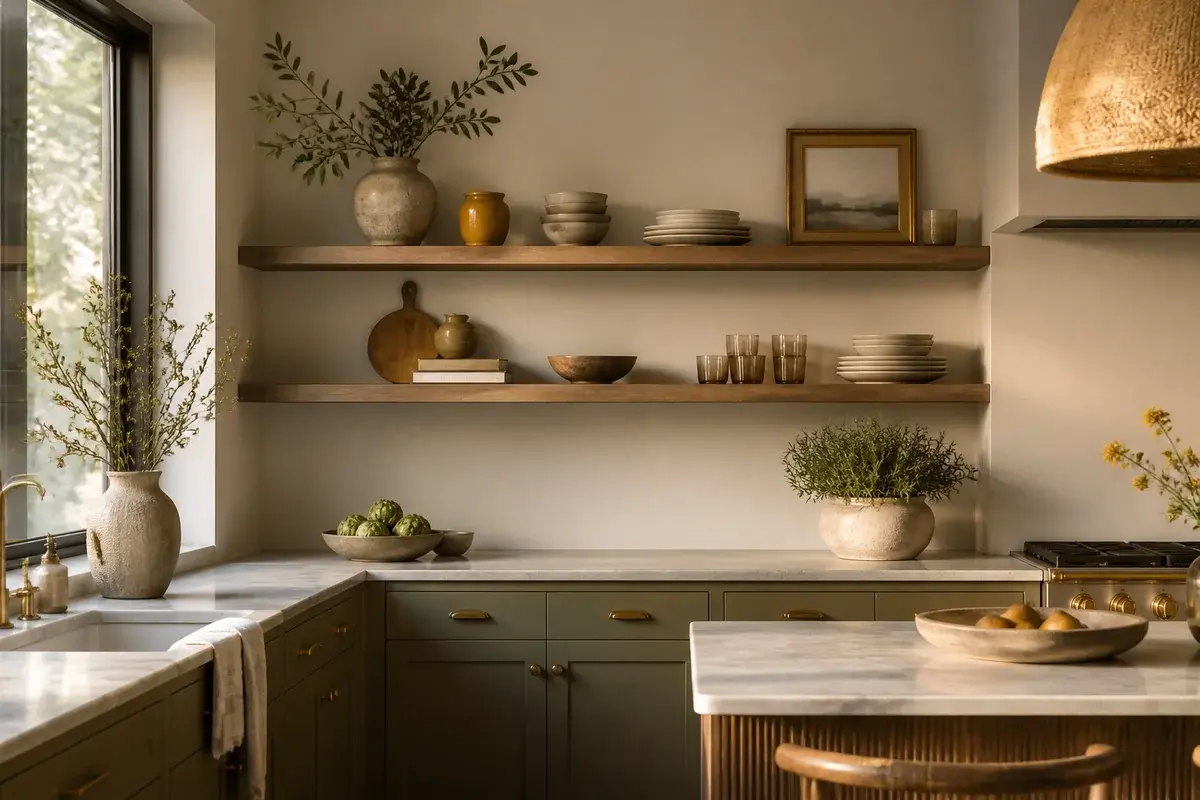
If you want the look anyway, take one bay rather than a whole wall, and put it away from the range, over a coffee station or beside the sink. Fill it with what you touch every day. Ten to twelve inches deep holds dinner plates and mixing bowls; at eight inches you're down to mugs and side plates. Anchor the brackets into studs at 16 inches on center, because a loaded shelf of stoneware is far heavier than it looks. And if a pared-back, minimalist look is the real goal, closed doors get you there faster than open ones do.
Add One Thing That Makes You Smile
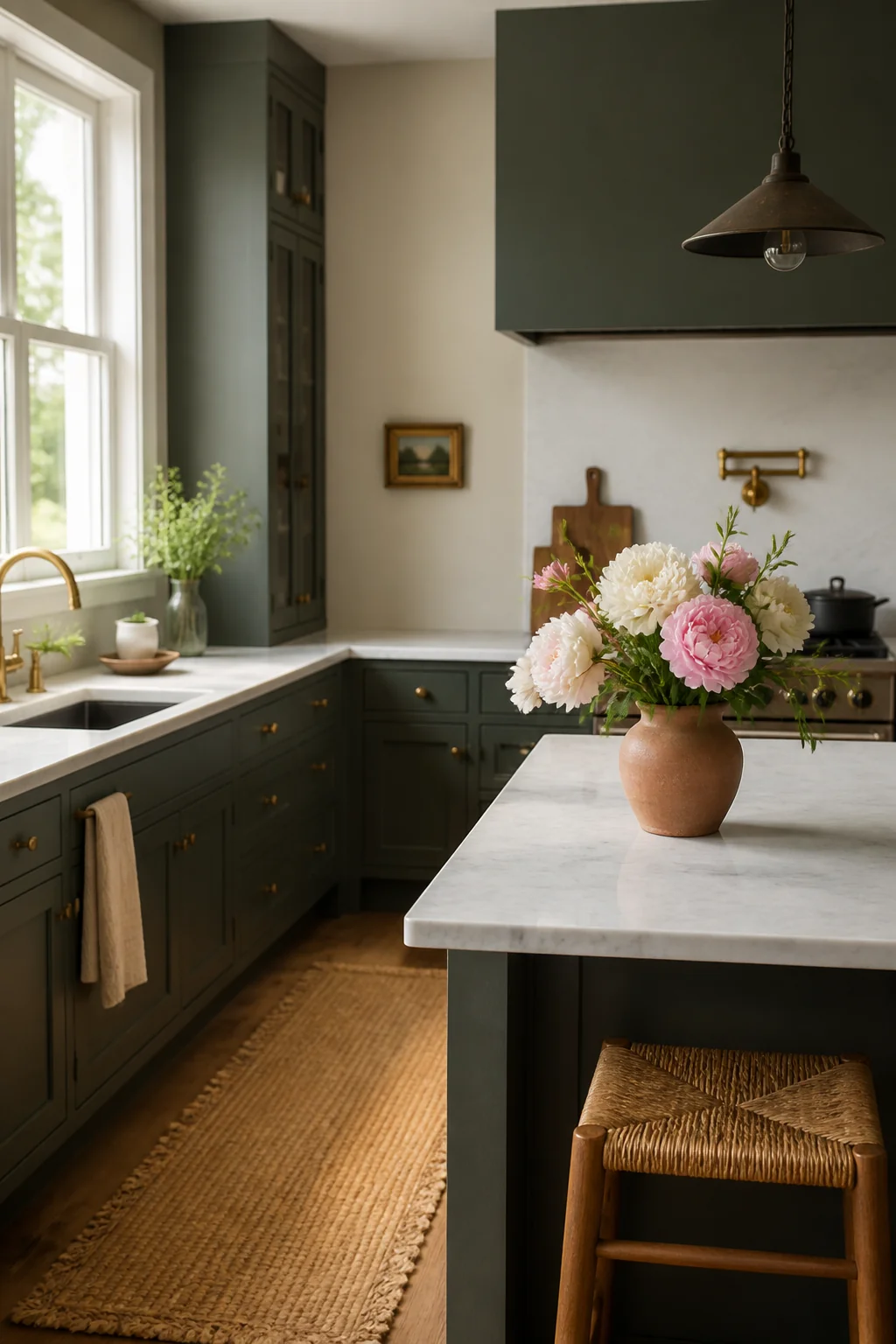
Paint's done, light's fixed, doors are closed, and the room can still feel like nobody lives in it. The cure is usually one object, placed where you stand the most.
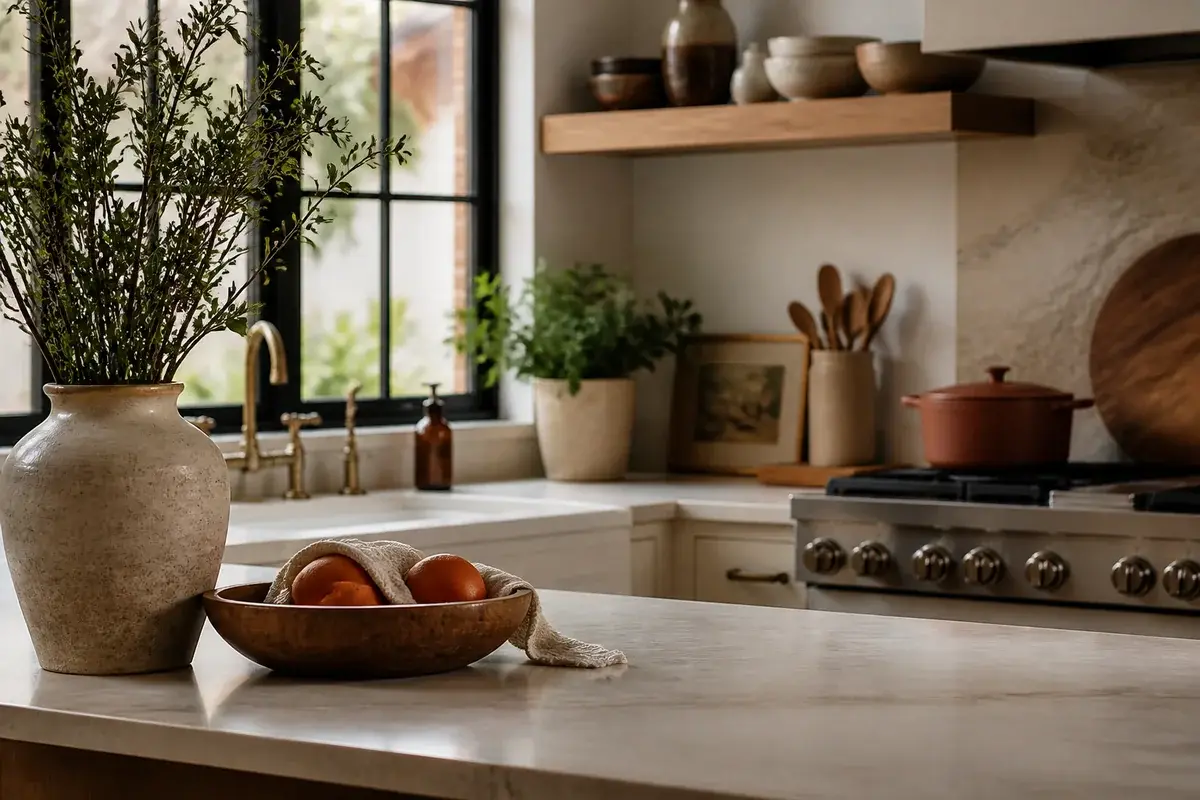
Herbs are the simplest version. A small ceramic pot runs $10 to $20, and it earns its counter space twice over, since you look at it and cook from it. Three things are worth knowing before you buy. Basil wants six or more hours of direct sun and will sulk into thin, leggy stems at a north-facing window. Rosemary is far more forgiving and prefers to dry out between waterings. Mint strangles anything sharing its pot, so give it one of its own. Whatever you plant, get a pot with a drainage hole and stand it on a saucer, or water sits against the counter and leaves a ring you can't buff out of marble.
If your window is dim, don't fight it. A wooden bowl of lemons, a good board leaned against the backsplash, a bunch of eucalyptus that keeps its shape for a month as it dries. The point is one thing with some life in it, at eye level, where you're standing anyway, rather than arranged in a corner you walk past.
Budget-Friendly Changes That Hold Up
You don't need $5,000 to fix a kitchen. Here's what under $200 covers, itemized.
Paint: $20 for a quart, closer to $45 for a gallon. An under-cabinet LED run: $40. Cabinet pulls from a big-box store: around $35 for a kitchen's worth in brass or matte black. Dish towels in a color you chose rather than the ones that came free with something: $25. A planter and something living in it: $15.
If the money has to go in an order, spend it on light first. It changes how everything already in the room looks, which makes it the only purchase that improves your other purchases. Paint second, hardware third.
One warning on hardware, because it's the step people end up redoing. Measure the center-to-center distance between the existing screw holes before you buy anything. Three inches and 96 millimeters are both common and they are not the same, since 96mm works out to roughly 3 3/4 inches. A pull that's close but wrong means filling and re-drilling every door and drawer front. Knobs use a single screw and skip the problem entirely, which is why they're the safer swap in a rental.
The Real Fix: Stop Decorating for Instagram
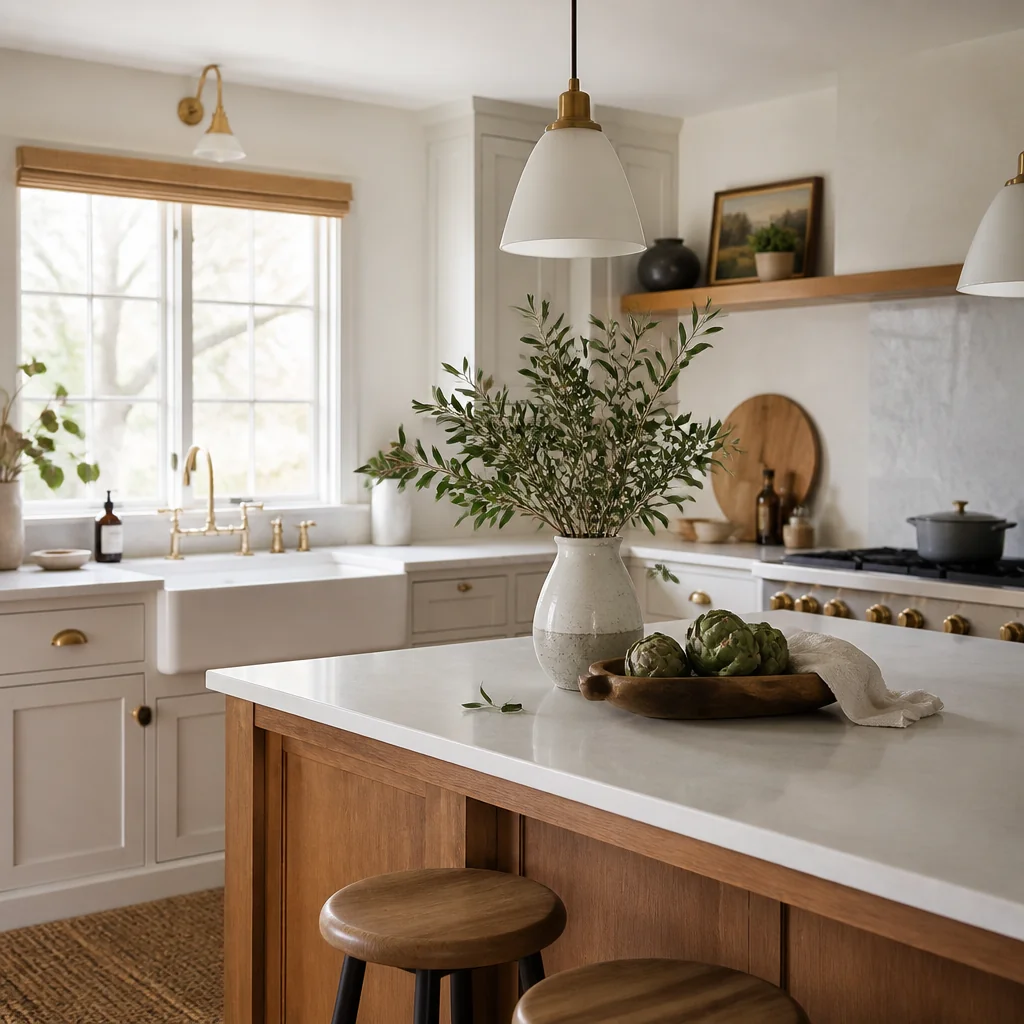
A camera sees one wall at a time, from a flattering height, with everything you own pushed just outside the frame. It can't tell you whether the drawer you open forty times a day sticks, or whether the counter you prep on is the same one that collects the mail.
That's the mistake sitting underneath all the others. Kitchens get decorated to be looked at instead of stood in, and this is the one room in the house where you're almost never just looking.
Three questions will get you further than any trend roundup. What color do you want to see while you're at the stove? What irritates you every single time you're in here, whether that's the dark corner, the sticking drawer, or the pile that always lands in the same spot? And what one thing would make the room better at 7 AM, which is when you're least generous about it?
Answer those honestly and you'll spend differently. Usually less. Almost always on light and storage before ornament.
Save this for your next project
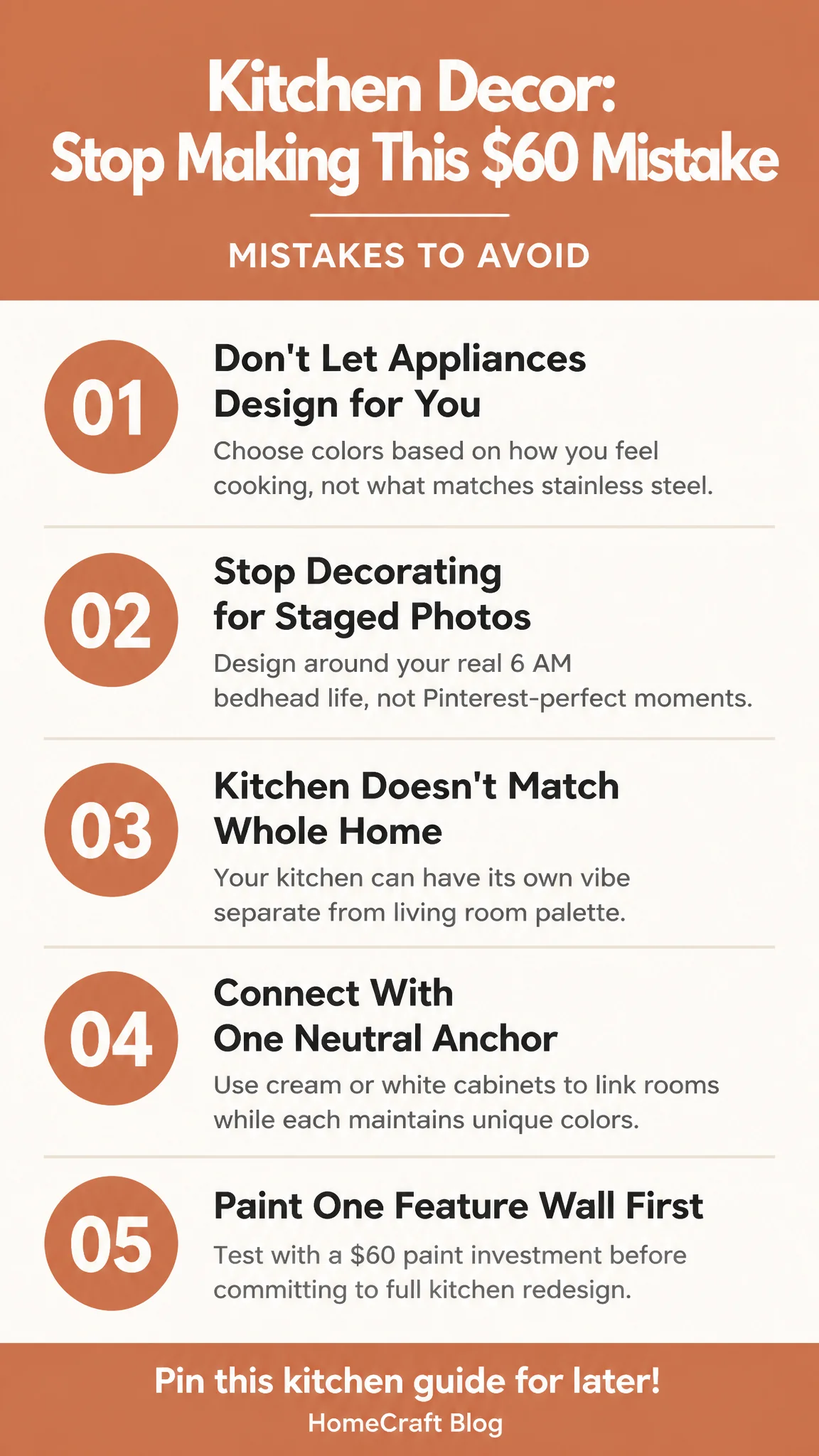
If you take one thing from any of this, make it the lighting. Fix that before you buy a single decorative object, because everything else you do has to sit in whatever light you give it.