
Why Your Dorm Bedding Feels Cheap (Even When It Isn't)
Dorm bedding ideas that read intentional: how to size a fitted sheet to a twin XL, what thread count and fill weight to look for, and how to layer three pieces.

This post contains affiliate links. As an Amazon Associate I earn from qualifying purchases. If you buy through our links, we may earn a commission at no extra cost to you.
That $80 comforter set looked great folded on the shelf. Two weeks into the semester it's pilling along the seams, the color has gone flat under the room's overhead light, and the whole thing sags in the middle by noon no matter how carefully you made the bed that morning. The receipt says you paid for something better than this. This page is only about the bed; decorating the rest of a dorm room has its own guide.
Bedding usually looks cheap because of how it fits the mattress, how many layers are sitting on it, and how the bed gets used between washes, more than because of what it cost. A $200 sheet set can look terrible on a bed that's five inches too long for it, and a $40 set can look deliberate. What follows is the short list of things that make the visible difference, roughly in the order we'd spend money on them.
The Fitted Sheet Problem Nobody Talks About
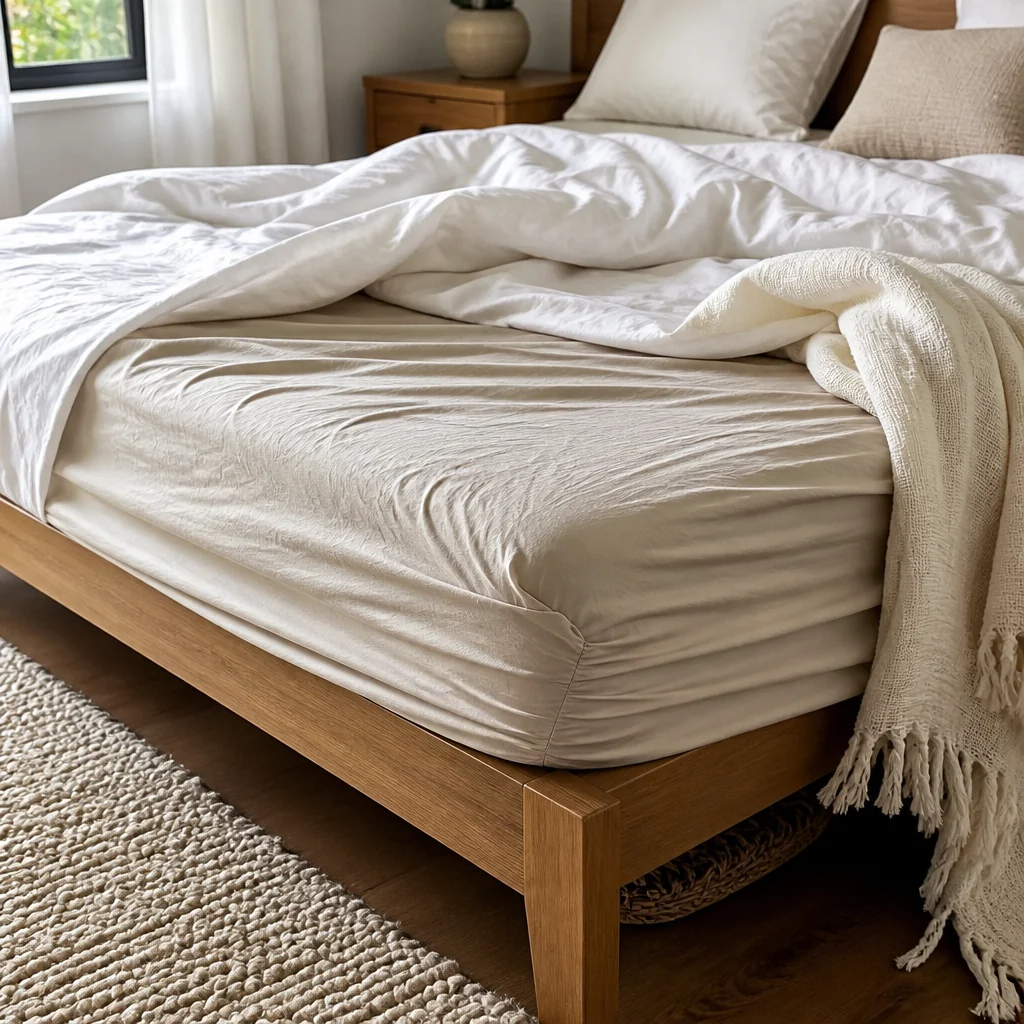
The fitted sheet is why the bed looks rumpled at nine in the morning when you made it at eight.
Dorm mattresses are their own category. Most are twin XL, 38 by 80 inches, and after a few hundred students they've compressed to around 6 or 7 inches thick, while the fitted sheets sold to fit them are cut with 12 to 15 inch pockets. All that extra pocket depth has to go somewhere, so it bunches into ridges across the middle or lets a corner pop the first time you drop onto the edge of the bed.
Sizing up fixes it, but only the right size up. A full XL fitted sheet is 54 by 80 inches: same length as your mattress, sixteen inches wider, which is exactly enough surplus to wrap under and stay wrapped. It runs about $15 to $20. Do not grab a standard full sheet instead. At 54 by 75 inches it's five inches short lengthwise and will pull off the foot corners nightly.
If you'd rather keep the sheet you own, sheet suspenders clip corner to corner underneath in an X for around $8 a set.
Layering Is The Secret Nobody Tells You About

A comforter on its own reads unfinished no matter what it cost. Three layers reads styled.
The standard build is a flat sheet as the base, the comforter or duvet in the middle, and a throw folded across the bottom third of the bed. Each one is doing a job. The flat sheet absorbs the nightly wear, so the comforter goes through the wash far less and keeps its loft longer. The comforter carries the color. The throw breaks up what is otherwise one large flat rectangle, and it lands right where a comforter creases worst.
Size the throw to the bed. Roughly 50 by 60 inches covers the foot of a twin XL with enough overhang to fall past the frame rails. A chunky knit in charcoal over a white comforter runs $30 to $40. Acrylic knit pills faster than cotton, but it keeps its bulk through a hot dorm dryer, which a cotton waffle weave does not. That trade matters more than it sounds when the whole room is barely 200 square feet and the bed doubles as your couch.
For pillows, vary the shape rather than the pattern: one sleeping pillow, one 18 inch square with a woven or ribbed face, one 12 by 20 lumbar in front.
Why Your Comforter Looks Flat
Thin fabric reads as cheap under overhead lighting, and dorm lighting is unforgiving.
Two different numbers are at work here, and people mix them up. The first is thread count on the sheets. At 180 the weave has visible gaps, light passes straight through, printed color looks washed out, and the fabric hangs dead straight instead of falling in folds. At 300 thread count cotton there's enough body to drape, and drape is what your eye reads as expensive. A 300 count twin XL set sits around $50 to $70. Past roughly 400 you're mostly paying for the label.
The second number belongs to the comforter, and it's fill weight, not thread count. For a down alternative, 250 to 350 GSM gives you something with presence. Under that, the comforter collapses onto whatever is beneath it and the bed looks deflated by week two. On a budget line the label is your clue: choose all-season or full weight over light or summer weight.
If your money only stretches to one upgrade, this is the one that shows from the doorway.

The Bed Skirt You're Probably Skipping
A bed skirt does two things at once: it hides the bins, the suitcase and the dust under the bed, and it gives the frame a visual base so the mattress stops looking like it's floating on metal legs.
Measure before you buy, because the number that matters is the drop, not the mattress size. The drop is the distance from the top of the platform or box spring down to the floor. Skirts are sold in 14, 15 and 18 inch drops, and dorm frames on adjustable legs are frequently cranked higher than any of those to make room for storage. Anything over 18 inches and a fitted gathered skirt will hang short, which looks worse than no skirt at all. Use a wrap-around elastic style, or a flat panel you hem to length.
A plain gathered polyester skirt runs about $20. Neutral, or within a shade or two of the comforter, is enough; an exact match isn't the goal.
One case where the answer is no: if the bed is lofted high enough to fit a desk underneath, a skirt just curtains off the space you're trying to use.
Color Coordination Without Everything Matching
Your comforter doesn't have to match your sheets. It does have to agree with them.
What reads as wrong is almost always undertone rather than color. Put a warm greige comforter next to a cool blue-gray pillow and you've set two different grays side by side, which your eye catches immediately even if you can't name what's off. Bright white sheets against cream ones do the same thing in reverse: the white starts looking blue and the cream starts looking dirty. Pick warm or cool for the bed and keep every piece in that lane. Taupe comforter, cream sheets, a mustard throw all sit warm together. Swap in hot pink and the whole thing splits.
Before you spend anything, photograph the made bed with your phone under the room's own overhead light, then look at the picture. Cheap LED and fluorescent tubes push a green or blue cast that your brain corrects for in person and the camera does not. The photo is closer to what everyone walking in sees.
Buy the small pieces last. Pillow covers at $8 to $12 are the cheap direction to fix a color story from, once the comforter is already on the bed.
Your Bed Is Also The Couch, The Desk And The Snack Table
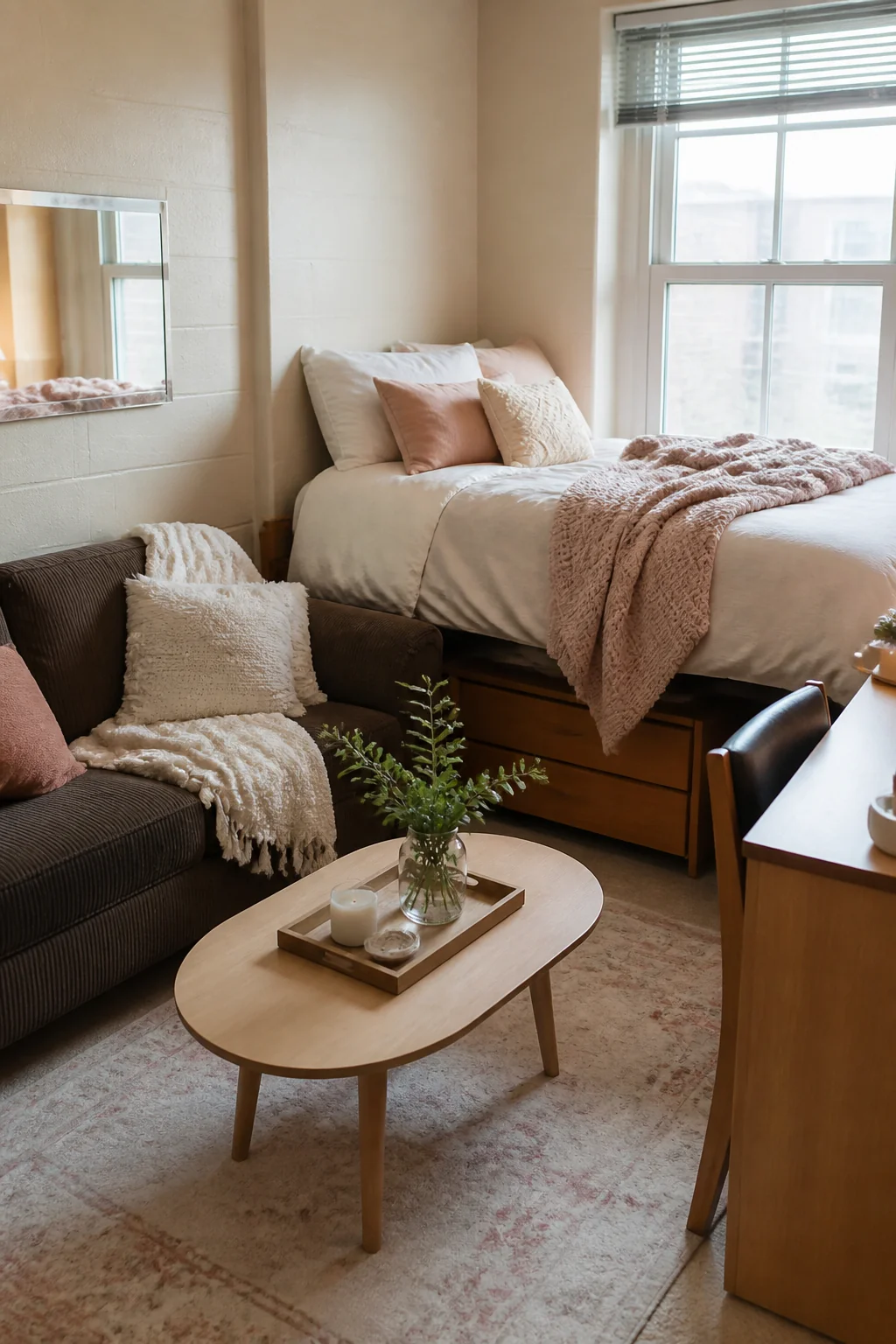
In a room around 10 by 12 feet with one chair in it, the bed is the couch, the desk, the dining table and the guest seating, often all before dinner. Nobody's breaking that habit mid-semester.
It is, though, the whole reason the bedding looks wrecked by October. Denim rivets and backpack zippers abrade the face fabric of a comforter, and food grease and body oils set into cotton much harder than sweat does. Washing a comforter often enough to keep up with that is what kills its loft.
So sacrifice a top layer instead. A washable throw around 50 by 60 inches, laid over the foot and middle of the bed, becomes the surface people sit on. Cotton or a cotton blend, since it goes through the wash weekly; fleece mats down after a handful of hot cycles and then looks worse than the comforter it was protecting.
Wash sheets weekly rather than every other week, in warm water rather than hot, which breaks fibers down early. A second fitted sheet in rotation at around $12 means laundry day never ends with a bare mattress.
Of everything above, the fitted sheet does the most visible work for the least money. Fifteen dollars and a correctly sized sheet removes the wrinkling that makes a good comforter look secondhand, and no amount of styling on top of a badly fitted sheet will cover it.
Keep this guide handy
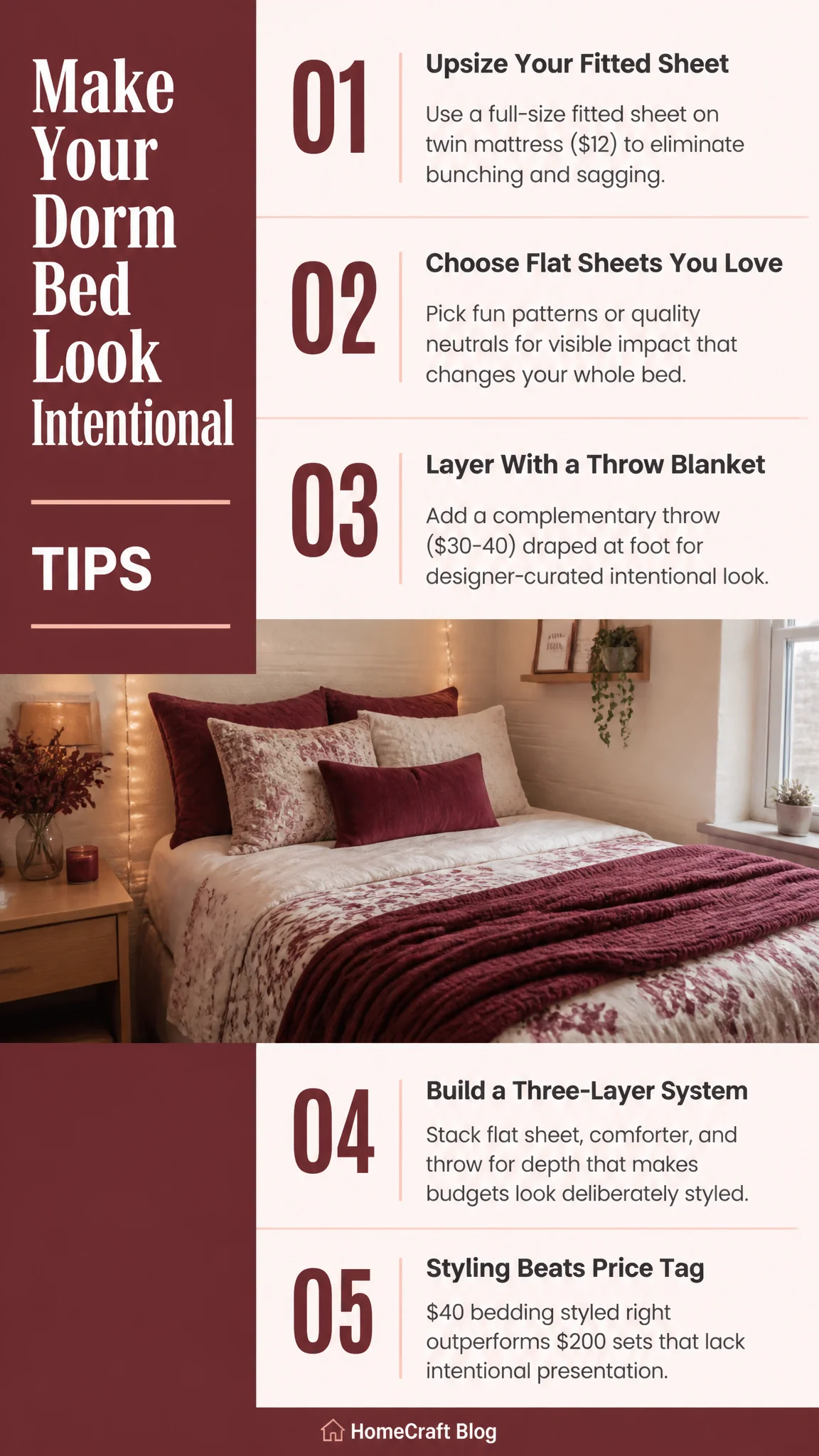
After that it's an order of operations. Fabric with enough body to drape, then the three layers, then the color corrections in pillow covers, which is the cheapest place to change your mind. One caution worth carrying out of here: measure the drop under your frame before you order a bed skirt. It's the one item on this list that gets bought twice.